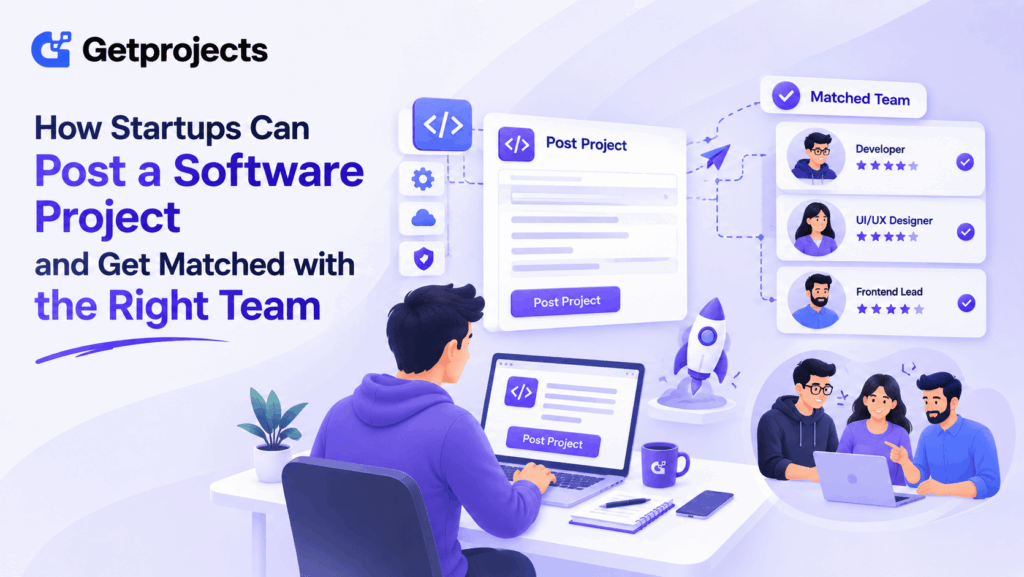
How Startups Can Post a Software Project and Get Matched With the Right Team
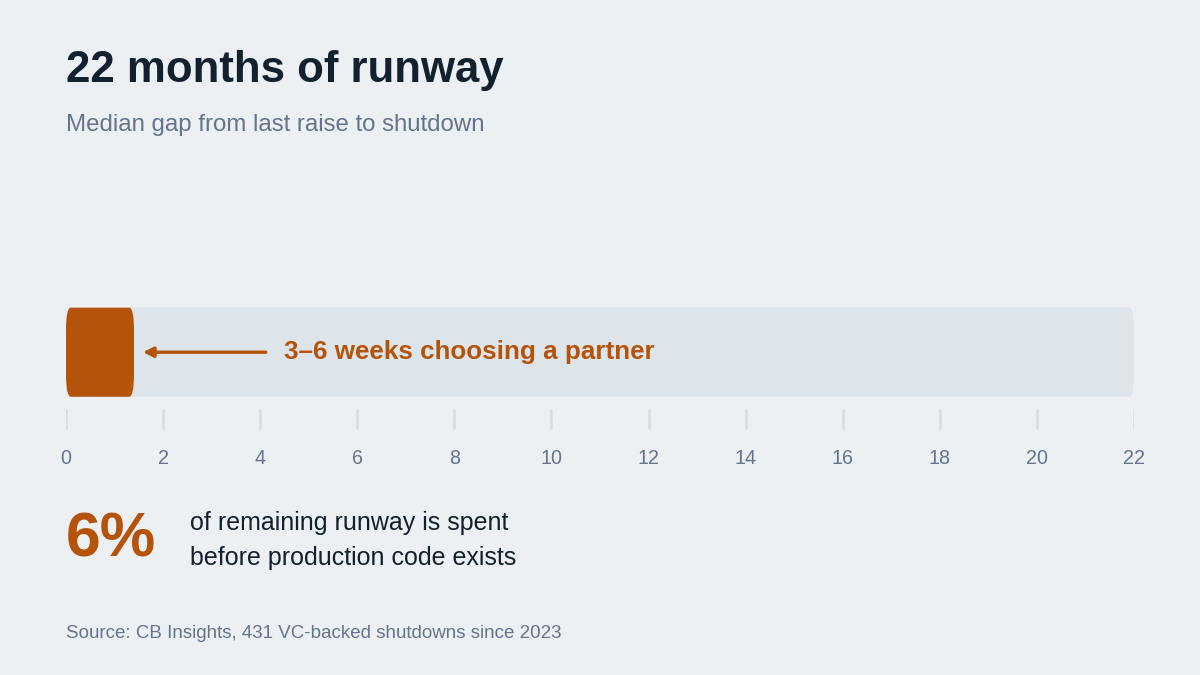
The median venture-backed startup that shut down had 22 months between its final fundraise and its last day of operation. Spending three to six weeks selecting a development partner consumes roughly 6% of that window before a single line of production code exists.
That math is the reason how startups post a software project has become an operational question rather than a procurement one. The constraint is not agency supply; thousands of credible firms are actively looking for work. The constraint is that early-stage teams are asked to write a formal specification for a product they have not validated, then evaluate vendors using criteria they have not yet earned the right to have.
Cold outreach makes this worse. A founder emails 15 agencies, hears back from 6, books 5 discovery calls, and discovers on call four that two of them do not work under $75,000 and one has never shipped a consumer mobile app. That is two weeks spent generating information a structured brief would have surfaced in two minutes.
The alternative is not a better email template. It is changing what gets sent and who receives it: a structured, comparable brief distributed to a pre-filtered pool of agencies that already match on budget band, domain, and stack so the shortlist arrives before the calendar fills with calls that go nowhere.
Speed of partner selection is not a convenience metric for a startup. It is a direct claim on the runway that buys market feedback.
How Startups Post a Software Project: A Working Definition
How startups post a software project is the process of converting an early product idea into a structured, comparable brief scope, budget band, timeline, stack requirements, and stage and publishing it to a matching platform so qualified agencies can be filtered, verified, and contacted directly, instead of being sourced through cold outreach or open bidding.
The Real Bottleneck: Why Partner Selection Burns Three to Six Weeks
Founders assume the delay comes from agencies being slow to respond. In practice, most of the lost time sits earlier, in the translation layer: turning “an AI-powered marketplace for dental clinics” into something a technical team can price.
Estimates only converge when the technical scope is pinned down. Without it, three agencies looking at the same idea return $18,000, $54,000, and $140,000 and none of them are wrong, because each priced a different product.
The cost of that ambiguity is documented at enterprise scale. McKinsey and the University of Oxford studied more than 5,400 large IT projects and found average overruns of 45% on budget and 7% on schedule, with software projects carrying the highest risk of both. Startups face a compressed version of the same failure mode with none of the balance-sheet tolerance.
Three specific costs stack up during a conventional search:
- Unqualified conversations. Typical response rate on cold agency outreach runs 30–40%, and roughly half of those that reply are outside the budget band or the domain.
- Repeated context-setting. Each discovery call re-explains the same idea for 30–45 minutes, with no reusable artifact at the end.
- Non-comparable proposals. Five proposals arrive in five formats: one fixed-price, two time-and-materials, two hybrid, making genuine comparison impossible without a normalization pass the founder has to run manually.
Add 8–12 hours of founder time and two to four weeks of elapsed calendar, and vendor selection becomes one of the most expensive unbudgeted line items in a pre-seed build.
There is a second-order cost that rarely gets counted. Scope drifts during a long search. Each call introduces a new suggestion: add a dashboard, add SSO, rethink the data model and the product that gets quoted in week four is measurably larger than the one that was viable in week one. Changing how startups post a software project at the front of the process freezes scope early, which is the only reliable way to keep the first build inside a single funding cycle.
Startup Software Project Posting: From Vague Idea to Structured Brief
The fix is mechanical. Startup software project posting works when the input requirement is lowered to what a founder actually knows on day one, and the structuring is handled downstream by an AI brief tool rather than by the founder writing a 12-page requirements document.
An AI-assisted brief takes a two-line description and interrogates it the way a solutions architect would on a first call: what does the user do first, what data moves, who pays, what has to exist at launch versus month six. The output is a normalized project brief that every agency reads the same way.
Normalization is the entire value. When ten agencies read identical scope, budget, and timeline fields, their quotes become comparable on the first pass, no manual reconciliation, no fourth call to work out what each proposal actually covers. This is the structural difference between how startups post a software project on a matching platform and how they describe it in fifteen individually written emails.
What counts as “enough” to post
Founders delay posting because they believe they need wireframes, a spec, and a fixed budget. They need three things:
- A user action. “A clinic uploads patient scans and gets a treatment estimate in under 60 seconds.”
- A budget band, not a number. $15,000–$25,000, $25,000–$50,000, $50,000–$100,000. Bands filter more accurately than precise figures and prevent anchoring.
- A launch trigger. A demo day, a pilot customer, an investor update. Deadlines shape architecture decisions more than feature lists do.
Everything else stack, team composition, testing strategy, engagement model is a recommendation the matched agency should be making, not a decision the founder should be pre-committing to.
The five inputs that decide match quality
Matching engines that compare 50+ data points still weigh a small number of them heavily. These five carry the most signal:
- Budget band against the agency’s floor. An agency with a $60,000 minimum will never be a good $20,000 partner, regardless of skill.
- Domain history. Fintech, health-tech, and marketplace builds carry compliance and architecture patterns that transfer; generic CRUD experience does not.
- Stage fit. Teams that build enterprise platforms over-engineer MVPs by default with more infrastructure, longer timelines, higher burn.
- Stack alignment. Tech stack fit determines whether the first four weeks are productive or spent ramping up.
- Current capacity. An excellent agency starting in nine weeks is worse than a good agency starting Monday when runway is the binding constraint.
How verified agencies for startups are screened
Directory listings are self-reported. Verified agencies for startups should clear a layered check before a profile is visible: domain and website ownership, business email verification, independent review history, and confirmed team details size, locations, named leads.
Agency vetting matters most in the ranges startups operate in. Between $10,000 and $50,000, the market contains a high share of resellers who broker the work to a third team the client never meets. Verification of team details is what separates a 12-person studio from a one-person sales front.
Two checks founders should add themselves, regardless of platform verification:
- Ask for repository access and code ownership and IP transfer terms in writing before the first invoice.
- Request one reference from a project the agency did not finish. How a team describes a build that went sideways is more predictive than any portfolio.
Budget bands: what $15,000, $40,000, and $90,000 actually buy
MVP development cost tracks scope and integration count far more than developer seniority. As a working reference across common agency rates.
- $15,000–$25,000: single-platform MVP, 4–8 core screens, one integration (payments or auth), 6–10 weeks. No native mobile, minimal admin tooling.
- $25,000–$50,000: web plus responsive mobile, 3–4 integrations, basic admin panel, 10–16 weeks. Enough for a paid pilot.
- $50,000–$100,000: multi-role platform, native mobile, custom data model, compliance work, 16–28 weeks.
Offshore development rates move these bands significantly $25–$45 per hour across much of South and Southeast Asia and Eastern Europe versus $100–$175 in North America but hourly rate is the wrong optimization target. A $40/hour team that needs 900 hours costs more than a $70/hour team that needs 450 and ships six weeks earlier.
Find a dev team for a startup fast, without a bidding war
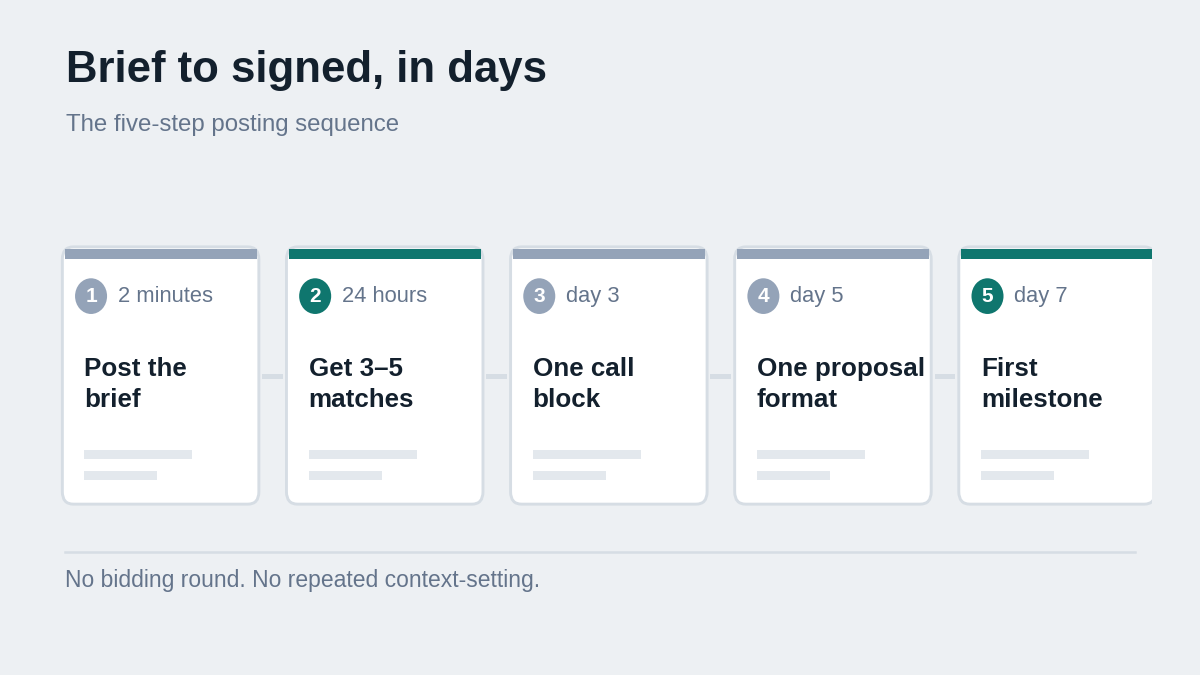
Speed comes from removing steps, not compressing them. The sequence that consistently closes in days rather than weeks:
- Post the structured brief two minutes, no fixed spec required.
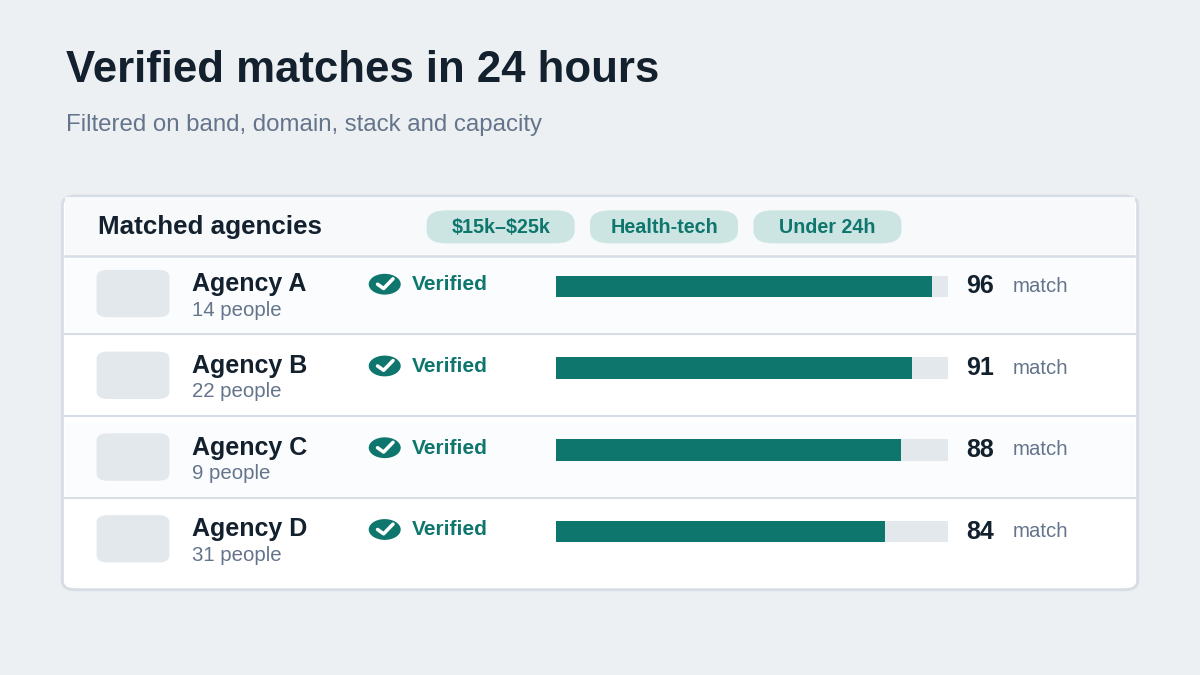
- Receive a filtered vendor shortlist of 3–5 matched agencies within 24 hours.
- Run 30-minute calls with all of them in a single block, using one question set.
- Request proposals in one format: scope, timeline, team, milestone-based payments.
- Sign with a 2–3 week paid discovery or first milestone rather than a full-project commitment.
Bidding platforms invert this. They generate 20–40 proposals, most templated, then extract 10–20% commission from the agency which shows up as either an inflated quote or a junior team. A commission-free marketplace with direct connection removes the bidding layer entirely: the client pays the agency, and nothing else sits between them.
Startup MVP Agency Matching in Practice
Startup MVP agency matching is easiest to judge by elapsed time and rework, not by satisfaction scores. Two anonymized scenarios illustrate the difference. (Figures are representative of the pattern, not a single named client.)
Seed-stage logistics SaaS, $30,000 band. The founding team had spent 19 days on outreach and collected four non-comparable proposals ranging from $22,000 to $85,000. A structured re-post returned four matched agencies in under a day, all pre-filtered to the band and to prior logistics work. Contract signed in six days; the first milestone shipped in 11 weeks.
Pre-seed health-tech, $15,000–$25,000 band. Two of the three agencies the founder had shortlisted through a paid directory turned out to be reselling delivery offshore, discovered only after a team-detail check. Verified matching surfaced a 14-person studio with existing HIPAA-adjacent work at $21,000, avoiding both a broker markup of roughly 25% and a compliance rebuild later.
Neither outcome came from better negotiation. Both came from changing how startups post a software project structured input first, filtered pool second, calls last.
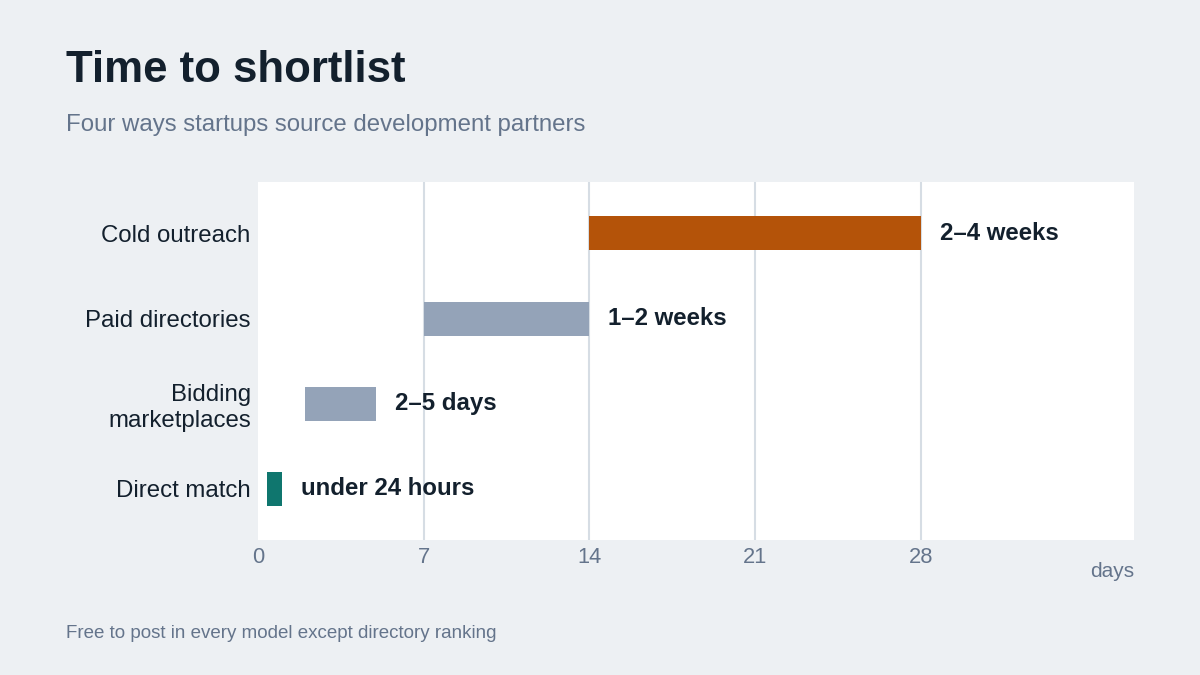
Comparison: Four Ways Startups Source Development Partners
| Sourcing model | Time to shortlist | Cost to the client | Vetting depth | Typical failure mode |
| Cold outreach | 2–4 weeks | Free, 8–12 founder hours | None | Non-comparable proposals, budget mismatch |
| Bidding marketplaces | 2–5 days | Free to post; 10–20% commission priced into quotes | Ratings only | Race to the bottom, junior teams |
| Paid directories | 1–2 weeks | Free to browse; $499+/year for agencies to rank | Self-reported | Pay-to-rank order, reseller listings |
| Direct-match marketplaces | Under 24 hours | Free to post and connect | Layered verification | Smaller pool, narrower niches |
The column that matters most for an early-stage team is the failure mode, not the price. Understanding how startups post a software project through each model explains why the same brief produces a $22,000 quote in one channel and $85,000 in another.
What Most Startup Teams Get Wrong
The recurring mistakes are not about diligence. They are about optimizing the wrong variable.
Founders over-interview. Decision quality peaks at three to five agency conversations and declines after that more calls produce more noise, not better discrimination. Teams that run 10 calls usually end up choosing the last one they spoke to.
Fixed-price contracts get requested on undefined scope. Any agency that quotes a fixed price for an unvalidated product has priced the ambiguity into the number, typically at 30–40%. A paid discovery sprint costing $2,000–$5,000 produces a defensible fixed price for the build phase and is the cheaper path.
Portfolio logos get over-weighted. An agency that built for a Fortune 500 client will apply Fortune 500 architecture to a 12-week MVP. Stage fit beats brand recognition at seed stage, consistently.
Rate is treated as cost. Velocity is expensive. Two extra months of burn erases any savings from a $20/hour rate difference.
The insider version of how startups post a software project well is unglamorous: post earlier than feels comfortable, with less detail than feels safe, in a channel where the receiving agencies have already been filtered. The brief is a filter, not a contract and every week it sits unwritten is a week of runway spent on internal debate rather than market feedback.
Post Project for Startup Free and Compare Verified Matches
If the build decision is already made and the open question is who ships it, the fastest path is to post a project for startup free, receive three to five verified agency matches within 24 hours, and run one comparison round instead of a month of outreach. GetProjects operates a 0% commission, no-bid model clients pay the agency directly, and every agency profile clears a layered verification check before it goes live.
Post a project at getprojects.ai/clients. Two minutes, no fixed spec required, no cost to connect.
FAQ
How do startups find software developers without a technical co-founder?
Non-technical founders should describe outcomes, not implementation. A structured brief that captures the user action, budget band, and launch trigger lets matched agencies propose the stack and team shape. Bring one technical advisor into the final two calls to pressure-test architecture and hire assumptions that single review typically costs nothing and prevents the most expensive category of mistake.
Is it free to post a software project as a startup?
On direct-connect platforms, yes. Posting, receiving matches, and contacting agencies carry no listing fee or commission; the only payment is to the agency eventually hired. Bidding marketplaces are also free to post but take 10–20% from the agency, which surfaces in the quote. Paid directories charge agencies for ranking, which distorts the order results appear in.
How much does it cost to build an MVP?
A single-platform MVP with 4–8 screens and one integration typically runs $15,000–$25,000 over 6–10 weeks. Adding native mobile, multiple roles, or compliance requirements moves it to $50,000–$100,000. The variable that moves cost most is integration count, followed by the number of distinct user roles not design polish.
How long does it take to hire a development agency?
Cold outreach averages three to six weeks from first email to signed contract. Structured posting with pre-filtered matching compresses it to three to seven days: matches within 24 hours, calls in a single block, one proposal format. The elapsed time saved is runway, not convenience.
How do you verify a software agency before signing a contract?
Confirm four things: domain and business email ownership, independent review history, named team members with verifiable profiles, and whether delivery is in-house or brokered. Then require repository access from week one and written IP transfer terms. Platforms that verify these layers before a profile goes live remove most of this work, but the repository and IP terms remain the client’s responsibility.
What should a startup software project brief include?
Five elements: the primary user action, a budget band rather than a fixed figure, a launch trigger, any non-negotiable integrations, and current stage. Feature lists, wireframes, and stack choices are optional when posting a good matching process that produces those recommendations. If a brief takes longer than a few minutes to complete, it is asking for decisions that belong to the agency.
Can a startup post a project without a fixed budget or a finished spec?
Yes, and waiting for either is the more expensive option. A band and a user outcome are sufficient inputs; agencies with a floor above the band are filtered out before they reach the shortlist. This is why how startups post a software project now looks closer to a two-minute intake form than a formal RFP and why a first matched call can happen the next day rather than the next month.