How Much Does an MVP Cost to Build in 2026 The Complete Budget Guide
Every week, a founder somewhere discovers that their $8,000 MVP budget will produce something that takes 6 months and costs $35,000 because the first agency they spoke to told them what they wanted to hear, the second filled their brief with assumptions, and the third was honest but got rejected because their price was too high.
That’s why understanding MVP development cost before approaching an agency is essential for setting a realistic scope and avoiding unexpected expenses.
According to Clutch Software Development Pricing Guide 2026, software development projects reviewed on Clutch typically range from $10,000 to $49,000, while most software development companies charge $24–$49 per hour. These benchmarks show why MVP budgets can vary significantly based on scope, team location, and technical complexity.
The MVP development market is defined by budget-scope misalignment. Founders want too much for too little. Agencies either over-promise to win the contract or give an honest quote and lose to the over-promiser. The founder who hires the over-promiser discovers the truth at the first milestone when scope is quietly reduced to fit the budget.
This guide tells you the honest numbers of what different MVP types actually cost, why they cost that, and how to scope your MVP so your budget and your ambition match before you talk to a single agency.
The Scope Problem Why MVP Costs Vary by 10×
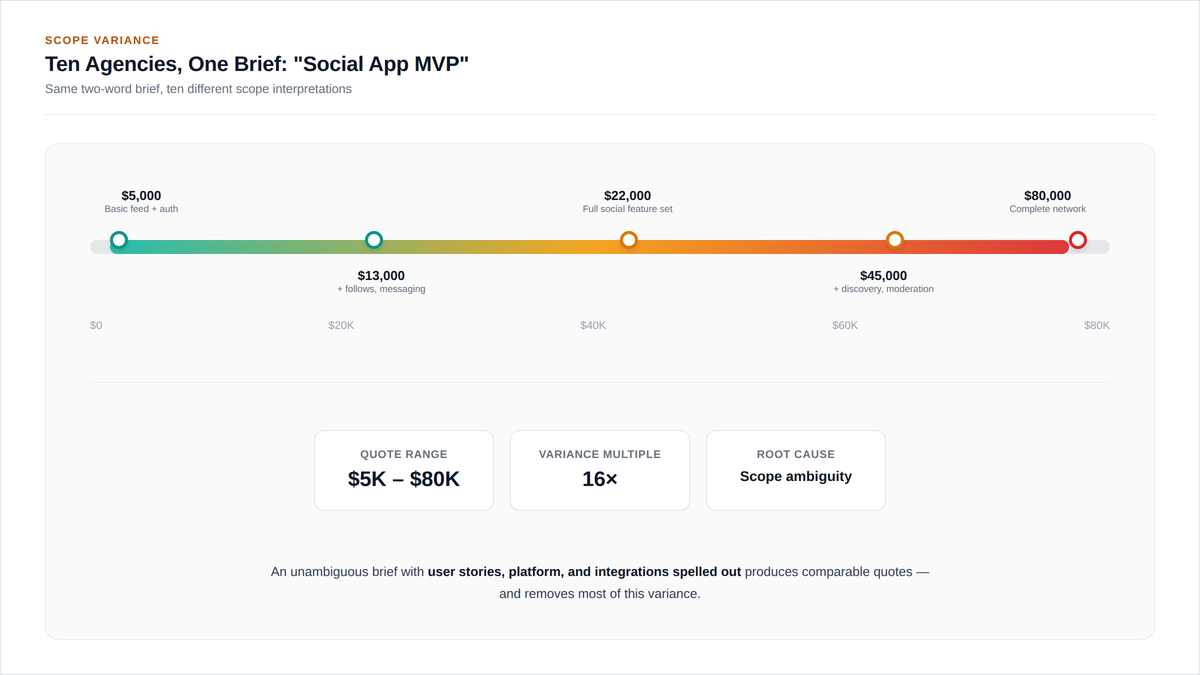
Ask ten agencies to quote a “social app MVP” and you will receive quotes ranging from $5,000 to $80,000. This range does not reflect different quality levels; it reflects ten different interpretations of what “social app MVP” means.
One agency quoted $5,000 for a basic feed with user authentication and post creation. Another quoted $80,000 for a complete social network with messaging, notifications, feeds, discovery, media uploads, and moderation tools. Both called it an MVP. Neither definition is universally correct and the gap becomes obvious once you look at a full social networking app development cost breakdown, where a basic MVP, a mid-level build, and a full-scale platform sit at three completely different price tiers.
The root cause of MVP cost variance:
| Variance Source | What Happens | How to Fix It |
| Scope ambiguity | Agency invents scope to fill in what brief does not specify | Write user stories before requesting quotes |
| Feature creep in the brief | Founder includes “nice to haves” alongside essentials | Ruthlessly distinguish essential from nice-to-have |
| Platform assumptions | Agency assumes iOS only; founder expects iOS + Android | Specify platforms explicitly |
| Design assumptions | Agency assumes template UI; founder expects custom design | Specify design requirements explicitly |
| Backend assumptions | Some agencies quote mobile app without backend; founder expects full stack | Verify what is and is not included |
| Integration assumptions | Brief mentions “login with Google” and agency adds social login for all platforms | List every integration by name |
The solution to cost variance is not finding the right agency, it is writing a brief specific enough that every agency quotes the same thing. An unambiguous brief produces comparable quotes. Comparable quotes produce an informed selection.
MVP Cost by Type The Honest Numbers
All cost ranges below assume a strong Indian development agency (the best value for most $5K–$30K budgets) with mid-to-senior developers and a 3 to 5 person team.
Mobile app MVPs:
| MVP Type | Platforms | Core Features | India Cost | Timeline |
| Simple utility app | iOS only or Android only | User auth, 5–8 screens, 1 integration, no backend | $4,500–$7,000 | 6–10 weeks |
| Simple utility app | Both (Flutter) | Same as above, cross-platform | $6,500–$9,500 | 8–12 weeks |
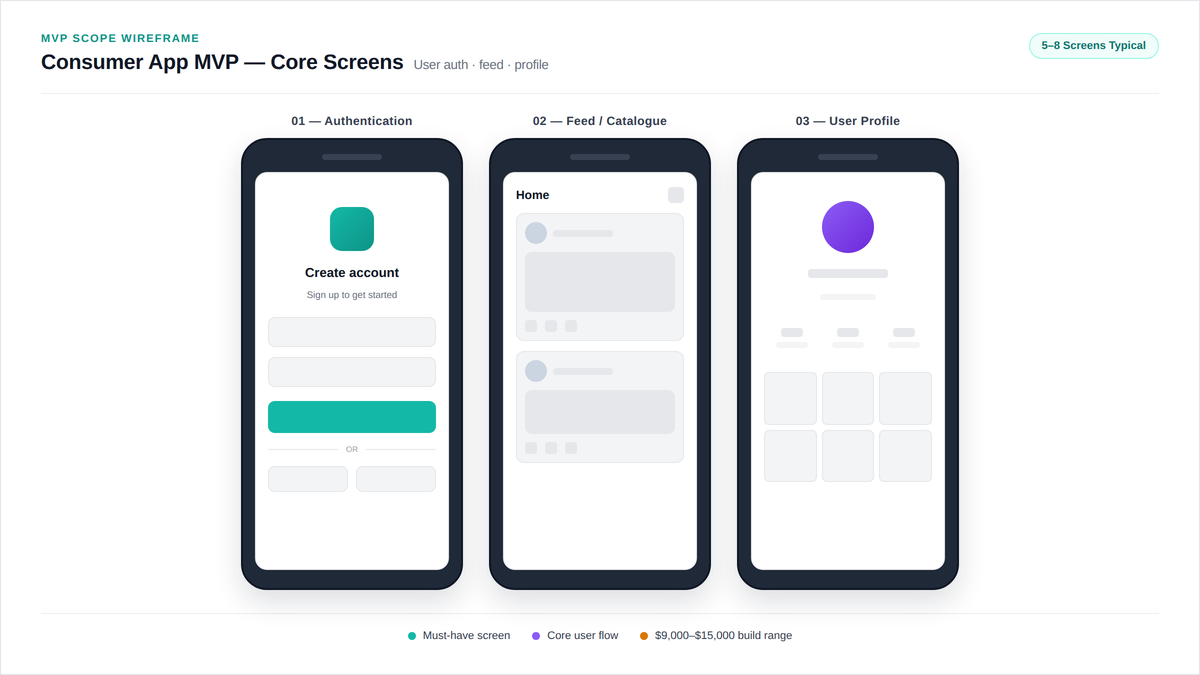
| Consumer app with backend | Both (Flutter) | User profiles, feed or catalogue, user-generated content, notifications | $9,000–$15,000 | 12–18 weeks |
| On-demand / marketplace | Both (Flutter) | Two user types, booking/ordering, payment (Stripe/Razorpay), basic tracking | $12,000–$20,000 | 16–22 weeks |
| Social app (basic) | Both (Flutter) | User profiles, posts/feed, follows, basic messaging, notifications | $13,000–$22,000 | 16–24 weeks |
| Fintech app | Both (Flutter) | Secure auth, KYC, payment integration, transaction history, basic compliance | $12,000–$20,000 | 14–20 weeks |
Web app and SaaS MVPs:
| MVP Type | Platform | Core Features | India Cost | Timeline |
| Simple web tool | Web only | User auth, core workflow, data storage, basic admin | $5,000–$9,000 | 6–12 weeks |
| SaaS MVP (B2B) | Web | Multi-tenancy (org + users), core feature set, subscription billing (Stripe), admin panel | $11,000–$18,000 | 14–20 weeks |
| Marketplace web platform | Web | Two user types, listing/booking, payment, reviews, basic search | $13,000–$22,000 | 16–24 weeks |
| B2B workflow tool | Web | Company accounts, role management, workflow automation, integrations (2–3), reporting | $12,000–$20,000 | 14–22 weeks |
| API-first product | Web + API | Core API, documentation, developer portal, authentication, rate limiting | $9,000–$16,000 | 10–16 weeks |
The True Cost of an MVP Beyond Development
The development quote is the starting point, not the finish line. Every MVP has 4 to 7 additional cost categories that most budgets do not account for, a pattern that shows up across mobile app budgets too, where hidden costs routinely blow past the initial estimate.
The complete MVP budget what you actually need:
| Cost Category | Typical Amount | Included in Dev Quote? |
| Development (coding) | The quoted amount | Yes |
| UI/UX design | $1,500–$5,000 | Sometimes verify explicitly |
| Project management | 10–15% of dev cost | Often included, sometimes extra |
| Quality assurance | 15–20% of dev cost | Often included, sometimes extra |
| App Store accounts | $124 (Apple $99/yr + Google $25 one-time) | No |
| Cloud infrastructure setup | $200–$800 | Rarely |
| Monthly hosting costs | $80–$350/month | No ongoing |
| Third-party API subscriptions | $50–$300/month | No ongoing |
| Post-launch bug fixes (beyond warranty) | $1,500–$4,000 | No |
| First year maintenance | $2,000–$5,000 | No |
The real total cost for a “typical” $12,000 MVP:
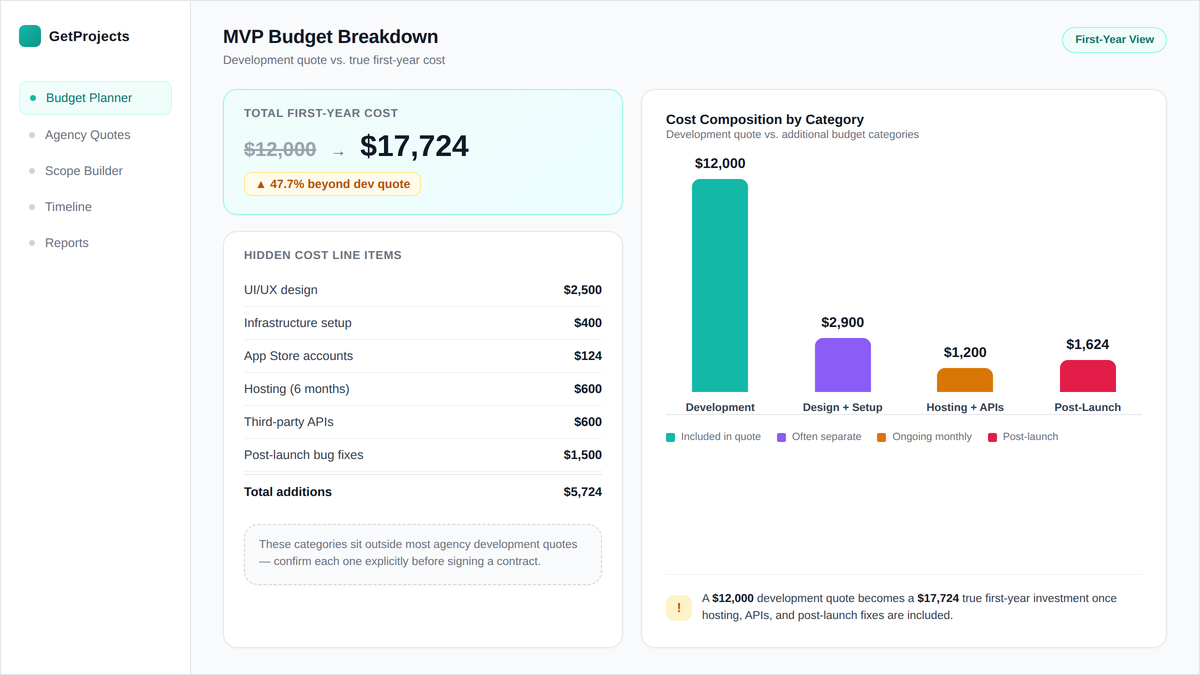
| Item | Amount |
| Development quote | $12,000 |
| Separate UI/UX design (if not included) | $2,500 |
| Infrastructure setup | $400 |
| App Store accounts | $124 |
| First 6 months hosting | $600 |
| Third-party APIs (6 months) | $600 |
| Post-launch bug fixes (3 months) | $1,500 |
| True total first-year cost | $17,724 |
The $12,000 development quote becomes a $17,724 first-year investment. This does not mean the MVP is not worth building, it means your budget should account for the full picture, not just the development quote.
The Scope Trap The Most Expensive MVP Mistake
The scope trap works like this: a founder wants to build a marketplace. The brief mentions the core features but also includes “a few other things” : a blog, social sharing, referral programme, analytics dashboard, white-label option, and API documentation. Each addition seems small. Together, they double the scope.
A strong MVP development agency will flag this and help you cut scope. A weak one will include everything in a quote, discover mid-project that the budget does not cover it, and either cut scope without telling you or deliver a half-finished product. Knowing how to select an MVP agency upfront is what separates the two outcomes.
The scope prioritisation exercise do this before any agency conversation:
List every feature you think the MVP needs. Then categorise each one as:
Must-have: the MVP fails to test its hypothesis without this feature. Nice-to-have: this feature improves the product but the MVP is still testable without it. Future phase: genuinely out of scope for the MVP. If you’re unsure where the MVP line sits, this breakdown of what actually counts as an MVP helps draw it.
For most products, the Must-have list is 30 to 40% of the original feature list. The savings from this exercise are not just financial; a smaller MVP ships faster, provides cleaner learning, and is easier to iterate on.
The minimum viable test criterion:
Before finalising any MVP feature, ask: does this feature help me answer the question “will people use and pay for this product?” If the answer is no if this feature does not directly test your core hypothesis it is not in the MVP. That question is really about validating your startup idea before you spend on features that don’t test it.
What the Budget Difference Buys A Direct Comparison
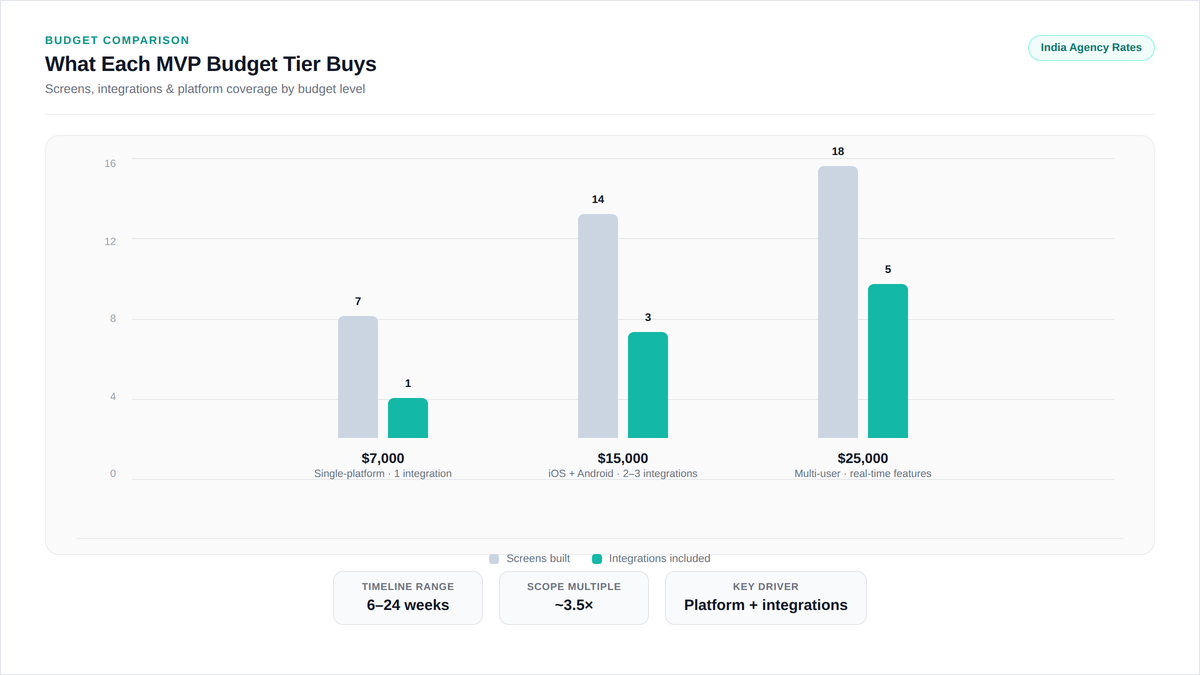
$7,000 vs $15,000 vs $25,000 three actual MVP outcomes at India agency rates:
| Budget | What You Get | What You Sacrifice |
| $7,000 | Single-platform app, 6–8 screens, standard component library design, one external integration, basic user authentication | Custom design, cross-platform, complex backend logic, multiple integrations |
| $15,000 | Cross-platform app (iOS + Android), 12–15 screens, professional UI built on a design system, backend API with database, 2–3 integrations, admin panel, basic analytics | Custom design system, complex real-time features, multiple user role complexity |
| $25,000 | Launch-ready V1, multiple user types, polished design with custom elements, 4–5 integrations, real-time features, comprehensive admin panel, performance optimised, 60-day post-launch support | Consumer-grade polish, complex AI features, enterprise integrations |
The difference between $7,000 and $15,000 is not double the quality, it is double the scope. Specifically: cross-platform coverage (both iOS and Android), more screens, a proper backend, and multiple integrations. If your hypothesis only needs to be tested on one platform with one integration, $7,000 builds a genuine MVP. If you need both platforms and multiple integrations to test your hypothesis, $15,000 is the minimum.
How to Get an Accurate MVP Quote
The most reliable way to get an accurate MVP quote is to write a brief that removes all assumptions. The brief that produces comparable, accurate quotes contains four elements.
A problem statement what problem your MVP solves, for whom, and what the key hypothesis you are testing is. This gives agencies the context to make scope decisions aligned with your goal rather than their defaults. If you haven’t nailed this down yet, validating the idea first makes the problem statement much sharper.
User stories for every feature “As a [user type], I want to [action] so that [benefit].” One user story per meaningful feature. 10 to 20 user stories for a typical MVP brief. This forces specificity that removes the scope interpretation variability that produces quote ranges.
Platform and technology preferences iOS only, Android only, both (Flutter or React Native), web only, web and mobile. Integration list with specific service names (Stripe, Twilio, Mapbox not “payment processing and notifications and maps”). Design preferences: custom design system, or build on Material UI or other component library.
The budget range states it. “$10,000 to $15,000 for the MVP described above, with Phase 2 features available in a separate roadmap.” This produces quotes scoped to your budget rather than to the agency’s interpretation of your ambition. It also makes it easier to compare software development quotes apples-to-apples once proposals come in.
Post your MVP brief on getprojects.ai the platform matches your brief against agencies who have built similar products, so proposals come from agencies with relevant experience, not agencies who build everything and claim expertise in your category. It’s worth knowing how to select the right MVP development company once those matched proposals arrive.
Frequently Asked Questions
What is the minimum budget for a functional MVP that real users can test?
The minimum budget for a genuinely functional MVP something with real authentication, real data storage, and a real core workflow that users can complete is $4,500 to $6,000 with a strong Indian development team. Below this threshold, you are typically getting a prototype with limited backend, a no-code tool with custom branding, or a single-screen demo that demonstrates the concept without enabling real usage. For mobile apps specifically, $5,000 builds a single-platform app (iOS or Android, not both) with 5 to 7 screens and one integration. For web apps, $5,000 builds a simple web application with user authentication, basic CRUD functionality, and one or two key workflows.
How do I know if my MVP is too big for my budget?
Two checks: time and features. If your MVP requires more than 16 to 18 weeks of development with a full team at your budget level, it is probably too big. MVPs that take longer than 4 to 5 months typically have scope that exceeds the minimum required to test the hypothesis. Count your user stories if you have more than 25 user stories in your MVP brief, apply the must-have filter: which 10 to 15 user stories are truly essential to test whether people will use and pay for your product? The remaining stories become Phase 2. This exercise typically reduces scope by 30 to 40% and brings most MVPs within a $10,000 to $20,000 budget range.
Should I pay for UI/UX design separately or find an agency that includes it?
Both approaches work, but clarifying which model applies is critical before signing any contract. Agencies that include design in their development quote are typically using a standard component library (Material Design, Tailwind) with your brand colours and typography not a custom-designed experience. This produces professional, functional results and is appropriate for most B2B MVPs and first-launch consumer products. If your product’s differentiation is partly in the experience of how it looks and feels is important to adoption, invest separately in a dedicated designer (a freelance UI/UX designer for $2,000 to $4,000) who produces designs that the development team implements. Mixing the two without clarifying the model is the most common source of design dissatisfaction in MVP builds.
What happens to my MVP budget if requirements change during development?
In a fixed-price contract, requirements changes outside the defined scope become change requests each quoted and charged separately. A single significant change request can add $1,000 to $5,000 to a fixed-price project. To minimise change request exposure: invest in specification before development begins (a paid discovery sprint of $500 to $1,000 that produces a detailed functional spec reduces change requests by 60 to 80%), and accept that some requirements will change and budget 15 to 20% above the development quote as a change request buffer. The founders who stay within budget are the ones who either specified their requirements completely before development started or who maintained iron scope discipline during development saying no to every addition that is not essential to the MVP hypothesis.