India vs Eastern Europe vs LATAM for Software Development in 2026 The Honest Comparison
Three regions dominate offshore and nearshore software development for US and UK buyers: India, Eastern Europe, and Latin America. They each offer skilled development talent at rates significantly below US or UK market prices. They each have produced excellent software for global companies. And they each have genuine trade-offs that make them the right or wrong choice depending on what you are building, what your budget is, and how you prefer to work.
Choosing the right offshore development region can define your project’s success or failure. While India, Eastern Europe, and Latin America all offer strong engineering talent, the real differences lie in cost structures, communication styles, and scalability.
That’s why understanding offshore development India vs Eastern Europe vs LATAM is critical before selecting a partner especially when you’re balancing budget, speed, and collaboration.
According to Statista, global software market revenue is projected to surpass $858 billion in 2026, fueled by remote hiring and cross-border development demand. This growth has made regional comparisons more relevant than ever for companies building distributed teams.
Most comparisons of these regions are written by agencies who want to sound objective but are pitching their own geography. This is not that. This guide gives you the honest trade-offs, the rate reality, the communication patterns, and the specific scenarios where each region wins.
The Three Regions at a Glance: Offshore Development India vs Eastern Europe vs LATAM
India:
India is the world’s largest software outsourcing destination, a position it has held for 30 years. The country produces 1.5 million engineering graduates annually, has the world’s second-largest developer community, and has built production software for virtually every major technology company and startup ecosystem. The primary advantages are cost efficiency (the lowest rates of the three regions), talent depth (every major technology stack is well-represented), and startup experience (India has been building for US and UK startups since the early 2000s). If you’re evaluating vendors directly, our breakdown of the best software development companies in India is a good next step before you shortlist
Eastern Europe:
Eastern Europe, primarily Poland, Romania, Ukraine, Czech Republic, Hungary, and Bulgaria, offers the best combination of quality and time zone overlap for European buyers and the most similar engineering culture to Western Europe. Rates sit between India and Western Europe, and if you want to see exactly how that compares country by country, our guide to software developer hourly rates by country breaks down the numbers in detail. The primary advantages are strong computer science education, excellent English proficiency at the senior level, minimal time zone friction for UK and EU buyers, and a reputation for rigorous engineering practices.
Latin America:
Latin America, primarily Brazil, Mexico, Colombia, and Argentina, has emerged as the most compelling nearshore option for US buyers in the last 5 years. The primary advantage is time zone overlap. Latin American developers work simultaneously with US teams, enabling the kind of real-time collaboration that is difficult across 10-hour time differences a factor worth weighing carefully in our full guide on how to outsource software development. Rates are higher than India and comparable to Eastern Europe.
The Rate Comparison What You Actually Pay
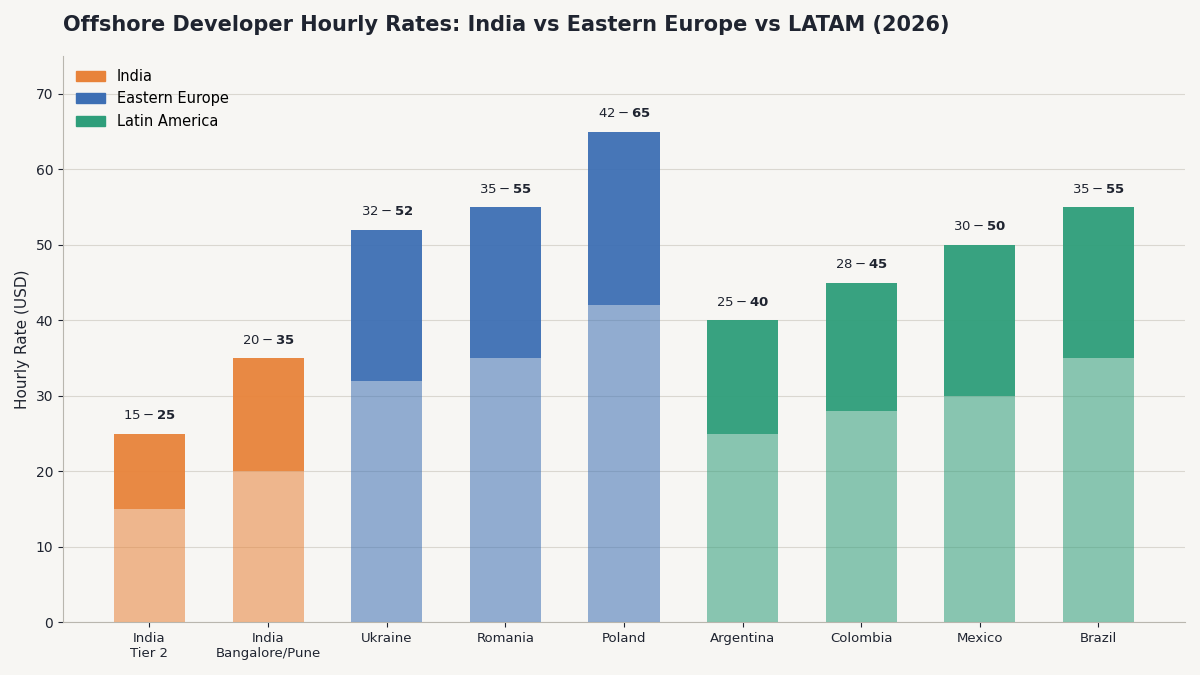
Mid-level full-stack developer agency rates (the most common hiring level for $5K–$30K projects):
| Region / Country | Hourly Rate Range | Monthly Cost (160 hours) | Annual Cost (single developer) |
| India Bangalore/Pune | $20–$35/hour | $3,200–$5,600 | $38,400–$67,200 |
| India Tier 2 cities | $15–$25/hour | $2,400–$4,000 | $28,800–$48,000 |
| Eastern Europe Poland | $42–$65/hour | $6,720–$10,400 | $80,640–$124,800 |
| Eastern Europe Romania | $35–$55/hour | $5,600–$8,800 | $67,200–$105,600 |
| Eastern Europe Ukraine | $32–$52/hour | $5,120–$8,320 | $61,440–$99,840 |
| Latin America Brazil | $35–$55/hour | $5,600–$8,800 | $67,200–$105,600 |
| Latin America Mexico | $30–$50/hour | $4,800–$8,000 | $57,600–$96,000 |
| Latin America Colombia | $28–$45/hour | $4,480–$7,200 | $53,760–$86,400 |
| Latin America Argentina | $25–$40/hour | $4,000–$6,400 | $48,000–$76,800 |
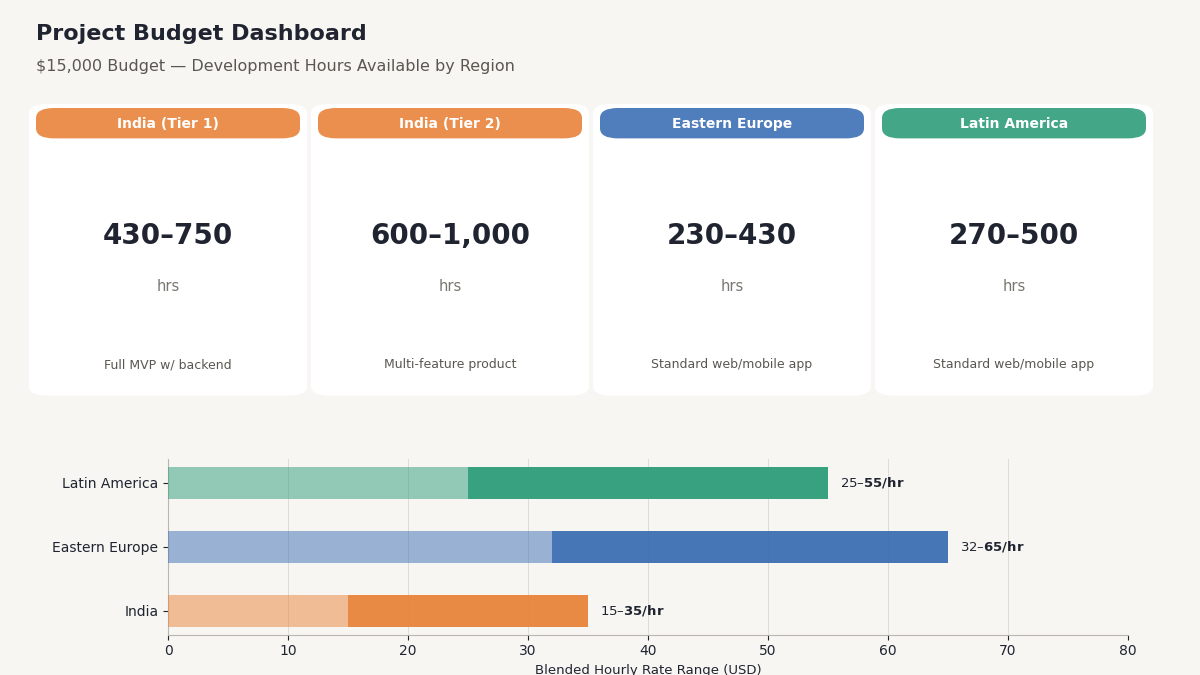
What this means for a $15,000 project:
| Region | Hours Available | What It Builds |
| India (Tier 1) | 430–750 hours | Full cross-platform MVP with backend |
| India (Tier 2) | 600–1,000 hours | Substantial product with multiple features |
| Eastern Europe | 230–430 hours | Standard mobile or web application |
| Latin America | 270–500 hours | Standard mobile or web application |
Time Zone Reality The Most Misunderstood Variable
Time zone is the factor most buyers worry about and most agencies misrepresent. Here is the actual overlap situation.
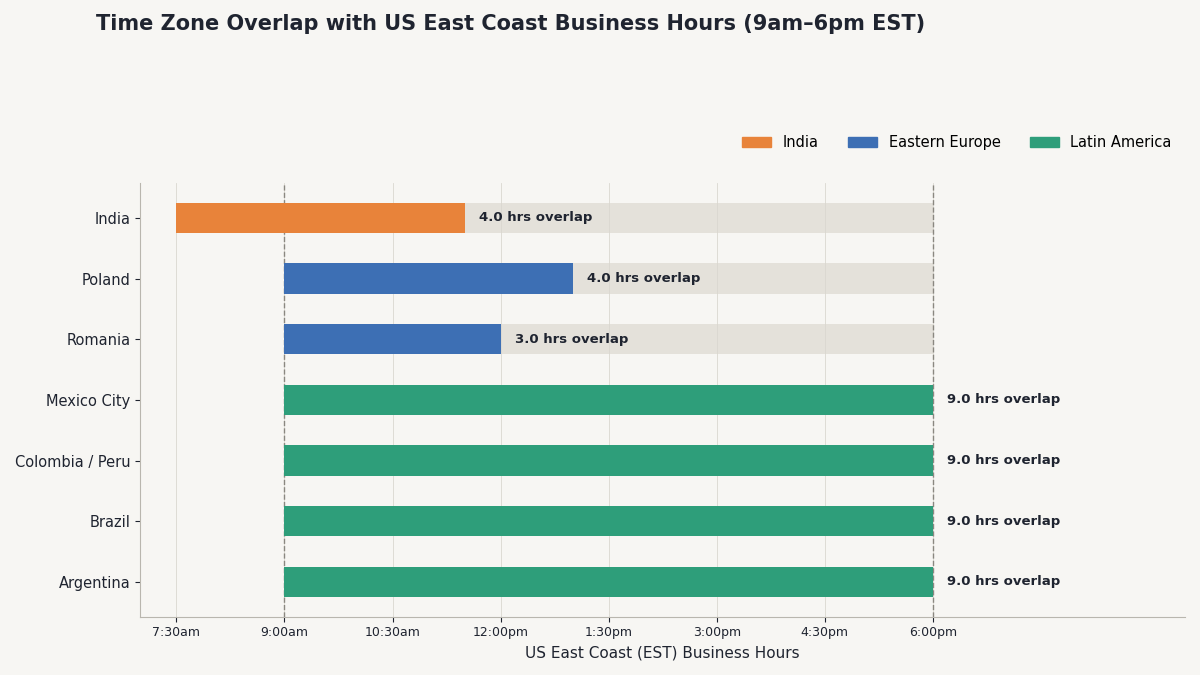
Time zone overlap for US East Coast (EST) buyers:
| Region | Time Zone | Overlap with 9am–6pm EST |
| India | UTC+5:30 | 7:30am–11:30am EST next day (4 hours with early India morning) |
| Poland | UTC+1 / UTC+2 | 9am–1pm EST (4 hours) |
| Romania | UTC+2 / UTC+3 | 9am–12pm EST (3 hours) |
| Mexico City | UTC-6 | 9am–6pm EST (full overlap) |
| Colombia / Peru | UTC-5 | 9am–6pm EST (full overlap) |
| Brazil (São Paulo) | UTC-3 | 9am–6pm EST (full overlap) |
| Argentina | UTC-3 | 9am–6pm EST (full overlap) |
The honest assessment:
For US West Coast (PST) buyers, India has virtually no same-day overlap; it requires either very early morning calls from PST or end-of-day calls from India, neither of which is sustainable long-term. Eastern Europe has 1 to 2 hours of PST overlap. Latin America has full overlap.
For US East Coast and UK buyers, India has a workable 3 to 4 hour overlap window if the India team starts their day early (8am IST). Eastern Europe has a 4 to 6 hour overlap with EST, excellent with the UK/EU.
The time zone concern is most significant for projects that require frequent real-time collaboration evolving requirements, daily decision-making, and close iteration cycles. For projects with well-defined requirements and a structured async-first workflow, India’s time zone is manageable and the cost advantage is significant.
If you’re not sure your specs are tight enough for this to work, our guide on how to write software requirements walks through what “well-defined” actually looks like before you hand work off. The buyer who is disciplined about async communication, detailed Slack updates, Loom recordings, thorough written specifications, can work effectively with India regardless of time zone.
Quality and Technical Capability The Honest Assessment
Every region has produced excellent software. Every region has produced terrible software. The quality of any specific engagement depends far more on the specific agency than the country. With that caveat:
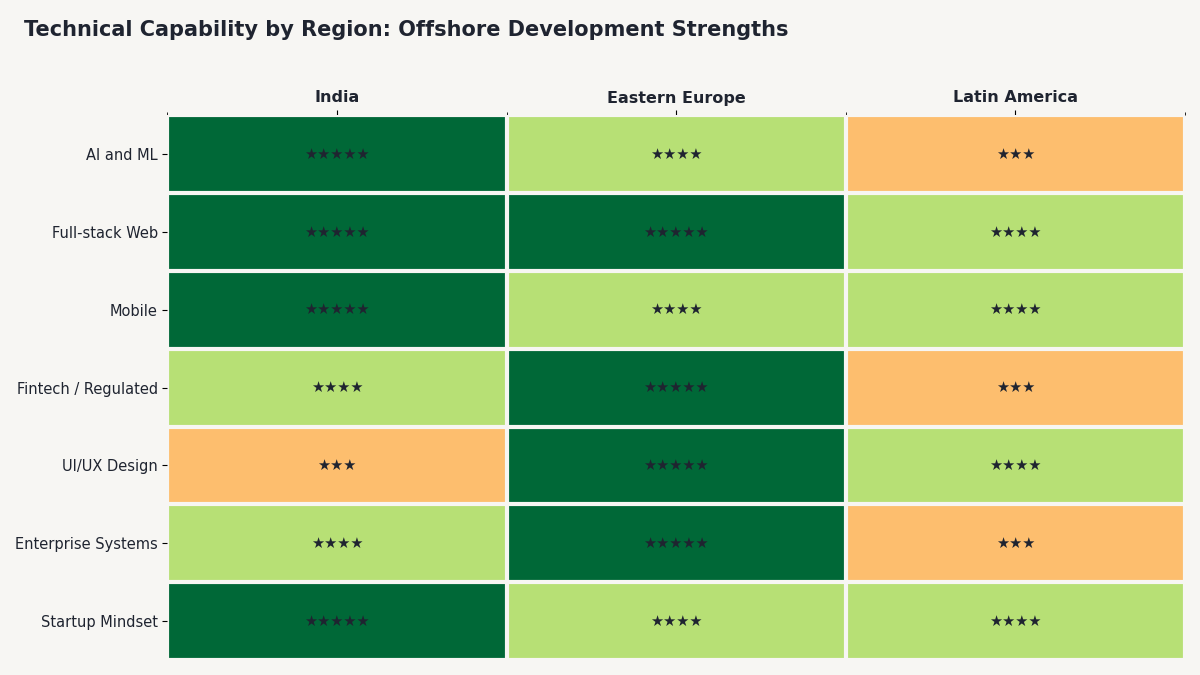
Strengths by region:
| Technical Area | India | Eastern Europe | Latin America |
| AI and ML | ⭐⭐⭐⭐⭐ Best IIT/IISc talent, massive ML community | ⭐⭐⭐⭐ Strong | ⭐⭐⭐ Growing |
| Full-stack web (React/Node) | ⭐⭐⭐⭐⭐ Very strong talent pool | ⭐⭐⭐⭐⭐ Very strong | ⭐⭐⭐⭐ Strong |
| Mobile (Flutter/React Native) | ⭐⭐⭐⭐⭐ Deep talent pool | ⭐⭐⭐⭐ Strong | ⭐⭐⭐⭐ Strong |
| Fintech / regulated software | ⭐⭐⭐⭐ Strong major Indian fintech ecosystem | ⭐⭐⭐⭐⭐ Very strong EU regulations well understood | ⭐⭐⭐ Growing |
| UI/UX design quality | ⭐⭐⭐ Variable top agencies strong | ⭐⭐⭐⭐⭐ Design culture is strong | ⭐⭐⭐⭐ Strong design culture |
| Enterprise / complex systems | ⭐⭐⭐⭐ Strong decades of enterprise outsourcing | ⭐⭐⭐⭐⭐ Very strong | ⭐⭐⭐ Growing |
| Startup / product mindset | ⭐⭐⭐⭐⭐ Strong extensive startup outsourcing history | ⭐⭐⭐⭐ Strong and growing | ⭐⭐⭐⭐ Strong |
Communication Patterns What No One Tells You
The biggest practical difference between the three regions is not technical quality, it is communication style and how it affects daily project management.
India:
Indian development culture traditionally emphasises respect for hierarchy and client wishes, which can manifest as a reluctance to proactively flag problems, push back on bad requirements, or escalate risks without being asked.
The best Indian agencies have evolved beyond this pattern; they hire senior engineers who are direct communicators and build cultures of proactive transparency. But when evaluating Indian agencies, specifically probe for this: ask about a project that went off track and how they communicated it to the client.
Our breakdown of red flags in a software development company covers exactly this kind of question, along with others worth asking before you sign. The answer tells you whether you are working with an agency that will tell you when something is wrong or one that will silently struggle until a deadline is missed.
Eastern Europe:
Eastern European engineers typically communicate in a more direct, structured style closer to Western European professional communication norms. They are generally comfortable pushing back on requirements, flagging technical risks proactively, and saying “this is not the right approach” when it is not. The communication style is more formal and documented than the other two regions.
Latin America:
Latin American communication tends to be the most similar to US communication culture, relationship-oriented, relatively informal, comfortable with real-time collaboration and rapid iteration. The cultural alignment with US startup culture is genuine and often cited as a significant factor in project satisfaction beyond the time zone advantage.
The Decision Framework Which Region Is Right for Your Project
Choose India when:
Your budget is under $15,000 and maximising development hours is the priority. Your project has well-defined requirements and a structured async workflow. You are building AI, ML, or data-heavy features where India’s talent concentration is strongest. You have experience managing remote teams and are comfortable with async-first collaboration.
Choose Eastern Europe when:
Your budget is $15,000 to $30,000 a range we break down in detail in our custom software development cost guide and the time zone overlap with the UK or EU is important for your collaboration style. Your project involves complex regulated requirements — GDPR, financial services, healthcare in EU markets — where Eastern European agencies have deep compliance experience. Design quality is a significant factor in your product and you want a region with a strong design culture. You want the cultural proximity of a team whose engineering practices were shaped by similar Western European standards.
Choose Latin America when:
You are a US-based buyer for whom real-time collaboration during US business hours is non-negotiable. Your project involves rapidly evolving requirements that require daily decision-making with your development team. You value cultural alignment with US startup communication norms, informal, fast, relationship-driven. Your budget is $12,000 to $30,000 and you value the time zone over the cost efficiency of India.
The Hybrid Approach Using Multiple Regions
The most sophisticated outsourcing buyers in 2026 use a hybrid model: Eastern Europe or Latin America for the senior engineering leadership (architect, tech lead) who needs close collaboration with the product team, and India for the implementation team doing volume development work at lower rates.
If you’re building this kind of distributed setup, our guide on how startups should build their first tech team walks through how to structure leadership and execution roles across regions. This model captures the cost efficiency of India for bulk development hours and the communication quality of Eastern Europe or LATAM for the decisions that actually shape the product.
For projects above $25,000, this hybrid approach is worth exploring; the effective blended rate is 30 to 40% lower than a pure Eastern European or Latin American team while maintaining the quality oversight of senior Western-timezone engineers.
Frequently Asked Questions
Which region produces the best software developers India, Eastern Europe, or Latin America?
All three regions produce excellent developers. The quality difference between a top-tier Indian agency and a top-tier Eastern European agency is negligible; both are capable of building production-grade software that competes with anything produced in-house. The quality difference within each region between top-tier and mid-tier agencies is far larger than the quality difference between regions. The right question is not “which country produces better developers?” but “which specific agencies in each country have track records of delivering projects similar to mine?” GetProjects.ai’s agency verification process focuses on evaluating specific agencies rather than making country-level generalisations.
Is it true that Eastern European developers are better at complex technical problems than Indian developers?
This is a generalisation that holds at the population mean but breaks down at the agency level. Eastern European countries particularly Poland, Czech Republic, and Romania have consistently strong computer science education at the university level and a culture that values engineering rigour. India has the IITs, IISc, and BITS Pilani producing world-class engineers at the top of the distribution, as well as many mid-tier engineering colleges producing graduates of variable quality. The best Eastern European agencies consistently produce excellent engineers. So do the best Indian agencies. The worst agencies in both regions produce poor work. Selecting at the agency level rather than the country level is what produces consistent quality outcomes.
How do I manage communication across a significant time zone difference like the US to India?
The most effective framework for US-to-India collaboration is async-first with structured sync points. Async-first means: requirements, decisions, questions, and updates are communicated in writing (Slack, email, Confluence) with enough detail that the India team can act on them without a synchronous conversation. This removes the dependency on real-time availability. Structured sync points means: a 30-minute daily standup at a fixed time that works for both sides (typically early morning US East Coast, which is late afternoon India), weekly or bi-weekly longer planning sessions, and ad-hoc calls reserved for genuinely complex discussions that cannot be resolved asynchronously. Buyers who adopt this workflow report high satisfaction with India-based teams. Buyers who try to manage India teams the same way they manage a co-located team expecting real-time availability and instant responses consistently report frustration.