
Software Developer Hourly Rates by Country in 2026 The Complete Comparison Guide
You have a $15,000 development budget. In the US, that buys 100 hours of a mid-level developer barely enough to build a single feature. In India, it takes 500 to 700 hours to build a complete MVP. In Eastern Europe, it buys 250 to 400 hours, enough for a substantial module of a larger product. The rate you pay per hour determines everything about what you can build within a fixed budget.
According to Statista, global software market revenue is expected to surpass $858 billion in 2026, driven largely by remote hiring and cross-border development demand. This has widened the gap in hourly rates across regions while giving companies more flexibility than ever before.
The global developer talent market has never been more transparent or more confusing. Remote work has enabled hiring from anywhere, but rates vary by a factor of 10 between the cheapest and most expensive markets. This guide gives you the actual numbers for 2026, the quality signals that go with each market, and the framework to decide which region makes sense for your specific project.
Software Developer Rates by Country The Complete 2026 Table
These rates reflect what software development agencies charge clients for developer time, not what developers are paid as salaries. Agency rates include overhead, management, quality assurance, and profit margin.
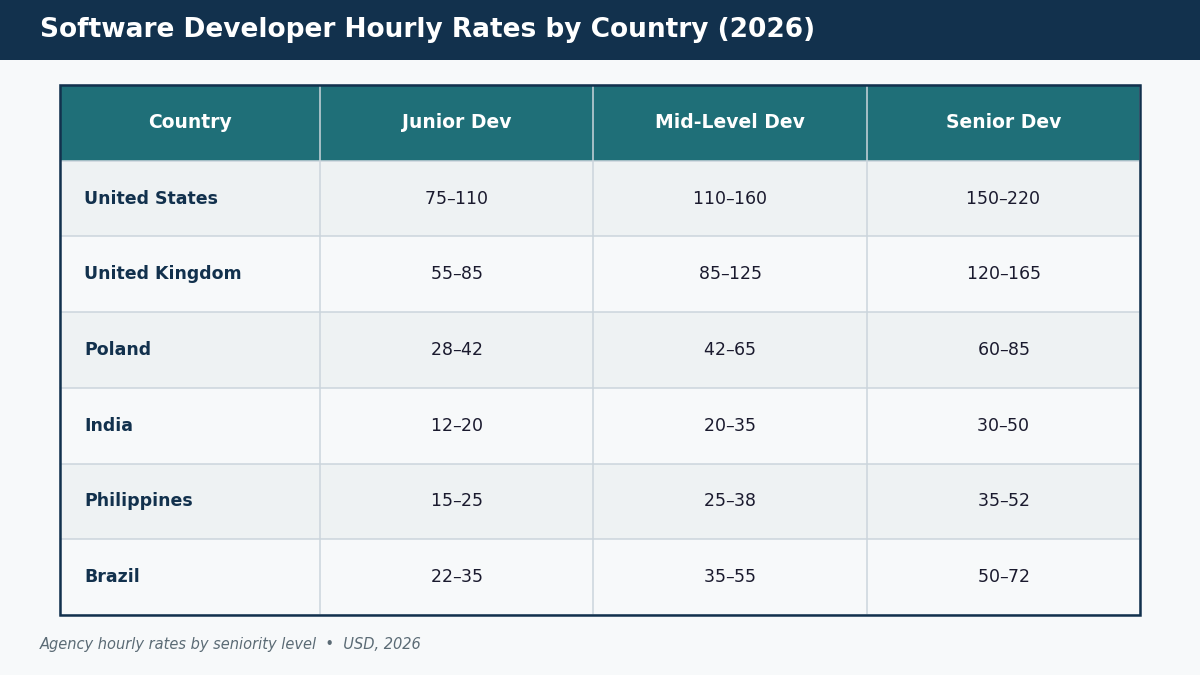
Hourly rate ranges by country and seniority:
| Country | Junior Dev | Mid-Level Dev | Senior Dev | Full-Stack (Mid) | Tech Lead |
| United States | $75–$110 | $110–$160 | $150–$220 | $120–$170 | $170–$250 |
| Canada | $60–$90 | $90–$130 | $130–$175 | $95–$140 | $140–$200 |
| United Kingdom | $55–$85 | $85–$125 | $120–$165 | $90–$130 | $130–$190 |
| Australia | $55–$80 | $80–$120 | $115–$160 | $85–$125 | $130–$185 |
| Germany | $55–$80 | $80–$120 | $110–$155 | $85–$120 | $125–$175 |
| Netherlands | $55–$80 | $80–$115 | $105–$150 | $85–$120 | $120–$170 |
| Poland | $28–$42 | $42–$65 | $60–$85 | $45–$70 | $70–$100 |
| Romania | $25–$38 | $38–$58 | $55–$78 | $40–$62 | $65–$90 |
| Ukraine | $22–$35 | $35–$55 | $50–$72 | $38–$58 | $60–$85 |
| Czech Republic | $30–$45 | $45–$68 | $62–$88 | $48–$72 | $72–$105 |
| India | $12–$20 | $20–$35 | $30–$50 | $22–$38 | $40–$65 |
| Philippines | $15–$25 | $25–$38 | $35–$52 | $27–$42 | $45–$65 |
| Vietnam | $15–$24 | $24–$38 | $35–$50 | $26–$40 | $43–$62 |
| Indonesia | $12–$20 | $20–$32 | $28–$45 | $22–$35 | $38–$55 |
| Brazil | $22–$35 | $35–$55 | $50–$72 | $38–$58 | $60–$85 |
| Mexico | $20–$32 | $32–$50 | $45–$65 | $35–$52 | $55–$78 |
| Colombia | $18–$28 | $28–$45 | $40–$60 | $30–$48 | $50–$72 |
| Argentina | $15–$25 | $25–$40 | $38–$55 | $28–$44 | $48–$68 |
What You Actually Get at Each Rate The Quality Conversation
Rate and quality are correlated but not as simply as higher rate equals better quality. The relationship is more nuanced and more useful than that.
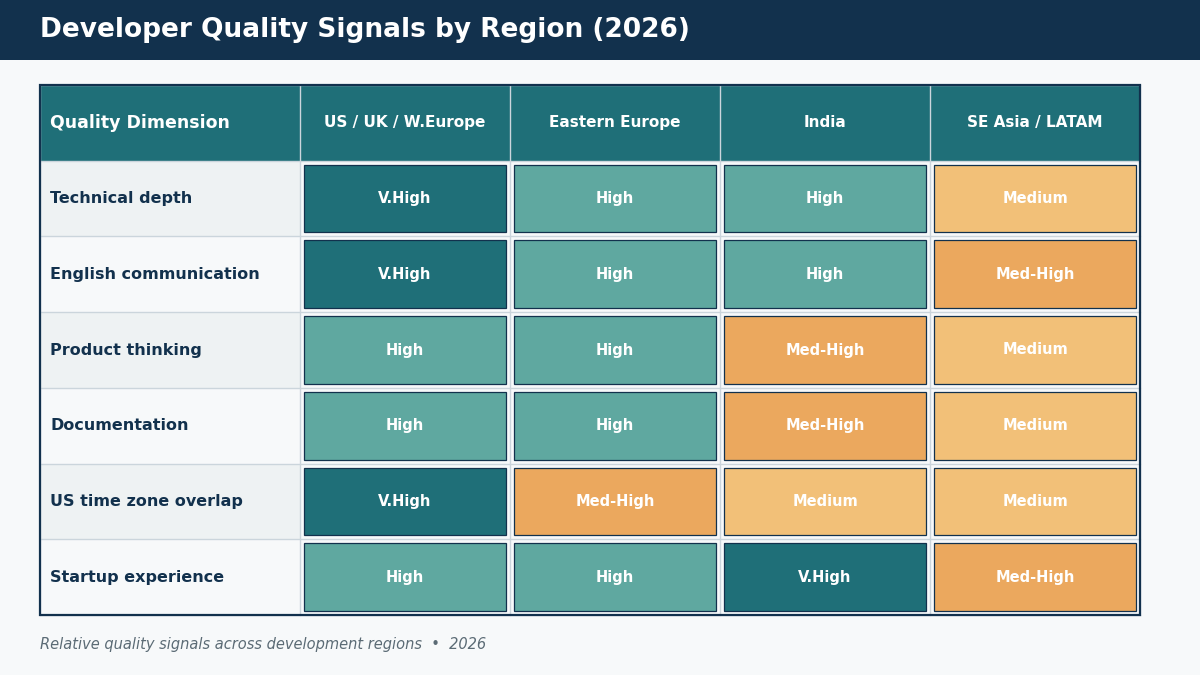
The quality dimensions that vary by region:
| Quality Dimension | US / UK / Western Europe | Eastern Europe | India | Southeast Asia / LATAM |
| Technical depth | Very high | High to very high | High | Medium to high |
| English communication | Native or near-native | Strong widespread high-level English | Strong widespread business English | Good variable quality |
| Product thinking | Strong expensive markets value senior judgment | Strong CS education is rigorous | Variable strong at top agencies, weaker at mid-tier | Variable |
| Documentation habits | Strong | Strong | Variable top agencies strong, mid-tier weak | Variable |
| Time zone overlap with US | Same or near-same | 6–8 hour difference daily overlap | 10–11 hour difference minimal overlap | Variable |
| Startup experience | High | High and growing | Very high decades of startup outsourcing | Growing |
| Regulatory experience (HIPAA, GDPR, PCI) | Very high | High | High at specialised agencies | Growing |
The practical implication:
For a $5K–$15K project where every dollar of development budget matters, India and Southeast Asia deliver the most scope per dollar. For a $20K–$30K project where communication and time zone overlap are significant concerns, Latin America or Eastern Europe may be worth the premium; the 2 to 3× higher rate is partially offset by reduced communication overhead and project management burden.
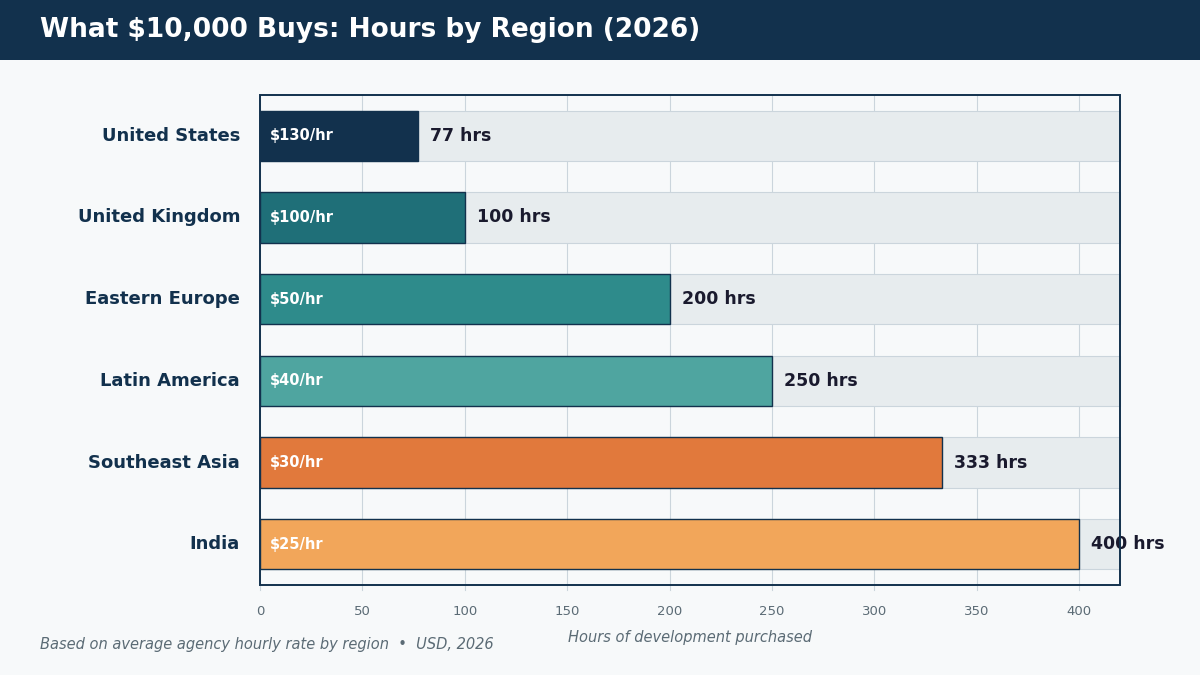
What $10,000 Buys at Each Rate A Direct Comparison
This is the calculation that matters most for budget planning.
| Country | Average Agency Rate | Hours for $10K | What That Builds |
| United States | $130/hr | 77 hours | Basic landing page + backend form, or 2–3 weeks of one developer |
| United Kingdom | $100/hr | 100 hours | Simple feature addition to existing product, basic admin dashboard |
| Eastern Europe | $50/hr | 200 hours | Simple mobile app or web application with basic backend |
| India | $25/hr | 400 hours | Full cross-platform mobile app MVP or web application with multiple features |
| Southeast Asia | $30/hr | 333 hours | Complete mobile MVP or feature-rich web application |
| Latin America | $40/hr | 250 hours | Solid mobile app or web application with several integrations |
The math is unambiguous. At $10,000, the difference between US and Indian rates is the difference between a feature and a product.
This does not mean US developers are worth less than Indian developers per hour of their time. It means that for a budget-constrained startup or SME, geographic arbitrage is one of the most powerful tools available. The same $10,000 that buys 77 hours of a US developer’s time buys 400 hours of an equally competent Indian developer’s time.
How to Choose the Right Region for Your Project
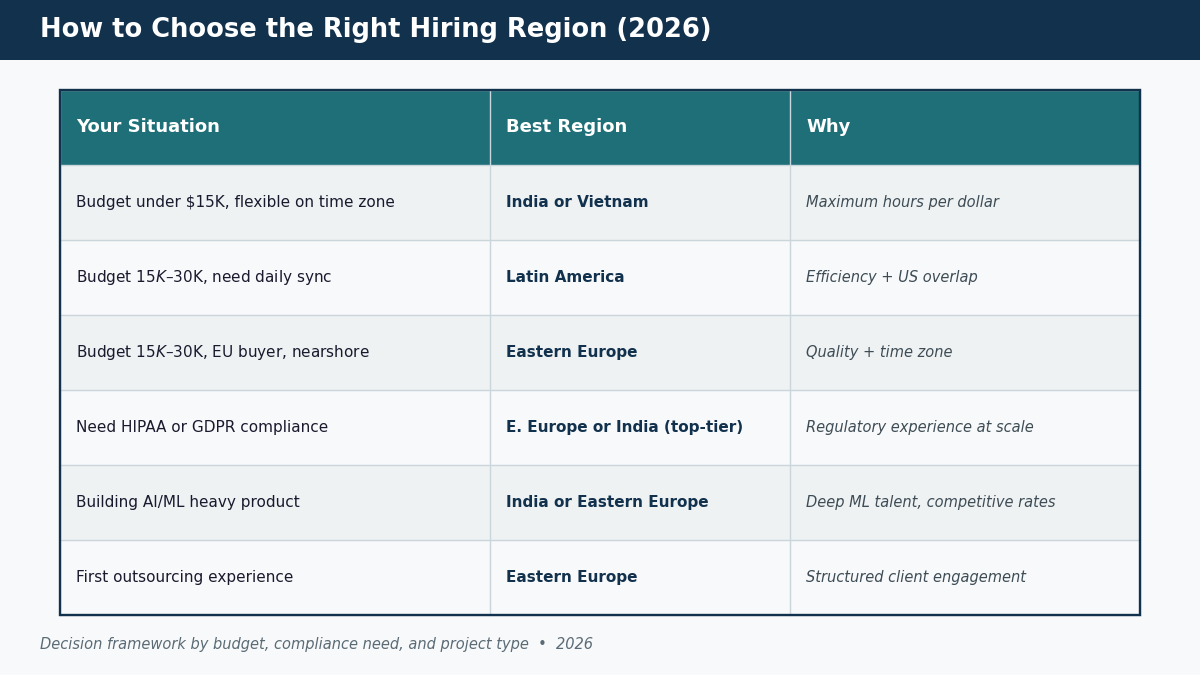
The right region is the one that optimises for your specific project’s constraints. Budget is not the only variable.
Decision framework:
| Your Situation | Best Region | Why |
| Budget under $15K, willing to manage time zone | India or Vietnam | Maximum hours per dollar |
| Budget $15K–$30K, need daily sync | Latin America | Budget efficiency + US time zone overlap |
| Budget $15K–$30K, UK/EU buyer wanting nearshore | Eastern Europe | Quality + time zone |
| Need HIPAA or GDPR compliance expertise | Eastern Europe or India (top-tier agencies) | Regulatory experience at scale |
| Building AI/ML heavy product | India (Bangalore/Hyderabad) or Eastern Europe | Deep ML talent at competitive rates |
| Building consumer app needing design sensitivity | Eastern Europe or Latin America | Strong design culture |
| Need in-person meetings | Onshore or nearshore only | US, Canada, UK, Eastern Europe |
| First outsourcing experience, need hand-holding | Eastern Europe | More structured client engagement processes |
The time zone factor more nuanced than it appears:
Time zone overlap matters more for some projects than others. A project with well-defined requirements, daily async updates, and weekly video syncs works well with any time zone difference.
A project that requires constant back-and-forth on evolving requirements, where decisions need to be made in real time, needs more overlap. Honest assessment of your project’s communication needs should drive the time zone decision not a general preference.
Rate Negotiation What Is and Is Not Negotiable
Most agencies have some flexibility in their rates, but not unlimited flexibility. Understanding what is negotiable helps you get better value without damaging the relationship before work begins.
What is typically negotiable:
Project rate vs. hourly rate agencies often offer a lower effective rate on fixed-price projects than on time-and-material, because fixed-price projects have predictable cashflow.
Payment terms upfront payments sometimes unlock discounts. Long-term commitment agencies will discount a 6-month or 12-month retainer engagement. Non-prime time work some agencies offer reduced rates for projects that can be staffed on off-peak shifts.
What is not negotiable:
Scope of work at a negotiated lower rate. If an agency is already at their floor rate and you ask for both the lower rate and the full original scope, you will get the lower rate with quietly reduced quality, fewer code reviews, less experienced developers, less testing. Before you negotiate, it helps to get a clear project cost estimate upfront so you know what’s realistic at your budget.
A lower rate with genuinely reduced scope is legitimate negotiation. A lower rate with the same scope is the beginning of a project that ends in disappointment.
Frequently Asked Questions
Why do software developer rates vary so much by country?
Developer rates reflect the cost of living in each country, local market supply and demand for technical talent, and the overhead costs agencies carry. A developer in Warsaw earning $40,000 per year lives as comfortably as a developer in San Francisco earning $150,000 per year because Warsaw costs of living are approximately 3.5× lower. This structural cost difference is what enables Eastern European agencies to charge $50/hour and still attract and retain excellent talent, while US agencies need to charge $130/hour to cover the same quality of engineer. The rate differential is not about quality, it is about purchasing power parity.
Are developer rates from India lower because quality is lower?
No and this conflation is one of the most persistent misconceptions in software outsourcing. India produces more software engineers than any other country and has been delivering complex enterprise software for US and European clients for 30 years. The top Indian agencies have built production systems for Apollo Hospitals, Adani Group, and hundreds of funded startups. The lower rate reflects lower cost of living in India, not lower quality. The quality difference that does exist is not geographic, it is between agencies. A top-tier boutique agency in Bangalore will consistently outperform a mediocre agency in London. Rate is a signal of market cost structure, not a signal of individual developer quality.
How do I verify that an agency’s quoted rate will produce the seniority level I am paying for?
Three practical checks: first, ask for the LinkedIn profiles of the specific developers who will work on your project and verify their experience independently, not the agency’s description of them but their own career history. Second, conduct a short paid technical assessment, ask the lead developer to review your project brief and produce a 2-page technical architecture document. This $300 to $500 investment reveals their actual technical depth and communication quality before you commit. Third, ask the agency specifically: at the quoted rate, what is the experience level of the developer and how many concurrent clients will they be serving? An honest agency answers this directly.
Should I pay a higher rate for better results or maximise hours at a lower rate?
The answer depends on what kind of work your project involves. For complex architecture decisions, security-sensitive features, or integration-heavy systems, a senior developer at $50/hour making the right decisions quickly is more valuable than a junior developer at $20/hour making the wrong decisions expensively. For well-defined, repeatable development work building standard CRUD screens, implementing designed UI components, writing test cases, a competent mid-level developer at $22/hour is the right choice. The practical approach: pay for a senior developer or tech lead to make architecture and design decisions at the start of the project, then let junior and mid-level developers implement those decisions at lower rates. This is exactly how good agencies structure their teams.