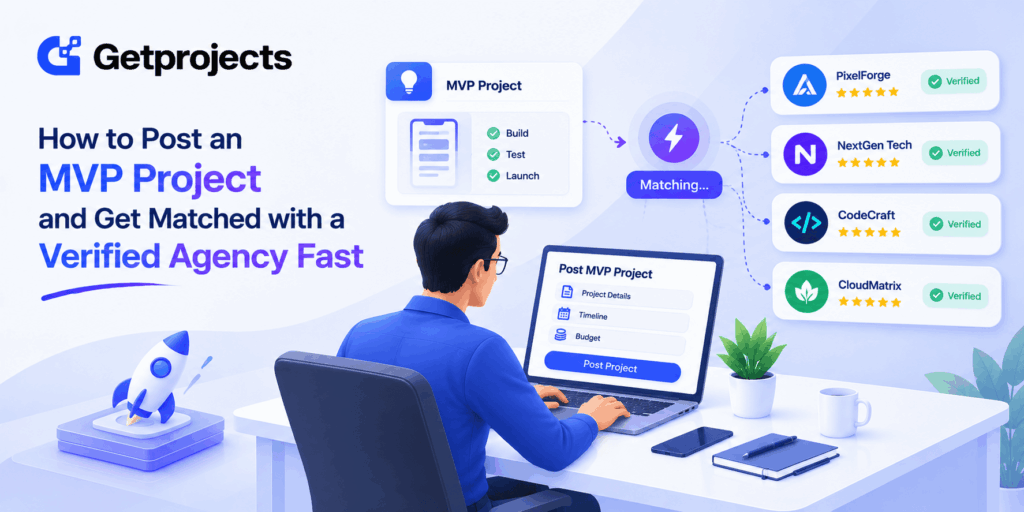
How to Post an MVP Project and Get Matched With a Verified Agency Fast
Seventy percent of venture-backed companies that shut down since 2023 ran out of capital and the median one had just 22 months between its final raise and its final day. Six to ten of those weeks typically disappear into a single unbilled activity: deciding who builds the product.
CB Insights analyzed post-mortems, founder interviews and shutdown announcements from 431 VC-backed companies that closed in 2023. “Ran out of capital” topped the list at 70%, but the report explicitly flags it as the final cause of death rather than the root problem: poor product-market fit (43%) and bad timing (29%) explain why the capital dried up first.
That framing matters for anyone sourcing a build partner. Bad timing is not only a market condition, it is manufactured internally every time a vendor search stretches from two weeks into two months while the market window closes.
The instinct is to slow down. Interview more firms. Collect more proposals. It feels like diligence. In practice, a 40-day selection cycle against an 18-month runway spends roughly 7% of a company’s remaining life on procurement, produces a shortlist assembled from sales decks rather than verified evidence, and still ends with the same three finalists that surfaced in week one.
The alternative is not moving faster with less rigor. It is moving the rigor earlier. When you post MVP projects, get matched workflows correctly, a structured brief, machine-readable requirements, and agencies that were verified before they ever appeared in your inbox the shortlist arrives in a day and the diligence you actually care about (code, references, contracts) starts on day two instead of day thirty.
This guide covers what to put in the brief, how verification should work, what an agency-built MVP costs in 2026, and the specific mistakes that turn a fast match into a slow rebuild.
What It Means to Post an MVP Project and Get Matched
To post MVP projects, getting matched means publishing a structured minimum viable product requirement scope, budget band, timeline, and tech stack to a marketplace that algorithmically compares it against pre-verified agency profiles and returns a ranked shortlist of qualified development partners, typically within 24 hours, without bidding or commission fees.
The distinction from a job board matters. A job board broadcasts; a matching layer filters. One produces 40 replies you must sort. The other produces 3–5 firms that already clear your budget, domain, and capacity constraints, assuming your team agrees on what actually counts as an MVP before the brief goes out.
The Runway Math Nobody Puts in the Budget
Vendor selection reads as free because no invoice is generated. It isn’t. A four-person founding team spending 40% of six weeks on discovery calls, proposal reviews and reference chasing burns roughly $18,000–$30,000 in loaded salary before a single line of code exists.
Add the opportunity cost. An MVP that ships in month 3 instead of month 5 gets two extra months of user data ahead of a seed round. That is usually the difference between a deck with a waitlist and a deck with a retention curve.
The selection phase has three structural failure points, and each one has a measurable cost:
Unqualified inbound. Posting to open bidding platforms generates 25–60 proposals, of which 70–80% come from firms with no relevant domain work. Reading them is a 6–10 hour tax that produces nothing.
Unverifiable claims. Portfolio pages are curated, not audited. An agency that lists a fintech case study may have supplied two contractors to a subcontracted team. Without portfolio verification and direct client reference checks, you are buying a narrative.
Commission drag. Bidding marketplaces commonly take 10–20% of contract value, and paid directories charge agencies $499+/year for placement. Both costs are priced into your quote. You pay a finder’s fee disguised as a development rate.
Teams that post MVP projects get matched through a verified, commission-free channel remove all three at once: the filter runs before you see anyone, the vetting is done upstream, and no intermediary sits between your budget and the engineering hours it buys.
How to Post MVP Requirement Online Without Losing Leverage
The quality of your match is capped by the quality of your input. An mvp project posting platform running AI-driven matching across 50+ data points can only compare what you give it, and a three-line brief produces three-line-quality recommendations.
Most founders under-specify because they are afraid of scaring agencies off or of anchoring the price too low. Both fears are backwards. Specificity attracts the firms that can actually deliver and repels the ones planning to discover scope during billing.
What to Include in an MVP Project Brief
A brief that produces a usable shortlist runs 300–600 words and covers seven things:
- The core user action. One sentence: what the user does in the product that makes it valuable. Not the vision, the action.
- Must-have features for v1, capped at 5–7. Anything beyond that is v2, and saying so in the brief signals you understand MVP discipline.
- Explicit non-goals. “No native mobile app,” “no admin analytics,” “no multi-tenancy” saves more estimation time than any feature list.
- Budget band, not a single number. “$25,000–$40,000” filters correctly. “Negotiable” invites padded quotes and wastes everyone’s week.
- Timeline with a reason. “Demo-ready by March 15 for a partner pilot” tells an agency how to sequence. “ASAP” tells them nothing.
- Stack constraints and integrations. Existing infrastructure, required APIs, compliance obligations (HIPAA, SOC 2, PCI, GDPR) these change engineering team composition and cost more than feature count does.
- Post-launch expectation. Handover to an in-house team, or a 6-month retainer? This single line changes which firms should bid for your attention.
A properly built MVP scope document takes about 90 minutes to write and saves 15–20 hours of clarification calls.
The Seven-Step Process to Post MVP Project Get Matched in 24 Hours
- Write the brief using the seven inputs above 90 minutes.
- Set hard filters: budget band, delivery region or timezone overlap, domain experience, and minimum team size.
- Post MVP requirement online to a verified marketplace rather than an open bidding board under two minutes on a well-built platform.
- Receive the algorithmic shortlist of 3–5 matched agencies, ranked against your constraints, usually inside one business day.
- Run 30-minute technical screens with each non sales call. Ask to meet the actual tech lead who would run your sprint.
- Verify independently: two client references from projects of similar scope, a code sample or repo walkthrough, and confirmation of who owns the IP.
- Negotiate contract terms before scope: payment milestones, change-request pricing, IP ownership clause, and exit conditions.
Steps 1–4 compress into 24–36 hours. Steps 5–7 are where diligence belongs, and they run in parallel across all shortlisted firms rather than sequentially.
Fixed-Price vs Time-and-Materials for a First Build
Fixed-price vs time-and-materials is the decision most teams get backwards on an MVP. Fixed-price looks safe and usually isn’t: it forces the agency to price in a 20–30% risk buffer and makes every mid-sprint learning a billable change request which is fatal for a product whose entire purpose is to learn.
Time-and-materials with a capped discovery phase (typically $3,000–$6,000 for 1–2 weeks) and a not-to-exceed ceiling on the build phase gives you the flexibility an MVP needs with the budget control a board needs. Use fixed-price only when scope is genuinely frozen: a marketing site, a migration, an integration with a known API surface.
Verified MVP Development Companies: What Verification Should Actually Cover
A “verified” badge means nothing unless you know what was checked. Serious verified mvp development companies clear four independent layers before a profile goes live, and you should be able to ask which ones were applied:
- Business legitimacy registered entity, active website, matching email domain. Filters out resellers and shell profiles.
- Team reality named engineers, LinkedIn-verifiable leadership, actual headcount versus claimed headcount. Filters out 3-person shops presenting as 40-person firms.
- Delivery evidence reviews tied to identifiable clients, case studies with verifiable outcomes, repeat-client ratio.
- Performance history on-platform response time, project completion rate, dispute history.
The agency vetting process you run on top of that should be narrow and technical, because the commercial screening is already done.
How to Verify an MVP Development Company Before Signing a Contract
Ask for three things, and treat hesitation on any of them as a result: a 20-minute screen share of code from a comparable project, direct contact with two past clients (not testimonial contacts), and the named tech lead’s commitment to your sprint, in writing.
Technical due diligence on a $30,000 MVP does not require a CTO-level audit. It requires confirming that the people who will write your code exist, are available, and have shipped something structurally similar. Most failed engagements trace back to a bait-and-switch on team composition, not to incompetence.
What MVP Agency Matching 24 Hours Can and Cannot Compress
Speed claims deserve scrutiny. MVP agency matching 24 hours after posting compresses exactly one thing: the search-and-filter phase. It cannot compress reference checks, contract negotiation, or your own internal alignment on scope and any platform implying otherwise is selling convenience at the cost of diligence.
A realistic end-to-end timeline for a well-run process is 7–10 business days from brief to signed SOW: one day to match, three to five days for technical screens and references, two to three days for contracting. Compare that to the 30–45 days a traditional RFP cycle consumes, and the saving is real without being magical.
How Much an Agency-Built MVP Costs in 2026
Budget bands filter agencies faster than any other input, so it helps to know where yours sits before you post. Across the market, agency-delivered MVPs cluster into four tiers:
- $8,000–$18,000 single-platform web MVP, 4–6 weeks, small offshore team, standard auth and CRUD, no complex integrations.
- $20,000–$45,000 web plus responsive mobile, payments, admin panel, third-party integrations, 8–12 weeks. The most common band for seed-stage products.
- $50,000–$90,000 regulated data, multiple integrations, native mobile, or real-time infrastructure, 12–16 weeks.
- $100,000+ usually no longer an MVP. If your v1 estimate lands here, the scope needs cutting before the vendor search continues.
Rates vary 3–4x by geography for comparable quality: $18–$35/hour in South and Southeast Asia, $40–$70/hour in Eastern Europe and Latin America, $90–$180/hour in North America and Western Europe. Geography should be chosen for timezone overlap and communication load, not price alone; a 10-hour gap on a 6-week sprint costs more in blocked decisions than it saves in hourly rate.
Case Studies: What Compressed Selection Looks Like
Fintech, pre-seed, Bengaluru. A two-founder team with 11 months of runway had spent five weeks collecting nine proposals through referrals and a bidding marketplace, with a quote spread of $22,000–$78,000 for identical scope. They rewrote the brief with explicit non-goals and a $30,000–$40,000 band, posted it, and received four verified matches within a day. They signed in nine days at $34,000 and shipped a payments MVP in 11 weeks, recovering roughly four weeks of runway.
B2B SaaS, Series A, Austin. A CTO needed a customer-facing analytics module built in parallel with the core roadmap and had no capacity to run a vendor search. Filtering on domain expertise, a minimum five-person team and 4-hour timezone overlap returned three matched agencies; two cleared reference checks. The engagement started 8 days after posting at $52,000 on a capped time-and-materials structure, versus an internal estimate of six weeks just to complete procurement.
Decision Framework: Four Ways to Source an MVP Partner
Founders searching to find an mvp development agency fast are choosing between four models, and the differences are structural rather than cosmetic.
| Sourcing model | Time to shortlist | Vetting depth | Cost to client | Typical failure mode |
| Open bidding marketplace | 3–7 days | Self-reported | 10–20% commission, priced into quotes | Race to the bottom; 25–60 unqualified bids |
| Paid-listing directory | 5–14 days | Pay-to-rank placement | $499+/yr paid by agency, recovered in rates | Ranking reflects ad spend, not delivery record |
| Personal network / referral | 1–3 weeks | High trust, zero breadth | Free | Sample size of two; no price benchmark |
| Verified direct-connect marketplace | Under 24 hours | Layered pre-verification | Free to post; pay the agency directly | Requires a well-written brief to work |
The fourth model is the only one where the filtering happens before you spend attention, and where the price you are quoted is the price of the work. A commission-free marketplace removes the 10–20% intermediary cut that otherwise shows up as inflated hourly rates.
What Most Teams Get Wrong
The dominant mistake is treating vendor selection as a funnel problem when it is a specification problem. Teams add more agencies to the top, assume volume produces signal, and end up comparing quotes that cannot be compared because each firm scoped the vague brief differently. The $22,000–$78,000 spread in the fintech example above was not a market inefficiency; it was nine agencies solving nine different interpretations of the same paragraph.
The second mistake is confusing slowness with rigor. A six-week selection cycle that ends with three sales calls and a gut decision is not more diligent than a three-day cycle that ends with code review and two reference calls. Elapsed time is not evidence. Runway burn rate is the only clock that matters, and it does not pause for deliberation.
The third and the most expensive is negotiating scope before negotiating terms. Teams spend two weeks refining feature lists with their preferred agency, build sunk-cost commitment, and then discover the change-request rate is $150/hour, the IP transfers only on final payment, and there is no exit clause before milestone three. By then, leverage is gone. Settle terms while you still have a vendor shortlist, not after you’ve emotionally selected a winner.
A fourth pattern worth naming: founders who over-index on portfolio aesthetics. A beautiful case study page tells you an agency has a good designer and a marketing budget. It tells you nothing about sprint discipline, test coverage, or whether the senior engineer on the pitch call will still be on your project in week four.
Compare Verified Agencies Before Your Next Sprint Starts
If you’re evaluating build partners and want to post MVP projects, get matched with verified agencies without commission cuts, bidding wars, or a six-week procurement cycle, GetProjects connects businesses directly with vetted IT companies across 50+ cities, with layered verification completed before any profile goes live.
Posting takes under two minutes and costs nothing. You pay the agency you hire, directly, at the rate they quoted.
Frequently Asked Questions
How do I find a development agency for my MVP without a public RFP?
Use a matching marketplace rather than a broadcast. Public RFPs invite volume and expose your budget and roadmap to every firm that reads it. A structured post routed through an algorithmic filter reaches only pre-verified agencies that clear your constraints, keeping your requirements private while still producing a competitive shortlist within a day.
How long does it take to get matched with an MVP development agency?
Matching itself takes under 24 hours on platforms that pre-verify agency profiles. Full selection technical screens, two reference checks and contracting realistically adds 6–9 business days. Expect 7–10 business days from posting to a signed statement of work, against 30–45 days for a traditional RFP cycle.
How much does it cost to build an MVP with an agency in 2026?
Most seed-stage MVPs land between $20,000 and $45,000 for an 8–12 week build covering web, payments, an admin panel and standard integrations. Simpler single-platform builds run $8,000–$18,000. Regulated or real-time products reach $50,000–$90,000. If your v1 quote exceeds $100,000, the scope is no longer minimal.
What should an MVP project brief include?
The core user action in one sentence, 5–7 must-have features, explicit non-goals, a budget band rather than a single figure, a timeline with a stated business reason, stack and compliance constraints, and your post-launch intent. Roughly 300–600 words. Briefs at this specificity cut clarification calls by 15–20 hours across a shortlist.
Are MVP project posting platforms free for clients?
On commission-free models, yes posting costs nothing, connecting with agencies costs nothing, and you pay only the agency you hire, directly. Bidding platforms instead take 10–20% of contract value and directories charge agencies annual listing fees; in both cases that cost is recovered through the rate you’re quoted.
How do I verify an MVP development company before signing a contract?
Request a code walkthrough from a comparable project, direct contact details for two past clients, and written confirmation of the named tech lead assigned to your sprint. Platform-level verification should already have confirmed entity registration, domain ownership, team size and review authenticity. Your job is the technical layer on top.
What happens if the matched agency isn’t the right fit?
Nothing should be locked in. A shortlist of 3–5 means you can decline all of them and re-post with adjusted filters at no cost. If you’re unsure whether your scope or budget band is realistic, a short scoping conversation before posting usually resolves it faster than another round of agency calls.