
Red Flags When Hiring a Software Development Company 12 Warning Signs to Watch For
A bad software development engagement does not start badly. It starts with an enthusiastic sales call, a polished proposal, and reasonable timelines. It deteriorates slowly, missed deadlines explained away, scope questions deflected, demo after demo with no deployable product until the founder is 4 months in, $15,000 spent, and further from launch than when they started.
The signals that predict this outcome are almost always present before the contract is signed. Most buyers either do not know what to look for or suppress the discomfort of a red flag in the excitement of starting a project.
That’s why spotting red flags software development company issues early is critical—before contracts are signed and budgets are locked in.
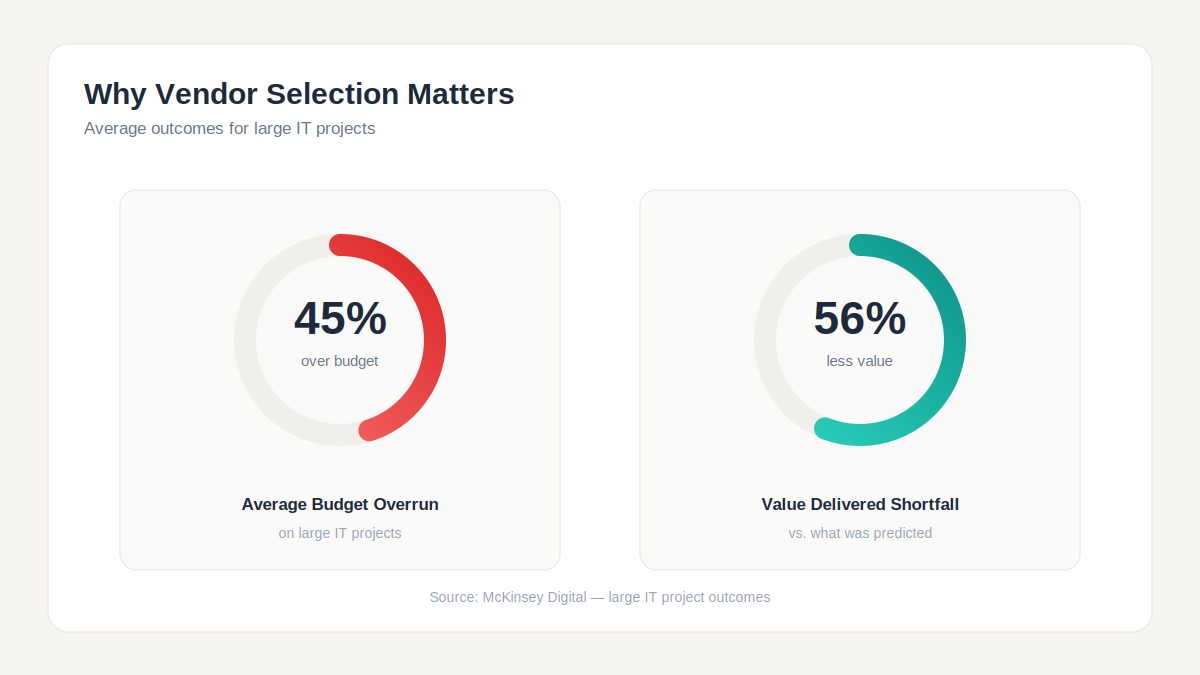
According to McKinsey Digital, large IT projects run 45% over budget and deliver 56% less value than predicted on average. These outcomes are rarely random; they’re usually tied to early warning signs missed during vendor selection.
This guide covers the 12 most reliable warning signs and what each one actually indicates about how the engagement will go.
Red Flag 1 They Cannot Show You a Live Product
A portfolio page with screenshots and mockups proves one thing: the agency has a graphic designer and a website. It proves nothing about whether they can ship working software.
The test is simple: ask for URLs of live products they have built in the last 18 months. Not case study PDFs. Actual products, accessible right now, that you can use.
What this means in practice: Open the App Store or Play Store and search for the apps they claim to have built. Check the review count zero reviews on a “successful” app they describe in a case study is a significant mismatch. Check the last update date. An app last updated 2 years ago has been abandoned, which raises questions about the client relationship and delivery quality.
Agencies that build real products for real clients have an easily verifiable trail of living software. Agencies that produce mockups and internal tools for clients who never launch have a portfolio of images that proves nothing.
Red Flag 2 The Quote Arrives Within 24 Hours of a Vague Brief
A legitimate estimate for a $10,000 to $30,000 software project requires the agency to understand: what the product does, who uses it, what the critical flows are, what integrations are required, and what quality standards apply. Understanding these things takes conversation, clarifying questions, and time to think.
An agency that quotes $12,000 for your project within 24 hours of reading a 3-paragraph brief did not think about your project. They applied a price template. When you discover that the scope you had in mind does not match the scope they were thinking about, the mechanism for resolving the gap is change requests, each one adding cost and time.
The legitimate fast quote scenario: Some agencies will provide a range estimate quickly “based on your brief, this is likely $8K–$18K depending on scope detail.” That is a reasonable first response. The red flag is a specific, confident single price number without a discovery conversation. If you’d rather skip that guessing game altogether, you can post your project for free and get matched with agencies whose expertise actually fits your scope, instead of teams recycling a template. You can also browse profiles of verified IT companies directly to see how they scope and price similar work before you ever get on a call.
Red Flag 3 They Agree With Everything You Propose
A developer who never pushes back on your requirements is not being collaborative; they are being passive. And passive developers build exactly what you ask for, not what you actually need.
Real technical partners question requirements that do not make engineering sense. They suggest simpler approaches when you are overengineering. They flag when your proposed timeline is unrealistic. They tell you when a feature you want will double the project cost and offer an alternative that achieves 80% of the value for 20% of the effort.
An agency that nods along to every requirement in the sales process is telling you that they have not thought critically about your project. They will build whatever you specify, and if what you specify turns out to be the wrong thing, they will build the wrong thing without comment.
The test: In your initial conversation, describe one requirement that is technically complex or architecturally unusual. If the agency says “yes, no problem” immediately without asking any clarifying questions, that is the flag. Good technical teams ask questions before they commit.
Red Flag 4 You Cannot Identify Who Will Actually Work on Your Project
“We have a team of experienced developers who will work on your project.” This sentence appears in more agency proposals than almost any other, and it means nothing.
Before signing any contract, you need to know: the name and LinkedIn profile of the senior developer who will lead development, their experience level and what similar projects they have delivered, what other projects they are currently assigned to, and what percentage of their time will be allocated to your project.
Agencies that cannot or will not answer these questions before the contract is signed are hiding one of two things: they do not know who will work on your project (it will be assigned to whoever is available when the project starts), or the person who works on your project will be less experienced than the person they show you in the sales process.
The practical check: Ask for the lead developer’s portfolio specifically what have they personally shipped? A strong agency is proud of their engineers and happy to introduce them. An agency that treats developer identities as confidential is treating their developers as interchangeable resources, which is how you end up with a junior engineer working unsupervised on your product.
Red Flag 5 The Contract Requires More Than 30% Upfront
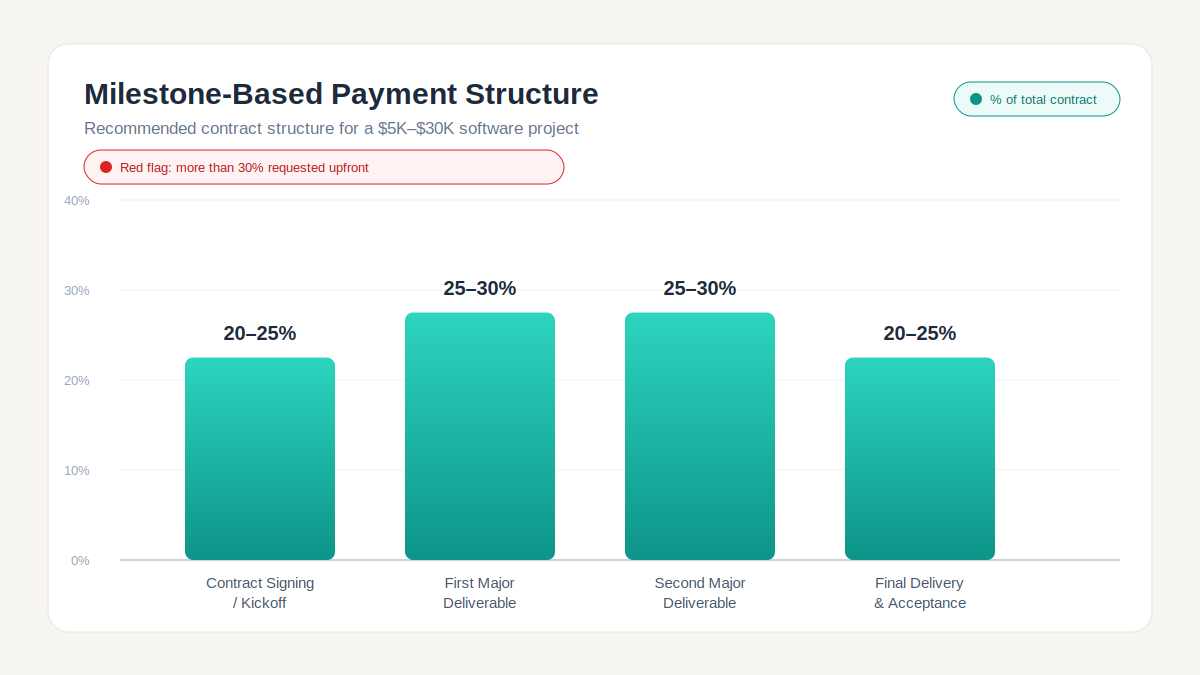
A milestone-based payment structure aligns the agency’s incentives with yours. They get paid when they deliver working software. A contract that requires 50% or 70% upfront before any code is written removes this alignment; the agency has most of the money before you have seen any of the product.
The appropriate structure for a $5K–$30K project:
| Milestone | Payment |
| Contract signing / kickoff | 20–25% |
| First major deliverable (working prototype or first module) | 25–30% |
| Second major deliverable (core feature complete) | 25–30% |
| Final delivery and acceptance | 20–25% |
Any structure that front-loads more than 30% of the contract value before a working deliverable is a risk signal. Not necessarily a dealbreaker, sometimes agencies with strong track records command higher upfront payments. But for a first engagement with an agency you have not worked with before, milestone-based payments are standard practice.
Red Flag 6 They Do Not Ask About Your Success Metrics
A software development company that cares about building good products wants to know how you will measure success. Not just “is the app live?” but “how many users, what retention rate, what conversion at the key moment, what revenue.”
Agencies that never ask these questions are optimising for deliverable completion, not product outcomes. The agency that builds exactly what you specified, on time, within budget, and ships a product that no one uses and considers that a successful engagement is not a good partner.
The product-focused agencies that consistently produce the best work are genuinely curious about what success looks like. They ask about your target users, your launch strategy, your hypothesis about what will drive adoption. This curiosity is not just pleasant, it produces better product decisions throughout the engagement.
The test: In your first conversation, observe whether the agency asks anything about why you are building this, who will use it, and how you will know it is working. An agency that does not ask these questions in the first conversation will not ask them during development either. If you want to skip past the agencies that skip this step, you can browse verified profiles and see their track record before you even get on a call.
Red Flag 7 Their Client Testimonials Are All Anonymous or Undated
“GetProjects helped us build an incredible product. 10/10 recommendation.” A satisfied client
That testimonial proves nothing. A name, a company, a product, and a date are the minimum requirements for a testimonial that provides useful information. Anonymous testimonials are indistinguishable from fabricated ones. Undated testimonials may be from 5 years ago when the agency had a different team and different quality.
What a credible testimonial looks like: “We worked with [Agency Name] in Q3 2025 to build our marketplace MVP. We launched on time and within our $18,000 budget. The lead developer was responsive, the code quality was high enough that our Series A hires could work with it immediately. [Name], Co-founder, [Company Name].”
Verify independently: LinkedIn is your friend. Search the testimonial author’s name and company. Verify they exist, that they have the role described, and that the company built the product described. Takes 5 minutes and eliminates a significant category of fraudulent social proof.
Red Flag 8 They Cannot Explain Their Development Process
Every agency claims to use “agile methodology.” Most use a loose interpretation of agile that means “we work in 2-week blocks and have standups.” When you ask for specifics, the quality of the answer tells you a great deal.
A development agency with a real, consistent process can describe it in detail: how requirements are captured and confirmed, how the sprint backlog is managed, what happens when scope changes, how testing is integrated into development, how you see progress between major milestones, and what the handoff process looks like at the end. This is the kind of detail worth checking before you commit verified agencies are expected to have this documented, not improvised on the call.
An agency that responds to “can you walk me through your development process?” with vague generalities about agile and collaboration has a process that exists in the proposal but not in daily practice.
The question to ask: “If I disagree with a technical decision made during development, what is the process for discussing and resolving it?” The answer reveals whether the agency treats clients as partners in decision-making or as order-givers whose feedback is processed through an account manager.
Red Flag 9 No Access to Your Own Code Repository During Development
This is non-negotiable: you must have access to the code repository throughout the project, not just at the end.
Agencies that only share code at project completion are either protecting their ability to withhold the code if payment disputes arise (which should never be a concern in a properly structured contract) or hiding the quality of work-in-progress from your review.
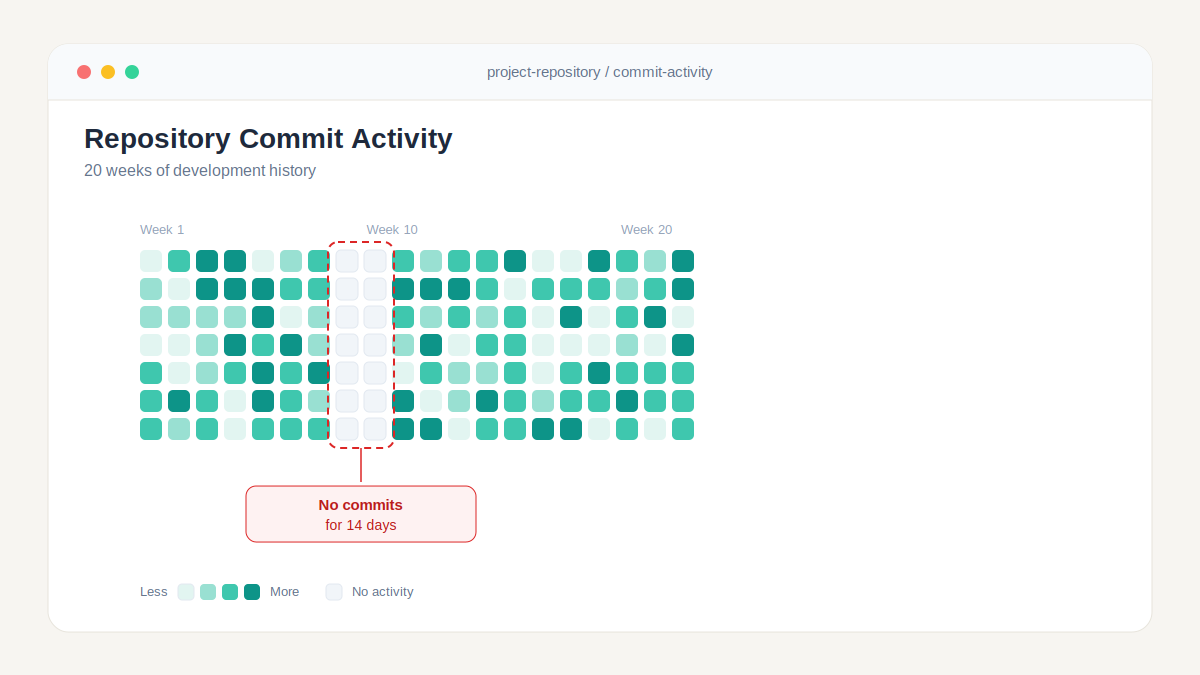
Your code repository is the only real-time evidence that work is progressing. A project manager who tells you everything is on track while the code repository shows no commits in 2 weeks is a project manager you should distrust.
The requirement to include in every contract: Client has read access to the development repository at all times throughout the project. All work is committed at least daily during active development sprints. No final payment is contingent on repository access.
Red Flag 10 They Do Not Mention Maintenance After Launch
Software does not stop needing attention when it launches. Every major iOS and Android update requires testing and often code changes. Security vulnerabilities in dependencies need patching. Bugs discovered by real users need fixing. Infrastructure needs monitoring.
An agency that never raises the question of post-launch maintenance in the sales process either expects to be done with you after delivery or is planning to charge you project rates for maintenance work that could have been structured as a retainer.
Good agencies raise the post-launch discussion proactively: what is the plan for bug fixes in the first 30 days? What happens if a critical security vulnerability is discovered 90 days after launch? Is there a maintenance retainer option? What does a handoff look like if you want to take the product in-house?
An agency that has no answers to these questions has not thought about the product’s life beyond the contract term. When you’re ready to find a team that does, you can post your project for free and screen for exactly this during the matching process.
Red Flag 11 Dramatically Lower Price Than Every Competitor
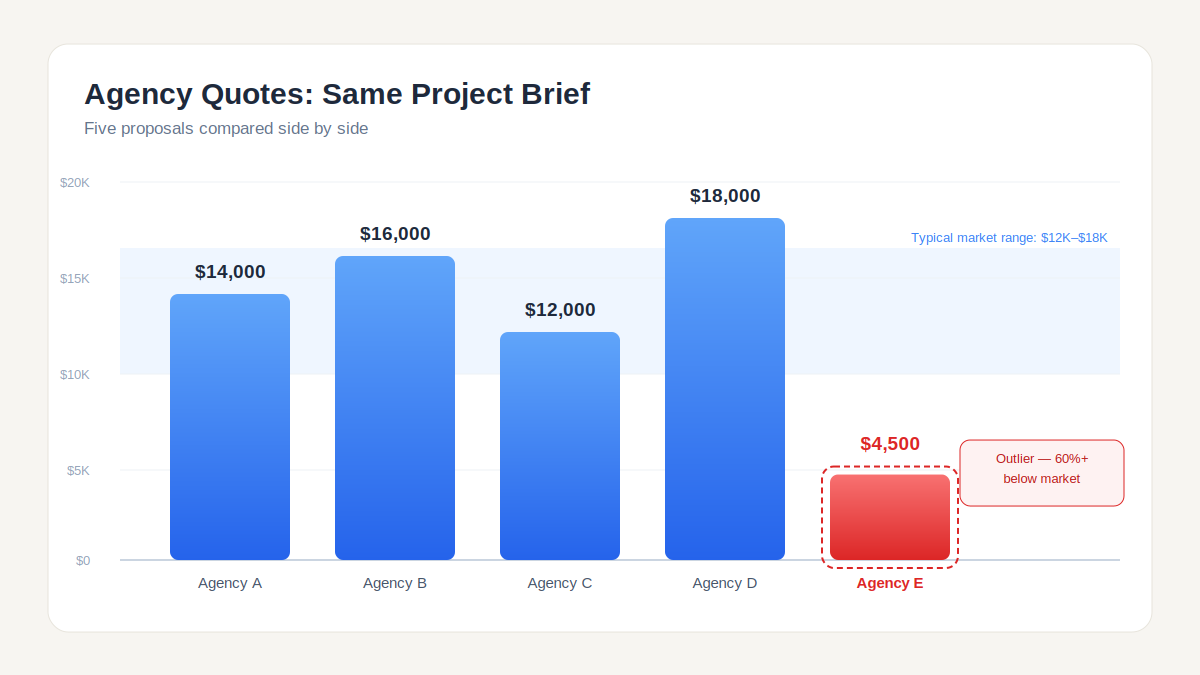
If five agencies quote your project between $12,000 and $18,000 and one quotes $4,500, the outlier is not a bargain; it is a misaligned scope, an underqualified team, or a deliberate lowball to win the contract followed by change requests.
The right response to a dramatically low quote is not to accept it, it is to ask specifically what is included that would allow them to deliver at that price. In most cases, the answer reveals that they are proposing a much more limited scope, a less experienced team, or a development approach (template-based, no custom design, no testing) that is incompatible with what you actually need.
Price is information. A price that is 60% below market is telling you something about what is being offered. Take it seriously.
Red Flag 12 They Push You to Sign Quickly
“This price is only available until Friday.” “We have another client interested in this slot.” “We need a signed contract to hold the team availability.”
Scarcity tactics in B2B software development are a warning sign. A genuine agency with a pipeline of quality work does not need to pressure clients into quick decisions. They have enough confidence in their work and their track record to let the sales process take the time it requires. It’s part of why agencies go through a vetting process before they’re allowed to reach out to clients in the first place. It filters for teams that don’t need to rely on pressure to win work.
Pressure tactics are a signal that the agency needs your revenue more than it is confident in its product. An agency that cannot afford to wait a week for a considered decision is telling you something about their business health and their relationship with clients.
The Bottom Line
Every one of these 12 red flags has a legitimate opposite, a positive signal that indicates a trustworthy, capable agency. The agencies that consistently deliver good work at the $5K–$30K budget level share a set of characteristics: they are proud of their portfolio, honest about scope, transparent about process, accessible at the senior level, and interested in your success beyond delivery.
GetProjects.ai vetted network applies exactly these criteria. We decline more agencies than we accept.
Post your project at getprojects.ai and receive proposals only from agencies that have passed our portfolio verification, reference check, and client satisfaction review. It takes 10 minutes to post and it is free.
Frequently Asked Questions
What is the single most important check before hiring a software development company?
Call one of their previous clients. Not an email call. A 15-minute phone conversation with a client who completed a project of similar size and type in the last 18 months tells you more than any portfolio review, proposal, or reference letter. Ask three questions: Was the project delivered on time and budget? How was communication managed? Would you hire them again for your next project? The answers to these three questions are more predictive of your experience than any other due diligence activity.
Is a fixed-price contract safer than time-and-material for a first engagement?
Fixed price is safer when scope is clearly defined with a detailed functional specification with clear acceptance criteria. Without this, a fixed-price contract creates perverse incentives: the agency is incentivised to cut quality and scope to protect their margin, and every requirement that was not explicitly specified becomes a billable change request. Time-and-material is safer when requirements will evolve during development; the agency is incentivised to work efficiently because they are billing by the hour, and scope changes are absorbed into the ongoing workflow rather than generating formal change requests. For a first engagement with a new agency, a hybrid approach works well: fixed price for a well-defined MVP scope with a clear acceptance test, and time-and-material for any subsequent phase where requirements are exploratory.
How do I know if the agency I am considering is financially stable?
Three informal checks: How long have they been in business? Agencies that have been operating for more than 3 years have survived at least one difficult business period and have a track record of stability. Do they have a consistent team? Ask whether the developers who would work on your project have been with the agency for more than a year. High team turnover is a sign of financial or managerial instability. How full is their pipeline? An agency that is desperate for your business in a way that feels unusual, too eager, too flexible, too willing to start immediately may be financially stressed. This is not a definitive indicator but it is worth noting.
What should I include in a contract to protect myself?
Four clauses that matter most: IP assignment all code and deliverables are assigned to you on payment, not retained by the agency. Repository access you have read access to the development repository throughout the project without condition. Source code escrow for projects above $15,000, a copy of the code is held in escrow and released to you in defined circumstances including agency insolvency or contract breach. Acceptance criteria each milestone has specific, objective acceptance criteria that define what “done” means, preventing disputes about whether a deliverable has been completed.