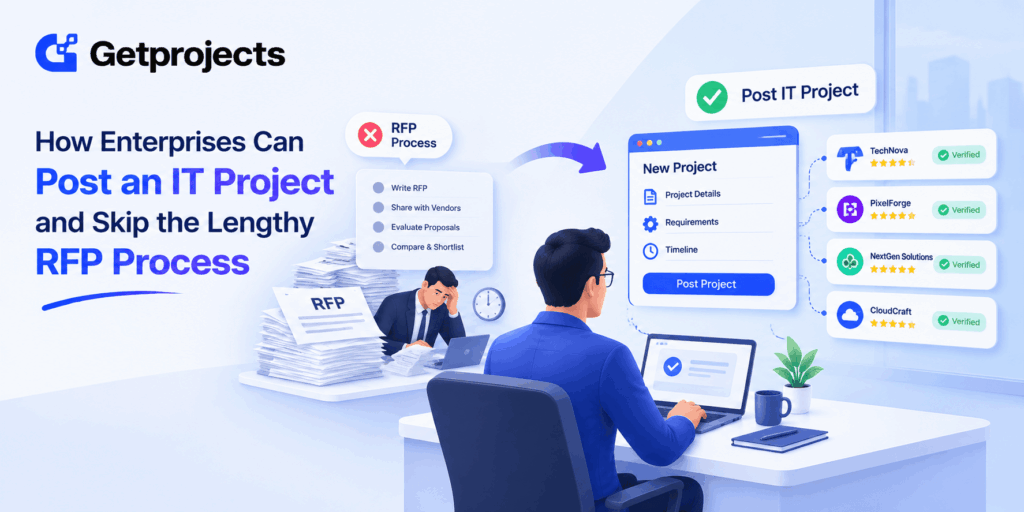
How Enterprises Can Post an IT Project and Skip the Lengthy RFP Process
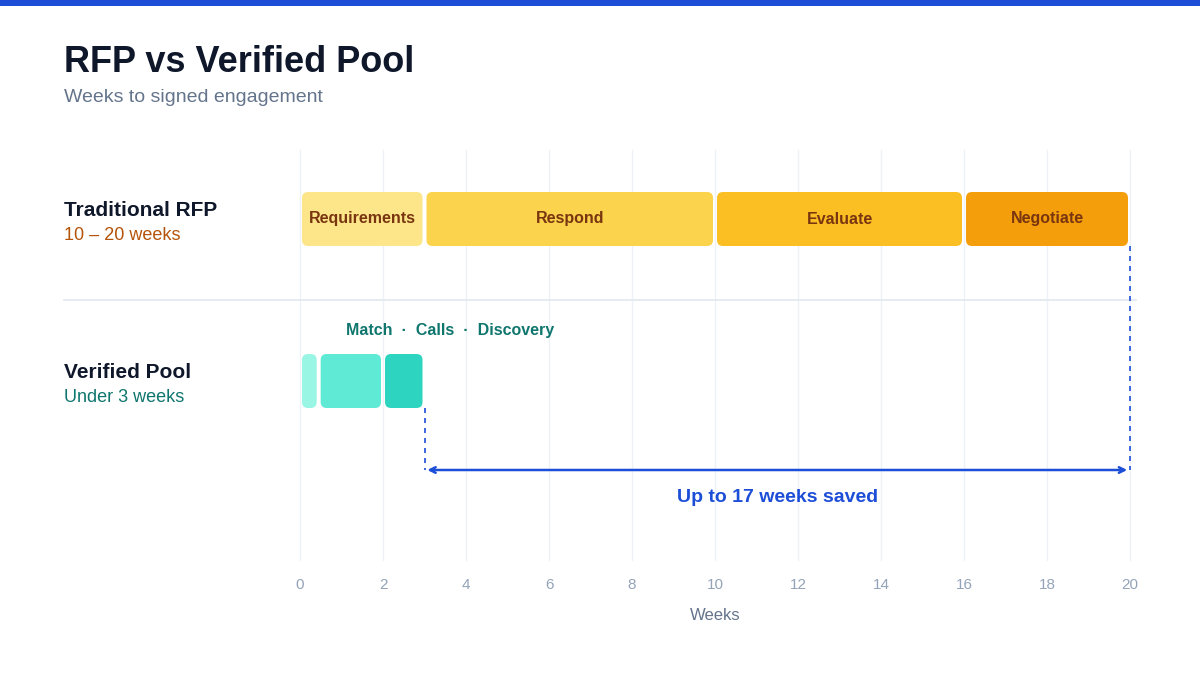
A mid-market enterprise RFP for a custom software build runs 10 to 20 weeks from requirements definition to signed contract. The engineering capacity it was written to secure is usually committed elsewhere by week twelve.
That is not a procurement failure. It is the RFP performing exactly as designed a document built for capital equipment purchases in the 1980s, applied to a services category where the differentiators are team quality, domain familiarity, and delivery velocity. None of those three show up cleanly in a 140-question response template.
The question worth asking is not whether the RFP is thorough. It is whether thoroughness still requires the document. Understanding how enterprises post IT projects without RFP cycles starts with separating two things procurement has fused together: the evidence a vendor decision needs, and the process traditionally used to collect it. The evidence is non-negotiable. The process is not.
Gartner’s research on the B2B buying journey finds that buyers are 1.8 times more likely to complete a high-quality deal when they use supplier-provided digital tools alongside a sales conversation rather than working through either channel on its own. The same research shows buying is not linear, teams loop back through six distinct buying jobs, revisiting each at least once.
That finding reframes the problem. An RFP is a single-channel process: documents first, conversation deferred until after scoring closes. It separates the two inputs that work best in combination, and it assumes a straight-line path through requirements that buying teams demonstrably do not follow.
The faster route is not less rigorous. It is both channels running at once pre-verified vendor records and structured capability data available before you engage, paired with direct technical conversations in week one instead of week ten. That combination produces the same auditable trail in days rather than months. What follows is the operational detail: what to verify, what to keep from the RFP, what to discard, and where the risk actually sits.
How Enterprises Post IT Project Without RFP: A Working Definition
Posting an IT project without an RFP is a sourcing method where an enterprise publishes a structured project brief scope, budget band, compliance requirements, timeline to a pre-verified vendor pool and receives a matched shortlist, replacing the draft-issue-respond-score cycle with verification data collected before the buyer ever engages.
The distinction matters. When we describe how enterprises post IT projects without RFP documentation, we are not describing sole-sourcing, and we are not describing an informal referral. Enterprise IT project sourcing through a verified pool still produces comparative evidence, documented selection criteria, and a defensible paper trail. It simply front-loads the diligence into the platform layer instead of pushing it onto a 90-day procurement calendar.
The Real Cost of the RFP Cycle in Enterprise IT Project Sourcing
Procurement teams routinely underestimate the internal cost of an RFP by a factor of three to four, because only the procurement hours get counted. That miscalculation is the single strongest financial argument for how enterprises post IT projects without RFP overhead in the first place.
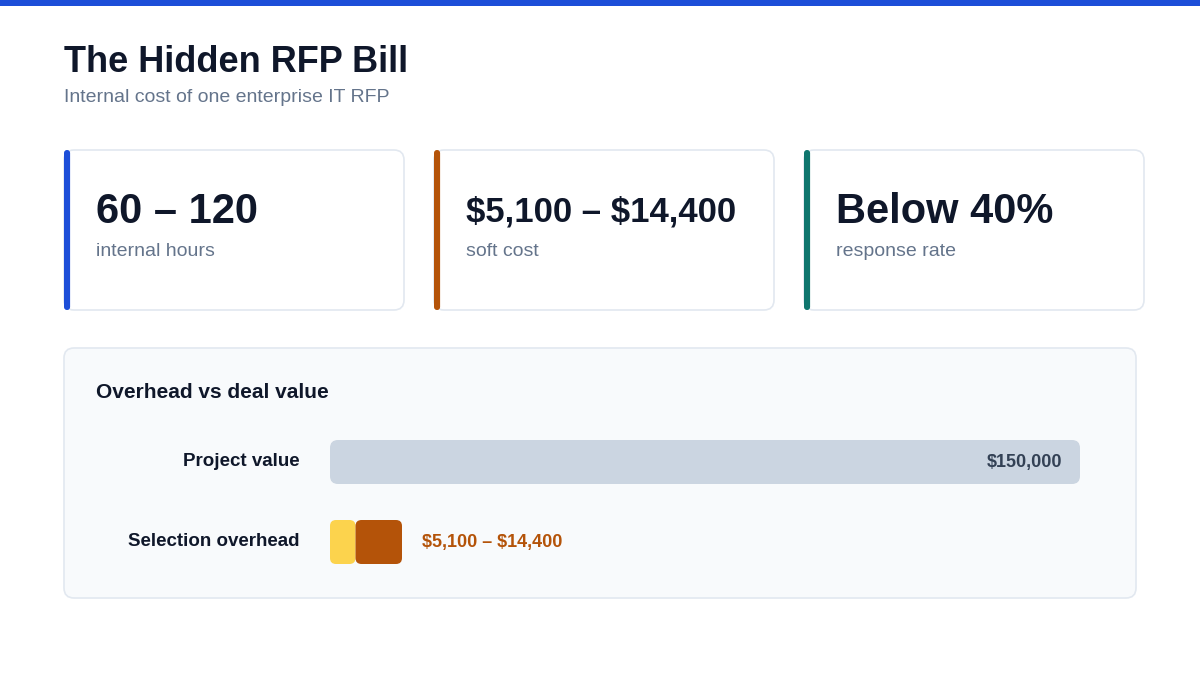
A single enterprise IT RFP consumes 60–120 internal hours before a vendor is selected: requirements workshops across four to six stakeholder groups, legal review of the template, security questionnaire assembly, scoring calibration, and evaluation meetings. At a blended internal cost of $85–$120 per hour, that is $5,100–$14,400 in soft cost on a decision that may only be worth $150,000.
The procurement cycle time is the larger expense. Analysis of public-sector solicitations puts the average at roughly 57 days from posting to award, and enterprise technology purchases with legal and security review commonly run 8 to 16 weeks. Contract negotiation alone stretches 3–4 months in regulated industries.
Three structural problems compound the delay:
- Response quality is a proxy for proposal capability, not delivery capability. Agencies with dedicated bid teams typically firms above 200 employees outscore specialist 30-person shops that would deliver better work. The RFP systematically filters toward the vendors best at answering RFPs.
- Requirements freeze too early. A scope written in week one is scored in week ten against a business need that has already shifted. Change orders in the first quarter of delivery are the predictable result.
- The best agencies opt out. A firm with a healthy pipeline will not invest 25–40 hours responding to a speculative enterprise RFP against eight unknown competitors. Response rates on cold enterprise IT RFPs frequently land below 40%.
Taken together, those three failures explain why enterprises post IT projects without RFP scaffolding has become a live procurement question rather than a fringe one. The net effect of the traditional cycle is a slow process that narrows the candidate pool rather than widening it. That is the case for a faster alternative to RFP process design not speed for its own sake, but access to vendors the RFP never reaches.
How the Verification-First Model Works
The operating principle behind how enterprises post IT projects without RFP documents is straightforward: move verification upstream. Instead of asking every vendor to prove legitimacy during your evaluation window, source from a pool where legitimacy was established before the project existed.
The 7-Step Process to Post Enterprise Project Briefs Without an RFP
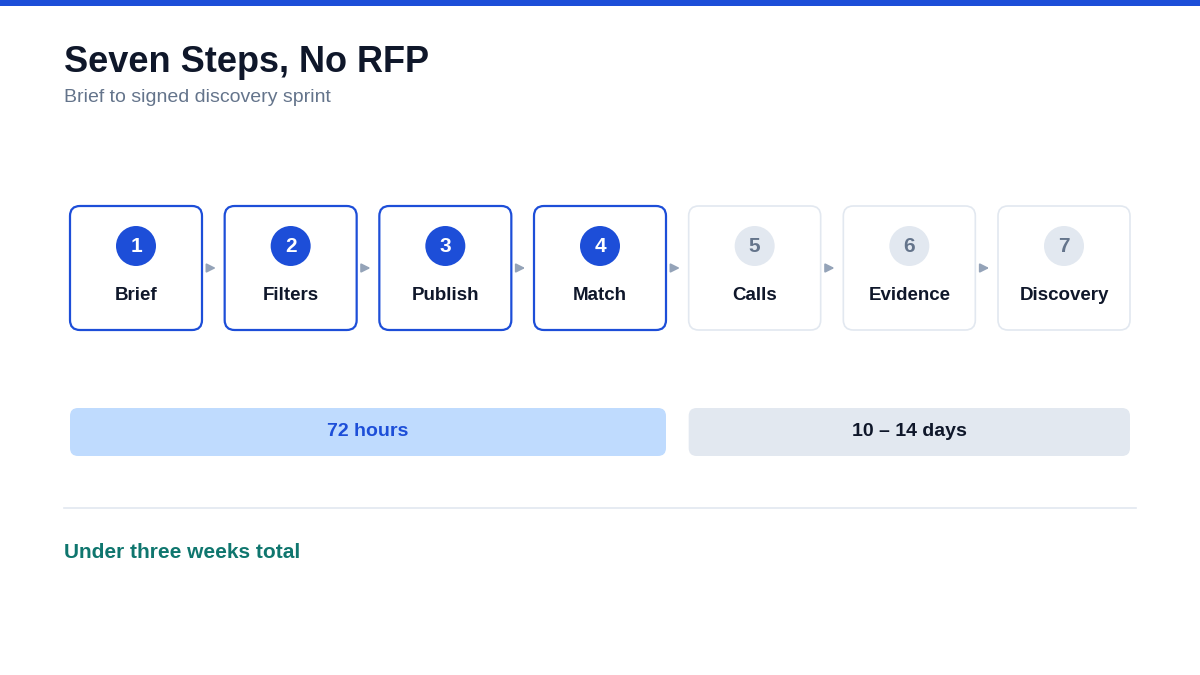
- Write a 400–600 word structured brief. Scope, deliverables, integration surface, budget band, target start date, and hard compliance constraints. This replaces the 40-page RFP document and takes 20–40 minutes, not three weeks.
- Define non-negotiables separately from preferences. Data residency, SOC 2 Type II, ISO 27001, HIPAA, or GDPR obligations are filters. Tech-stack preferences and team location are weightings. Mixing the two is the most common scoping error.
- Publish to a verified pool rather than an open bid board. Open boards optimize for volume; verified pools optimize for fit. You want six credible responses, not sixty.
- Receive an algorithmic match, then review the reasoning. Matching that compares 50+ data points budget alignment, domain history, team composition, past client profile, delivery performance should surface why each agency appeared. Opaque ranking is not auditable.
- Run a 45-minute technical conversation with 3–4 shortlisted firms. Working sessions expose architectural thinking that written responses cannot. Ask each to critique your scope, not confirm it.
- Request targeted evidence, not a full proposal. Two comparable case references, one anonymized code sample or architecture document, named delivery team CVs, and current insurance and security attestations.
- Run a paid discovery sprint with the leading candidate. A two-week, $5,000–$15,000 paid discovery de-risks a $200,000 engagement far more reliably than a scored document ever will.
Sequencing is what makes how enterprises post IT projects without RFP timelines defensible rather than reckless. Steps one through four typically complete within 72 hours. Steps five through seven add 10–14 days. Total elapsed time: under three weeks, against 10–20 weeks for the equivalent RFP.
How Enterprises Post IT Project Without RFP Documents and Still Vet Deeply
Vendor vetting is where most procurement teams fear they are giving something up. In practice, layered agency verification performed continuously is more rigorous than self-reported RFP responses, because the vendor is not the sole source of truth.
A defensible verification layer confirms, at minimum:
- Corporate identity registered entity name, matching email domain, and a live website whose ownership records align with the claimed business.
- Delivery history named clients, engagement durations, and outcomes cross-checked against third-party review platforms rather than a curated PDF.
- Team substance verified headcount, named senior staff, and public professional profiles that confirm the bench actually exists.
- Portfolio authenticity shipped products traceable to app stores, public repositories, or client confirmation, not mockups.
- Commercial credentials insurance, certifications, and security attestations confirmed as current rather than as of the date a proposal was written.
This diligence phase procurement normally spends four to six weeks assembling, and inheriting it is the mechanical reason why enterprises post IT projects without RFP cycles. When a platform maintains it as a precondition of listing, the enterprise inherits it. Verification becomes a filter applied before you see a profile which is precisely what an enterprise vendor matching platform is for.
Compliance Controls You Should Keep
Skipping the RFP does not mean skipping governance. Four controls carry the audit burden and should survive any process change:
- Documented selection criteria, recorded before the shortlist is produced. This is what an internal auditor actually asks for.
- Comparative evaluation evidence a minimum of three assessed candidates with scored reasoning attached.
- Security review of the winning vendor, including subprocessor disclosure and data-handling terms. Run this once, on one firm, instead of collecting questionnaires from eight.
- Delegation-of-authority sign-off at the correct spend threshold, unchanged from your existing policy.
Keeping these four controls intact is what separates how enterprises post IT projects without RFP paperwork from simply buying on instinct. Most enterprise procurement policies mandate competitive evaluation, not a request for proposal. Reading the policy language carefully is usually enough to clear the path.
Cost Implications Worth Modelling
The commercial difference between sourcing models is larger than most teams assume. Commission-based bidding marketplaces extract 10–20% of project value, which vendors price back into their quotes on a $250,000 engagement, that is $25,000–$50,000 of margin funding the intermediary. Paid-listing directories charge agencies $499 and up annually for placement, which correlates listing prominence with marketing budget rather than delivery quality.
A commission-free marketplace removes both distortions. GetProjects operates on a 0% commission, direct-connect model the client pays the agency and nobody else which means quoted rates reflect delivery cost rather than platform economics.
Real-World Application
Two recent engagements illustrate how enterprises post IT projects without RFP timelines in practice.
A logistics enterprise with 1,400 employees needed a warehouse management integration built against an existing SAP instance. Its standard RFP path was quoted internally at 14 weeks. The team instead published a scoped brief to a verified pool, held four technical calls in nine days, and signed a discovery sprint 17 days after the brief went live compressing the selection phase by roughly 80% and starting development inside the same fiscal quarter.
A regional financial services firm needed a customer portal rebuild with strict data residency requirements and had previously disqualified three vendors mid-RFP after discovering undisclosed offshore subprocessors. Sourcing from verified enterprise IT agencies where team location and subprocessor disclosure were confirmed before listing removed that failure mode entirely; the firm evaluated five compliant candidates and reduced its diligence spend by an estimated $9,000 in internal hours.
Decision Framework: Choosing a Sourcing Model
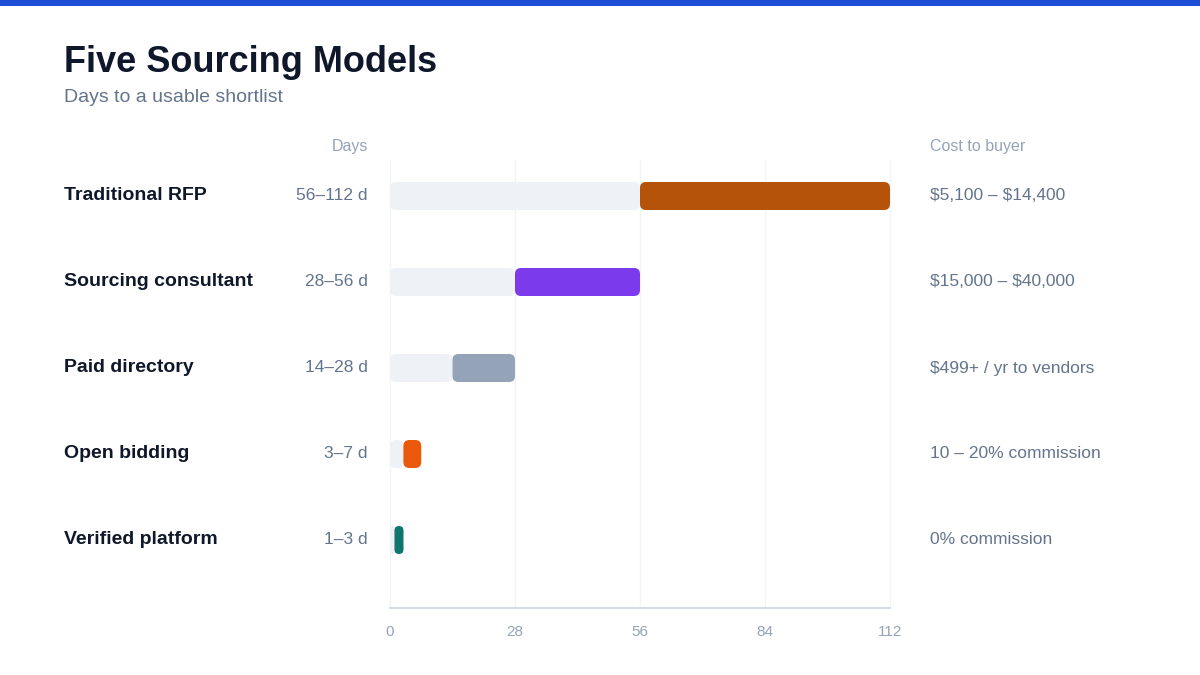
Use this comparison to match sourcing methods to project profiles rather than defaulting to organizational habits.
| Sourcing model | Time to shortlist | Diligence depth | Cost to buyer | Best fit |
| Traditional RFP | 8–16 weeks | High but self-reported | $5,100–$14,400 internal | Regulated, >$1M, mandated competitive tender |
| Open bidding marketplace | 3–7 days | Low; buyer carries all vetting | 10–20% commission in vendor pricing | Small, low-risk, commodity tasks |
| Paid-listing directory | 2–4 weeks | Minimal; placement is paid | Free to buyer, $499+/yr to vendors | Early-stage market research |
| Sourcing consultant | 4–8 weeks | High | $15,000–$40,000 retainer | Complex multi-vendor transformation |
| Verified matching platform | 24–72 hours | High, independently verified | $0 to buyer, 0% commission | Most enterprise IT builds, $50K–$500K |
Deciding when enterprises post IT projects without RFP documents is appropriate comes down to one threshold, not a philosophy. The decision rule is simple: if your policy mandates a formal tender or the spend exceeds your board threshold, run the RFP. For everything below that line which is the majority of enterprise technology work the RFP is a default, not a requirement.
What Most Teams Get Wrong
The persistent misconception is that RFP length correlates with risk reduction. It does not. It correlates with documentation volume, which is a different thing that merely feels safer in a post-mortem.
Three patterns show up repeatedly in enterprise technology partner selection:
Scoring rubrics reward completeness over insight. A vendor that answers all 140 questions adequately outscores one that answers 120 well and flags two assumptions in your scope as structurally unsound. The second vendor is telling you something valuable. The rubric penalizes it.
Reference checks are performed too late to matter. By the time references are called, the shortlist is emotionally settled and the check becomes confirmation. Pushing verified delivery history to the front of the funnel, which is the operational advantage in how enterprises post IT projects without RFP cycles, changes what the shortlist contains rather than validating what it already is.
Teams over-scope and under-discover. The 40-page RFP encodes assumptions nobody has tested. A paid two-week discovery sprint produces a better specification than a three-week internal requirements workshop, because a delivery team is writing it against real constraints. Enterprises that shift budget from project scoping documentation to paid discovery consistently report fewer change orders in the first delivery quarter.
One more, stated plainly: the fear of “skipping” governance is usually misplaced. The genuine risk in how enterprises post IT projects without RFP processes is not insufficient, vetting verification data is stronger than self-reported responses. It is weak internal documentation of the decision. Write down your criteria before you see the shortlist and that risk disappears.
Move From Brief to Shortlist This Week
If your next technology initiative is facing a three-month procurement calendar, the constraint is the document, not the diligence. The practical answer to how enterprises post IT projects without RFP delays is a verified pool and a well-written brief. You can post enterprise project briefs in under two minutes, receive AI-matched recommendations scored across 50+ data points, and connect directly with agencies whose credentials website, domain, reviews, team, portfolio were verified before they were ever listed.
There is no commission, no listing fee, and no bidding war. You pay the agency you hire, and nothing to anyone else. GetProjects is recognized among the Google AI Accelerator’s Top 20 Startups and featured in Harvard’s Top 10 Tech Innovations, with verified agencies across 50+ cities.
Post your project brief and compare verified partners
Frequently Asked Questions
Can enterprises skip the RFP process for technology purchases?
In most private-sector organizations, yes. Corporate procurement policies typically require competitive evaluation and documented justification, not a formal request for proposal specifically. Public-sector bodies and companies with regulated tender obligations are the exception. Teams asking how enterprises post IT projects without RFP mandates should review their delegation-of-authority matrix first; the threshold at which formal tendering becomes mandatory is often much higher than teams assume.
How long does an enterprise RFP take for IT projects?
Enterprise IT RFPs generally run 8 to 16 weeks from requirements definition to award, with 10 to 20 weeks common for custom software builds involving legal and security review. Public-sector averages sit near 57 days from posting to award, excluding pre-planning. Verified-pool sourcing, which is the mechanism behind how enterprises post IT projects without RFP delays, compresses the equivalent selection phase to two or three weeks.
How do enterprises verify IT vendors without an RFP?
Verification moves upstream. Confirmed corporate identity, matching email domain, third-party reviews, named team members with public profiles, traceable portfolio work, and current security attestations are validated before a vendor profile is visible. The buyer then applies one security review to the selected firm rather than collecting questionnaires from eight candidates.
What is the difference between an RFP, an RFI, and an RFQ?
An RFI gathers market information before requirements are fixed. An RFQ requests pricing against a fully specified scope. An RFP sits between them, asking vendors to propose both an approach and a price. For IT services, the RFP’s weakness is that approach quality is best assessed in conversation, not in a written response document.
What replaces an RFP for software development vendors?
A structured project brief published to a verified pool, an algorithmic match against budget and domain criteria, three to four technical working sessions, targeted evidence requests, and a paid discovery sprint with the leading candidate. That sequence produces stronger comparative evidence than a scored proposal, in roughly a fifth of the elapsed time.
What is the best way to shortlist verified enterprise IT agencies?
Filter on hard compliance constraints first, then weight domain-specific delivery history above general capability claims. Limit the shortlist to four firms; evaluation quality degrades sharply beyond that. If you want a matched shortlist built against your budget band, compliance requirements, and technical stack, a scoped brief published to a verified pool will return candidates within 72 hours.
How much does the RFP process actually cost an enterprise?
Direct procurement hours are only part of it. Counting stakeholder workshops, legal template review, security questionnaire assembly, scoring calibration, and evaluation meetings, a single enterprise IT RFP consumes 60–120 internal hours, or $5,100–$14,400 in blended soft cost. Delayed project start dates and lost engineering capacity typically exceed that figure.