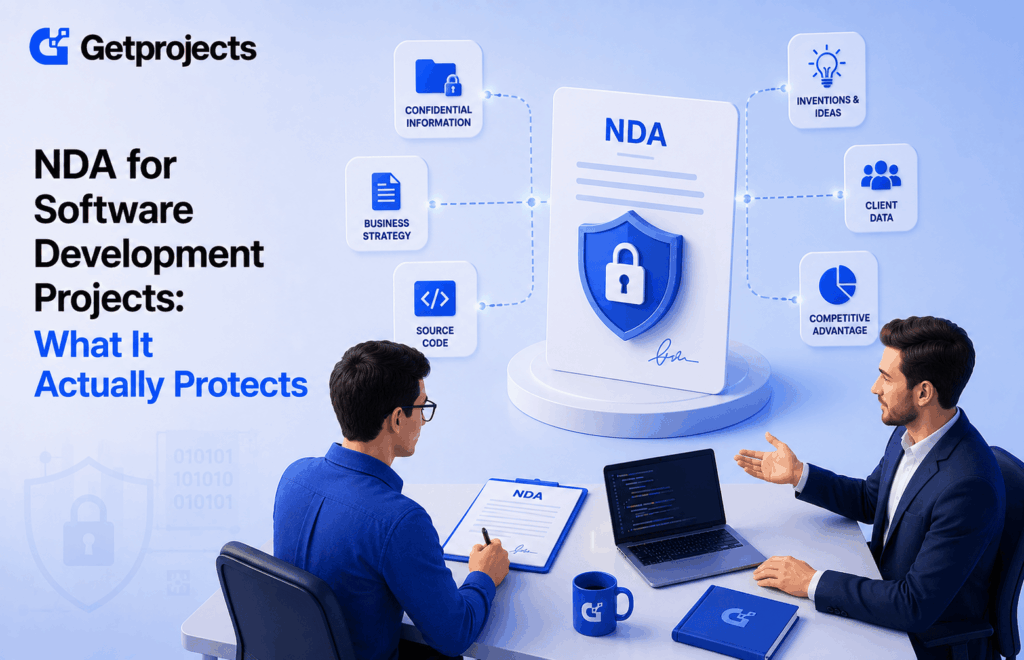
NDA for Software Development Projects: What It Actually Protects
Worldwide IT spending is projected to reach $6.37 trillion in 2026, up 14.2% year over year, with IT services the largest category inside that total. More software is being built by outside teams than at any point before, which means more proprietary material crossing more organisational boundaries, faster than legal review can keep pace. Almost none of that exposure is actually managed by the document buyers reach for first: an NDA for software development projects.
Gartner projects worldwide IT spending at $6.37 trillion in 2026, up 14.2%, with IT services and AI infrastructure leading the expansion.
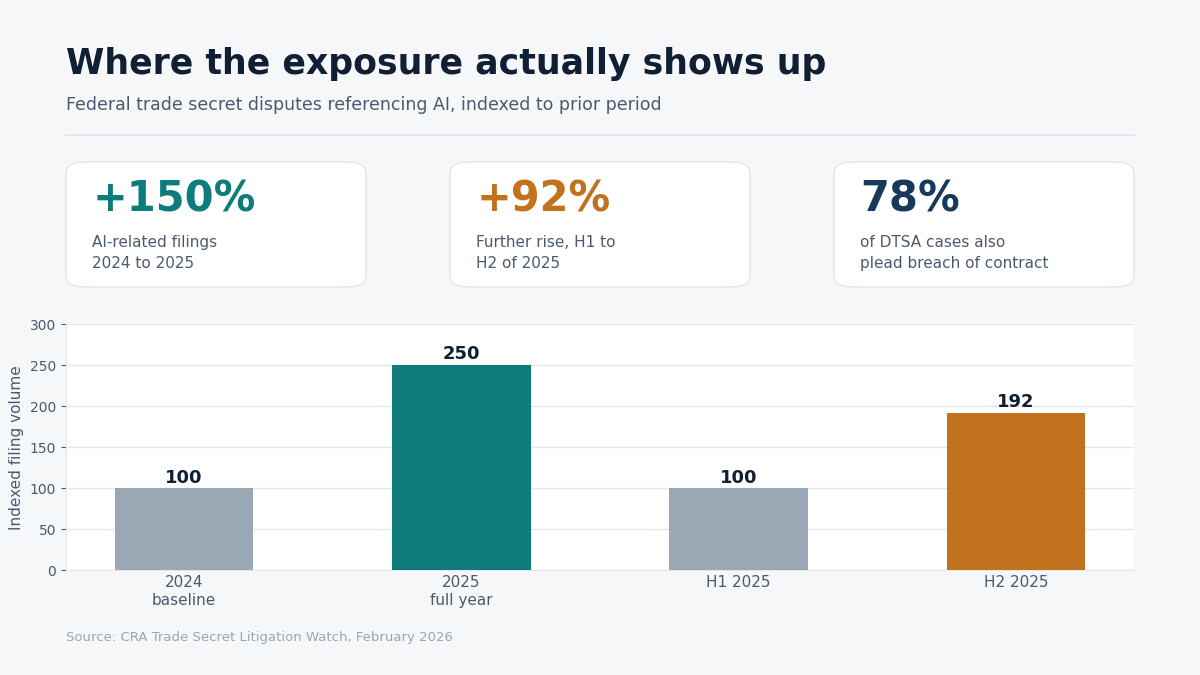
None of those disputes started with a stolen idea. They involve cloned repositories, exported customer databases, architecture documents forwarded to a competitor, and engineering teams poached mid-contract.
One figure from the same dataset should reframe how you read every clause below: 78% of Defend Trade Secrets Act cases also plead breach of contract. The confidentiality document rarely wins alone NDA; it is the evidentiary spine that makes a trade secret claim survivable. Drafting matters far more than signing, and most teams have the sequence backwards.
The near-term damage is scheduling, not litigation. Requiring a countersigned agreement before any technical conversation typically adds five to ten business days per vendor, so an eight-to-twelve-agency shortlist turns a four-day evaluation into a three-week one when it is entirely possible to shortlist an IT agency in 72 hours. Meanwhile the document being negotiated omits the two clauses that mattered: ownership of the delivered code, and a defined survival period for the data worth protecting.
What follows covers what the agreement protects, what it cannot, how mutual and one-way versions differ, why agencies sign constantly but almost never enforce, and when a vendor pushing hard on confidentiality paperwork is a reason to slow down.
What Is an NDA for Software Development Projects?
An NDA for software development projects is a contract in which one or both parties agree not to disclose or misuse defined confidential information shared during vendor evaluation, scoping, or delivery. It protects specified material NDA data, architecture, roadmaps, credentials, customer lists NDA not abstract concepts, and it does not transfer ownership of anything.
That last clause is where most misreadings begin. Confidentiality and ownership are separate legal mechanisms, governed by separate contract language, and signing one does not create the other, which is why protecting IP while outsourcing requires more than a single document.
The Core Problem: Teams Protect the Wrong Asset
Concepts are not protectable subject matter, and no NDA for software development projects changes that. United States law recognises three routes to exclusivity: NDA copyright over expression, patents over inventions, and trade secret protection over commercially valuable information kept secret. “A marketplace for X, but with AI matching” fits none of them.
The commercial reality is blunter. Any competent agency has heard three or four variations of your concept in the last quarter. Execution speed, distribution, and capital determine outcomes, and a signature on a non-disclosure agreement does nothing to affect any of them.
What is genuinely exposed during a development engagement is far more specific:
- Production database exports and anonymisation-incomplete test data
- API keys, cloud credentials, and third-party integration tokens
- Unit economics, CAC and LTV figures, and pricing logic
- Named customer lists, pipeline data, and churn analysis
- Twelve-to-eighteen-month product roadmaps and unannounced launch dates
- Internal architecture diagrams and known security weaknesses
Those items have replacement cost and demonstrable value. Those are the items an NDA for software development projects is built to cover, and they are almost always the items the template downloaded from a legal-forms site fails to enumerate.
The timing error compounds the substance error. Requesting a signature NDA before sharing project idea NDA before capability, availability, or budget alignment has been established NDA front-loads legal friction onto a stage where nothing confidential is being exchanged. A one-paragraph problem statement, a target platform, a budget band, and a timeline reveal nothing that a competitor could weaponize.
What Protection Actually Looks Like Inside a Development Engagement
Enforceability is a function of specificity. Broad definitions of “Confidential Information” covering everything exchanged tend to be read narrowly by courts, because a definition that covers everything identifies nothing. Under the Defend Trade Secrets Act, a trade secret claim also requires evidence that the owner took reasonable measures to keep the information secret NDA and a signed, specific confidentiality agreement is precisely the kind of evidence that satisfies that test.
The Five Categories Worth Naming Explicitly
Replace generic language with an enumerated schedule. A well-drafted NDA for software development projects names categories, not abstractions:
- Technical materials NDA source code, repositories, architecture documentation, database schemas, infrastructure configuration
- Commercial data NDA pricing models, margin structures, vendor contracts, unit economics
- Customer information NDA identifiable records, usage analytics, support histories, contract terms
- Strategic material NDA roadmaps, unreleased feature specifications, funding plans, M&A discussions
- Security posture NDA credentials, penetration test results, known vulnerabilities, incident history
Each category should carry its own survival period, and each should map to something concrete in your software requirements document. Credentials warrant indefinite protection. A roadmap dated Q3 2026 is worthless to anyone by 2028, and demanding perpetual protection for it weakens the agreement’s credibility as a whole.
Mutual NDA vs One-Way: What Each One Signals
Any competent mutual NDA software vendor relationship runs both directions, because information flows both ways. Agencies disclose delivery methodologies, team composition, subcontractor arrangements, rate cards, and reference client names NDA material with real competitive value in a market where agencies bid against each other for the same accounts.
A one-way agreement, in which only the client’s information is protected, is standard in enterprise procurement and generally accepted by vendors who want the account. It also tells a sophisticated agency something: that the client sees the engagement as one-sided before work has begun, which is worth weighing against any buyer framework for comparing agencies you are running in parallel.
Mutual agreements clear legal review faster in practice. Symmetrical obligations require less negotiation because neither side is accepting risk the other has escaped, which routinely compresses a two-week redline cycle into two or three days.
NDA vs IP Assignment: The Distinction That Costs Real Money
This is the single most expensive misunderstanding in agency-hiring paperwork. Confidentiality restricts disclosure. Assignment transfers ownership. They are different clauses in different documents doing different jobs.
Under US copyright law, the work-for-hire doctrine applies automatically to employees but covers independent contractors only within nine narrowly enumerated categories, and commissioned software is not one of them. Absent a signed written assignment, the agency that wrote your code may own the copyright in it, regardless of how comprehensive your confidentiality terms are or how much you paid the full mechanics of who owns the code when you outsource turn on that single document.
The IP assignment clause belongs in the master services agreement (MSA) or the statement of work, should assign all deliverables on payment, and needs an explicit position on the residuals clause, the provision letting a vendor reuse general skills, techniques, and know-how retained in unaided memory. Most agencies require one, and refusing outright will end the negotiation with any established firm. The workable compromise permits reuse of generic patterns and internal libraries while excluding anything client-specific.
Two related clauses deserve equal attention. A non-solicitation clause addresses team poaching in both directions and is often the provision with the clearest damages calculation attached. A source code escrow arrangement matters when the vendor holds deployment keys to revenue-critical infrastructure.
How Long Should an NDA Last?
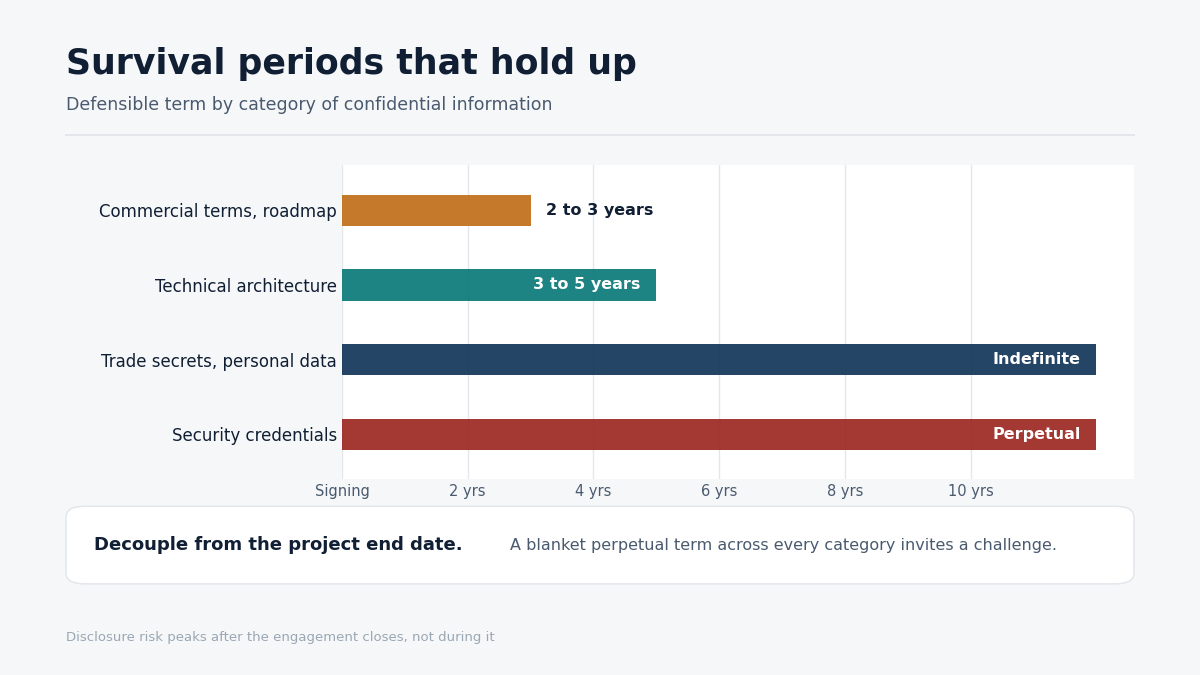
The duration question produces the wrong answer more often than almost any other term, in both directions. Perpetual obligations on all information are common in first drafts and rarely survive scrutiny. NDA courts in several jurisdictions decline to enforce indefinite restrictions on ordinary business information, and an unreasonable term invites a challenge to the whole document.
Defensible defaults for a software engagement:
- Two to three years for commercial terms, pricing, and roadmap material
- Three to five years for technical architecture and proprietary methodology
- Indefinite for genuine trade secrets and personal data, defined narrowly
- Perpetual for security credentials and vulnerability information
The survival period should also be decoupled from the term of the engagement. A confidentiality obligation that expires the day the project closes protects nothing, since disclosure risk peaks after the relationship ends.
Drafting the Confidentiality Clause in a Dev Agreement
Where a project proceeds past evaluation, the staNDAlone document should be superseded rather than stacked. A confidentiality clause dev agreement NDA meaning confidentiality integrated directly into the MSA NDA avoids the frequent problem of two instruments with conflicting definitions and different survival periods governing the same information.
Regulated data adds a further requirement. Personal data processed by a vendor needs a data processing agreement (DPA) with defined processing purposes, sub-processor consent, breach notification windows, and deletion obligations. Confidentiality language alone does not satisfy GDPR, HIPAA, or comparable regimes; anyone scoping HIPAA-compliant build requirements will hear this from their auditor first.
Finally, include a clause providing for injunctive relief and acknowledging that damages alone are an inadequate remedy. Without it, the practical response to a leak is a damages claim taking eighteen months to resolve, rather than an order stopping the disclosure this week.
A Seven-Step Disclosure Sequence for Vendor Evaluation
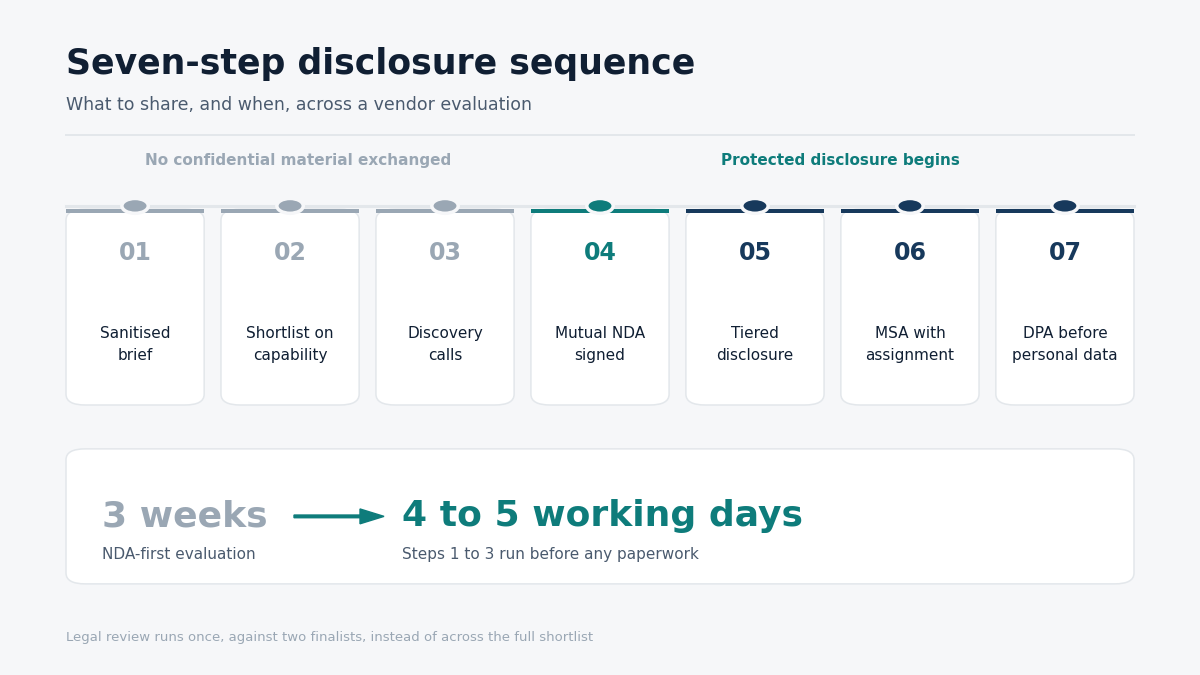
This sequence protects what matters without stalling the shortlist:
- Publish a sanitised brief. Problem statement, target platform, budget range, timeline. No proprietary data, no credentials, no customer names.
- Shortlist on capability signals. Portfolio depth, domain experience, team composition, verified reviews NDA none of which require confidential disclosure to assess.
- Hold discovery calls unprotected. Discuss the problem space, not your data. Three to five calls typically eliminate half a shortlist.
- Execute a mutual agreement at the two-to-three-vendor stage. This is the correct trigger point for an NDA for software development projects, not the first email.
- Disclose in tiers. Architecture and anonymised data during technical scoping. Production access and credentials only after contract signature.
- Sign the MSA with assignment, residuals, non-solicitation, and confidentiality integrated. One instrument, one set of definitions.
- Add a DPA before any personal data moves. Separate document, separate signature, separate audit trail.
Steps 1 through 3 typically compress vendor evaluation from three weeks to four or five working days, because the legal review that normally runs in series now runs once, against two finalists.
Real-World Application
The following are anonymised composites of patterns that recur consistently in agency-hiring cycles.
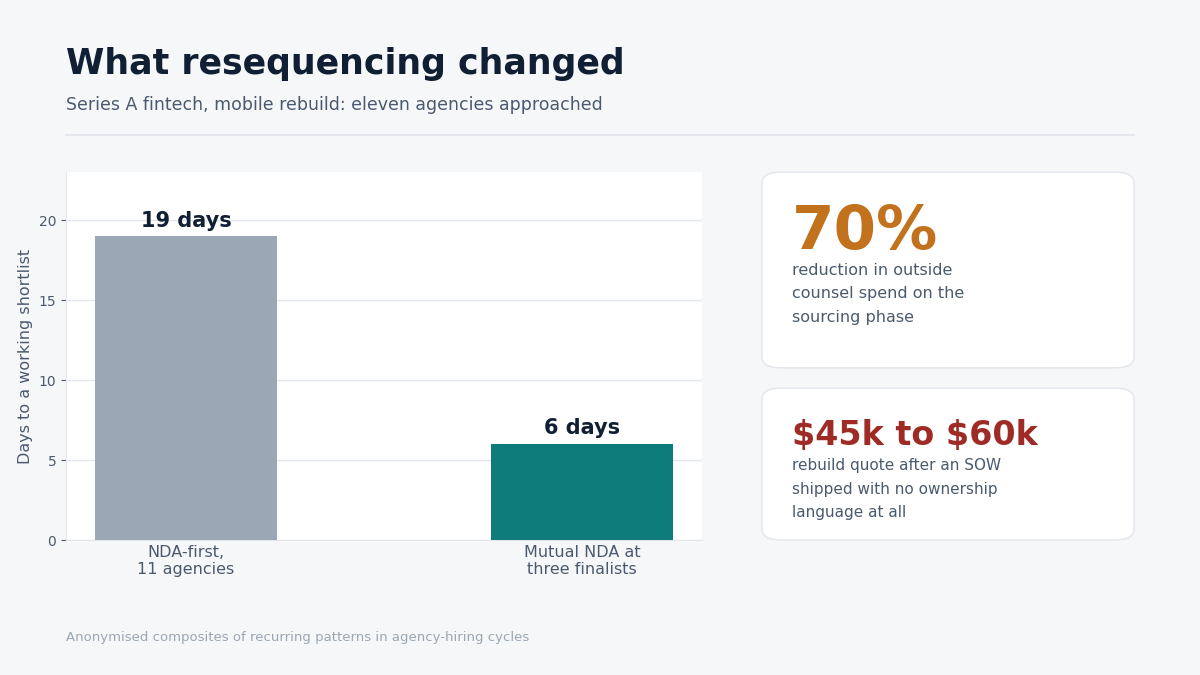
A Series A fintech, mobile rebuild. The team required countersigned confidentiality agreements from eleven agencies before any technical call, and legal review across those eleven ran nineteen days. Restructuring the process around a sanitised brief with mutual agreements executed only at the three-finalist stage produced a shortlist in six days and cut outside counsel spend on the sourcing phase by roughly 70%.
An enterprise retailer, ecommerce replatform. A one-way agreement was signed and executed cleanly, but the SOW carried no ownership language. Eight months post-launch, the internal team discovered that the recommendation engine, the project’s core differentiator, sat inside a vendor library the agency licensed to other clients. Retroactive negotiation of an assignment with a narrow residuals carve-out closed the gap, but the rebuild quote for that ecommerce replatform had already come in at $45,000–$60,000.
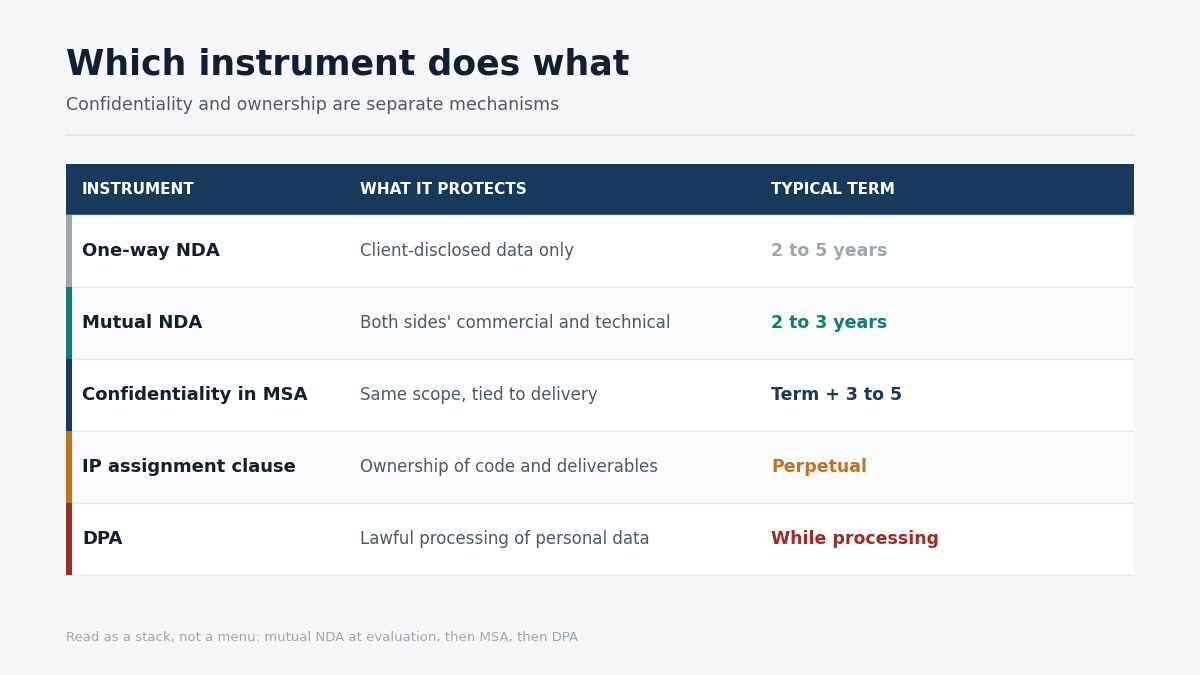
Decision Framework: Which Instrument Does What
| Instrument | What it actually protects | When to use it | Typical term |
| One-way NDA | Client-disclosed data only | Enterprise procurement, regulated data, unbalanced disclosure | 2–5 years |
| Mutual NDA | Both parties’ commercial and technical information | StaNDArd vendor evaluation at shortlist stage | 2–3 years |
| Confidentiality clause in MSA | Same scope, integrated with delivery obligations | Any engagement that proceeds to contract | Term + 3–5 years |
| IP assignment clause | Ownership of code, designs, and deliverables | Every paid development engagement, without exception | Perpetual |
| DPA | Lawful processing of personal data | GDPR, HIPAA, CCPA, or any regulated dataset | Duration of processing |
Read the table as a stack, not a menu. An NDA for software development projects is the first instrument in the sequence, not the whole of it. A properly papered engagement uses a mutual agreement at evaluation, then an MSA carrying confidentiality and assignment together, then a DPA where personal data is in scope.
What Most Teams Get Wrong
Agencies sign confidentiality paperwork at volume and enforce it almost never. A mid-sized firm may hold two hundred active agreements, and an NDA for software development projects is signed the same week it arrives without any expectation of ever being litigated.
Pursuing a breach means a preliminary injunction motion NDA commonly $50,000 to $250,000 in legal fees, twelve to twenty-four months of duration, and discovery into the firm’s own engineering practices. Against a $60,000 project, the economics never work. The document’s real function is deterrence and evidentiary positioning, and that is a legitimate function, but it is not the same as protection.
Cross-border engagements narrow the gap further. Choice-of-law and arbitration clauses are enforceable in most major outsourcing jurisdictions, but obtaining and executing an injunction against a small firm in another legal system is measured in quarters, not weeks. Vendor selection discipline is a better control than contract language: verified business registration, a checkable domain, references you actually call, and a real audit trail.
The inversion is an equally important NDA and this is where a request for an NDA for software development projects becomes a signal about the vendor rather than the client. Treat these as reasons to slow down:
- A vendor demanding a signature before disclosing team size, location, or subcontracting arrangements
- Confidentiality terms drafted to prevent you from disclosing the vendor’s pricing to other vendors
- A one-way agreement running in the vendor’s favour only, at the sourcing stage
- Refusal to name a single reference client even under mutual terms
- Confidentiality paperwork offered in place of verifiable credentials
The last one is the tell. Firms with real delivery history lead with case studies, named references, and a team roster; firms that instead lead with paperwork are usually compensating for something.
One more pattern worth naming: excessive confidentiality demands from the client side actively shrink the candidate pool. Strong agencies with full pipelines decline unusual legal friction at the sourcing stage, because the opportunity cost of a fourteen-day redline against an unqualified lead is higher than the value of the lead.
Marketplaces built around verified profiles NDA GetProjects among them NDA reduce that friction by front-loading verification, so evaluation can proceed on capability signals before legal instruments enter the conversation.
Getting the Sequence Right
Most problems with an NDA for software development projects are sequencing problems, not drafting problems. Paperwork arrives too early, covers too much, omits ownership, and delays the evaluation it was supposed to protect. The fix is procedural: sanitise the brief, shortlist on verifiable signals, execute mutual terms at the finalist stage, and integrate confidentiality and assignment into a single contract before work begins.
If you are structuring an NDA for software development projects and want to compare verified IT agencies without paying commissions or running a blind bidding process, GetProjects lets you post a project in under two minutes, at no cost, and connect directly with agencies vetted on website, domain, reviews, and team details before their profiles go live. You pay the agency you hire NDA nothing to the platform.
Frequently Asked Questions
Does an NDA protect my app idea?
No. Concepts are not protectable subject matter under copyright, patent, or trade secret law. Confidentiality agreements protect defined information NDA data, architecture, customer lists, roadmaps, credentials NDA not the underlying premise. Two companies can legally build the same product, and routinely do. What an agreement does protect is the specific material you disclose while getting it built.
How long should an NDA last?
Two to three years for commercial and roadmap information, three to five for technical architecture, and indefinitely for genuine trade secrets and security credentials. Perpetual obligations across all information categories are frequently unenforceable and invite challenges to the entire document. The obligation should survive the engagement’s end, since disclosure risk is highest after the relationship closes.
What is the difference between an NDA and an IP assignment?
Confidentiality restricts disclosure; assignment transfers ownership. They are separate clauses doing separate jobs. Without a written assignment, a contractor may own the copyright in code you paid for, because the work-for-hire doctrine does not automatically cover commissioned software. An NDA for software development projects with no accompanying assignment leaves the ownership question entirely open.
Do software development agencies sign NDAs?
Nearly all established agencies sign them as routine practice, usually within one to three business days for reasonable mutual terms. Resistance typically signals one of three things: an unreasonable clause such as a broad non-compete, a term inconsistent with the firm’s existing obligations, or a request made before the opportunity has been qualified.
Can an NDA stop a developer from building a similar app?
Generally not. An NDA for software development projects restricts use of your specific disclosed information, not participation in your market. Restraining competitive activity requires a non-compete, which is unenforceable or heavily restricted in many jurisdictions and rarely accepted by agencies serving multiple clients in one sector. The workable protection is a well-drafted residuals clause paired with clear ownership terms.
Should I ask an agency to sign an NDA before the first call?
Rarely worth it. A sanitised brief covering the problem, platform, budget band, and timeline exposes nothing enforceable and lets you assess three to five vendors in the time one legal review would take. Execute mutual terms once you are down to two or three finalists and are ready to share architecture, data, or roadmap detail NDA the point at which protection is actually needed. If you are unsure where your own disclosure line sits, that is a useful thirty-minute conversation to have before you start contacting vendors.