Best E-commerce Development Companies in 2026: Custom vs Platform and How to Choose
The first question any of the best e-commerce development companies should ask you, and any serious buyer should answer before approaching agencies, is whether you actually need custom development or whether a Shopify store would serve you better for 20% of the cost and 10% of the timeline. Getting this decision wrong in either direction is expensive.
The global E-commerce software market is projected to grow from USD 13.10 billion in 2026 to USD 44.32 billion by 2034, exhibiting a CAGR of 16.46% during the forecast period.
Shopify, WooCommerce, and Magento where sophisticated stores are built with minimal custom code. The remainder is genuinely custom e-commerce for companies whose requirements outgrow what platforms can accommodate.
Understanding which category you are in nd finding the right agency for that category he difference between a successful launch and a 6-month build for a store that Shopify would have handled in 6 weeks.
The Platform Decision: The Most Important Choice Before Hiring Anyone
Most $5K to $30K e-commerce projects should start with a platform question, not an agency question.
The decision framework:
| Use a platform (Shopify/WooCommerce) | Build custom |
| Standard product catalogue with variants | Non-standard product structures (configurable, built-to-order) |
| Standard checkout flow | Multi-step checkout with complex business logic |
| Standard payment processing | Custom payment rules, split payments, complex promotions |
| Single seller | Marketplace with multiple sellers |
| Standard fulfilment | Complex fulfilment logic (multiple warehouses, custom routing) |
| Content-light | Heavy content/editorial with e-commerce |
| Budget under $8K | Budget $15K+ for specific custom requirements |
| Timeline under 8 weeks | Timeline 12+ weeks acceptable |
The platform cost comparison:
| Solution | Development Cost | Monthly Platform Cost | Customisation Ceiling |
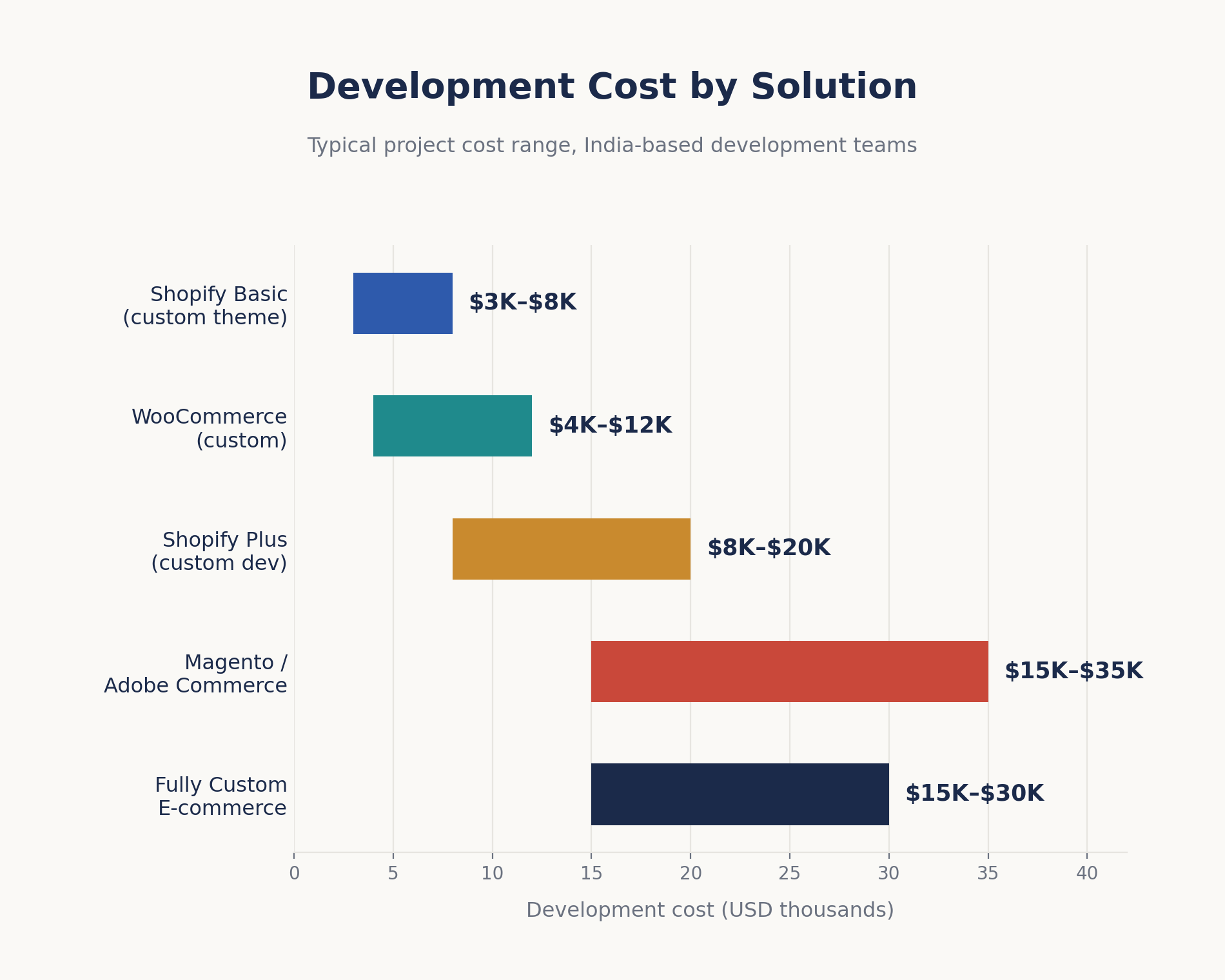
| Shopify Basic (custom theme) | $3K–$8K | $39–$79/month | Moderate theme and app ecosystem |
| Shopify Plus (custom development) | $8K–$20K | $2,300/month | High checkout extensibility, complex flows |
| WooCommerce (custom) | $4K–$12K | $0 (self-hosted) + ~$50–$200/month hosting | High open source, unlimited customisation |
| Magento / Adobe Commerce | $15K–$35K | $0 (Community) / $22K+/year (Enterprise) | Very high enterprise-grade |
| Fully custom e-commerce | $15K–$30K | $100–$500/month (infrastructure) | Unlimited |
For most first-time e-commerce builds at the $5K to $15K budget level, Shopify with a custom theme and 3 to 5 apps is the right answer ot because it is the most capable solution, but because it gets you to market in 6 to 10 weeks with professional quality for a fraction of the cost of custom development.
Custom development is the right answer when Shopify or WooCommerce genuinely cannot meet your requirements or when they can meet them with a different UX than you imagined.
What the Best E-commerce Development Companies Do Differently?
The gap between a best e-commerce development companies and a mediocre one is most visible in three areas: conversion rate focus, performance optimisation, and integration quality.
-
Conversion rate focus:
Best e-commerce development companies design every UX decision with conversion in mind, not just what looks beautiful, but what drives a visitor to purchase.
The checkout flow is minimal friction. The product page answers every purchase hesitation. The cart reminds users what they are losing by not buying. The mobile experience is optimised for thumb navigation and one-thumb checkout.
An agency that builds a visually attractive store without thinking about conversion rates has built a beautiful billboard. It shows product. It does not sell product.
-
Performance optimisation:
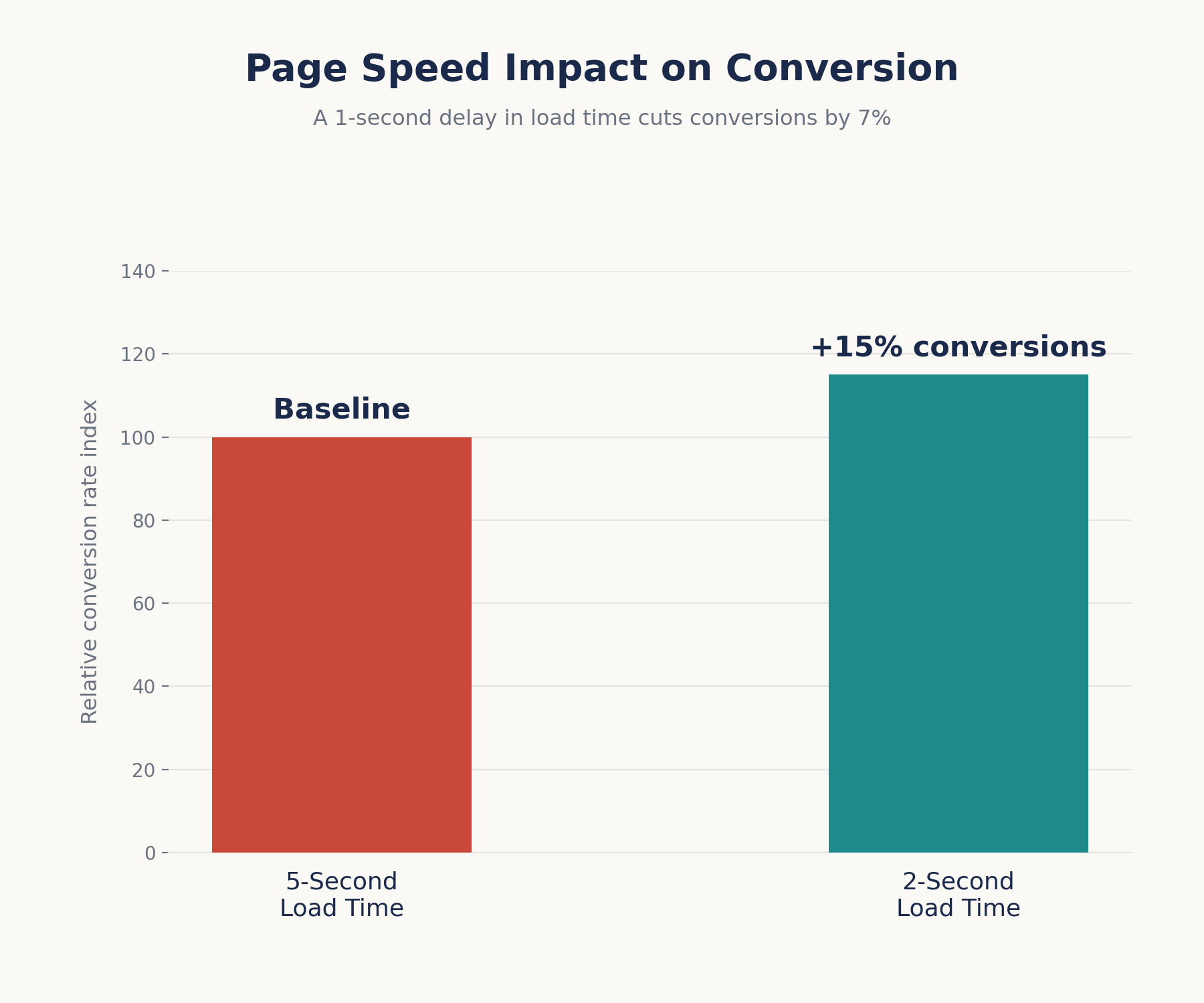
Page speed is the most statistically significant factor in e-commerce conversion rate after product-market fit. A 1-second delay in page load time reduces conversions by 7%.
A store loading in 2 seconds converts 15% better than one loading in 5 seconds.
Good e-commerce agencies optimise images automatically, implement lazy loading, configure CDN correctly, and test Core Web Vitals scores before handoff. Bad agencies hand off a store that scores 45 on Google PageSpeed and call it complete.
-
Integration quality:
E-commerce stores do not operate in isolation; they connect to inventory systems, accounting software, shipping carriers, email marketing platforms, and analytics tools.
The quality of these integrations determines whether the store is manageable as a business or requires constant manual intervention.
Good agencies test integrations with real data before handoff.
Bad agencies connect the integration, confirm it works in a single test, and consider it done, leaving edge cases that break in production.
E-commerce Development Cost at $5K–$30K
Cost by e-commerce project type with a strong Indian development team:
| Project Type | What It Includes | India Cost | Eastern Europe Cost | Timeline |
| Shopify store (custom theme) | Custom Shopify theme, 5–8 sections, product upload setup, basic app development configuration | $3K–$7K | $6K–$14K | 4–8 weeks |
| Shopify store (complex) | Custom theme + checkout customisation + subscription integration + loyalty + custom apps | $8K–$16K | $16K–$30K | 10–16 weeks |
| WooCommerce custom store | Custom WordPress + WooCommerce theme + 5–8 plugins + custom functionality | $5K–$12K | $10K–$22K | 8–14 weeks |
| D2C custom platform (simple) | Custom React storefront + Node.js backend + Stripe + basic product catalogue | $12K–$20K | $22K–$38K | 14–22 weeks |
| B2B e-commerce platform | Account-based pricing + approval workflows + bulk ordering + ERP integration | $15K–$28K | $28K–$50K | 18–28 weeks |
| Multi-vendor marketplace | Seller and buyer portals + commission engine + product approval + payout | $18K–$30K | $35K–$55K | 22–32 weeks |
The Shopify vs custom custom decision at different budgets:
At $5K to $10K, Shopify with a custom theme is almost always the right choice.
At $10K to $20K, Shopify Plus or WooCommerce custom development suits most requirements with significant flexibility.
Above $20K, genuinely custom development becomes viable if the specific requirements cannot be met by platform solutions.
What to Look for in the Best E-commerce Development Companies
Portfolio signals specific to e-commerce:
Live stores you can shop in, not screenshots of stores; actual stores where you can add to cart and reach checkout.
Check the mobile experience on your phone: is it smooth, is checkout thumb-friendly, do images load quickly? Check the page speed using PageSpeed Insights. A good agency’s stores score 70+ on mobile, 85+ on desktop.
Experience with your platform: a Shopify specialist and a custom developer are not interchangeable.
Shopify development requires knowledge of Liquid templating, Shopify CLI, metafields, and the checkout extensibility system introduced in Shopify 2.0.
A generic web development company that “can figure out Shopify” will take 3× longer and produce worse results than a Shopify specialist.
Conversion rate results: ask specifically if the agency can share any conversion rate benchmarks from their e-commerce clients.
Average e-commerce conversion rates run 1 to 3%. A good e-commerce app development agency has case studies where thoughtful UX and performance work improved conversion rates measurably.
Questions to ask:
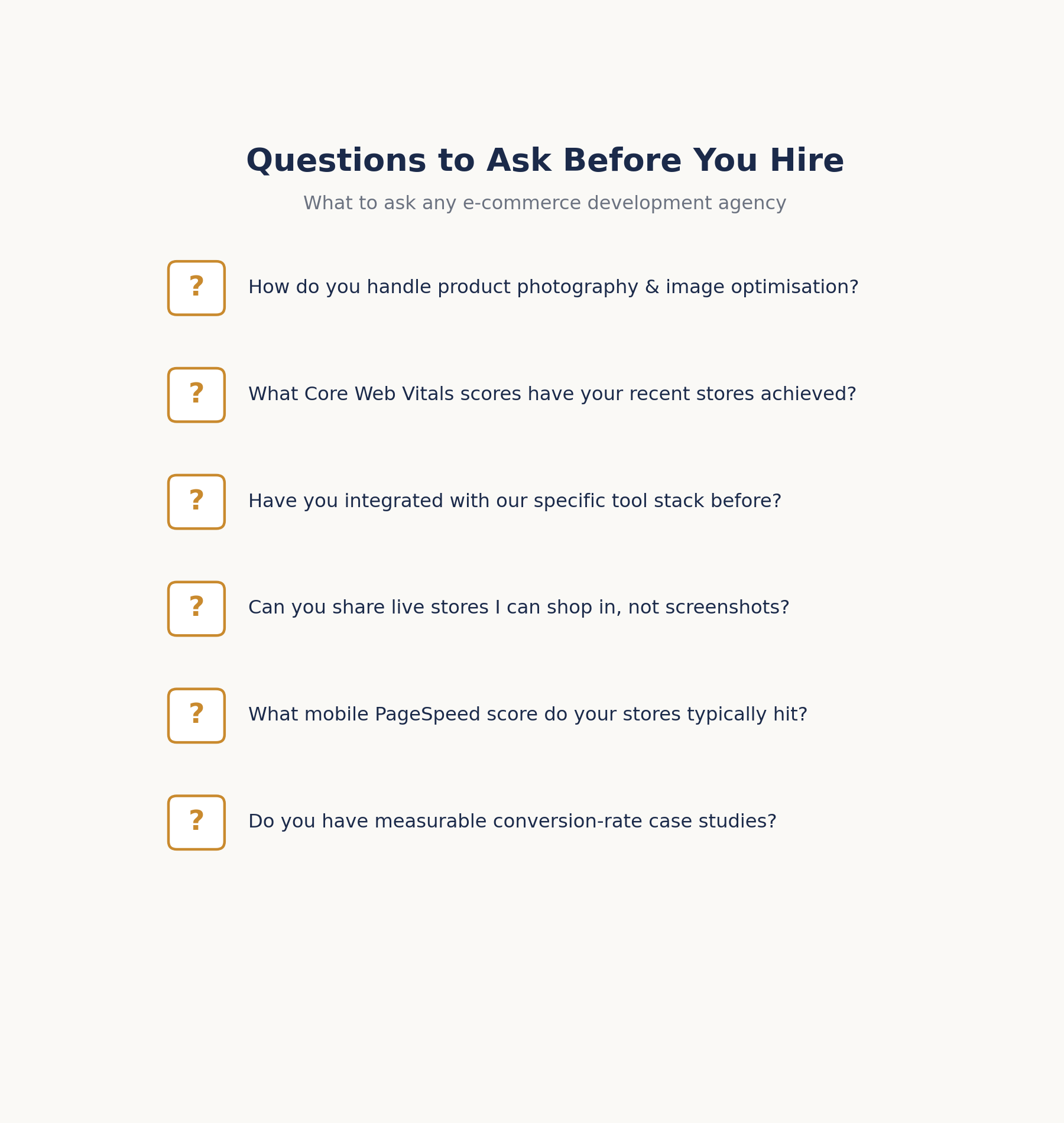
How do you handle product photography and image optimisation? Do you have guidelines, or do you leave it to the client? (Stores with inconsistent or poorly optimised images underperform regardless of development quality.)
What is your approach to Core Web Vitals optimisation, and what scores have recent stores achieved? (Minimum acceptable mobile PageSpeed score: 65. Good score: 80+.)
Have you integrated with [specific tools you use: Klaviyo, Gorgias, ShipStation, QuickBooks]? (Integration experience with your specific tools stack matters more than general e-commerce experience.)
The Hidden Costs of E-commerce Development
The app/plugin ecosystem costs:
A Shopify or WooCommerce store’s final functionality depends heavily on apps and plugins. These are not included in the development quote; they are ongoing subscriptions that add to your monthly operational cost. Common apps and their costs:
| App Category | Common Options | Monthly Cost |
| Email marketing | Klaviyo, Omnisend | $20–$150/month |
| Reviews | Judge.me, Yotpo | $0–$50/month |
| Loyalty/rewards | Smile.io, LoyaltyLion | $50–$200/month |
| Subscriptions | Recharge, Bold | $100–$500/month |
| Shipping | ShipStation, Easyship | $30–$100/month |
| Search | SearchPie, Searchanise | $0–$50/month |
| Upsell/cross-sell | Frequently Bought Together, ReConvert | $20–$50/month |
| Total typical app spend | $200–$600/month |
Payment processing fees:
Stripe and Shopify Payments both charge 2.9% + 30¢ per transaction. At $10,000 monthly revenue, this is $320 per month.
At $100,000 monthly revenue, this is $3,200 per month. Not a hidden cost exactly, but often forgotten in the business plan.
For high-volume businesses, negotiating custom rates with payment processors or switching to interchange-plus pricing can reduce this significantly.
FAQs: Best E-commerce Development Companies
1. When should I choose Shopify over custom e-commerce development?
Choose Shopify when your product catalogue is straightforward, your checkout requirements are standard, and your budget is under $15,000.
Shopify’s ecosystem of apps covers 90% of what most e-commerce businesses need; the platform is maintained by Shopify, so you are not responsible for security updates, and the time-to-market is 3 to 6× faster than custom development.
The primary reasons to move beyond Shopify are: selling in a marketplace model with multiple independent sellers, requiring highly complex pricing logic that Shopify’s engine cannot support, needing deep ERP integration that Shopify’s APIs cannot accommodate, or having specific B2B requirements around account-based pricing and approval workflows that require custom architecture.
2. What is headless e-commerce and do I need it?
Headless e-commerce separates the front-end customer experience from the back-end commerce engine using a platform like Shopify or Commercetools as the commerce layer while building a fully custom React or Next.js front-end.
It provides maximum UX flexibility and performance but adds significant development complexity and cost, typically 40 to 60% more than a standard platform implementation.
For most $5K to $30K e-commerce projects, headless is not the right choice; the performance and flexibility benefits do not justify the cost premium unless you have very specific UX requirements that a standard theme cannot accommodate.
The performance argument for headless has weakened significantly since Shopify launched its own headless framework (Hydrogen) and Next.js Commerce; you can get most of the performance benefits with a well-configured standard theme.
3. How do I evaluate whether an agency’s Shopify work is actually good?
Three practical checks: open one of their client stores on your mobile phone and test the full purchase flow, from product page to checkout to payment.
A good Shopify store loads the product page in under 3 seconds, has clear product images, an obvious add-to-cart, and a checkout that completes in 3 taps.
Run the store through Google PageSpeed Insights; mobile scores below 50 indicate an agency that either did not optimise or does not know how.
Check the Shopify theme code quality if you have a developer who can review it, or ask your developer to review the theme’s Liquid code for a sample section.
An agency that writes clean, documented Liquid code is easier to work with long-term than one that produces spaghetti code that is impossible to maintain or extend.
Post your e-commerce project on getprojects.ai and receive proposals from the best e-commerce development companies with verified store portfolios. Free to post; responses within 48 hours.