Best Custom Software Development Companies in 2026 How We Evaluated Them and What Makes the Shortlist
Most “top software development companies” lists are influenced by sponsorships, not real performance. The agencies with the biggest marketing budgets often dominate rankings, leaving founders to navigate misleading options and costly mistakes.
That’s why choosing the best custom software development companies requires more than scanning rankings; it demands a clear evaluation of expertise, project fit, and proven outcomes.
The global custom software development market continues to expand rapidly, projected to reach over $1.1 trillion by 2030, growing at a CAGR of 22.5%. With thousands of agencies competing globally, only a small fraction consistently deliver high-quality, scalable solutions aligned with business goals.
This guide breaks down how to identify genuinely reliable partners, evaluate portfolios effectively, and shortlist agencies that match your technical and business requirements without wasting time on the wrong conversations.
GetProjects.ai has evaluated 500+ agencies worldwide, verifying portfolios and client feedback to match businesses with the right development partners based on project fit or ad spend.
What Makes a Custom Software Development Company Worth Shortlisting?
The wrong question is “who is the best?” The right question is “who is the best for my specific project?”
A 500-person agency that built enterprise ERP for Fortune 500 companies is not the right fit for a $10,000 MVP. A 12-person boutique that specialises in fintech mobile apps is not the right fit for a logistics platform that needs 50 developers.
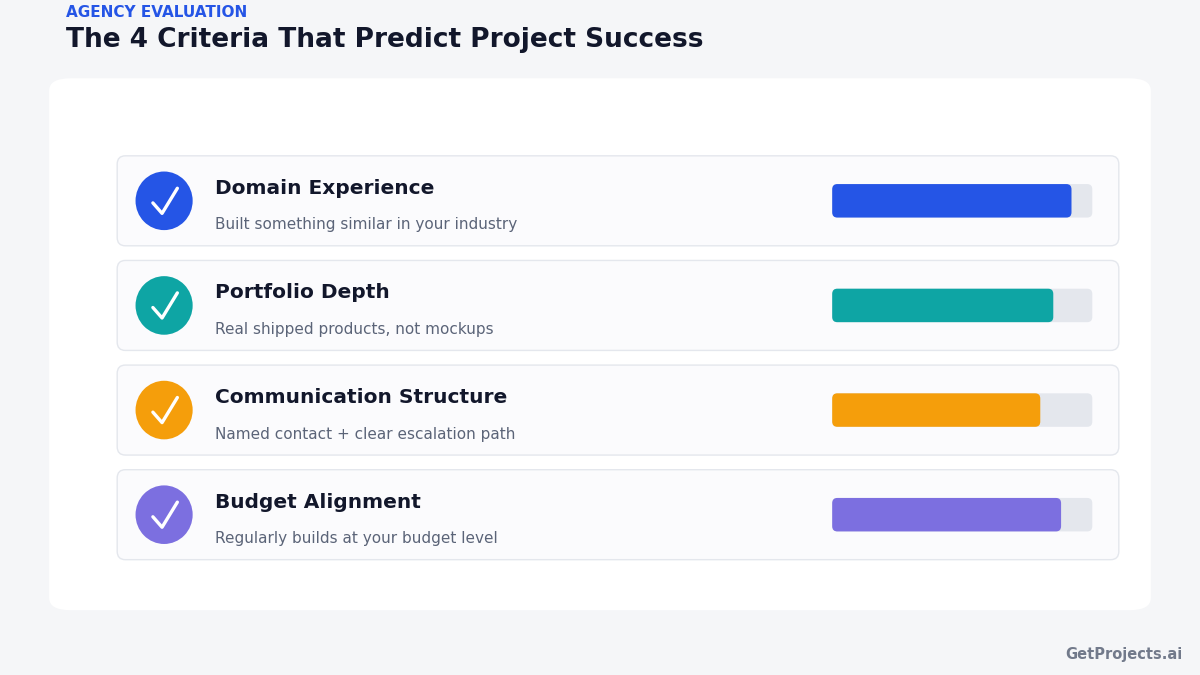
The four criteria that actually predict project success:
| Criterion | What to Look For | Red Flag |
| Domain experience | Have they built something similar? Not just in the same tech in your industry, with your kind of complexity | First project in your vertical presented as “we’re quick learners” |
| Portfolio depth | Real products used by real users not mockups, not internal tools | Portfolio of landing pages and brochure sites when you need an application |
| Communication structure | Who is your day-to-day contact? What is the escalation path? What does a weekly update look like? | “You’ll have a dedicated project manager” without specifying who |
| Budget alignment | Do they build at your budget level regularly? | A company whose case studies all mention $500K projects suddenly offering you $10K misaligned expectations on both sides |
The agencies worth your time can answer all four of these in their first response. The ones that cannot are telling you something important.
The Agency Landscape Types of Software Development Companies
Not all software development companies are the same category of business. Understanding the landscape saves you from mismatched conversations.
The five types:
| Agency Type | Size | Typical Budget Range | Strengths | Limitations |
| Product studio | 5–25 people | $8K–$50K | Founder-grade quality, direct senior access, fast decisions | Bandwidth constraints may not take multiple large projects |
| Boutique agency | 15–60 people | $10K–$80K | Specialised expertise, consistent delivery teams | May stretch beyond core competency for unusual requirements |
| Full-service agency | 50–300 people | $20K–$200K | Broad capability, delivery at scale | Less senior attention on smaller projects, more overhead |
| Offshore development centre | 100–1000+ people | $5K–$500K | Cost efficiency, large talent pool | Communication overhead, cultural fit requires management |
| Freelancer team / collective | 2–10 people | $5K–$25K | Cost efficient, flexible | Continuity risk, coordination complexity |
For the $5K–$30K budget range that most startups and SMEs operate in, the product studio and boutique agency types produce the most consistent results. They have enough structure to deliver reliably and enough interest in your project size to give it real attention.
A full-service agency with 200 employees quoting $12,000 for your project is likely assigning a junior team that is simultaneously managing 8 other projects. This is not a cynical observation, it is basic economics.
How to Evaluate a Custom Software Development Company for Your Project
The portfolio review is the most underused evaluation tool in software procurement. Most buyers ask agencies for references, have a 30-minute discovery call, and make a decision. The buyers who get the best outcomes spend 2 to 3 hours on the portfolio before the first call.
What to look for in a portfolio:
| Portfolio Signal | What It Means |
| Live products you can use or test | The team knows what it takes to ship, not just build |
| Apps on the App Store / Play Store with reviews | Real users, real feedback, real accountability |
| GitHub links or technical case studies | Evidence of code quality and engineering decisions |
| Before/after metrics | “We reduced load time from 8 seconds to 1.4 seconds” outcome thinking |
| Technologies matching your requirements | Not just “we’ve done React” recent, production-grade React work |
| Client testimonials with specific names and companies | Verifiable. Anonymous testimonials prove nothing |
Questions to ask in the first conversation:
What is the most similar project you have completed in the last 12 months and what was the budget? This single question reveals budget alignment and domain experience simultaneously.
Who exactly will be working on my project? Can you show me their LinkedIn profiles and what they have shipped? This reveals whether you are getting the team that closed the sale or a different team entirely.
What does your project delivery process look like between kickoff and first live version? Agencies with strong processes answer this in detail. Agencies without one give you a generic answer about “agile sprints.”
What has gone wrong on a project in the last year and how did you handle it? This is the most revealing question in the evaluation. Every agency has had a project go sideways. The ones worth hiring have clear, honest answers. The ones that say “we haven’t had any problems” are lying.
Cost and Engagement Models What to Expect at $5K–$30K
Most software development buyers at the $5K–$30K range are building one of three things: an MVP to test a product hypothesis, a specific application module to extend an existing product, or a complete small-scale product for a defined use case.
The cost depends on three variables: who is building (geography determines rate), how much is being built (scope determines hours), and how much certainty exists about what is being built (certainty determines whether fixed price or time-and-material is safer).
Cost by development region at the $5K–$30K range:
| Region | Typical Hourly Rate | What $10K Buys | Quality Signal |
| India | $15–$35/hour | 300–650 hours of development | Strong India produces world-class engineers at competitive rates |
| Eastern Europe | $30–$55/hour | 180–330 hours | Strong particularly strong in complex backend and AI |
| Southeast Asia | $20–$40/hour | 250–500 hours | Good particularly Philippines and Vietnam |
| Latin America | $25–$45/hour | 220–400 hours | Good timezone overlap with US is significant advantage |
| Western Europe | $65–$120/hour | 83–153 hours | Premium quality but $10K buys limited scope |
| United States / Canada | $100–$180/hour | 55–100 hours | $10K is barely a discovery phase with US rates |
What $5K–$30K realistically builds:
| Budget | What You Can Build | What You Cannot Build |
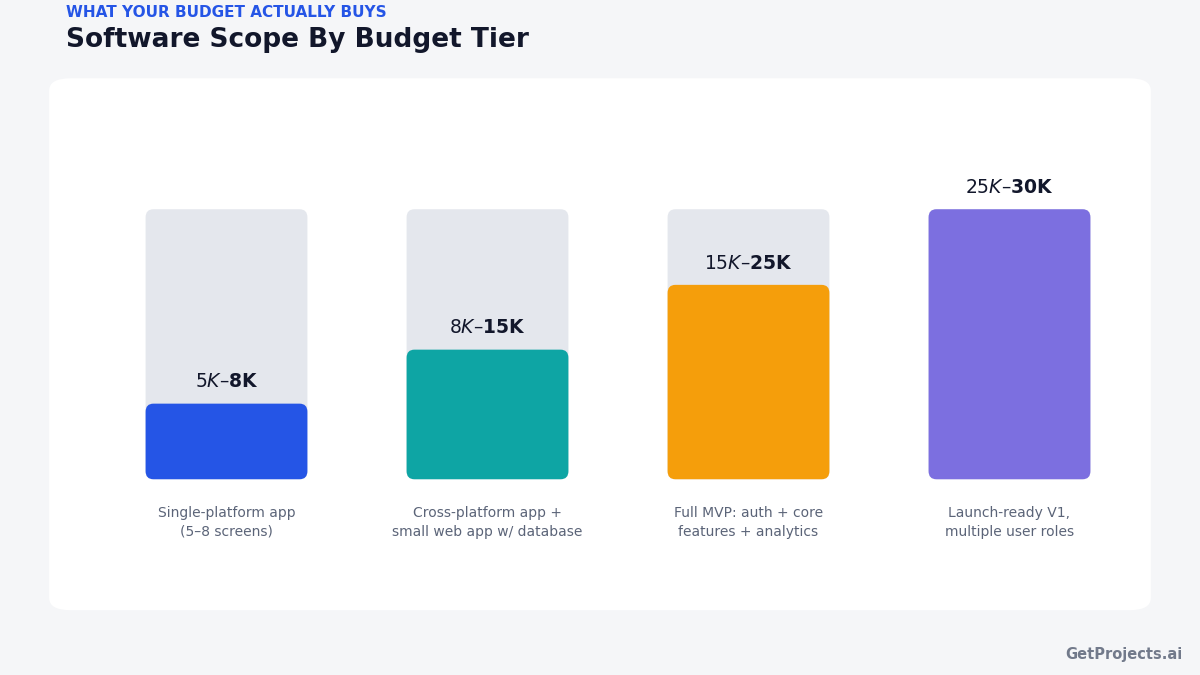
| $5K–$8K | Simple mobile app (one platform, 5–8 screens), Landing page with backend form + CRM integration, Basic admin dashboard | Full-featured SaaS, Multi-platform app, Anything with complex integrations |
| $8K–$15K | Cross-platform app (iOS + Android), Small web application with database, MVP with 3–5 core features, Basic API + admin panel | Enterprise-grade security, High-scale infrastructure, Complex third-party integrations |
| $15K–$25K | Full MVP with user auth + core features + basic analytics, E-commerce store with custom design + payment integration, IoT dashboard with sensor integration | Multi-tenant SaaS, Complex marketplace, Real-time features at scale |
| $25K–$30K | Solid V1 product with multiple user roles + integrations + launch-ready quality | Enterprise integrations, HIPAA/SOC 2 compliance from scratch, Machine learning features |
Engagement models at this budget level:
Fixed price is safer for well-defined projects where requirements are clear and unlikely to change. The agency quotes a total price, you pay in milestones, and scope is locked. The risk: if requirements are not clear, change requests add up quickly and can double the final cost.
Time and material is better for projects where requirements will evolve you are discovering as you build. You pay a weekly or monthly rate for the hours worked and retain flexibility to change direction. The risk: without strong project management on your side, scope can expand beyond your budget without clear accountability.
Red Flags to Watch for Before Signing
The most expensive mistake in software development is not choosing the wrong technology. It is signing a contract with the wrong agency. A bad agency at $10,000 costs you $10,000 plus 4 to 6 months of wasted time which for a startup is potentially fatal.
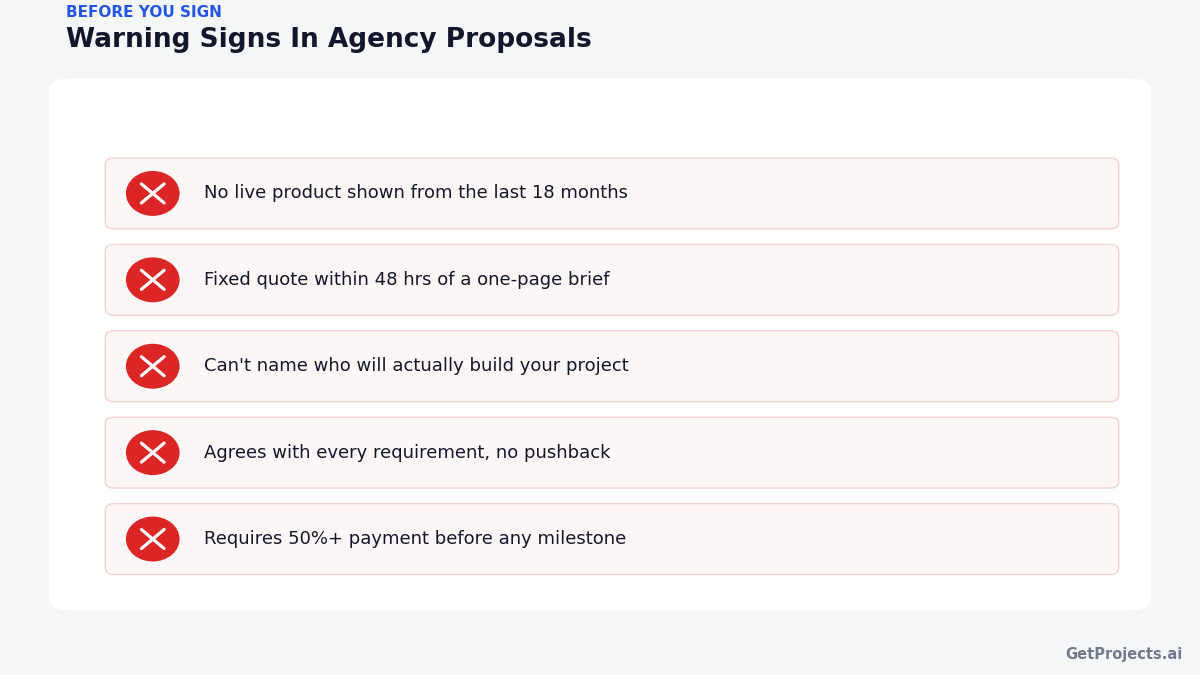
The seven warning signs that should pause any engagement:
An agency that cannot show you a live product they have built in the last 18 months has not built anything recently. Their knowledge is theoretical. Your project will be their training ground.
An agency that agrees with everything you propose in the sales process is not doing discovery; they are avoiding friction to close the sale. A good technical partner pushes back on requirements that do not make engineering sense, suggests simpler approaches, and flags assumptions that could become expensive later.
An agency that quotes a fixed price within 48 hours of a brief one-page requirements document is guessing. A quote that fast means they did not think about your project they applied a template price. Accurate quotes require at least a discovery conversation and ideally a scoping session.
An agency that cannot tell you the name and experience level of the developer who will work on your project is telling you that they do not know yet, meaning your project will be assigned to whoever is available when the project starts, not the person who sold you.
An agency that has never worked in your time zone and cannot commit to overlapping hours appropriate for the collaboration your project requires is optimising for their operational convenience, not your project success.
An agency that requires 50% or more payment upfront before any work is delivered is a risk signal. Milestone-based payment 20% kickoff, 30% after first deliverable, 30% after second, 20% at completion aligns incentives correctly.
An agency whose client testimonials are only from 2 to 3 years ago has not had a satisfied recent client willing to provide a reference. Something changed.
How GetProjects.ai Curates Its Agency Network
GetProjects.ai does not allow any agency to self-list with a paid placement. Every agency in our network has been reviewed against four criteria: verified portfolio with live products, at least 3 verifiable client references from the last 18 months, clearly defined technology specialisation, and demonstrated track record at the $5K–$30K project budget level.
We match buyers with agencies based on projects that fit your industry, your tech stack requirements, your budget, your timeline, and your geographic preference for the development team. You post your project once and receive proposals from 3 to 5 pre-vetted agencies whose work matches what you are trying to build.
The average time from project posting to first qualified proposal on GetProjects.ai is 18 hours. The average time buyers spend before selecting an agency is 5 to 7 days including portfolio reviews, reference calls, and proposal evaluation.
Post your project at getprojects.ai it takes 10 minutes and it is free.
Frequently Asked Questions
How do I know if a software development company is legitimate?
Four checks that take under an hour: verify their portfolio by downloading and using the apps they claim to have built, check the App Store listing, the review count, and when it was last updated. Search the company name on LinkedIn and verify that the team members listed actually work there with the experience claimed. Ask for two client references and actually call them not email, call. Check whether the company has been in business for more than 3 years and has a consistent web presence. Legitimate agencies welcome all of these checks. Agencies that push back on due diligence are telling you something important.
What is the minimum viable budget for a custom software project?
The minimum budget for a meaningfully functional custom software product, something you can actually test with users, is $5,000 to $8,000 with an Indian or Southeast Asian development team. Below this threshold, you are either getting a very limited feature set, a freelancer with no project management structure, or a template-based product with light customisation. If your genuine budget is below $5,000, the more honest assessment is that you should start with a no-code tool (Bubble, Webflow, Glide) to validate your concept before investing in custom development. A $3,000 custom development project almost never produces something that can be built on it produces technical debt that costs more to fix than to rebuild.
What is the difference between a software development company and a software development agency?
The terms are used interchangeably in the market. Both refer to a company that builds custom software for clients. Some larger organisations prefer “company” to signal institutional scale. Some smaller, more creative teams prefer “agency” to signal flexibility and design sensibility. The distinction that actually matters is not the name, it is whether the entity is primarily a technology business (engineers first, a few account managers) or primarily a services business (account managers first, engineers as a resource). Technology-first businesses produce better software. Services-first businesses produce better proposals and worse software.
How long does a $10,000 software development project take to complete?
At typical Indian agency rates of $20 to $30 per hour, $10,000 represents approximately 330 to 500 hours of development work. Depending on how that work is structured solo developer vs two-person team this takes 8 to 20 weeks. A two-person team (one frontend, one backend) working full-time on a $10,000 project can typically deliver a functional MVP in 10 to 14 weeks. A solo developer working part-time alongside other client projects typically takes 16 to 24 weeks for the same scope. Timeline is directly affected by requirements clarity every week of ambiguity adds a week to delivery. The most reliable way to compress the timeline is to invest heavily in discovery and specification before development begins.