How to Write a Software Development RFP That Gets Useful Responses The Complete Guide 2026
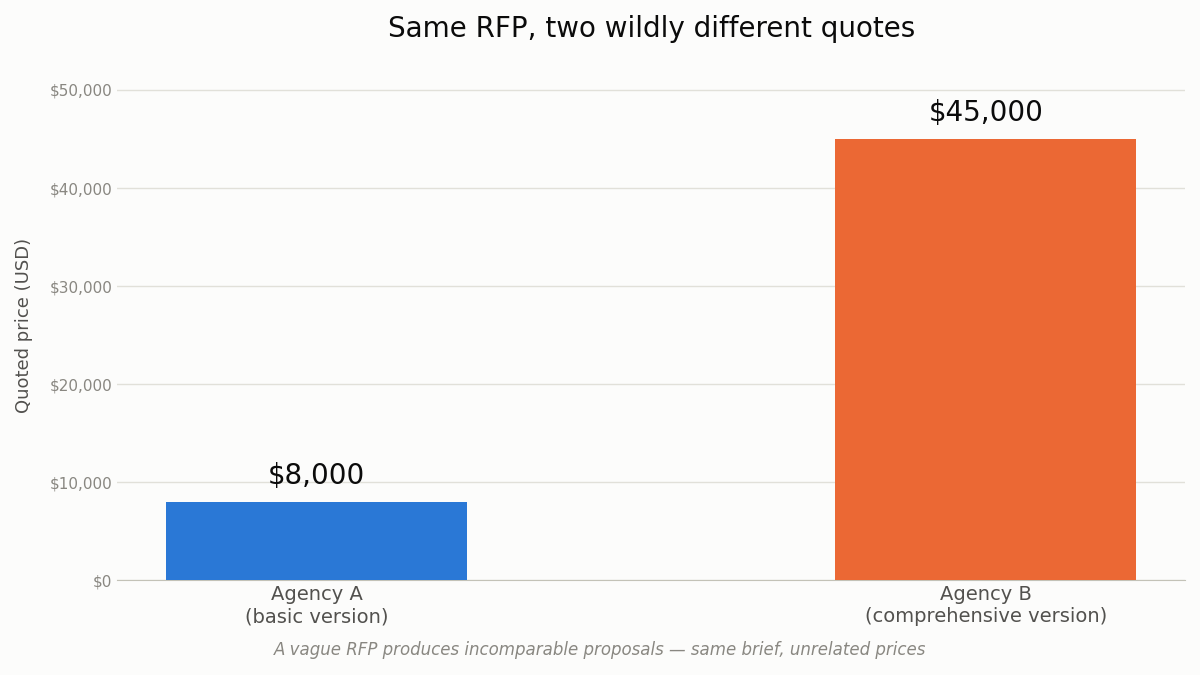
Most software development RFPs produce useless responses. Not because the agencies are incompetent because the brief was vague enough that every agency filled in the gaps with their own assumptions. One agency quoted $8,000 for a basic version. Another quoted $45,000 for a comprehensive version. Neither quoted for the same product, even though both were responding to the same document.
That’s why understanding how to write software development RFP documents properly is critical if you want accurate, comparable proposals from qualified vendors.
According to McKinsey Digital, large IT projects run 45% over budget on average, often due to unclear requirements and poor upfront planning. A well-structured RFP directly reduces this risk by aligning expectations from the start.
The purpose of a software development RFP (Request for Proposal) is to receive comparable proposals that allow you to make a genuine evaluation. When proposals are not comparable when each agency invented a different scope from the same brief the selection process becomes a guess. You pick the number that feels right and hope the scope matches what you wanted.
This guide shows you how to write an RFP that produces comparable, useful, accurate proposals from qualified agencies.
What a Software Development RFP Is and Is Not
An RFP is not a specification document. It is an invitation to collaborate on solving a problem, with enough context that qualified respondents can assess fit, propose an approach, and estimate a budget. If your requirements are already fully locked down to that level of detail, you may actually want a spec instead of seeing how to write software requirements for that format.
An RFP is also not a shopping list of features. A feature list without business context produces proposals that satisfy the feature list without solving the business problem. The agency that knows why you need user authentication behaves differently from the agency that just knows you need user authentication. The former asks whether existing authentication services are appropriate, the latter builds authentication from scratch. This is also the single biggest reason quotes come back impossible to evaluate side by side for a breakdown of what to do when that happens, see how to compare software development quotes.
What an effective software development RFP contains:
| Section | Purpose | Length |
| Background and context | Why you are building this the business problem | 1–2 paragraphs |
| Product description | What it does and who uses it | 2–3 paragraphs |
| Target users | Who will use the product with specifics | 1 paragraph |
| Core functionality | What the product must do functional requirements | 1–2 pages |
| Technical requirements | Platform, integrations, compliance constraints | 1 page |
| Out of scope | What you are explicitly not asking for | 1–2 bullet points |
| Timeline | When you need it and why | 1 paragraph |
| Budget range | What you are willing to spend | 1 sentence |
| Evaluation criteria | How you will choose the winning proposal | 1 paragraph |
| Response format | What you want agencies to provide | 1 paragraph |
Section by Section How to Write Each Part
Background and context:
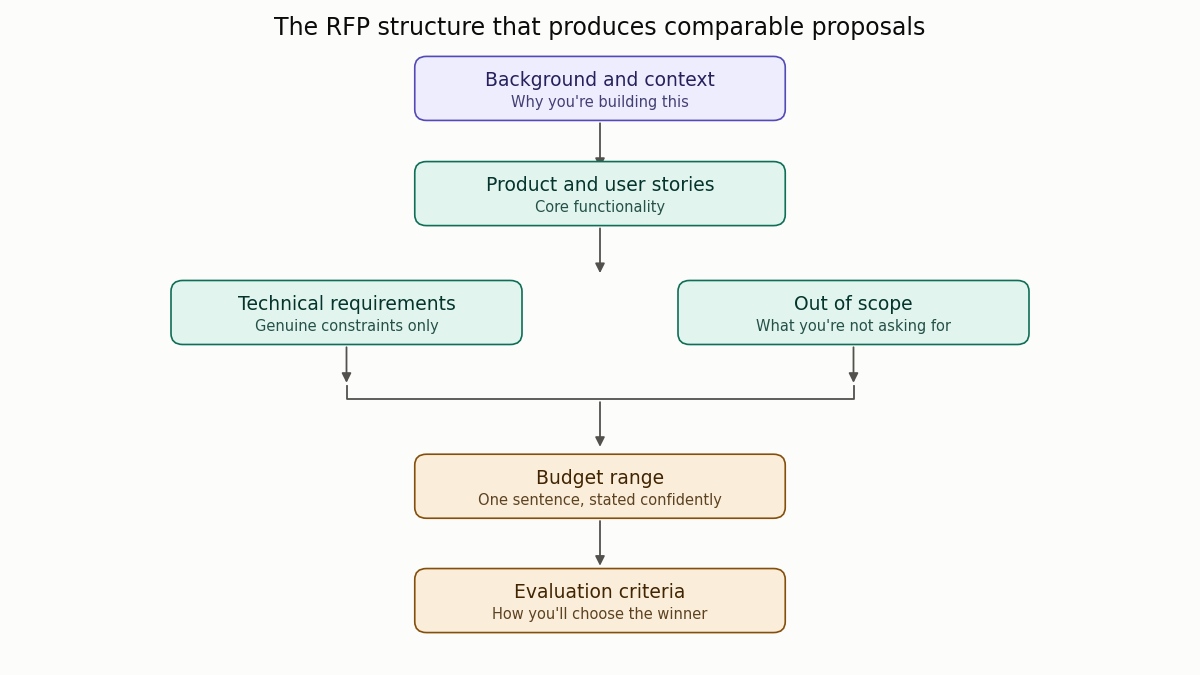
This is the section most RFPs skip and the section that most directly affects proposal quality. Tell the agency: what your company does, what problem you are solving with this software, why now, and what success looks like.
A weak background section: “We are a startup looking to build a booking platform.”
A strong background section: “We operate a network of 12 physiotherapy clinics in the UK. Currently, we manage appointments through a third-party booking system that does not integrate with our patient records or billing. We are losing approximately 20% of appointment slots to no-shows because we cannot send automated reminders through our own platform. We want to build a custom booking and patient management system that eliminates this dependency and enables the patient communication features the current system does not support.”
The strong version tells the agency your context, your problem, your current situation, and the specific outcome you want. Every sentence in it directly affects how they scope and price the response.
Core functionality:
This is the most important section of the RFP. It should describe what users can do with the product, not how it is built. Write it as user stories or use cases, not technical requirements.
User story format: “As a [user type], I want to [action] so that [benefit].”
Examples: As a patient, I want to book an appointment online at a time that suits me, so I do not have to call the clinic. As a clinic administrator, I want to see all upcoming appointments in a calendar view, so I can identify scheduling gaps. As a patient, I want to receive a reminder 24 hours before my appointment, so I remember to attend. If you’re scoping a similar patient-facing or clinic-facing product, our guide to building a telemedicine app breaks down the features and cost ranges you’d be asking agencies to scope against.
This format forces you to describe the product from the user’s perspective rather than from a technical specification perspective, and it gives agencies the context to make sensible architectural and scope decisions.
Technical requirements:
List the specific technical constraints that are genuinely fixed. Not preferences constraints.
Real technical requirements look like: must integrate with our existing Stripe account, must support HIPAA compliance, must work on iOS and Android, must connect to our existing PostgreSQL database.
Preferences that are not requirements look like: we prefer React, we think Node.js would be good, we would like a microservices architecture. Leave preferences out of the RFP or clearly label them as preferences; they constrain agency creativity without being genuine requirements.
Budget range:
This is the section most buyers omit and most buyers regret omitting. Stating a budget range does not get you overcharged. It produces better proposals.
When you state a budget of $10,000 to $18,000, agencies know they are proposing for a specific scope level. They do not propose a $5,000 minimal version or a $50,000 comprehensive version; they propose something appropriate for your stated budget. The proposals are comparable. You can evaluate them against each other. If you’re not yet sure what range is realistic for your project, our breakdown of custom software development costs by complexity tier is a useful starting point before you write the number down.
When you omit the budget, every agency proposes their own interpretation of what you want at whatever price they think you will pay. The proposals are incomparable. One agency proposes a $6,000 version with minimal features. Another proposes a $35,000 version with everything. You cannot evaluate them against each other because they are not the same product.
Out of scope:
Explicitly stating what you are not asking for saves everyone time and reduces the scope creep risk. If you do not want a mobile app just a web application say so. If you do not want integrations with your accounting software in this phase say so. Every ambiguity in scope becomes a disputed change request later. This is the same discipline that goes into scoping a lean first build see how to decide what belongs in your MVP for a closer look at drawing that line.
The Mistakes That Produce Bad Proposals
Mistake 1 Using technical jargon you do not fully understand:
“We want a microservices architecture with Kubernetes orchestration, a GraphQL API, and a React frontend with server-side rendering.” If you have strong reasons for each of these choices, include them. If you read about them and they sound good, leave them out. Specifying technical architecture without understanding why it is appropriate produces responses from agencies that either challenge your assumptions (good) or agree with specifications that are wrong for your project (bad).
Mistake 2 Asking for everything at once:
An RFP that lists 40 features across 8 user types for a $12,000 budget will receive either politely optimistic proposals that underscope everything, or honest proposals that tell you $12,000 builds 20% of what you asked for. Neither is productive. Before writing the RFP, decide what the minimum feature set is that makes the product worth building. If you’re unsure how to draw that line, our explainer on what an MVP actually is walks through the thinking. Ask for that. Put everything else in a Phase 2 section so agencies understand the full vision without scoping it.
Mistake 3 No evaluation criteria:
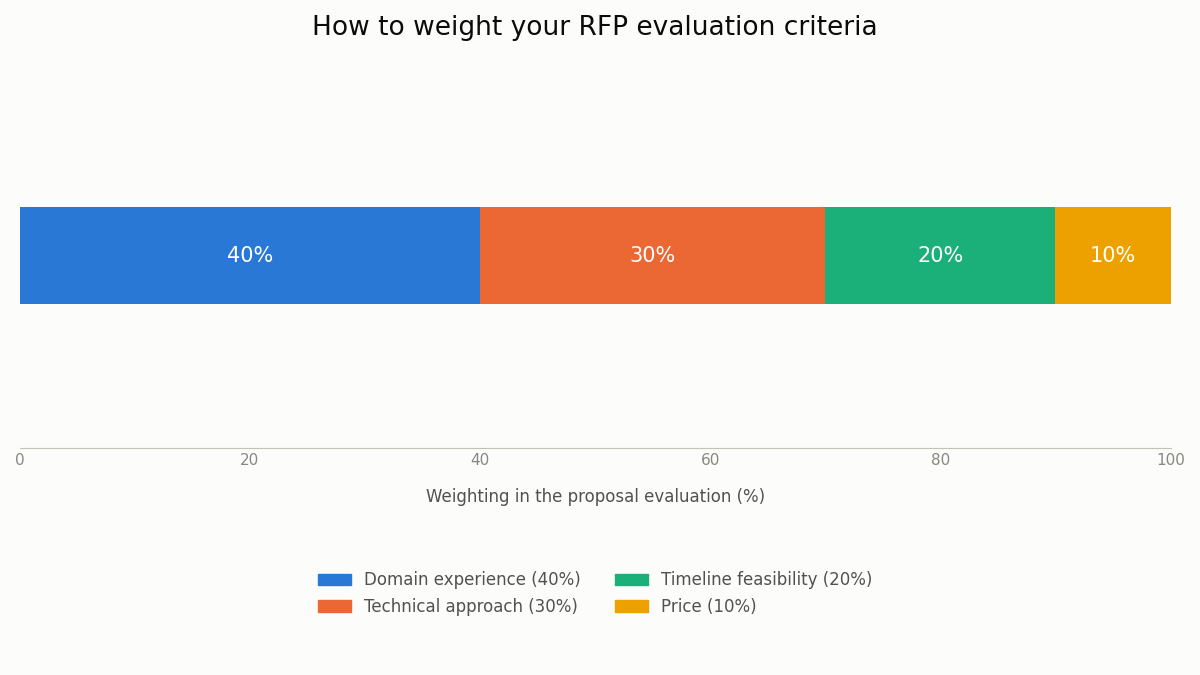
If you do not tell agencies how you will choose the winning proposal, you invite them to compete on price. The proposal with the lowest number wins, regardless of quality, experience, or fit. State your evaluation criteria clearly: domain experience in your industry (40%), quality of technical proposal and approach (30%), timeline feasibility (20%), price (10%). This calibration shifts competition from price to quality. For a fuller framework on weighing these factors once proposals arrive, see how to compare software development companies.
Mistake 4 Not asking for a technical approach:
The most useful part of a proposal is not the price, it is the technical approach section. How does the agency propose to solve your problem? What technology stack, what architecture, what approach to the most complex features? Agencies that have built similar products have considered approaches. Agencies that have not are guessing. The quality of the technical approach section is the best predictor of delivery quality.
Ask explicitly: “Please describe your proposed technical architecture and approach to the core features listed above.”
The RFP Format That Gets the Best Responses
Ideal length: 3 to 5 pages. Long enough to give genuine context. Short enough that busy agency principals actually read it.
Ideal structure:
| Section | Approximate Length |
| Company and context | 3–4 sentences |
| Problem being solved | 1 paragraph |
| Product description | 2–3 paragraphs |
| Core user stories | 10–20 user stories |
| Technical requirements | 5–10 bullet points (genuine constraints only) |
| Out of scope for this phase | 3–5 bullet points |
| Timeline and milestones | 2–3 sentences |
| Budget range | 1 sentence |
| What you want in the proposal | 1 paragraph |
| Evaluation criteria | 3–5 criteria with rough weightings |
What to request in proposals:
Ask every agency to provide: a proposed technical approach and architecture overview, a feature scope based on your budget range, a project timeline with major milestones, a team composition (who will work on this and at what level), a fixed price or time-and-material estimate with a clear scope assumption if you want a sense of what reasonable rates look like before comparing quotes, see software developer hourly rates by country two or three references from similar projects they have completed, and at least one live product they have built that is the most similar to what you are asking for.
Using GetProjects.ai as Your RFP Distribution Channel
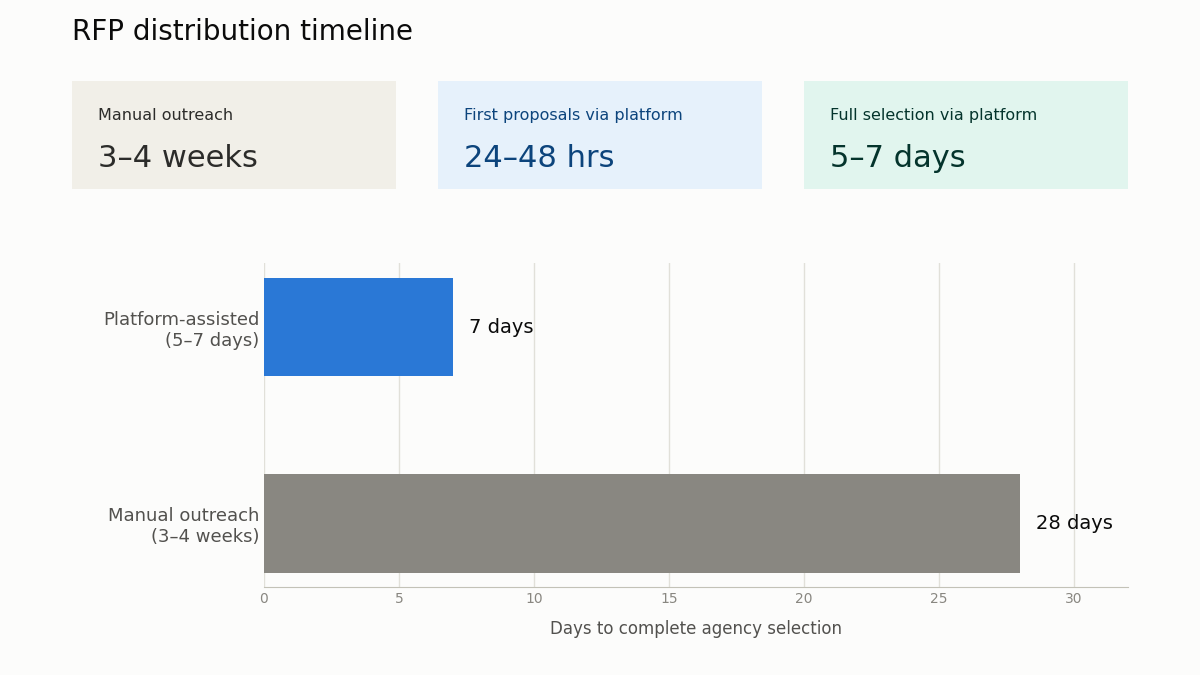
Writing the RFP is only half the challenge. Distributing it to qualified agencies without spending 3 weeks on agency outreach, cold emails, and qualification calls is the other half.
GetProjects.ai allows you to post your project brief once and receive proposals from pre-vetted agencies whose portfolios are relevant to your project. The platform matches your brief against the agency network based on: technology specialisation, industry experience, project budget range, and geographic preference. You receive 3 to 5 proposals from agencies that have already been verified to have relevant experience, not a directory of 200 agencies where you start from scratch.
The typical timeline on GetProjects.ai: post your project brief, receive first proposals within 24 to 48 hours, complete your evaluation and selection within 5 to 7 days. Compared to 3 to 4 weeks of manual outreach, qualification, and proposal collection, the efficiency is significant.
Post your project at getprojects.ai it is free for buyers and takes 10 minutes.
Frequently Asked Questions
Should I include my budget in the RFP?
Yes and do it confidently. Stating your budget does not get you overcharged; it gets you appropriately scoped proposals. When agencies know your budget, they propose a scope that fits it rather than proposing everything and hoping you can afford it. The result is proposals you can actually compare because they are scoping for the same resource level. The one caveat: state a range ($12,000 to $18,000) rather than a fixed number that gives agencies room to propose their optimal scope within the range and signals that you have flexibility without creating a race to the bottom at the lower number.
How many agencies should I send an RFP to?
Three to five is the optimal number for a $5K to $30K project. Fewer than three gives you insufficient comparison points. More than five creates evaluation overhead that rarely produces a better outcome; the right agency is almost always in your first three to five if they were selected based on relevant portfolio match rather than mass outreach. Sending an RFP to 20 agencies produces 20 proposals that you cannot meaningfully evaluate, not a better selection. Shortlist on portfolio relevance before sending the RFP.
What is the difference between an RFP and an RFQ?
An RFP (Request for Proposal) asks agencies to propose a solution; they interpret your requirements, suggest an approach, and provide a price based on their proposed scope. It is appropriate when you want agencies to contribute their expertise to the solution design. An RFQ (Request for Quotation) asks agencies to price a pre-defined specification you have already determined exactly what you want built and you want the lowest price to build it. It is appropriate when your specification is complete and requirements are fully locked. For most software development buyers at the $5K to $30K level, an RFP is more appropriate if you have a business problem and a general sense of the product, but you want the agency’s expertise to help shape the technical solution.
What happens if proposals come back significantly over my budget?
Three responses are appropriate depending on the situation. If all proposals are over budget, your scope expectations do not match your budget. Either increase your budget or reduce your scope by prioritising the features that are essential for the MVP and moving everything else to a later phase. If some proposals are within budget and some are over, the over-budget proposals may be proposing a more complete scope than the in-budget ones evaluate whether the additional scope is worth the additional cost or whether the in-budget scope is sufficient to validate your hypothesis. If all proposals are significantly under budget, you likely provided enough context for agencies to scope conservatively and there may be scope elements you assumed were included that are not scheduled discovery calls to verify what is and is not in each proposal before making a selection.