Work for Hire Clause in Software Development: What It Means for You
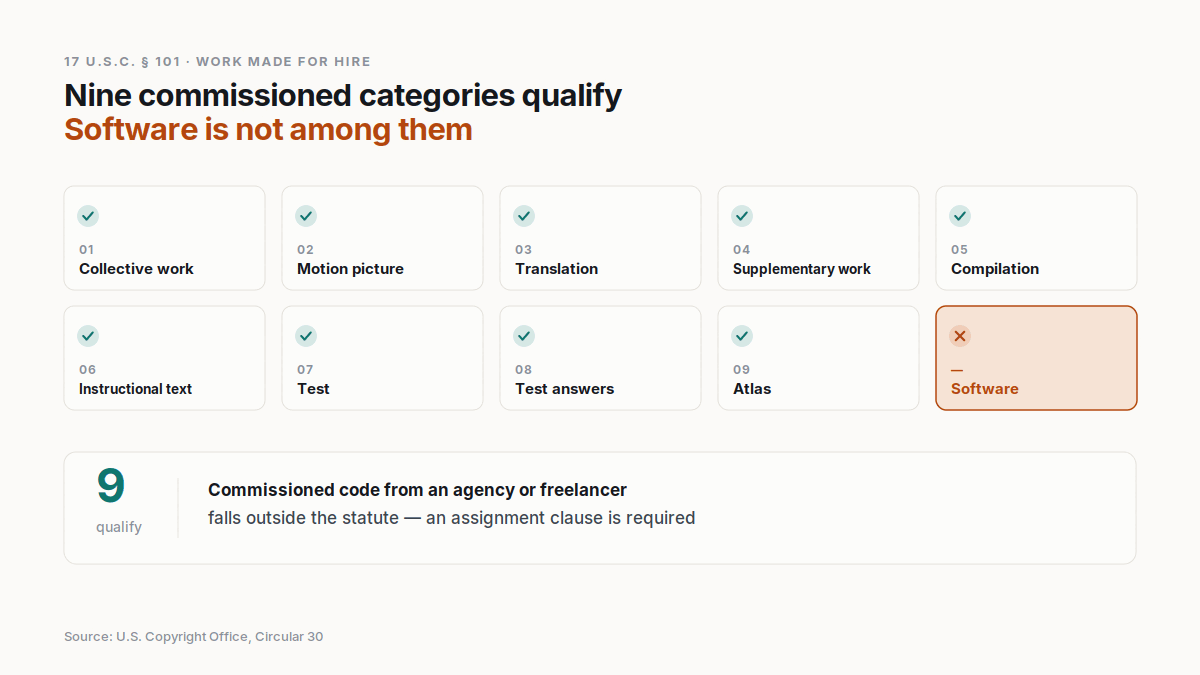
Nine categories of commissioned work can legally become “work made for hire” in the United States when the creator is not your employee. Software is not one of them.
That single omission is the reason a work for hire clause software development contracts have used for decades quietly fails to transfer ownership of the code you paid for. The clause looks decisive. It reads like a transfer. In a dispute, it frequently does nothing at all.
Under Section 101 of the US Copyright Act, a specially ordered or commissioned work qualifies as a work made for hire only if it falls into one of nine enumerated categories a contribution to a collective work, part of a motion picture or audiovisual work, a translation, a supplementary work, a compilation, an instructional text, a test, answer material for a test, or an atlas. Computer programs appear nowhere in that list.
The practical consequence is uncomfortable. When you commission a product from an agency or an independent developer and your contract says only that the deliverables are a work made for hire, the default rule under 17 U.S.C. § 201 applies: the author owns the copyright. The author is the developer, not you.
This does not surface during the build. It surfaces at a funding round, an acquisition, a security review, or the moment you try to move the codebase to a new vendor. By then the original contributors may have left, the agency may have been acquired, and your leverage is gone.
The fix is not complicated, and it is not expensive. It is roughly 180 words of contract language that most teams never read closely enough to notice is missing.
What Is a Work for Hire Clause in Software Development?
A work for hire clause software development agreements contain is a provision stating that deliverables created for a client are owned by the client from the moment of creation, with the client treated as the legal author. Under US copyright law the designation only holds for employees, because commissioned software sits outside the nine statutory categories.
That definition carries two immediate implications. First, work produced by your own salaried engineers within the scope of their employment genuinely is a work made for hire; the clause is accurate there. Second, work produced by an agency, a freelancer, or an offshore development partner almost never is, regardless of what the paperwork says.
The Core Problem: Who Owns Work for Hire Software by Default
Ownership does not follow the invoice. It follows authorship, and who owns work for hire software is decided by statute rather than by commercial intent or payment history.
The Supreme Court settled the framework in Community for Creative Non-Violence v. Reid (1989), holding that courts must first determine whether the creator was an employee under common-law agency principles. If the creator is an independent contractor, the first prong of the work-made-for-hire definition is unavailable and the second prong requires the work to fit one of the nine categories. Software fits none of them.
In Aymes v. Bonelli, the Second Circuit applied exactly this reasoning to a programmer and found he was a contractor, leaving copyright in the programs with him rather than the business that commissioned them.
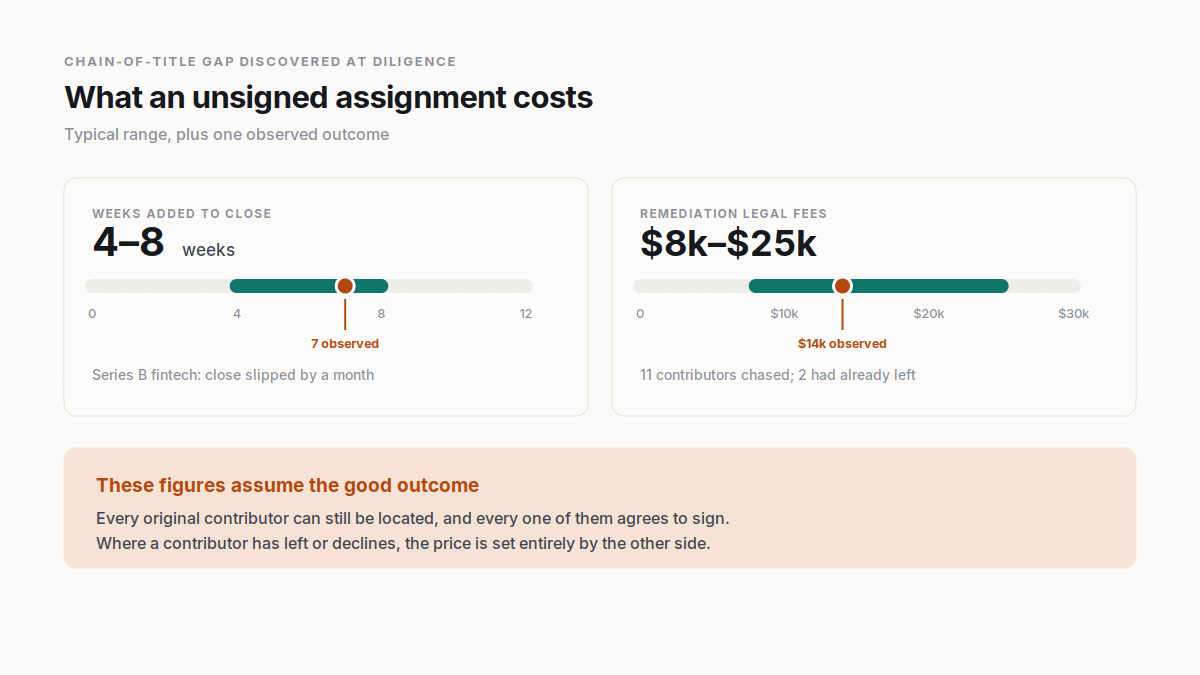
The commercial exposure is concrete. In a Series A or Series B diligence process, IP chain-of-title gaps typically add 4 to 8 weeks to a close and $8,000–$25,000 in remediation legal fees, and that is the good outcome, where every original contributor can still be located and is willing to sign.
Where a contributor has left, been acquired, or simply declines, remediation cost stops being the issue. A single unsigned assignment from a developer who wrote an authentication module can force a rewrite, or a negotiated buyout at a price set entirely by the other side.
Work for Hire vs Assignment: What Each Clause Actually Does
The distinction in work for hire vs assignment is not stylistic. The two clauses operate on completely different legal mechanics, and only one of them works reliably for commissioned code.
Why Work Made for Hire Code Usually Falls Outside the Statute
A work-made-for-hire designation is a status claim: it asserts that you were the author from the start, so no transfer ever needed to occur. Because that status is defined exhaustively by statute, you cannot create it by agreement. Two parties can write “this software shall be a work made for hire” into a contract and still produce work made for hire code that the statute does not recognise as such.
An assignment is a transfer claim: it concedes the developer was the author and moves the rights to you. Section 204(a) requires that transfer to be in writing signed by the assignor, which is the same low evidentiary bar as the NDA you signed at kickoff and entirely within your control.
Present Assignment Language Beats a Promise to Assign
The wording matters more than most procurement teams expect. “Contractor agrees to assign” is a promise of a future act, enforceable as a contract claim, but it leaves title with the developer until a further document is signed. “Contractor hereby irrevocably assigned” is a present assignment that moves title on execution.
The Supreme Court’s decision in Board of Trustees of Stanford University v. Roche (2011) turned on this exact difference in the patent context, and the drafting lesson transfers directly to software. Use the present tense.
Work for Hire Limitations That Surface Years Later
The work for hire limitations most teams never plan for are the ones with long fuses:
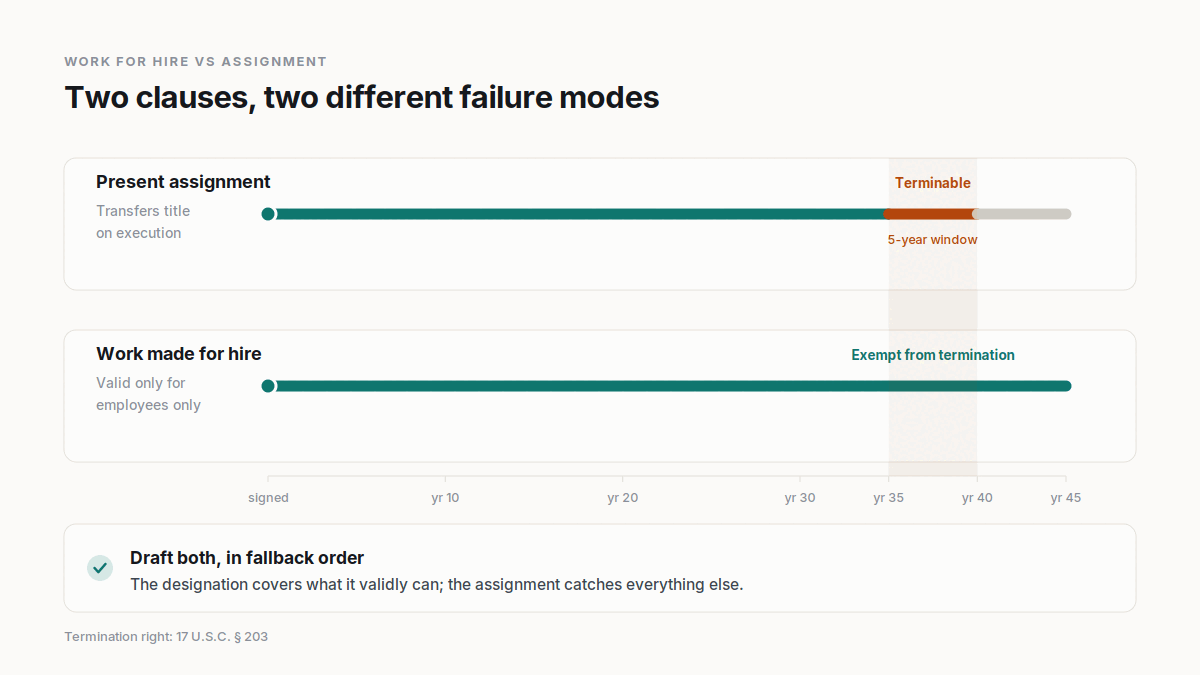
- The 35-year termination right. Under 17 U.S.C. § 203, an author who assigns copyright can terminate that grant during a five-year window beginning 35 years after execution. Works made for hire are exempt. A pure assignment is therefore terminable; a valid work made for hire is not. For long-lived platform code, this is a real reason to keep both provisions.
- Statutory employee reclassification. California Labor Code § 3351.5(c) and Unemployment Insurance Code §§ 621(d) and 686 deem a person commissioned under a signed work-made-for-hire agreement an employee of the commissioning party for workers’ compensation, disability and unemployment insurance purposes where that party takes ownership of all rights in the copyright. Contracting with an individual in California, the clause that was meant to protect you can create payroll tax and insurance exposure instead.
- Cross-border silence. The doctrine is a US construct. UK law (CDPA 1988, s.11) vests ownership in employers only, not clients of contractors. Indian law distinguishes a contract of service from a contract for service to the same effect. An offshore agency agreement resting on work-for-hire language alone transfers nothing in either jurisdiction.
How to Draft an IP Assignment Clause for Software: The Eight Components
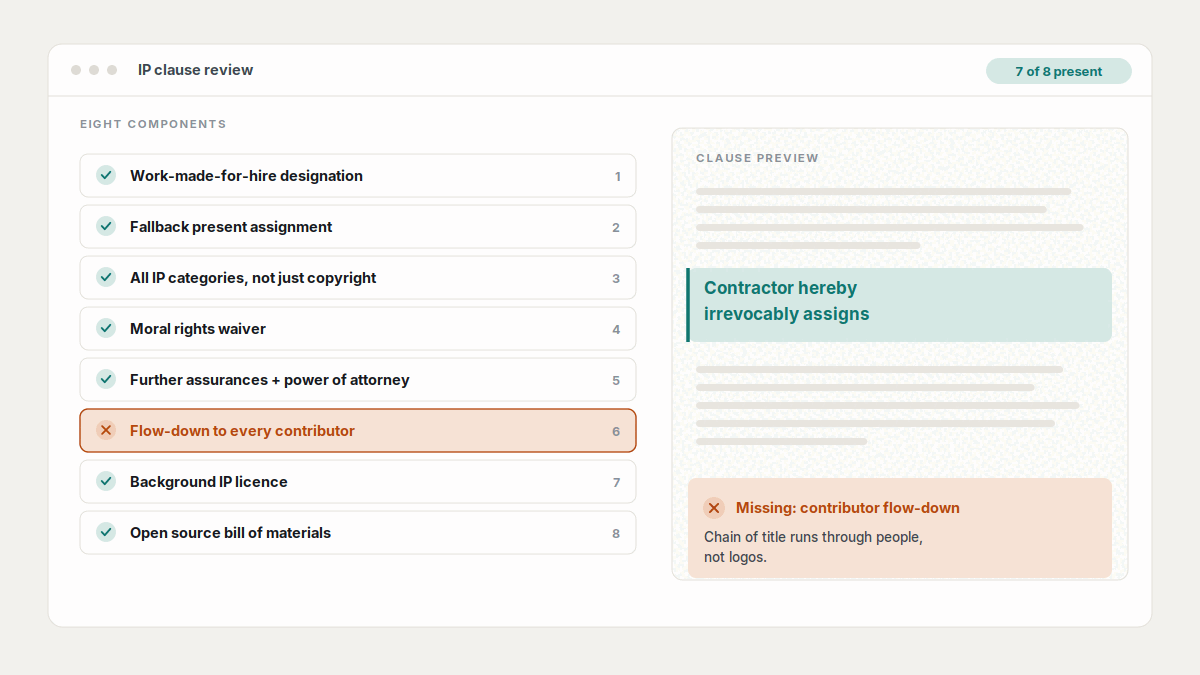
A defensible contractor ip clause is layered rather than single-shot, and belongs in the same review pass as the rest of your contract review. Include all eight:
- Work-made-for-hire designation claims it where it might validly apply, particularly for documentation, training materials and compilations that can genuinely fit the statutory categories.
- Fallback present assignment “to the extent any deliverable does not qualify as a work made for hire, Contractor hereby irrevocably assigns…”
- All IP categories, not just copyright patents, trade secrets, database rights, trademarks and the right to sue for past infringement.
- Moral rights waiver material in the EU, UK, Canada and India, where attribution and integrity rights survive assignment.
- Further assurances and power of attorney obliges the developer to sign perfecting documents, and lets you sign on their behalf if they go silent.
- Flow-down to every contributor the agency must hold equivalent signed assignments from each employee and subcontractor before they touch the repository.
- Background IP licence the agency keeps its reusable libraries but grants you a perpetual, irrevocable, worldwide, sublicensable, royalty-free licence to everything embedded in your deliverables.
- Open source bill of materials a complete component and licence inventory, with prior written approval required for copyleft dependencies.
Belt-and-Braces Wording You Can Adapt
Ownership of Work Product. All deliverables, software, source code, object code, documentation, designs, specifications and other materials created by Contractor for Client under this Agreement (the “Work Product”) shall be considered a “work made for hire” as defined in 17 U.S.C. § 101, and Client shall be the sole author and owner of all rights therein.
To the extent any Work Product does not qualify as a work made for hire, or such designation is held invalid or unenforceable for any reason, Contractor hereby irrevocably assigns, transfers and conveys to Client, exclusively and throughout the world, in perpetuity, all right, title and interest in and to the Work Product, including all copyrights, patent rights, trade secret rights, database rights and all other intellectual property rights therein, together with all rights to sue for past, present and future infringement.
Contractor waives, and agrees not to assert, any moral rights, rights of attribution and rights of integrity in the Work Product to the fullest extent permitted by applicable law. Contractor shall, at Client’s expense, execute all documents and take all actions reasonably necessary to perfect, record and enforce Client’s ownership, and irrevocably appoints Client as its attorney-in-fact to execute such documents if Contractor fails to do so within ten (10) business days of written request.
Contractor shall procure equivalent written assignments and waivers from every employee, subcontractor and individual contributor prior to their performance of any work hereunder.
Pair that with a background IP provision, a source code escrow arrangement where the agency hosts or operates anything you depend on, and where you contract with individuals in California a carve-out stating that the work-made-for-hire designation applies only to the extent it does not confer statutory employee status.
Real-World Application
Anonymised scenario 1 fintech, Series B. A US payments startup built its core ledger with an 18-person offshore agency under a master services agreement whose IP section contained a work-made-for-hire designation and nothing else. Acquirer’s counsel flagged the chain of title during diligence; the company spent seven weeks and roughly $14,000 chasing confirmatory assignments from 11 contributors, two of whom had already left the agency. The close slipped by a month.
Anonymised scenario 2 retail enterprise. A retailer commissioned a recommendation engine from a specialist agency and inherited the same silent contract, with no ownership confirmation tied to payment milestones. When the retailer moved to a new vendor, the original agency asserted ownership of the internal ranking library embedded in the deliverable not unreasonably, since nothing addressed background IP. The dispute settled with a $40,000 perpetual licence for code the retailer had already paid to have integrated.
Both outcomes were preventable during vendor selection, not during litigation.
Decision Framework: Choosing the Right Ownership Structure
| Contract approach | What it actually transfers | Where it fails | Best used for |
| Work made for hire only | Nothing, for commissioned code | Software is outside the nine § 101 categories; no effect outside the US | Salaried employees only |
| Present assignment only | Full copyright and IP on execution | Terminable by the author after 35 years under § 203 | Short-lived or project-specific builds |
| Both, in fallback order | Whichever is legally valid, automatically | Requires a California carve-out when contracting with individuals | Core platform and long-lived product code |
| Assignment plus licence-back | Client owns; agency licensed for reusable components | Needs a precise background IP schedule to avoid ambiguity | Agencies with substantial proprietary libraries |
Use this during evaluation, not after selection. Asking three shortlisted agencies for their standard IP clause takes an afternoon and tells you more about their maturity than any case study deck.
What Most Teams Get Wrong
The dominant failure is not ignorance of the law. It is treating the IP clause as boilerplate owned by nobody.
Procurement negotiates rate cards. Engineering negotiates scope and delivery milestones. The IP section arrives in the agency’s template, survives redlining untouched because it looks protective, and is never revisited. The work for hire clause software development vendors ship in their standard master services agreement is usually inherited from a US media template written for film and publishing, industries where several of the nine categories genuinely apply.
The second failure is subcontractor blindness. A signed assignment from the agency entity is worthless if the agency never obtained assignments from the individual developers who wrote the code. The chain of titles runs through people, not logos. Ask for evidence of contributor-level assignments before the first sprint, not during diligence.
The third is attaching IP terms to the statement of work rather than the master services agreement. SOWs get superseded, amended, and occasionally lost. Ownership belongs in the MSA, where it survives the engagement.
A blunt corollary: an agency that pushes back hard on a standard present assignment is telling you something useful. Either they intend to reuse your code, or they do not control their own contributor agreements. Both are disqualifying, and both are visible before you sign.
Comparing vendors on verified profiles and published terms as marketplaces like GetProjects are structured to allow makes that signal easier to read early, while you still have alternatives.
Before You Sign the Next Development Agreement
Pull your three most recent vendor contracts and search the IP section for the phrase “hereby assigns.” If it is absent, you have a remediation task cheapest today, most expensive at diligence.
If you are scoping a new build and want to compare verified agencies whose terms you can review before committing, GetProjects connects businesses directly with vetted IT companies at 0% commission, with no bidding and no listing fees. Post the project, review the IP clause alongside the rate card, and make ownership part of vendor selection rather than an afterthought.
Frequently Asked Questions
Is software a work made for hire?
Only when your own employees write it within the scope of employment. Commissioned software from a contractor or agency cannot qualify under the second statutory prong, because computer programs are not among the nine categories listed in 17 U.S.C. § 101. A separate copyright assignment clause is required to move ownership.
Who owns the code written by a contractor?
The contractor, by default. Copyright vests in the author at the moment of creation, and payment alone does not transfer it. Without a signed written assignment, a client typically holds only an implied licence to use the deliverable for its intended purpose, not the right to modify, relicense or sell it.
What is the difference between work for hire and assignment?
A work-made-for-hire designation asserts you were the author from the outset and is available only in statutory circumstances. An assignment concedes the developer authored the work and transfers the rights to you, requiring only a signed writing. Assignment is broadly enforceable; work for hire is narrow and frequently unavailable for code.
Does a work for hire clause work outside the United States?
No. It is a US-specific doctrine. UK, EU, Canadian and Indian law all default to the creator or, for employees, the employer with no equivalent mechanism for clients of contractors. Offshore development agreements need an express assignment plus a moral rights waiver governed by a clearly stated jurisdiction.
Can a developer reclaim rights 35 years after signing?
Yes, under 17 U.S.C. § 203, authors or their heirs can terminate a copyright grant during a five-year window opening 35 years after execution. Works made for hire are exempt from termination. This is the one situation where including both provisions genuinely helps, since the work-for-hire designation may hold for some deliverables.
What should an IP clause in a software contract include?
At minimum: a work-made-for-hire designation, a fallback present assignment covering all IP categories, a moral rights waiver, further assurances with power of attorney, contributor-level flow-down, a background IP licence, and an open source bill of materials. Reviewing an agency’s standard clause against that list before shortlisting takes under an hour.