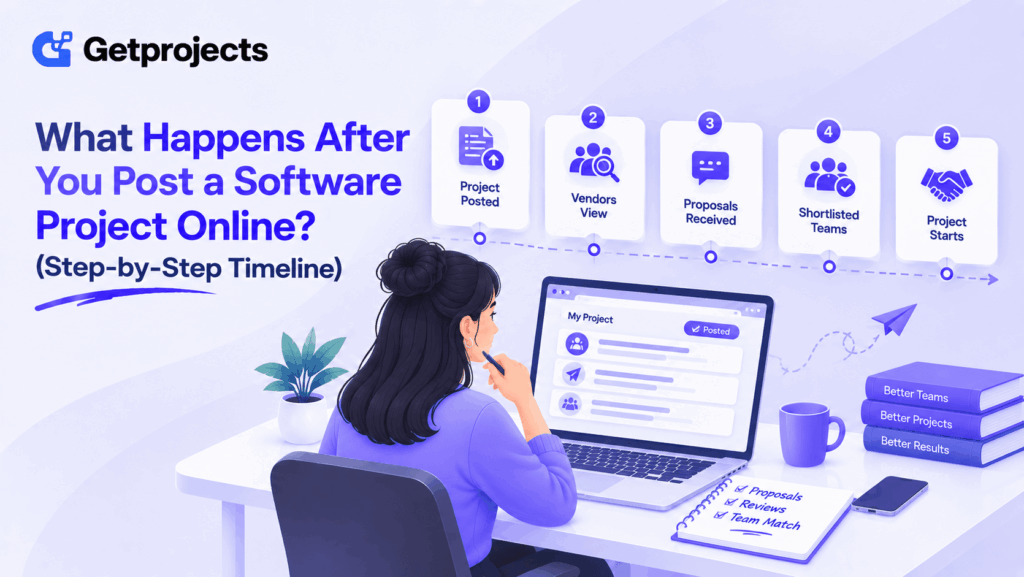
What Happens After You Post a Software Project Online (Step-by-Step Timeline)
Most teams assume the hard part of hiring a development partner is writing the brief. The evidence points somewhere else. A large share of failed vendor searches die in the seven days after submission, the stretch where nothing visible happens, the buyer loses confidence in the channel, and the project quietly goes back to the incumbent contractor who was already too expensive.
That silence is the real conversion killer, and understanding what happens after posting a software project online is what removes it. Buyers who know the sequence when matching runs, when profiles arrive, who reaches out first stay in the process. Buyers who don’t assume the form went nowhere and abandon it within 48 hours.
Gartner’s B2B buying research found that buyers spend only about 17% of their total purchase journey meeting with potential suppliers and when comparing multiple vendors, that time drops to roughly 5–6% per supplier. Buyers aren’t short on options; they’re short on time to evaluate them.
That statistic reframes the whole exercise. If a founder has five or six hours of real evaluation time across an entire vendor search, every hour spent filtering unqualified outreach is an hour not spent on technical due diligence. The value of a structured posting process isn’t speed for its own sake, it’s compression of the evaluation window.
This guide breaks down the sequence hour by hour: what runs automatically, what a human reviews, how long verification takes, how many agencies you should expect, and what the first conversation looks like. It also covers where the process breaks on bidding platforms and paid directories, and how to judge whether a match is actually qualified or just available.
What Happens After Posting a Software Project Online, Step by Step
What happens after posting a software project online is a four-stage sequence: the brief is parsed and normalized, an AI matching layer scores agencies against 50+ data points, a manual review confirms fit and verification status, and a shortlist of 3–5 matched agencies is delivered typically within 24 hours with portfolios, team size, and ratings attached.
That definition holds on a commission-free marketplace built on a direct matching model. It does not hold on bid-based platforms, where the sequence is inverted: your brief is broadcast publicly, and inbound volume replaces curation.
The Core Problem: Agency Response Time After Posting Is Either Instant or Invisible
Buyers experience two failure modes, and they’re mirror images of each other. On open bidding platforms, agency response time after posting is measured in minutes; a brief for a mid-sized fintech build can attract 40 to 80 proposals in the first 24 hours, most of them templated, many from firms with no domain overlap at all. On directory-style listings and RFP portals, the opposite happens: nothing arrives for four to nine days, because agencies are manually scanning listings between client deliveries.
Neither outcome produces a usable shortlist of agencies. The first buries signal under volume; the second produces so little momentum that the buyer starts cold-emailing firms they found on Google.
The cost is measurable. Teams that run an unstructured vendor search for a $40,000–$120,000 build typically spend three to five weeks between first outreach and signed SOW. Roughly 60–70% of that time is spent on agencies that were never a realistic fit, wrong stack, wrong budget band, wrong engagement model.
There’s a second-order cost most teams don’t price in. Engineering leads pulled into six redundant discovery call cycles lose 8–12 hours of build time, and the delay pushes the actual kickoff past the quarter it was budgeted in. A two-week sourcing delay on a six-month build is not a two-week delay; it’s a missed release window.
The question buyers actually need answered isn’t “who’s available.” It’s whether the process behind the form does the filtering before contact, or offloads it onto them afterward.
The Full Agency Matching Timeline Explained
This section covers the mechanics of what runs, in what order, and how long each stage takes. The agency matching timeline explained below reflects a direct-connect model with no bidding stage, which is what changes the shape of the curve.
Hour 0: Brief Submission and Normalization
Submission takes under two minutes and requires far less than most teams expect. A structured project brief needs only a working description of the outcome, a budget band, a target timeline, and any hard constraints, compliance requirements, existing stack, in-house team composition.
You do not need a finished technical spec. Roughly half of briefs submitted are scoping-stage, and the matching layer treats a defined scope of work as a signal to weight toward agencies with strong discovery practices rather than pure execution shops.
The system then normalizes the brief: mapping loose phrasing like “an app for logistics tracking” to concrete service categories, tech stacks, and delivery models so it can be scored consistently against agency data.
Hours 0–2: AI Matching Across 50+ Data Points
Matching is not keyword lookup. The engine compares your brief against more than 50 agency data points, domain expertise, past client profile, project size history, delivery performance, review sentiment, geography, and hourly rate benchmarks against your stated budget.
Budget fit does more work here than buyers expect. An agency that delivers excellent $250,000 enterprise platforms is a bad match for an $18,000 MVP, and vice versa. Scoring for budget bands alone eliminates a large share of wasted conversations.
Hours 2–20: Manual Review and Verification Confirmation
Automated scoring produces a candidate set; a human pass confirms it. Reviewers check that the agencies surfaced actually have current capacity, that the agency vetting process is complete for each one, and that nothing in the brief, a regulated industry, an unusual integration, makes a high-scoring match unsuitable in practice.
Verification itself happens before any profile goes live, not after you post. It’s layered: website ownership, email domain validation, independent review checks, and confirmation of team size and portfolio claims. Only verified firms enter the matching pool.
This is the stage buyers can’t see, which is exactly why what happens after posting a software project online feels opaque on most platforms. Nothing is broken during these hours; the filtering is doing its work.
Within 24 Hours: Your Shortlist Arrives
You receive 3–5 matched agencies, each with verified agency profiles covering portfolio work, team composition, ratings, service focus, and rate range. Three to five is deliberate. Below three, you have no comparison basis; above six, evaluation quality drops sharply as teams start skimming instead of assessing.
There is no bidding stage and no proposal inbox. Connection is direct: you reach out, or the agency reaches out, and the conversation starts from the brief rather than from a sales pitch.
Days 1–4: Discovery Calls and Comparison
Most buyers run two to four calls in this window, 30–45 minutes each. The useful ones cover team allocation, a comparable past build, how change requests are priced, and who owns the code and repositories.
Days 4–10: Proposal, Scope Lock, and Kickoff
Scoped proposals typically land three to six days after the first call. Teams that hold to the shortlist rather than reopening the search sign inside two weeks of posting.
The condensed sequence:
- Submit the brief (under 2 minutes) outcome, budget band, timeline, constraints
- Automated normalization and mapping to service categories
- AI matching across 50+ data points, weighted for budget and domain fit
- Manual review and verification confirmation
- Shortlist of 3–5 verified agencies delivered within 24 hours
- Direct connection no bids, no proposal queue, no platform intermediary
- Discovery calls (days 1–4), scoped proposals (days 4–10), kickoff
What to Expect After Posting Project: Two Real-World Patterns
These two examples show what to expect after posting project briefs at different scoping maturity levels.
Case 1 Seed-stage logistics startup, $35,000 MVP. The founder had a one-page brief and no technical co-founder. Four matched agencies arrived within 19 hours; two were eliminated on the first call over rate structure. The team signed on day 9 and cut an estimated three weeks off a search that had already burned 11 days on cold outreach.
Case 2 Mid-market healthcare platform, HIPAA-scoped rebuild. The buyer’s prior attempt on a bidding marketplace produced 63 proposals in 36 hours, of which four had genuine compliance experience. Re-posted through a curated process, the brief returned three agencies with verified healthcare portfolios in under 24 hours. Evaluation time dropped from an estimated 14 hours to roughly 4.
Project Posting Process Explained: How the Models Compare
Buyers rarely compare sourcing models; they compare individual agencies and assume the channel is neutral. It isn’t. With the project posting process explained across the four common routes, the trade-offs become concrete.
| Model | First response | Agencies to evaluate | Cost to buyer | Filtering burden |
| Open bidding marketplace | 5–60 minutes | 40–80 proposals | 10–20% commission (priced into quotes) | On the buyer |
| Paid-listing directory | 4–9 days | Unlimited, unranked | Free to browse; $499+/yr for agencies | On the buyer |
| Referral / network | 2–10 days | 1–3 | None | Low, but no comparison set |
| Curated no-bid marketplace | Within 24 hours | 3–5 verified | Free to post; no commission | On the platform |
The commission column matters more than it looks. A 15% platform cut on a $90,000 build is $13,500 that agencies recover somewhere usually through inflated estimates or reduced senior involvement.
What Most Teams Get Wrong
The most common mistake is treating the shortlist as a starting point for further search rather than a decision set. Buyers who receive four strong matches and then spend nine more days collecting three additional options almost never choose one of the extras they choose from the original four, two weeks later.
The second mistake is over-specifying the brief. Teams delay posting for three weeks to produce a 40-page requirements document, believing precision improves matching. In practice, a detailed spec written without agency input mostly encodes assumptions that get renegotiated in week two anyway. A clear outcome, a real budget band, and honest constraints match better than false precision.
The third is misreading silence. Buyers who don’t know what happens after posting a software project online interpret the verification window as rejection and re-post elsewhere, fragmenting their own search across three channels.
And the fourth: evaluating agencies on portfolio aesthetics instead of team continuity. The right question is not “what have you built” but “who specifically will be on my project, and what did they ship last.” Sales engineers are not delivery teams.
Before You Post Your Next Brief
If you’re evaluating an IT outsourcing partner and want a comparison set you can actually work through in an afternoon, not 60 templated proposals and not a nine-day wait, the sequence above is what a structured posting process should deliver: verified profiles, direct connection, and no commission priced into anyone’s quote.
GetProjects matches briefs against 50+ data points and returns 3–5 verified agencies within 24 hours, free to post and free to connect. Now that you know what happens after posting a software project online, the only remaining variable is how clearly you describe the outcome you want.
Post your brief at getprojects.ai it takes under two minutes.
Frequently Asked Questions
How long does it take to get matched with an agency?
On a curated marketplace, the shortlist arrives within 24 hours of submission. Matching itself runs in under two hours; the remaining window covers manual review and verification confirmation. If you’re wondering how long to get matched with agencies on bidding platforms, responses come faster but unfiltered volume replaces relevance.
Is posting a software project online free?
Posting is free on commission-free marketplaces. There are no listing fees and no cost to connect with matched agencies. You pay the agency you hire, directly, at the rate you negotiate with no platform percentage layered into the quote.
How many agencies will contact me after I post?
Three to five, in a curated model. That range is chosen for evaluation quality: fewer than three gives you no comparison baseline, and more than six causes buyers to skim profiles instead of assessing them properly. You will not receive dozens of unsolicited proposals.
Do I have to review bids or proposals?
No. Direct-connect platforms remove the bidding stage entirely. You get matched profiles with portfolio, team size, and ratings, then speak directly with the agencies you want to. Proposals come after a discovery call, scoped to your actual requirements rather than written blind.
Can I post a project without a finished technical spec?
Yes, and roughly half of briefs are submitted at the scoping stage. A clear outcome, a budget band, a timeline, and known constraints are enough to match accurately. Agencies with strong discovery practices are weighted higher when the project brief is early-stage.
How are agencies verified before they’re matched to me?
Verification is layered and happens before profiles go live: website ownership, email domain validation, independent review checks, and confirmation of team and portfolio details. Only verified firms enter the matching pool, which is why part of the 24-hour window is manual rather than automated.
Why do agencies sometimes not respond after you post a project?
On open directories and RFP portals, briefs sit in a queue that agencies scan between deliveries so response depends on their capacity that week. Curated matching inverts this: agencies are selected for current availability and domain fit before contact is made.