
How to Vet a Mobile App Development Company Before You Sign The Complete Checklist
Most founders hire a mobile app development company the same way they buy a piece of furniture. They see something they like, the price seems reasonable, and they commit. Six months later they have a product that looks nothing like what they imagined, with code they cannot build on, by a team they cannot reach.
The difference between this outcome and a successful mobile app development engagement is due diligence specific, structured evaluation that takes 3 to 5 hours and saves 3 to 6 months.
That’s why understanding how to vet mobile app development company options properly is one of the most important steps before signing a contract.
According to Grand View Research Mobile Application Market Report, the global mobile application market is expected to reach $330.6 billion by 2030, driven by growing demand for mobile-first digital experiences. As the market expands, selecting the right development partner becomes increasingly important.
This guide covers the complete vetting process from initial portfolio review through technical assessment, reference calls, contract review, and the specific questions that separate agencies who can deliver from agencies who can sell.
Step 1 Portfolio Review
The portfolio is the most important evaluation input and the most commonly under-used. Most buyers look at the screenshots the agency chose to show. That is the wrong starting point.
The active portfolio review:
Search for the apps the agency claims to have built on the App Store and Google Play. Download the ones that are most similar to what you want to build. Use them for 15 to 20 minutes. Look for: crashes or significant bugs during a realistic user session, how fast the app loads and how smooth navigation feels, how similar the design quality is to what you want to achieve, and whether the app was clearly built with care or assembled carelessly. If this step feels unfamiliar, our complete guide to hiring an app development company breaks down exactly what to test and how long to spend on it.
Check the App Store listing details: how many ratings does the app have (zero ratings on a “successful” app is a flag), when was it last updated (an app not updated in 2 years has been abandoned), and what do the reviews say (read the 3-star reviews, not just the 5-star ones).
Cross-reference the claimed portfolio against the agency’s company age. An agency claiming 50 completed apps that was founded 3 years ago is implausible. At 3 to 4 apps per year for a small agency, 50 apps would require 12 to 15 years of operation. For a structured way to weigh this alongside other evaluation criteria, see our practical framework for comparing software development companies.
What to look for specifically:
| Portfolio Signal | What It Reveals |
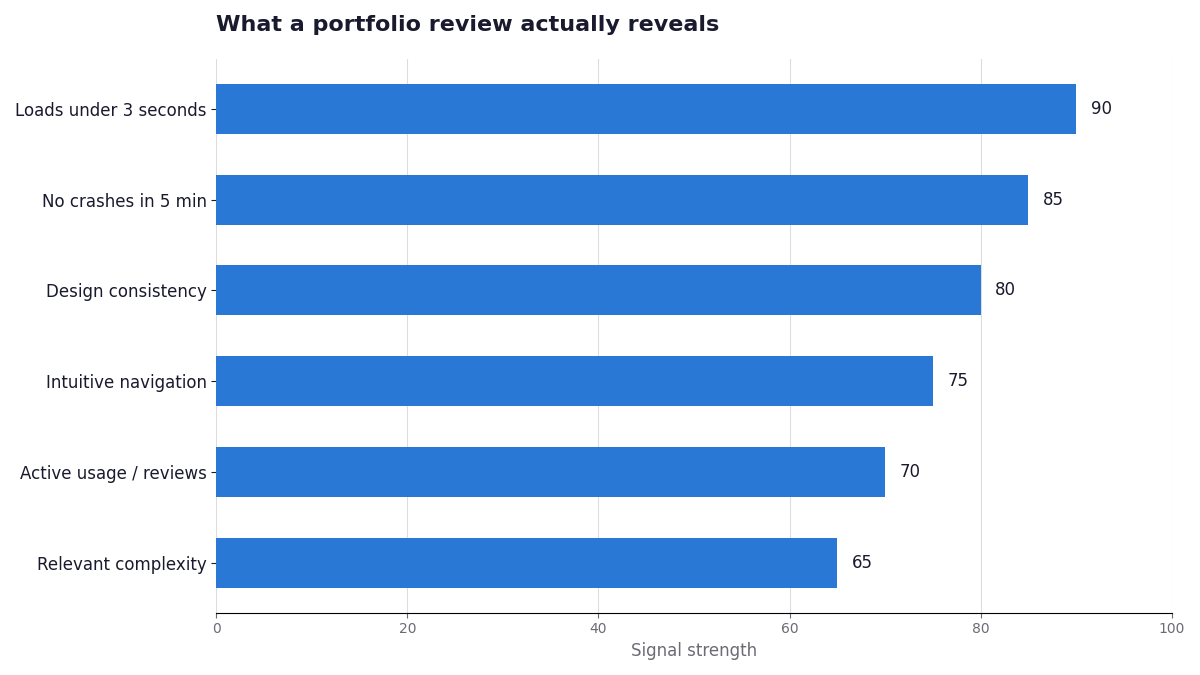
| App loads in under 3 seconds | Basic performance competence |
| No crashes in first 5 minutes of use | Basic QA competence |
| Design is consistent throughout the app | Design process and attention to detail |
| Navigation is intuitive without instructions | UX thinking |
| The app is actually being used (reviews + updates) | Real client relationships, maintained products |
| Similar complexity to your project | Experience relevant to your build |
Step 2 Team Assessment
Before a discovery call, research the agency’s team on LinkedIn. Most agencies list their key people on their website to verify that these people actually work there.
What to check on LinkedIn:
Does the founder/CTO have a genuine technical background, actual development experience, not just agency management? Are the developers listed as working at the agency or are they listed as freelancers who might only work there occasionally? Do their developers have experience with the technology stack you need, not just “mobile development” but specifically Flutter or React Native or Swift?
How long have the core team members been with the agency? An agency where every team member joined in the last year is either very new or has had significant turnover, both are risk factors. An agency where the same senior developers have been there for 3 to 5 years has stability that is rare in the development agency world. If you’re working against a tight deadline, our guide on how to shortlist an IT agency in 72 hours shows how to run this kind of tenure check efficiently without skipping it.
Step 3 The Discovery Call
This is where most buyers focus all their evaluation energy. It should be the third step, not the first after you have already filtered based on portfolio and team research.
The questions that reveal what you need to know:
“Walk me through the technical architecture of a mobile app you completed in the last 12 months.” This is the single most revealing question. A senior developer who can clearly explain what they built, why they made specific architectural decisions, and what they would do differently, is demonstrating exactly the technical maturity you need. An account manager who deflects to a PDF case study is not. If you want to understand what a solid architecture answer should actually sound like, our guide on building a SaaS product breaks down the architectural decisions a competent team should be able to explain.
“Who specifically will work on my project and can I speak with them directly?” The person who responds to this question reveals the agency’s structure. A founder who says “let me introduce you to the lead developer who will run your project” is building transparency. An account manager who says “our team will be assigned based on availability at kickoff” is hiding what you need to know.
“What has gone wrong on a project in the last 6 months and how did you handle it?” This is the question that produces the most useful signal of any in the evaluation. Agencies that have delivered real projects have had something go wrong: a technical challenge, a communication breakdown, a scope dispute, a missed milestone. Agencies that say they have never had problems are either lying or have not delivered enough projects to have encountered real-world complexity. The agencies worth hiring have honest, specific answers.
“What would you do differently on your most recently completed project?” A team that reflects on their work and identifies real improvements is a team that is getting better. A team that says everything was perfect has no learning culture. This reflective quality is one of the traits we outline in our broader guide on how to select the best IT company for founders and enterprises.
“What do you see as the biggest technical risks in my project?” This reveals how deeply they have thought about your specific project, not just their standard pitch. If they can identify real technical risks specific to your requirements, risks you had not thought about, they are giving you a preview of the kind of thinking they will bring to the build. A well-scoped requirements document makes this question easier for them to answer well, which is why our guide on how to write software requirements is worth reviewing before the call.
Step 4 Technical Assessment
This step is optional for projects under $8,000 and strongly recommended for projects above $12,000. It is a paid discovery sprint where you pay the agency $300 to $800 for 3 to 5 days of light engagement before the main project.
What to ask for in the technical assessment:
A review of your requirements document with specific questions and clarifying comments reveals their process rigour and attention to detail.
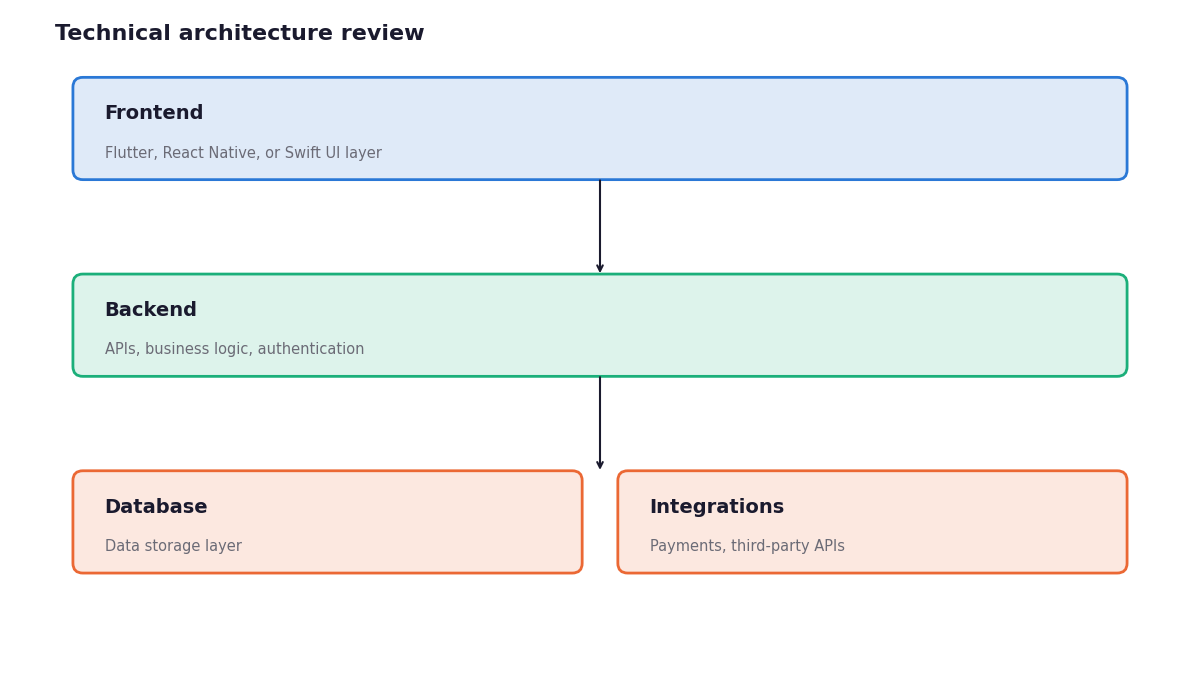
A rough technical architecture diagram showing how they would structure the app frontend, backend, database, key integrations. This reveals technical thinking and whether their approach is appropriate for your project.
A preliminary screen flow review if you have wireframes or mockups, ask them to review for UX issues and technical feasibility. This reveals their UX thinking and whether they can add value beyond pure code execution.
What the technical assessment costs versus what it saves:
Investing $500 in a technical assessment before committing $15,000 to a development project is the most cost-efficient due diligence available. The assessment reveals communication quality, technical depth, and process structure under real working conditions rather than sales conditions. Of the small percentage of buyers who do paid discovery sprints before signing, almost none report wasted money, even when they ultimately choose a different agency. If you’re still weighing whether the main project itself is priced fairly, our guide to comparing software development quotes is a useful next step once the assessment is done.
Step 5 Reference Calls
Ask for two to three references from clients who completed projects of similar size and type in the last 18 months. Call them, do not email. A 15-minute phone call provides information that a written reference never will.
The three most important questions in a reference call:
Was the project delivered on time and within budget, and if not, what caused the overrun? This is the factual baseline. A reference who says “we went slightly over budget because of some scope changes we requested” is very different from a reference who says “we went 60% over budget and 4 months late because they consistently underestimated complexity.”
How was communication managed throughout the project, and what was the worst communication breakdown and how was it handled? Every project has communication friction. What you are evaluating is how the agency responds to friction, transparently and proactively, or deflectively and reactively. The communication process is just one piece of the full hiring sequence, and our step-by-step guide to hiring a software development company shows where this check fits relative to everything else.
If you were starting the project today with what you know now, would you use this agency again and why or why not? The honest answer to this question is the most useful single data point in the reference check. If the answer comes back lukewarm, it’s worth widening your search rather than settling, and our roundup of platforms to find software development agencies is a good place to restart that search.
Reference red flags:
A reference who is reluctant to answer questions specifically. A reference who gives exclusively positive feedback without a single criticism or caveat real engagements have real friction and real clients acknowledge it. A reference who seems surprised you are calling and is not familiar with the specific project you mentioned. A reference who is a company or client you cannot independently verify exists.
Step 6 Contract Review
Before signing any mobile app development contract, verify that five specific provisions are present. These are the provisions that protect your interests if the relationship goes wrong.
The five non-negotiable contract provisions:
Intellectual property assignment all code, designs, and deliverables are assigned to you upon payment. The agency retains no IP rights. This provision must be explicit “all work product created under this agreement is owned by the client upon payment” not implied.
Source code access you have read access to the development repository throughout the project, not just at delivery. This provision prevents the scenario where the agency withholds code as leverage in a payment dispute.
Acceptance criteria each milestone has specific, objective criteria defining what “done” means. Not “we will deliver the app” but “we will deliver a fully functional app that passes all test cases in the attached test plan, loads to the home screen in under 3 seconds on a mid-range Android device, and has zero crash-inducing bugs in the primary user flows.” Clear acceptance criteria start with a clear requirements document, and our guide on how to write software requirements shows how to define these details before the contract is even drafted.
Post-delivery warranty the agency provides a defined warranty period (typically 30 to 90 days) during which they will fix bugs discovered in the delivered work at no additional cost. Warranty terms are one of many details worth comparing side by side when you’re deciding between agencies, which our practical framework for comparing software development companies can help structure.
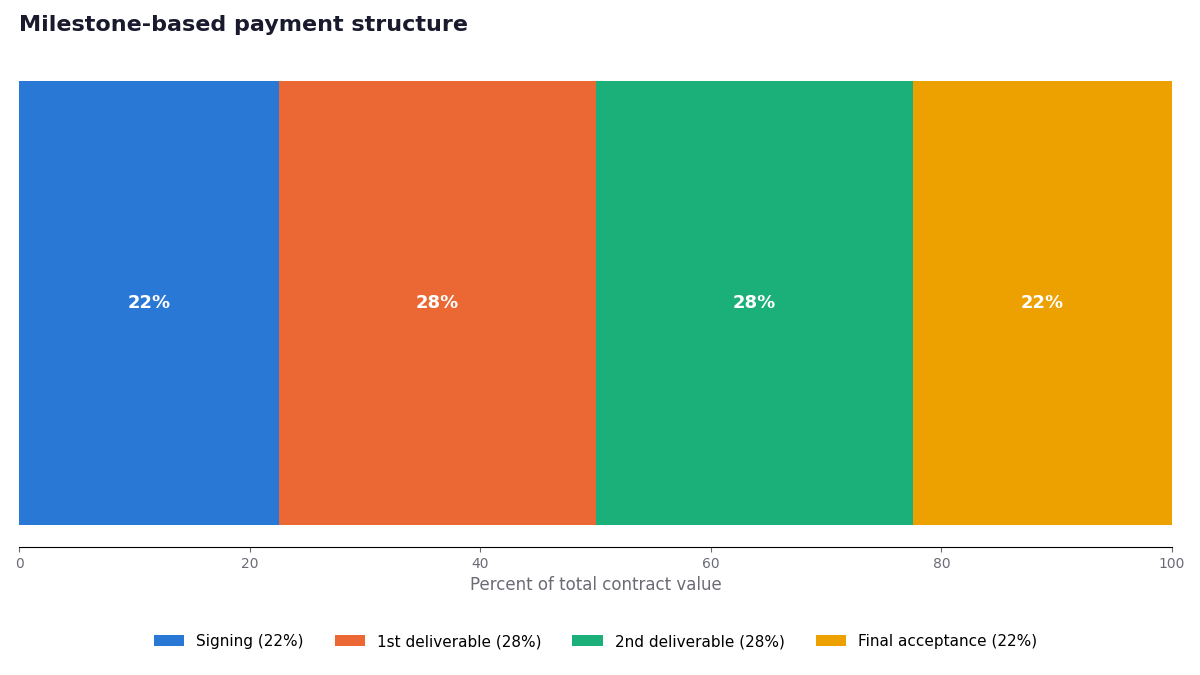
Payment milestones payment is tied to specific deliverables, not to calendar dates. Never pay in full upfront. A typical structure: 20 to 25% at signing, 25 to 30% after first major deliverable, 25 to 30% after second major deliverable, 20 to 25% at final acceptance. If you’re unsure whether a quoted payment structure is reasonable for your project size, our guide on mobile app development cost gives you a benchmark to check it against.
The Vetting Checklist Summary
Before the first call:
Portfolio verified downloaded and used at least 2 apps from their portfolio. Team research done key people LinkedIn-verified, tenure and background checks. App Store evidence rating counts, update history, review quality checked.
During discovery:
Technical architecture question asked and answered specifically. Team composition confirmed, named developer plus LinkedIn profile. The project failure story asked and answered honestly. Technical risks in your project are identified. Clear process described for requirements, development, and delivery. If any of these come back vague or evasive, treat it as an early warning rather than a minor gap, our guide on red flags in a software development company covers what to do next when that happens.
Post-discovery:
Paid technical assessment completed ($300–$800, 3–5 days). Reference calls completed minimum 2 calls with named, verifiable clients. Reference responses are honest , acknowledging some friction while overall positive.
Before signing:
IP assignment clause verified. Repository access clause verified. Acceptance criteria defined for each milestone. Post-delivery warranty period specified. Payment structure is milestone-based, not calendar-based or upfront-heavy.
Frequently Asked Questions
How long should the vetting process for a mobile app development company take?
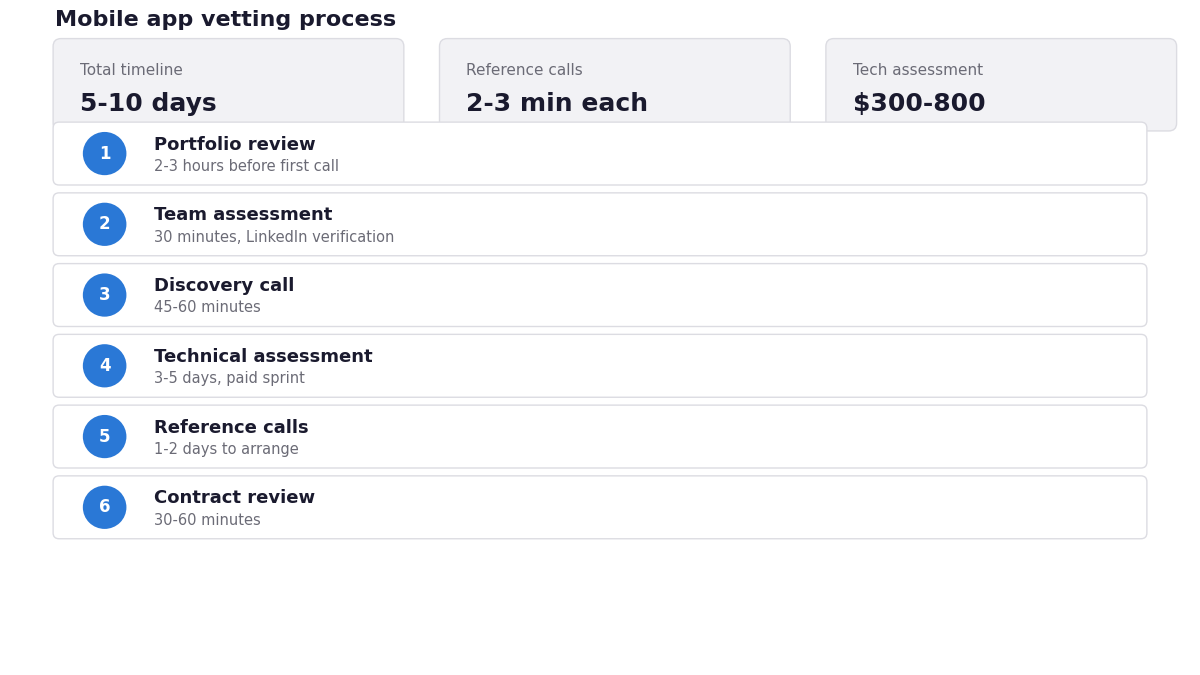
For a project between $8,000 and $20,000, a thorough vetting process takes 5 to 10 business days from first contact to contract signature. Portfolio review and team research take 2 to 3 hours before the first call. The discovery call takes 45 to 60 minutes. A paid technical assessment takes 3 to 5 days. Reference calls take 1 to 2 days to arrange and complete. Contract review takes 30 to 60 minutes. Buyers who compress this process to 24 to 48 hours by skipping steps are making a $10,000 to $20,000 decision based on a sales pitch. The 5 to 10 day process is proportionate to the financial and time commitment involved.
What should I do if an agency does not have a relevant portfolio for my project type?
If an agency does not have a portfolio example similar to your project, that is not automatically disqualifying every agency once built their first healthcare app or their first fintech integration. What matters is whether they have demonstrated technical depth in the underlying requirements. An agency that has built 10 complex marketplace apps has likely developed the payment integration, user management, and real-time features that your healthcare app might also need, even if it was not in a healthcare context. Evaluate the technical complexity of their existing portfolio against your technical requirements, not just the industry label.
Is it reasonable to ask to speak directly with the developer who will work on my project before signing?
Not only is it reasonable it is recommended for any project above $8,000. The developer who will work on your project is more important than the account manager or founder who handles the sales process. A 20-minute technical conversation with your lead developer before signing reveals their communication style, technical depth, and English proficiency all of which matter more to the day-to-day experience of your project than the smoothness of the sales pitch. Agencies that refuse this request are protecting the information gap between their sales quality and their delivery quality. Agencies that welcome it are confident in both.