
Nearshore vs Offshore Software Development in 2026 The Honest Comparison
The terms nearshore and offshore are used frequently and defined inconsistently. Some buyers choose nearshore because they have heard it is better. Some choose offshore because they have heard it is cheaper. Most cannot articulate why they prefer one over the other beyond those two generalisations. Both generalisations are partially true and significantly oversimplified.
That’s why understanding nearshore vs offshore software development is essential before deciding where to hire. The right model depends less on geography and more on how your team prefers to collaborate and scale.
According to Grand View Research IT Services Outsourcing Market Report, the global IT services outsourcing market is expected to grow at a CAGR of 8.6% through 2030, driven by increasing demand for skilled technology talent and cost-efficient software delivery. As outsourcing adoption grows, choosing the right engagement model becomes a critical business decision.
The decision between nearshore and offshore development is not primarily a quality decision. Both models produce excellent software when the agency is excellent. It is primarily a collaboration style decision on how you prefer to work, what your communication requirements are, and what trade-offs you are willing to make between cost and proximity.
This guide defines both models precisely, compares them honestly across the dimensions that matter, and gives you the framework to choose based on your specific project rather than conventional wisdom.
Definitions What Nearshore and Offshore Actually Mean
Offshore development means hiring a development team in a country that is geographically distant from yours — typically in a different hemisphere, with a significant time zone difference, and a different cultural context. For US buyers, offshore most commonly means India, Southeast Asia (Vietnam, Philippines), or Eastern Europe (when US buyers use the term loosely). For UK buyers, offshore typically means India or Southeast Asia. If India is on your shortlist, it’s worth understanding how the country’s talent pool and delivery models compare across cities before you commit to a region.
Nearshore development means hiring a development team in a country that is geographically proximate to yours — in the same or adjacent time zones, typically with more cultural overlap, and often more expensive than offshore. For US buyers, nearshore means Latin America (Mexico, Colombia, Brazil, Argentina). For UK buyers, nearshore means Eastern Europe (Poland, Romania, Czech Republic) or Western Europe. Because that price premium varies a lot by country, it helps to check actual developer rates by country before assuming nearshore is out of budget.
The practical distinction is time zone overlap. Nearshore teams typically share 4 to 8 hours of working day overlap with the client. Offshore teams typically share 0 to 4 hours of working day overlap. How much that overlap actually matters often comes down to your engagement model, so it’s worth pairing this decision with a look at dedicated team, time-and-material, and fixed-price structures before you scope the contract.
The Cost Comparison What You Actually Pay
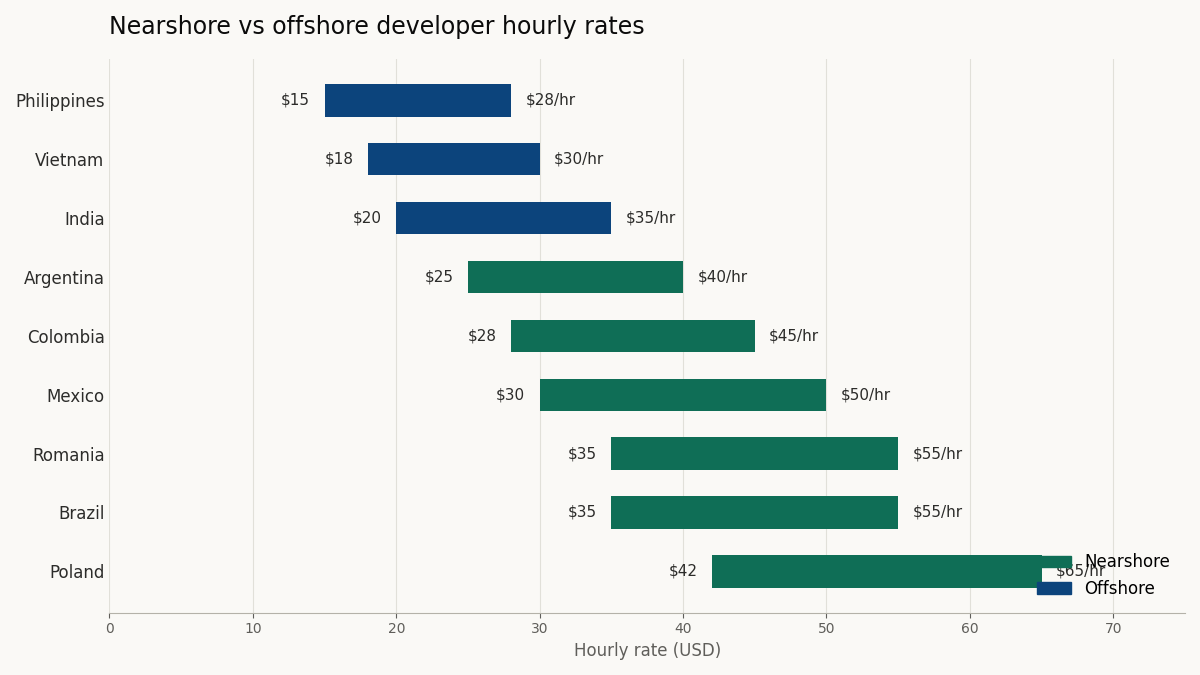
Hourly rates for mid-level full-stack developers:
| Model | Region | Hourly Rate Range | Monthly Cost (160 hours) |
| Nearshore (US buyer) | Mexico | $30–$50/hr | $4,800–$8,000 |
| Nearshore (US buyer) | Colombia | $28–$45/hr | $4,480–$7,200 |
| Nearshore (US buyer) | Brazil | $35–$55/hr | $5,600–$8,800 |
| Nearshore (US buyer) | Argentina | $25–$40/hr | $4,000–$6,400 |
| Nearshore (UK buyer) | Poland | $42–$65/hr | $6,720–$10,400 |
| Nearshore (UK buyer) | Romania | $35–$55/hr | $5,600–$8,800 |
| Offshore (US/UK buyer) | India | $20–$35/hr | $3,200–$5,600 |
| Offshore (US/UK buyer) | Vietnam | $18–$30/hr | $2,880–$4,800 |
| Offshore (US/UK buyer) | Philippines | $15–$28/hr | $2,400–$4,480 |
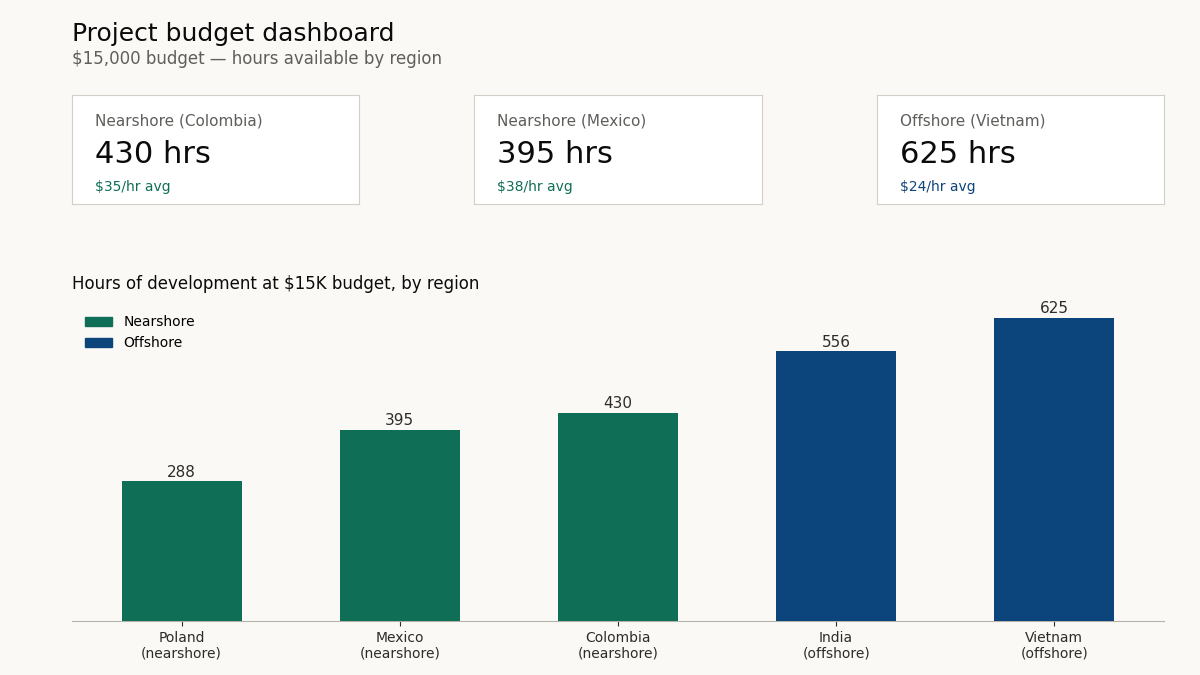
What this means for a $15,000 project budget:
| Model | Region | Hours Available |
| Nearshore | Mexico ($38/hr avg) | 395 hours |
| Nearshore | Colombia ($35/hr avg) | 430 hours |
| Nearshore | Poland ($52/hr avg) | 288 hours |
| Offshore | India ($27/hr avg) | 556 hours |
| Offshore | Vietnam ($24/hr avg) | 625 hours |
The cost difference is real but not as dramatic between nearshore and offshore as the popular narrative suggests. The difference between Colombia nearshore and India offshore is approximately 30 to 40% at equivalent seniority levels, but not the 5× difference you find comparing onshore US to offshore India.
Time Zone Overlap The Real Impact on Projects
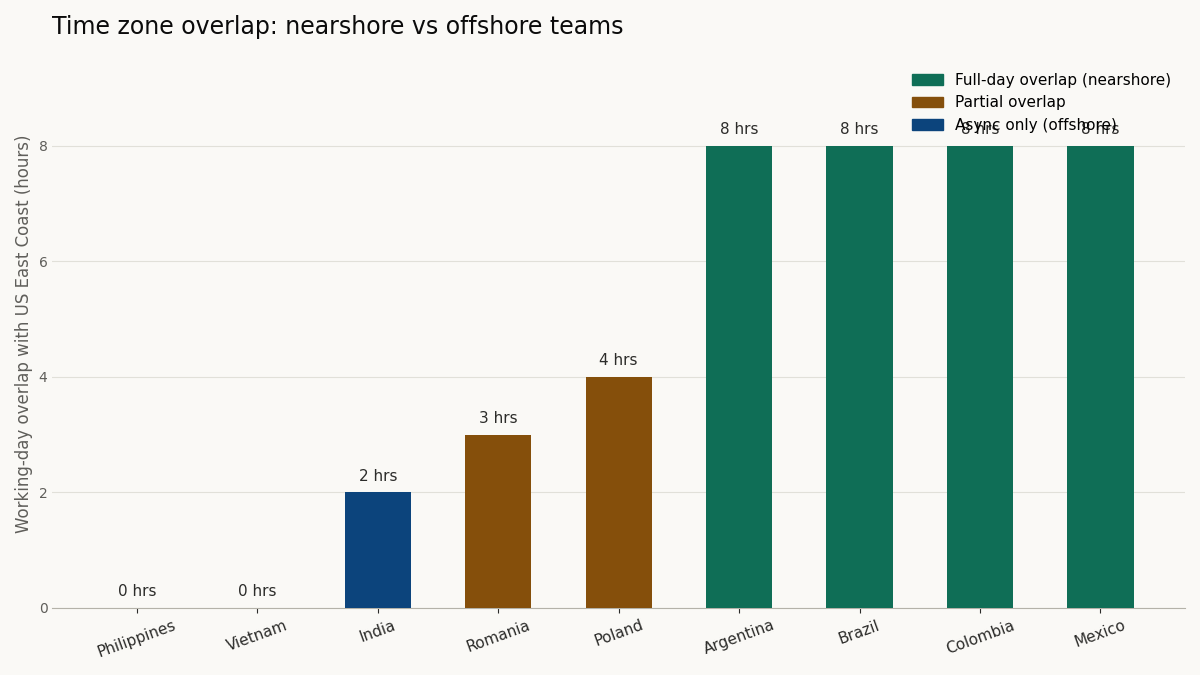
Time zone is the reason most buyers cite for choosing nearshore. Here is the actual data on what time zone difference means for a project.
Time zone overlap for a US East Coast (EST) buyer:
| Region | Time Zone | Overlap with 9am–5pm EST | Real-time collaboration |
| Mexico | UTC-6 | Full overlap (8 hours) | Full day co-working possible |
| Colombia | UTC-5 | Full overlap (8 hours) | Full day co-working possible |
| Brazil (São Paulo) | UTC-3 | Full overlap (8 hours) | Full day co-working possible |
| Argentina | UTC-3 | Full overlap (8 hours) | Full day co-working possible |
| Poland | UTC+1/+2 | 3–5 hours overlap | Morning EST is workday Poland |
| Romania | UTC+2/+3 | 2–4 hours overlap | Morning EST is workday Romania |
| India | UTC+5:30 | 0–4 hours (with early India morning) | Primarily async + end-of-day calls |
| Vietnam | UTC+7 | 0 hours standard requires schedule adjustment | Primarily async |
| Philippines | UTC+8 | 0 hours standard requires schedule adjustment | Primarily async |
The honest assessment of time zone impact:
Real-time collaboration: the ability to jump on a video call, Slack message, or pair programming session at any moment during the workday is genuinely easier with nearshore teams in the same time zone. This matters most for:
Projects with rapidly evolving requirements — when decisions need to be made in real time as you discover what works, rather than locking scope upfront. This is exactly the scenario where a clear intake process pays off, and it’s worth reviewing how to write software requirements that survive mid-project changes before you start engaging vendors.
It matters less for: projects with well-defined requirements, teams with disciplined async communication practices, and technical buyers who can specify requirements precisely in writing.
The async-capable offshore buyer:
Experienced technology leaders who have managed offshore teams successfully all describe the same workflow: detailed written specifications, daily end-of-day updates from the offshore team, and weekly video calls for higher-level discussion. This workflow produces excellent results with offshore teams and is not significantly more burdensome than the management overhead of a nearshore team once the pattern is established.
Quality Comparison Region by Region
Neither nearshore nor offshore is uniformly better quality. The quality of any specific engagement depends on the agency, not the model. With that caveat, there are regional tendencies worth understanding.
Strengths by region:
| Region | Technical Strengths | Communication Style | Cultural Fit (for US buyers) |
| Latin America (LATAM) | Full-stack web, mobile, growing AI/ML | Direct, relationship-oriented, informal | Very high US cultural alignment |
| Eastern Europe | Full-stack, AI/ML, complex systems, design | Formal, rigorous, direct about problems | Good professional communication norms similar to US |
| India | AI/ML, full-stack, enterprise systems, broad talent depth | Variable top agencies direct, mid-tier less so | Good strong startup outsourcing culture |
| Vietnam | Full-stack web, mobile | Less direct, strong written communication | Medium |
| Philippines | Web development, mobile | Very direct, very US-culturally aligned | High |
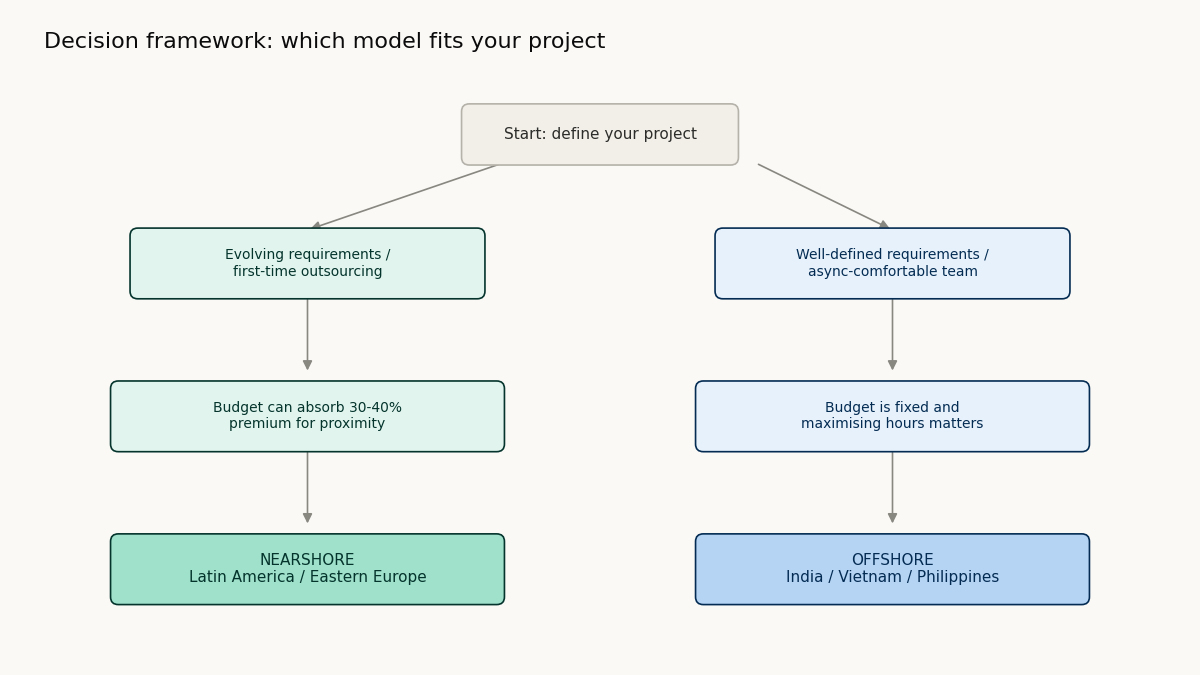
The Project-Type Decision Framework
When nearshore is clearly the better choice:
You are a US-based buyer with a project requiring daily collaboration, evolving requirements, design-heavy development, product discovery — and you are not experienced at managing remote teams asynchronously. The time zone overlap of Latin America makes real-time collaboration trivial. Cultural alignment reduces communication friction. The cost premium over offshore is 30 to 40% — meaningful but justifiable for the collaboration quality. If product discovery and design-led work are central to your project, it’s worth comparing freelancers, agencies, and product studios to see which delivery model actually fits that kind of collaborative work best.
You are a UK-based buyer and Eastern Europe’s time zone overlap (3 to 6 hours with UK) is important for your development workflow. Eastern European agencies consistently produce technically strong work at rates that represent a significant discount over UK onshore development.
You are building a design-sensitive consumer product and want a team with a strong design culture. Eastern Europe and Latin America both have stronger design cultures than the typical Indian development agency at the mid-market level.
When offshore is clearly the better choice:
Your budget is under $12,000 and maximising development hours is critical. The 30 to 40% cost difference between India offshore and Latin America nearshore translates to 43 to 57% more development hours at the same budget that is the difference between a 10-screen MVP and a 14-screen MVP, or between a 14-week timeline and a 10-week timeline.
Your requirements are well-defined and your communication can be primarily async. A founder who writes clear specifications, reviews daily updates, and is available for weekly video calls can work effectively with India or Vietnam regardless of time zone. If you’re not yet confident your specifications are tight enough to support that kind of async handoff, it’s worth working through how to write a software development RFP that leaves less room for misinterpretation across time zones.
You are building AI, ML, or data-heavy features where India’s talent concentration is highest.
The Practical Trade-off Table
| Dimension | Nearshore (LATAM for US) | Offshore (India) |
| Cost per hour | $28–$55 | $15–$35 |
| Hours for $15K budget | 270–535 | 430–1,000 |
| Time zone overlap (EST) | Full 8 hours | Minimal 0–4 hours |
| Real-time collaboration | Easy | Requires scheduling discipline |
| Cultural alignment (US buyer) | Very high | Good |
| AI/ML talent depth | Growing | Very strong |
| Design quality (consumer products) | Strong | Variable top agencies strong |
| First-time outsourcing experience | Smoother | Requires async discipline |
| Long-term team continuity | Good | Good stable agencies have low turnover |
The Hybrid Model Using Both
Many mature technology companies use both nearshore and offshore in the same development programme — leveraging each model’s strengths for different roles. Senior engineers and product leaders who need frequent product collaboration are nearshore. Implementation engineers doing well-defined development work are offshore. This hybrid model is achievable at project budgets above $25,000 where team composition can be structured deliberately. If you’re mapping out what that budget actually buys across roles and complexity tiers, our breakdown of custom software development costs is a useful reference point before you split the team.
Frequently Asked Questions
Is nearshore software development better than offshore?
Neither is universally better; they optimise for different priorities. Nearshore is better when: real-time collaboration is important to how you work, your project has frequently evolving requirements, or you are a first-time outsourcing buyer who has not yet developed async communication discipline. Offshore is better when: maximising development hours for a fixed budget is the priority, your requirements are well-defined and can be communicated asynchronously, or you need access to a deep talent pool in specific technical areas like AI and machine learning. Most experienced technology leaders choose based on project type and collaboration style rather than a blanket preference.
What is the real cost difference between nearshore and offshore development?
For comparable seniority levels, nearshore (Latin America for US buyers, Eastern Europe for UK buyers) typically costs 30 to 50% more per hour than offshore (India, Vietnam). At a $15,000 project budget, this means nearshore buys approximately 300 to 430 hours compared to offshore’s 430 to 600 hours, a meaningful difference in scope, but not the 5 to 10× difference that exists between onshore US and offshore India. The cost comparison should factor in management overhead; some buyers find that the reduced management friction of nearshore produces enough efficiency to partially offset the rate premium.
Can I get the benefits of nearshore time zones with offshore rates?
Partially. Some Indian agencies offer “overlap hours” guaranteeing senior developer availability during US or UK business hours, typically a 3 to 4 hour window of real-time availability per day at no premium. Philippines-based agencies are increasingly popular for this reason Philippine rates are lower than Latin America and the Philippines’ cultural alignment with the US is high. The Philippines time zone (UTC+8) means a Philippines agency starting work at 6am Manila time can overlap with US East Coast morning hours, a workflow that some buyers find more manageable than pure India async.
Which nearshore region is best Mexico, Colombia, or Brazil for US buyers?
All three are strong options for US buyers, with different characteristics. Mexico is the closest culturally and geographically to the US, has a growing tech talent pool particularly strong in full-stack web development, and offers rates slightly above Colombia and Argentina. Colombia has produced an exceptional engineering talent pool from universities in Medellín and Bogotá, rates are competitive among the top LATAM options, and the talent-to-cost ratio is arguably the best in the region. Brazil has the largest talent pool in LATAM and the highest concentration of senior developers, but Portuguese as the primary language (rather than Spanish) means English proficiency varies more than in Mexico or Colombia. For most US buyers, Colombia and Mexico are the first choices for nearshore LATAM development.