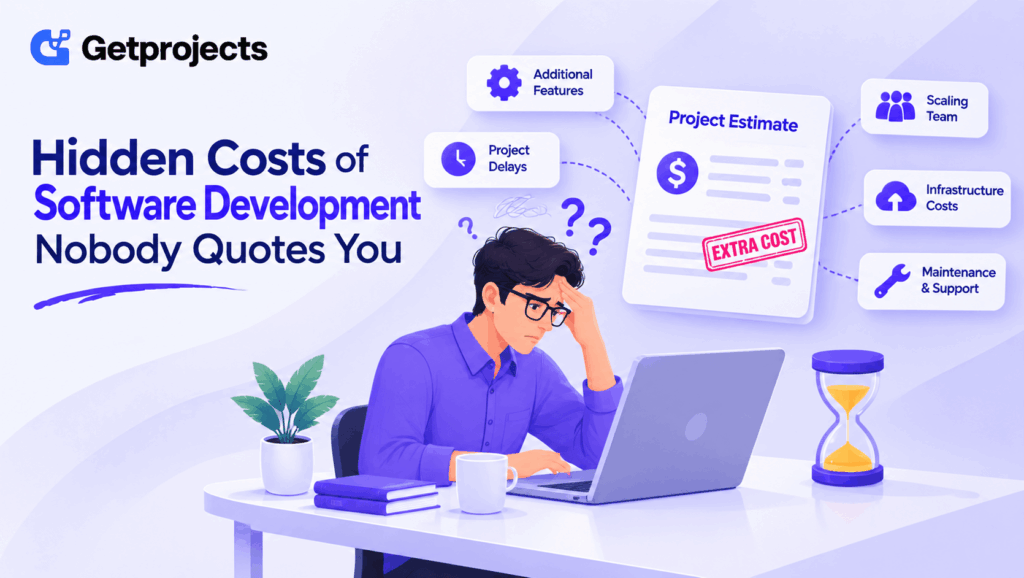
Hidden Costs of Software Development Nobody Quotes You
A signed development quote is a forecast, not a price. For most first-version products, whether an MVP, a customer portal or an internal operations tool, final spend lands 30–50% above the approved figure. The overrun rarely comes from one bad decision. It builds up from the hidden costs of software development: line items that exist in almost every project but appear in very few proposals.
Most estimates of custom software development cost the build itself: design hours, development hours, perhaps a modest testing allowance. Everything around the build sits outside that number. Discovery workshops, scope changes, cloud bills, software licences, internal management time, post-launch fixes and the cost of switching vendors are all real and recurring, and they are usually unpriced.
The omission is not always deliberate. Agencies competing on price have every incentive to present the smallest credible figure, and buyers comparing four proposals side by side tend to reward the lowest one. The outcome is a procurement process that consistently underestimates the hidden costs of software development and then treats the gap as bad luck.
Flexera’s 2026 State of the Cloud Report puts estimated wasted spend on cloud infrastructure and platform services at 29%, the first increase after five years of decline, which the report ties to the added cost complexity of AI workloads and newer PaaS and SaaS offerings. For any product running in the cloud, that leakage starts on launch day and never appears in a build quote.
This guide breaks down where those costs sit, how large they typically run, and how to get them onto paper before a contract is signed rather than after the first invoice dispute.
What Are the Hidden Costs of Software Development?
The hidden costs of software development are the expenses a project incurs beyond the quoted design and build fee, including discovery, scope changes, testing, infrastructure, licences, internal management time, maintenance and vendor transition. They are rarely itemized in proposals, yet they commonly add 30–60% to the total cost of a custom software project.
“Hidden” is slightly misleading. Almost none of these costs are unknowable; they are simply unpriced. An experienced vendor can estimate most of them within a 10–15% range when asked directly, which is why the questions to ask a software development company before signing matter more than the headline rate.
Why Software Budgets Break Before the First Sprint
Overruns are usually blamed on execution: slow developers, shifting requirements, an underperforming agency. In practice, a software project budget overrun is often locked in before any code is written, because the approved budget only ever covers part of the work.
Consider how software development estimates are assembled. The agency estimates effort per feature, multiplies it by a blended rate (commonly 30–60 per hour for offshore teams and 120–180 for US-based firms) and adds a 10–15% buffer. That number covers what a 6–10 page brief described. It does not cover what the brief left out, which on most first builds is 20–40% of the final feature set.
Three structural pressures widen the gap:
- Competitive bidding rewards optimism. When five agencies quote the same brief, the lowest number usually wins, and it is usually the one that assumes the fewest unknowns.
- Buyers compare rates, not scopes. A $40-per-hour team quoting 1,200 hours and a $70-per-hour team quoting 1,000 hours look $22,000 apart. If the cheaper proposal excludes QA and DevOps, that gap can close or reverse.
- Post-launch is treated as a separate problem. Most contracts end at deployment, while industry estimates commonly place 50–80% of a product’s lifetime spend after launch.
The practical result is predictable. Budgets that look 15% over on paper are often 40–50% over once internal time, infrastructure and the first year of fixes are counted. That is the real scale of the hidden costs of software development, and it is why finance teams increasingly ask for a multi-year cost view instead of a build quote.
Software Development Cost Breakdown: Where Hidden Spend Actually Sits
A build quote is one layer of a larger cost stack. The seven categories below account for most of the variance between quoted and final spend.
Discovery and Requirements Work
Many agencies either skip formal discovery or fold it quietly into the first sprint. A structured discovery phase covering user flows, technical architecture, integration mapping and a prioritized backlog typically takes 2–4 weeks and costs 5,000–20,000, depending on complexity.
Skipping it does not remove that cost; it relocates it into rework. A common planning rule holds that a change made during development costs 3–5x more than the same change made on a wireframe, and roughly 10x more after launch. Among all the hidden costs of software development, weak discovery is the one that multiplies every other category.
Mid-Project Scope Changes
Even a well-scoped project moves. Stakeholders see a working build and realize onboarding needs a second path, or the sales team asks for a CRM integration that was never in the brief. Each one arrives as one of many change requests, and without a clear software development change order process, each is billed at full rate and outside the original timeline.
Left unmanaged, these additions compound. Over 4–6 months they become scope creep, and on fixed-price contracts this is where much of a vendor’s margin is recovered.
Version one always changes. A 15–25% contingency line is the simplest defense against the hidden costs of software development, because it admits that change inside the budget itself. Agree in writing how changes are estimated, approved and billed before kickoff.
Quality Assurance and Security Reviews
Some quotes list “testing” but mean developer self-checks only. Dedicated QA and testing, including test plans, regression suites, device and browser coverage and load testing, typically adds 15–25% to development effort. Products handling payments or personal data also need security reviews or penetration tests at 4,000–15,000 per round.
When this work is excluded, it does not disappear. It returns as production bugs, emergency patches and support tickets billed at urgent rates, which makes it one of the hidden costs of software development that users notice before finance does.
Infrastructure and Third-Party Services
Build quotes almost never include running costs. Typical cloud hosting costs for a modest SaaS product start at 300–1,500 per month, and cloud server management cost for startups rises further with users, data volume and AI features. Add third-party licensing for payments, maps, email delivery, authentication, analytics and monitoring, and a product can carry 500–3,000 in monthly tooling before it earns meaningful revenue.
AI-enabled features add a newer layer: model API usage billed per token or per request, a line that often dominates AI agent development cost and can swing 3–5x month to month as adoption grows. Asking every vendor for a monthly run-rate estimate at 1,000, 10,000 and 100,000 users makes the hidden costs of software development tied to infrastructure visible at the proposal stage.
Client-Side Management Time
Someone inside your company has to write user stories, attend sprint reviews, answer developer questions and approve releases. On a mid-sized build, that is typically 8–15 hours a week of a product owner’s time for 4–9 months. At a loaded internal cost of 60–100 per hour, that is 8,000–55,000 of project management overhead that never appears on the agency invoice.
Time zones compound it. With less than 2–3 hours of daily overlap, a same-day question becomes a 24-hour delay, and across a 6-month engagement those delays can add 3–6 weeks. Because this is internal time rather than an invoice, it is among the hidden costs of software development that finance teams rarely trace back to the project.
Documentation, Code Quality and Exit Costs
If the relationship ends, whether by choice or because the agency reprioritizes, the next team has to understand what was built. Thin documentation, infrastructure set up under the vendor’s accounts and code that only one developer understands all create vendor lock-in. Replacement teams commonly spend 3–6 weeks on code audits and knowledge transfer before shipping anything new.
The codebase itself can become a liability. Accumulated technical debt from shortcuts taken to hit a demo date turns into refactoring work later, and teams inheriting a rushed codebase often lose 20–30% of early capacity to stabilization. Exit costs are the hidden costs of software development least likely to be discussed at proposal stage, because neither side wants to think about how to exit a software development contract.
Sourcing and Platform Fees
How you find a vendor carries its own price. Marketplace commission fees on bidding platforms commonly run 10–20%, and agencies price that cut into their rates; paid directories charge agencies $499 or more per year for visibility, which also flows back into client pricing. On an $80,000 project, a 15% platform cut is $12,000 spent on neither design nor development, which is why the cost of hiring an IT company directly is often lower.
This cost behaves differently from the others. It is one of the few hidden costs of software development that can be removed entirely rather than managed, simply by choosing a sourcing model that does not take a cut.
How to Avoid Hidden Costs in Software Outsourcing
Run this sequence before approving any proposal:
- Fund a short paid discovery before committing to the full build, and require a prioritized backlog and architecture outline as its deliverables.
- Ask each vendor to itemize testing, DevOps, project management and post-launch work separately from development hours.
- Request a monthly run-rate estimate covering hosting, licences and API usage at three user levels.
- Add the scope-change process to your software development contract checklist: how changes are estimated, who approves them and at what rate.
- Hold a 15–25% contingency as its own budget line, visible to both sides.
- Keep code repositories, cloud accounts and documentation in your company’s name from day one.
- Define a 30–90 day defect warranty, plus a separate maintenance retainer with stated response times.
- Check delivery history, team stability and references from similar-sized projects as part of vendor vetting, not after selection.
No checklist makes a project risk-free. These steps will not eliminate the hidden costs of software development, but they convert most of them from surprises into negotiable line items.
Software Maintenance Costs: The Bill That Starts at Launch
Launch is the midpoint of a product’s cost curve, not the end. Bug fixes, OS and browser compatibility updates, dependency upgrades, security patches and small enhancements continue for as long as the product is live, and post-launch support is consistently the most under-budgeted line in agency engagements.
Many contracts include a 30-day warranty and then stop. After that, every fix is new billable work, often at a higher rate because the original team has moved on to other clients, which is one reason some buyers put a software escrow agreement in place.
How Much Does Software Maintenance Cost Per Year?
A widely used planning range is 15–25% of the original build cost per year. A $100,000 product should expect 15,000–25,000 annually just to stay stable, before any new features. Mobile apps sit toward the top of that range because Apple and Google push mandatory platform updates every year.
Over a 4–5 year horizon, cumulative maintenance commonly matches or exceeds the initial build. That makes total cost of ownership, not the build quote, the only fair basis for comparing proposals or weighing in-house vs outsourced software development, and it is why the hidden costs of software development should be modeled across at least three years. A cheaper build with fragile code can easily cost more over 36 months than a pricier one with clean architecture and automated tests.
The True Cost of Outsourcing Software Development: Two Scenarios
Both scenarios below are anonymized and reflect patterns that recur across startup and mid-market agency engagements.
Scenario 1: The fixed-price MVP that doubled. A Series A fintech startup picked the lowest of four bids: a $45,000 fixed-price quote for a lending MVP on a 12-week timeline. The proposal excluded QA, identity-verification licences and hosting setup. After 11 scope changes, a security review and a second release cycle, total spend reached $92,000 and launch slipped to 22 weeks, meaning the hidden costs of software development exceeded the original quote.
Scenario 2: The higher quote with the smaller overrun. A mid-sized logistics company chose a $78,000 proposal over a $55,000 alternative because it itemized discovery, automated testing, DevOps and a 90-day warranty. Final spend came to $84,000, an 8% variance. First-year maintenance stayed under $12,000 because the product shipped with full documentation and roughly 70% automated test coverage.
The difference between these outcomes was never the hourly rate. It was how much of the hidden costs of software development each proposal chose to price up front.
Fixed Price, Time and Materials or Dedicated Team: A Decision Framework
No engagement model is cost-neutral, and weighing a dedicated team vs time and material vs fixed price only decides where costs surface. Each model moves the hidden costs of software development to a different place rather than removing them, as the table below shows.
| Engagement model | How the quote looks | Where unpriced costs surface | Best fit |
| Fixed price | Lowest and most predictable on paper | Padded risk margins, scope-change billing, disputes over what was “in scope” | Small, tightly specified builds under ~$40,000 |
| Time and materials | Open-ended, rate-based | Slow velocity, unclear burn rate, overruns without a monthly cap | Evolving products with an engaged product owner |
| Dedicated team | Fixed monthly fee | Idle capacity, slow ramp-up, knowledge concentrated in 1–2 people | Long-running products with a continuous roadmap |
Whichever model you choose, score each proposal against five questions. A vendor that cannot answer yes to at least four is pricing the build, not the project:
- Are QA, DevOps and project management itemized separately from development?
- Is there a monthly run-rate estimate for hosting, licences and API usage?
- Is the process for estimating and approving scope changes written into the contract?
- Will repositories, documentation and cloud accounts be owned by you from day one?
- Are warranty length and post-warranty maintenance rates clearly stated?
What Most Teams Get Wrong About Agency Hiring Costs
The most expensive assumption in software procurement is that the hourly rate is the cost. Comparing software developer hourly rates by country tells you little on its own: a $35-per-hour team that needs 1,800 hours and three rework cycles costs more than a $65-per-hour team that ships in 900 hours with tests in place.
Fixed price is the second misconception. It does not transfer risk to the vendor; it prices risk into the quote and recovers the rest through scope-change billing. Teams that choose a fixed price for an evolving product usually pay twice, once in the padded estimate and again in the changes.
Third, sourcing is treated as free. Bidding environments reward the most optimistic estimate rather than the most accurate one, and platform commissions quietly inflate every rate. This is part of why commission-free, no-bid models such as GetProjects have gained ground with procurement teams: removing the platform cut and the race to the lowest bid removes two forces that push quotes below reality.
Finally, most teams under-invest in the brief. One focused week learning how to write a project brief for developers, covering user roles, must-have integrations, compliance needs and success metrics, reduces estimate variance more than any rate negotiation. Teams that budget accurately are not luckier; they treat the hidden costs of software development as a planning input from week one.
Price the Whole Project, Not Just the Build
If you are scoping a build and want proposals you can compare line by line, the most useful step is to shortlist an IT agency in 72 hours from vendors who have nothing to gain from an artificially low number. Surfacing the hidden costs of software development before signing is far cheaper than discovering them on the third invoice.
GetProjects lets you post a project for free in under two minutes and get matched with verified agencies using 50+ data points, with no bidding and 0% commission on what you pay them. Bring the five-question checklist above into every vendor conversation, and the number you approve will sit much closer to the number you pay.
Post your project free: https://getprojects.ai/
Frequently Asked Questions
What are the hidden costs of software development?
They are expenses outside the quoted build fee: discovery, scope changes, dedicated testing, hosting and licences, internal management time, maintenance and vendor transition. Individually each looks small, but together they commonly add 30–60% to a first-version budget. The fix is not a bigger buffer alone; it is requiring vendors to itemize each category before you sign.
Why do software projects go over budget?
Most overruns start with an incomplete brief and a quote that priced only what was written down. Feature additions mid-build, excluded QA, integration surprises and slow client-side approvals then compound. Underestimating the hidden costs of software development at approval stage is the root cause in most cases, and fixed-price contracts can mask it until change billing begins 3–5 months in.
What is not included in a software development quote?
Typically excluded: discovery workshops, dedicated QA, DevOps and deployment setup, hosting, third-party licences and API usage, security testing, management time on your side, and maintenance after a 30-day warranty. Some quotes also exclude app store submission and data migration. Ask for a written list of exclusions; a vendor unwilling to provide one is signaling where the hidden costs of software development will appear.
Fixed price vs time and materials: which has fewer hidden costs?
Neither eliminates them. Fixed price suits small, tightly specified builds under roughly $40,000 but pushes costs into scope-change billing. Time and materials fit evolving products and keep pricing transparent, provided you cap monthly spend and track velocity. For most first-version products, a paid discovery phase followed by capped time and materials gives the best balance.
How much should you budget for software maintenance?
Plan for 15–25% of the original build cost each year, rising toward the upper end for mobile apps, regulated products and anything with heavy third-party integrations. Keep this separate from new-feature work, and agree a monthly retainer with defined response times so routine fixes are not billed at emergency rates.
How do you compare quotes from development agencies?
Normalize every proposal to the same scope, then compare itemized costs for QA, DevOps, management, hosting estimates and post-launch terms rather than headline rates. Check delivery history on projects of similar size and verify the agency is who it claims to be. A commission-free matching platform that pre-verifies agencies can shorten this process and make the hidden costs of software development easier to compare.