How to Exit a Software Development Contract Without Losing Everything
Most companies plan meticulously for how a software contract starts and almost not at all for how it ends. By the time someone searches how to exit a software development contract, the relationship is usually already damaged, deadlines are slipping, invoices are contested, and the agency holds the one asset that matters most: the repository.
The mistake is treating an exit as a legal afterthought instead of an operational sequence with a specific order of operations. Get that order wrong, and a company can lose weeks of engineering work, admin access to its own infrastructure, and every ounce of leverage in the final invoice dispute. Learning how to exit a software development contract before the relationship sours not after is what separates a clean handover from a six-week standoff, and it starts with the same software development contract checklist most teams only review after things go wrong.
This guide covers termination for cause vs. termination for convenience, the cure periods that protect both sides, exactly what a client is owed at exit, and the notice period terms most teams skip past at signing. It ends with a 10-item exit checklist built for the moment before notice goes out not after.
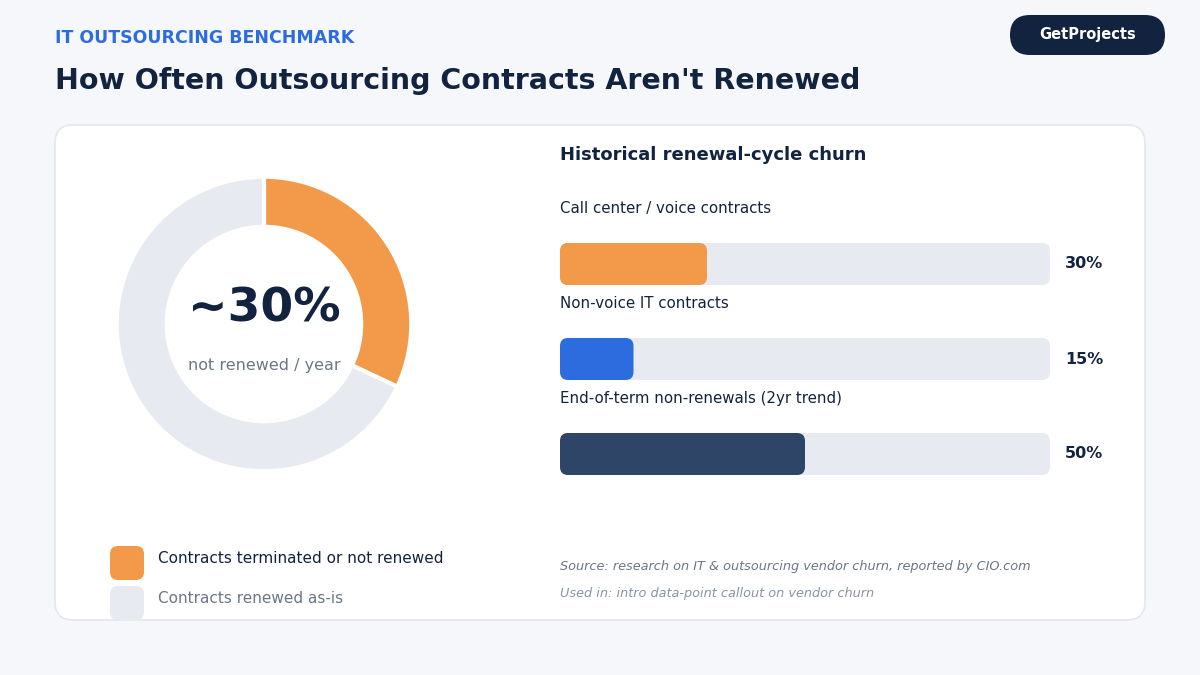
Vendor churn in IT outsourcing is not a fringe problem. Historically, roughly a quarter to a third of expiring outsourcing contracts are not renewed in a given year, and that share has climbed further in recent renewal cycles as buyers reassess underperforming vendor relationships, according to research reported by CIO.com.
What Is a Software Development Contract Exit?
A software development contract exit is the formal process of ending an agreement with a development vendor before its natural completion. It covers delivering written notice, handing over code and credentials, resolving outstanding payment, and confirming that IP transfer rights sit fully with the client, not the vendor. Many of these obligations trace back to how the original statement of work defined ownership and deliverables in the first place.
Understanding how to exit a software development contract this way, as a sequence rather than a single letter, is what most termination templates online fail to explain.
The Core Problem: Contracts Are Written for Onboarding, Not Offboarding
Most software development agreements spend pages on kickoff timelines, milestones, and payment schedules, and a single paragraph on termination. That imbalance is exactly what turns out messy, and it’s why so many searches for how to exit a software development contract start after notice has already gone out rather than before.
In practice, exit disputes cluster around three points: repository and admin access transfer, ownership of work product, and reconciliation of the final invoice. A typical mid-size custom software engagement runs $80,000–$250,000 over 4–9 months and when a client tries to exit at month 3 without a clear exit clause software vendor provision, the agency has every incentive to slow-walk the handover until the last invoice clears. Ownership disputes at this stage are exactly what a clear answer to who owns the code when you outsource is meant to prevent.
Notice periods are the other blind spot. A notice period dev contract clause that reads “30 days” sounds simple until a client realizes the vendor can bill for the full 30 days regardless of whether real work continues. Without a defined wind-down scope, “notice” becomes 30 more days of invoices for a team that has mentally already left.
The technical reality compounds this. A dev team rarely documents infrastructure as they go; if a client waits until after notice to ask for architecture diagrams, environment variables, and deployment scripts, they are negotiating from a position of total dependency. Roughly 90% of the leverage in any exit exists in the 24 hours before notice is sent, not after which is exactly why the sequence matters more than the wording of the letter itself.
A related but underrated failure point: contracts that never define who owns third-party accounts. Domain registrars, cloud hosting, payment gateways, and analytics tools are frequently set up under the agency’s own credentials “for convenience” during the build. By the time a client wants to terminate development agreement terms, those accounts can be functionally unreachable without the vendor’s cooperation.
Teams that never budget time to research how to exit a software development contract before problems appear tend to discover these gaps at the worst possible moment mid-dispute, with a live production system depending on someone else’s login, and usually alongside a handful of other red flags in a software development company that were visible months earlier.
How to Exit a Software Development Contract: A Step-by-Step Framework
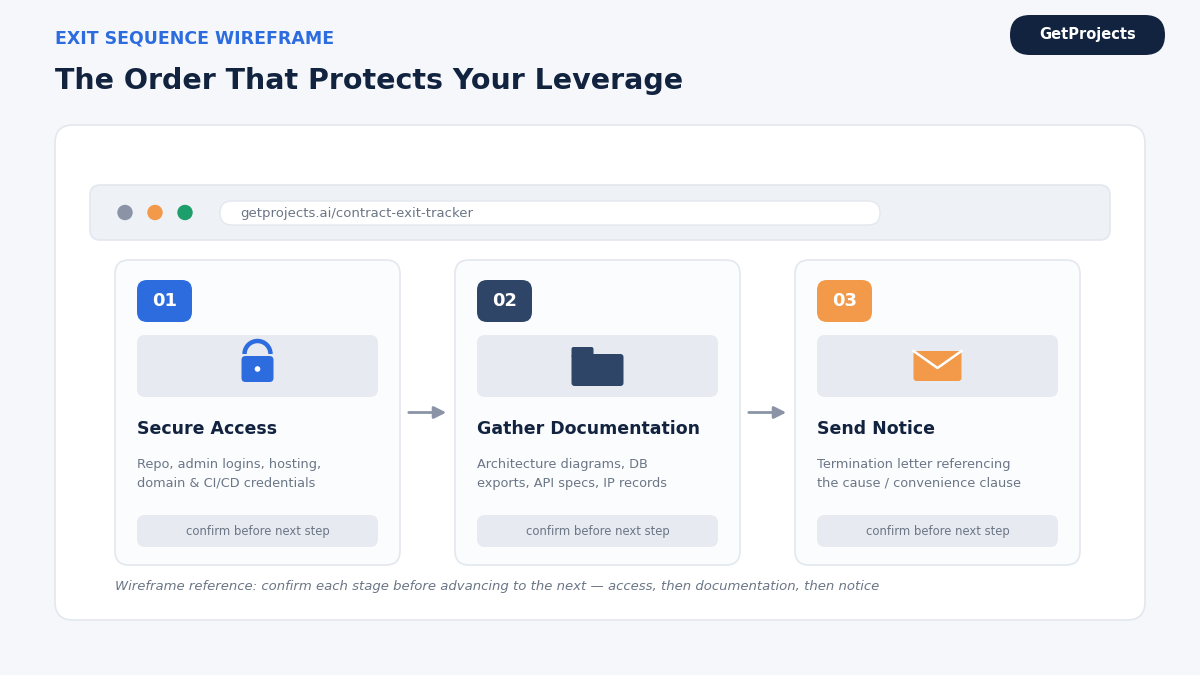
Knowing how to exit a software development contract cleanly comes down to sequencing three things correctly: access first, documentation second, notice third.
Termination for Cause vs. Termination for Convenience
Every serviceable development agreement should define two distinct exit paths.
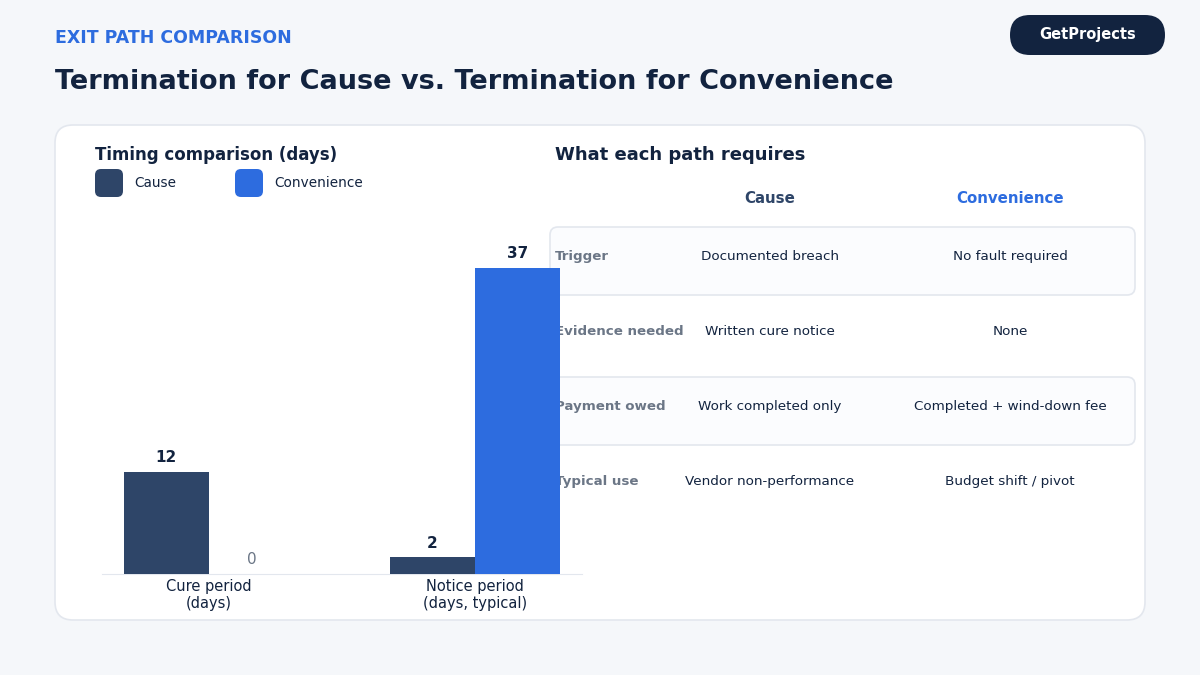
Termination for cause applies when the vendor materially breaches the contract, missed milestones, security failures, abandoned staffing, repeated SLA breach events. This path typically requires no further payment beyond work completed and delivered, though it usually triggers a cure period first (see below).
A termination for convenience clause, by contrast, lets either party exit without alleging fault simply because priorities changed, budget shifted, or the relationship isn’t working. This path almost always comes with an obligation: paying for work completed to date, plus sometimes a wind-down fee covering a fixed number of transition days. Which path is even available often traces back to how the engagement was structured: a dedicated team vs. time & material vs. fixed price model each carry different default exit economics. Clients should never sign an agreement without a convenience-exit option; without one, the only legal way to exit a software development contract early is by proving breach, which can take months and legal fees neither side wants to absorb.
The Cure Period, and Why It Protects Both Sides
A cure period is the window commonly 10–15 business days a vendor gets to fix a documented breach before the client can terminate for cause. It exists so a single missed deadline doesn’t become an automatic contract kill switch, and it exists to protect the client too: it forces the breach to be documented in writing, which becomes the evidence needed if the exit later gets disputed or goes to arbitration.
Skipping the cure period is the single most common way clients weaken their own termination-for-cause claim. Courts and arbitrators look for a documented notice-to-cure trail; without it, a “for cause” termination can get reclassified as “for convenience” after the fact, changing what the client owes and eliminating any leverage they thought they had.
What to Reclaim on Termination
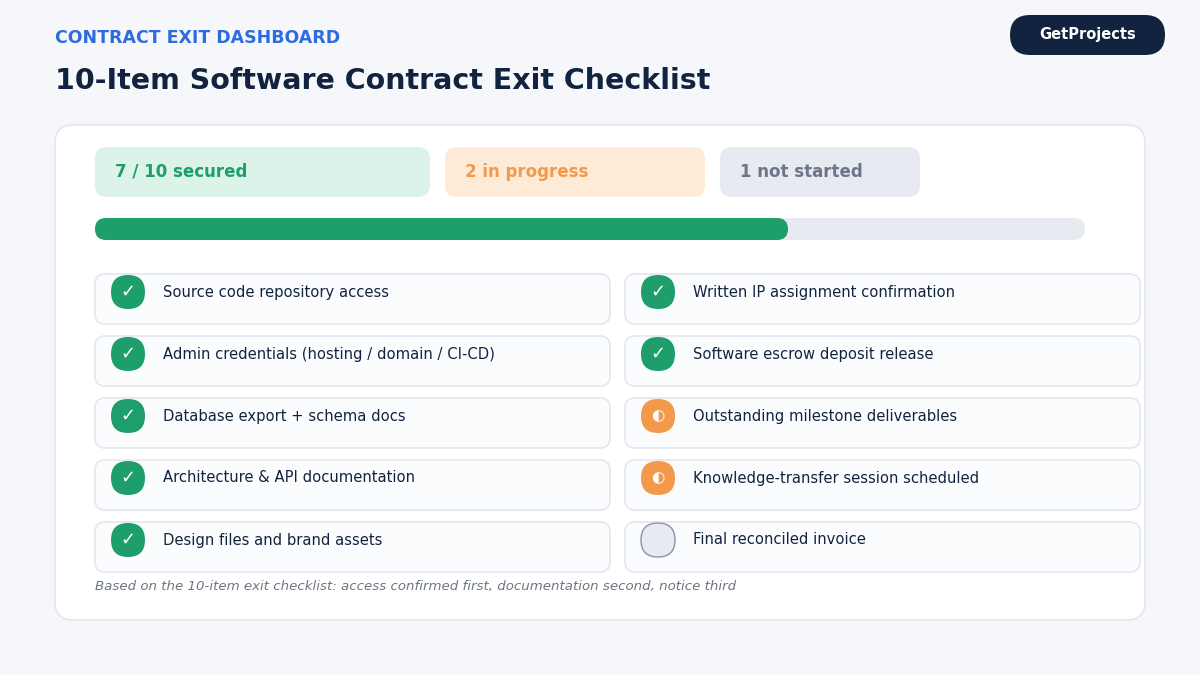
What to reclaim on termination should be spelled out contractually, not negotiated after the fact and it starts with a firm answer on protecting your IP while outsourcing long before the exit conversation happens. At minimum, a client should confirm:
- Full source code repository access (not a zip export actual repo transfer or ownership)
- Admin credentials for hosting, domain, CI/CD, and third-party API accounts
- Database exports, including schema and historical data
- Technical documentation: architecture diagrams, API specs, environment configs
- Design files and assets (Figma, Sketch, brand assets)
- Written confirmation of IP assignment for all custom-built code
- Any software escrow agreement deposit release, if one was in place
- Outstanding deliverables per the last agreed milestone
- A knowledge-transfer session or written dev team handover summary
- Final reconciled invoice with no ambiguous “time and materials” gaps
If a contract doesn’t name these explicitly, a client is negotiating for them during an already-strained exit, the worst possible timing to discover how to exit a software development contract without a documented owner for every credential.
Notice Period Dev Contract Requirements
A workable notice period dev contract clause should specify: the number of days (commonly 15–30 for smaller engagements, 30–60 for enterprise-scale ones), what obligations continue during that window, and a hard date for full credentials handover. Vague notice language “reasonable notice” almost never favors the client, since “reasonable” gets defined by whoever has more leverage when the dispute starts.
Vendor Offboarding and Data Portability
Vendor offboarding is more than a credentials handoff; it’s a data portability exercise. Contracts should specify the format data will be exported in (raw SQL dump vs. proprietary export), who performs the migration, and whether the outgoing vendor is obligated to assist a new team during the transition window. This is the same groundwork worth laying before any team commits to how to outsource software development in the first place. Without it, clients frequently discover that “their data” is technically accessible but practically unusable outside the original vendor’s tooling.
Case Studies
A Series B logistics-software company hired an offshore agency for a 6-month platform rebuild. At month 4, delivery slipped and the client invoked the cure period, documented two missed milestones in writing, and terminated for cause after the 10-day cure window lapsed with no fix. Because repo access had been requested up front in the contract, the transition to a new vendor sourced through a commission-free marketplace took 9 days instead of the 6–8 weeks typical of contested exits. The client credited the speed entirely to having admin credentials confirmed before, not after, notice went out.
A healthcare SaaS startup exited a vendor relationship for convenience after a strategic pivot. The original agreement had no defined wind-down scope, so the vendor billed the full 30-day notice period at standard rates despite doing no substantive work during that window. On the next engagement, the client’s legal team wrote a wind-down cap a fixed, reduced fee for notice-period work directly into a new contract sourced through a properly scoped how to write a software development RFP, cutting the equivalent cost by roughly 60% the second time the company had to exit a software development contract.
A fintech scale-up ran into the third-party account problem directly: its original agency had set up the production AWS account under its own company email. When the relationship ended, reclaiming ownership took an extra 11 days of back-and-forth with AWS support to prove the client was the rightful account holder. The client’s next contract required all infrastructure accounts to be created under the client’s own domain from day one, closing that gap permanently.
Comparison: Termination for Cause vs. Termination for Convenience
Choosing the wrong exit path or discovering too late that only one is available is one of the costliest mistakes in this process. Anyone comparing options for how to exit a software development contract should read this table before the wind-down conversation, not during it. The table below lays out how the two compare in practice.
| Factor | Termination for Cause | Termination for Convenience |
| Trigger | Documented breach (missed milestones, SLA breach, security failure) | Either party’s discretion, no fault required |
| Notice required | Immediate after cure period expires | Per notice period dev contract clause (15–60 days) |
| Payment obligation | Work completed only; disputed if breach is proven | Work completed plus wind-down fee, if defined |
| Evidence needed | Written cure notice, breach documentation | None |
| Typical use case | Vendor non-performance, repeated missed deadlines | Budget shift, strategic pivot, relationship mismatch |
What Most Teams Get Wrong
Most clients treat the termination clause as boilerplate at signing and only read it closely once they want out by which point renegotiating it is nearly impossible. The exit terms deserve the same scrutiny given to comparing software development quotes before a signature ever goes on the contract, precisely because that is the only point where either side has equal leverage to define how to exit a software development contract fairly.
The second pattern: clients ask for code access after sending notice. Once a vendor knows the relationship is ending, cooperation drops and response times stretch. Every credential, every repo permission, every admin login should be confirmed or requested while the relationship is still active and the vendor still has an incentive to be responsive.
The third pattern is underestimating contract dispute resolution costs. Arbitration or legal review over a disputed final invoice frequently costs more than the disputed amount itself, often more than the cost of hiring an IT company directly would have been for the entire remaining scope. Clients who negotiate a clear wind-down fee and a data portability clause up front almost never end up in that position, and they rarely need to search for how to exit a software development contract a second time with the same vendor type.
Before You Send Notice
Knowing how to exit a software development contract is really about sequencing: access first, documentation second, notice third. Get that order backward, and the exit costs far more than the contract ever did. Get it right, and the transition to a new vendor becomes a scheduling exercise instead of a legal one. Every checklist item above exists because some client, somewhere, learned it the hard way mid-dispute, with a repository they no longer controlled.
If the current engagement is heading toward an exit, the next vendor decision matters more than it usually gets credit for. GetProjects connects businesses directly with verified IT agencies, no bidding wars, no commission cuts, and AI-driven matching against 50+ data points so the next contract is easier to walk away from cleanly if it ever needs to be. Post a project in under two minutes at getprojects.ai.
FAQ
What happens if you terminate a software development contract early?
The client typically owes payment for work completed to date, and if a termination for convenience clause exists a wind-down fee covering the notice period. Without that clause, early termination often requires proving cause, which can extend the exit by weeks and add legal costs on both sides.
Can you terminate a software development contract without cause?
Yes, if the agreement includes a termination for convenience clause. Without one, a client generally needs to demonstrate breach missed deadlines, quality failures, or an SLA breach to exit before the contract’s natural end date, which is a significantly slower path.
What should you get back when firing a development agency?
Source code repository access, admin credentials, database exports, technical documentation, design assets, and written IP assignment. This is the core of what to reclaim on termination, and it should be requested before, not after, notice is sent.
How long is a typical notice period for ending a dev contract?
Fifteen to 30 days for smaller engagements, and 30 to 60 days for enterprise-scale contracts. The notice period dev contract clause should also define what work, if any, continues during that window and at what rate.
Is the source code yours if you paid for custom development?
Only if the contract explicitly assigns IP ownership to the client. Many agency contracts default to a license rather than a full assignment, which is why confirming the IP transfer clause matters more than the payment terms themselves.
What is a cure period in a software contract?
A cure period is a window commonly 10 to 15 business days given to a vendor to fix a documented breach before the client can terminate for cause. It protects both parties by creating a written record of the issue and the vendor’s chance to resolve it.
How do you exit a software development contract without losing your data?
Secure a full database export, confirm schema documentation, and verify backup access before sending any termination notice. Waiting until after notice to request data access hands the vendor unnecessary leverage during an already strained transition, and it is the fastest way to lose the very thing the exit was supposed to protect.
Do you need a lawyer to exit a software development contract?
Not always. A straightforward termination for convenience with clear contract language can usually be handled internally by referencing the notice period dev contract clause directly. Legal review becomes worthwhile once a breach, disputed invoice, or unclear IP ownership is involved, since those situations are exactly where a poorly worded exit clause software vendor provision turns into a costly negotiation.