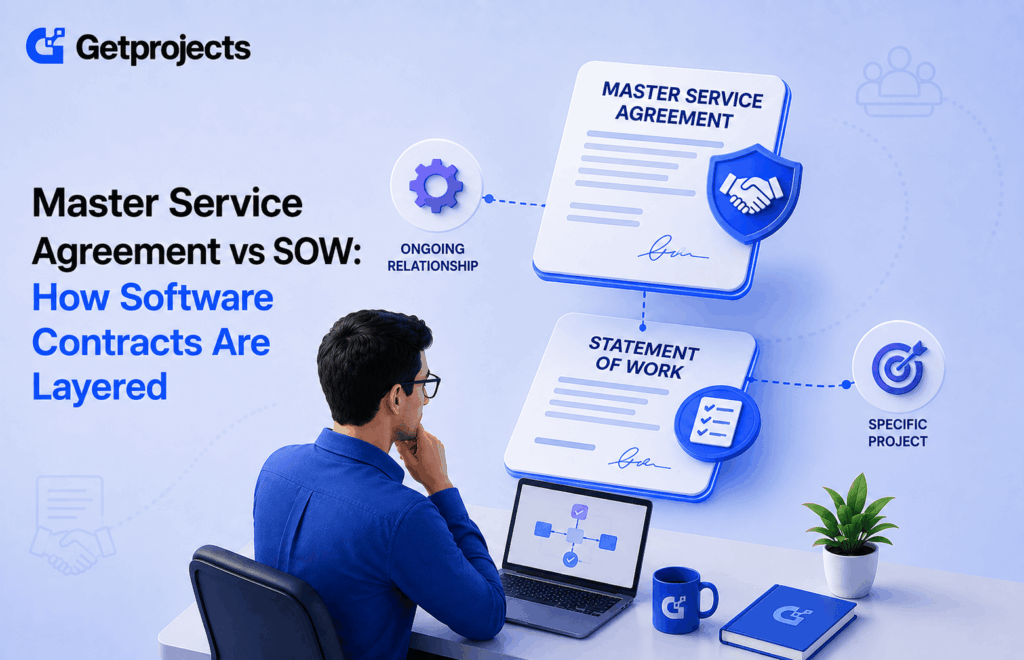
Master Service Agreement vs SOW: How Software Contracts Are Layered
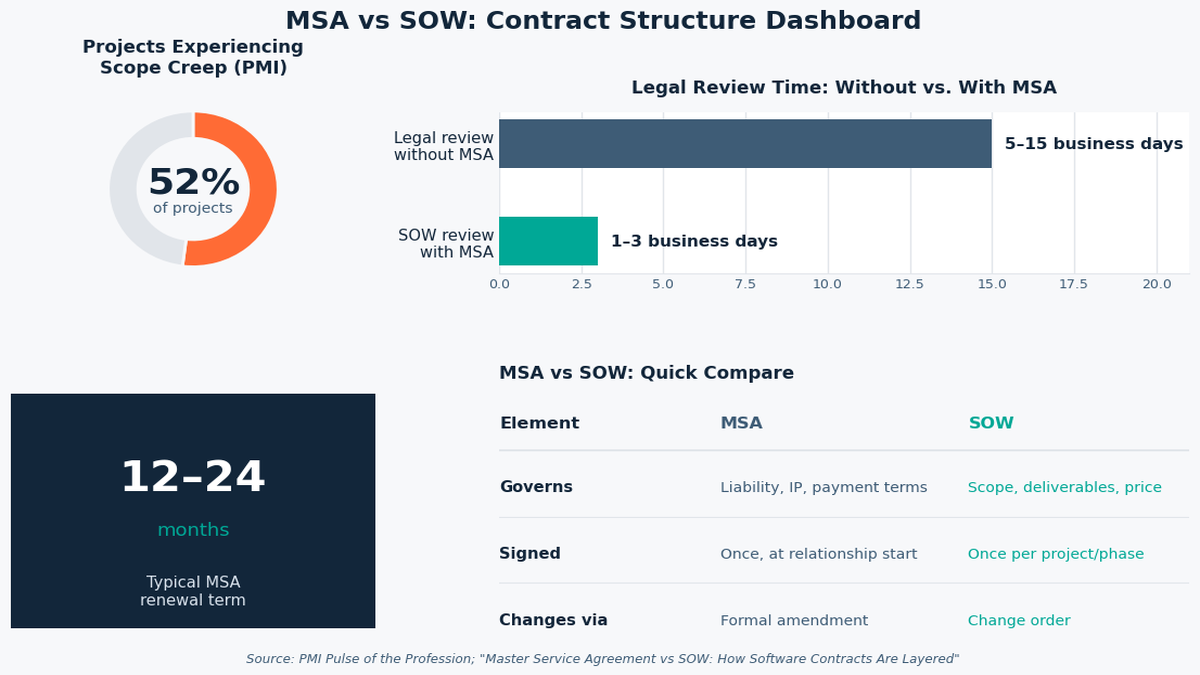
Fifty-two percent of projects experience scope creep after the work has already started, according to the Project Management Institute and most of that creep happens because nobody wrote down where one agreement ends and the next one begins. In software outsourcing specifically, the fix isn’t a better single contract. It’s a master service agreement software development structure that separates what rarely changes (the legal terms) from what changes on every project (the scope, timeline, and price).
Most founders and procurement leads sign one contract per project, renegotiating liability caps, payment terms, and IP language every single time they hire a new agency or start a new phase of work. That’s redundant, slow, and it’s why legal review on a $30,000–$60,000 software engagement can eat 2–3 weeks before a single line of code gets written, the kind of drag a proper software development contract checklist is built to catch early. A layered contract structure master service agreement software development terms at the top, statements of work underneath, change orders below that collapses that timeline to days.
According to Grand View Research – IT Services Outsourcing Market, the global IT services outsourcing market is estimated to reach $877.4 billion in 2026 and is projected to grow at an 8.6% CAGR through 2030. As outsourcing relationships become more extensive, having a contract structure that can support changing scopes and long-term engagements becomes increasingly valuable.
This matters more as companies scale their vendor relationships. A business running three or four concurrent agency engagements doesn’t want three or four separately negotiated liability clauses, three or four different indemnification standards, and three or four renewal schedules to track. The master service agreement software development approach exists specifically to prevent that fragmentation.
The global IT outsourcing market is on track to more than triple between 2019 and 2027, according to Statista projections, which means more companies are entering multi-year vendor relationships without a contract structure designed to support them. A single-project agreement was never built for a relationship that spans four, six, or ten engagements over several years; it was built for one transaction. If you’re still working out the basics of vendor relationships at that scale, it’s worth reviewing how to outsource software development before layering contracts on top of it. Layering the contract fixes that mismatch before it becomes expensive.
What Is an MSA Contract?
A master service agreement is a standalone legal contract between a client and a vendor that fixes the recurring terms of a working relationship liability, IP ownership, confidentiality, payment terms, dispute resolution so that individual projects don’t need to renegotiate them. Actual project scope, deliverables, and pricing live in separate statements of work signed under it.
The MSA itself typically runs 10–20 pages and rarely changes once negotiated, which is precisely the point it’s designed to be signed once and referenced repeatedly, not revisited every time a new project starts.
The Core Problem With Project-by-Project Contracts
Most teams underestimate how much time gets lost to redundant legal review often by 3–4x. A single-project contract bundles legal terms and project scope into one document, so every new engagement with the same agency triggers a full legal re-review, even if 90% of the language is identical to the last contract.
That redundancy compounds fast. A company running four projects a year with the same development partner, each requiring 10–15 business days of legal turnaround, loses 40–60 business days annually to contract admin that a properly layered structure would cut to a few days per project. Much of that admin traces back to scope that was never pinned down clearly in the first place, a gap covered in how to write a software development RFP. Procurement and legal teams rarely track this cost separately, so it hides inside “time to project kickoff” metrics instead of getting flagged as a contracting problem.
There’s a second cost: inconsistency. Without a master agreement, liability caps, IP assignment language, and termination clauses can drift slightly between contracts with the same vendor, creating gaps that only surface during a dispute, usually the worst possible time to discover them.
There’s a third cost that rarely shows up until year two or three: renegotiation fatigue. Legal and procurement teams handling five, six, or more vendor contracts a year without a master service agreement software development framework end up treating every single engagement as a first-time negotiation. That’s not just slower; it means the business never accumulates negotiating leverage with a vendor, because every contract starts from a blank page instead of building on agreed terms the same leverage gap that shows up when teams skip the step of learning how to compare software development quotes before signing.
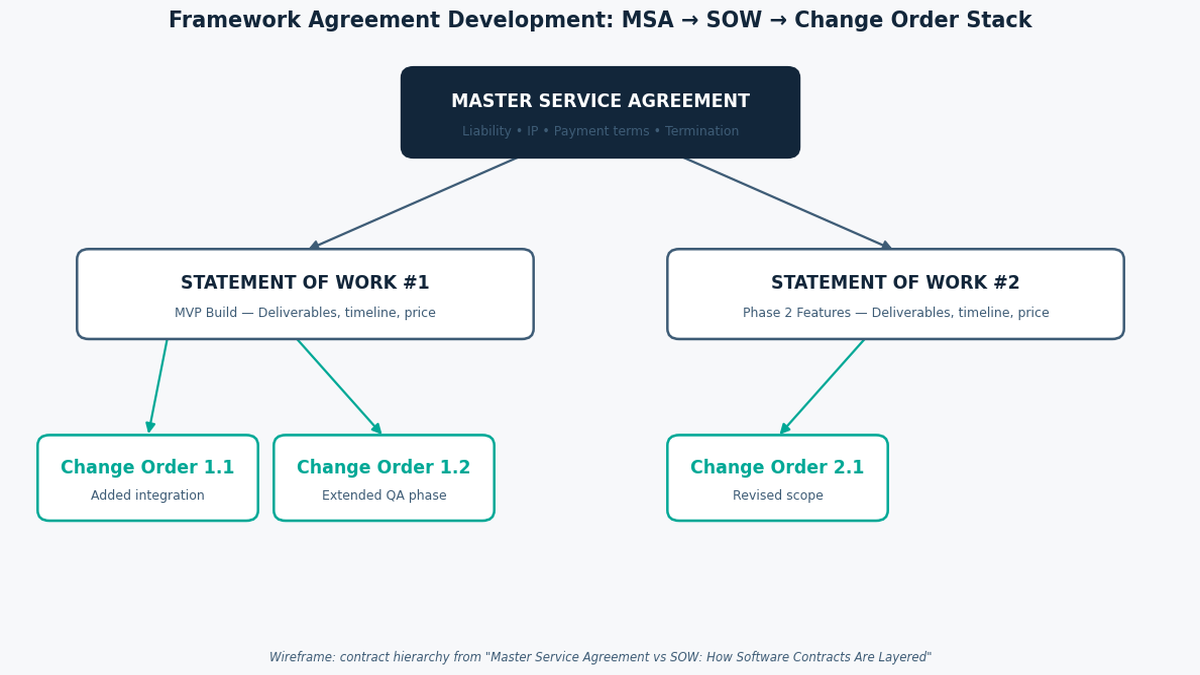
Framework Agreement Development: Building the MSA → SOW → Change Order Stack
Framework agreement development structuring a vendor relationship as a layered contract stack rather than a single document follows a strict hierarchy. Each layer governs a narrower slice of the relationship than the one above it.MASTER SERVICE AGREEMENT (MSA)
Each layer has a distinct purpose and a distinct owner. The MSA is typically owned by legal and procurement, since it rarely touches day-to-day delivery. The SOW is owned jointly by the project sponsor and the vendor’s account lead, since it defines what gets built and by when. Change orders are usually owned by whoever manages the engagement day to day, a project manager on either side because they need to move fast without triggering a full legal cycle every time. Keeping ownership clear at each layer is what prevents the stack from collapsing back into one document during a busy quarter.
Why an MSA Saves Time on Repeat Work
Once liability, IP, and payment terms are locked at the MSA level, every subsequent statement of work only needs to define scope, deliverables, and price the parts that actually change project to project, and the same variables at the center of any dedicated team vs. time and material vs. fixed price decision. Legal doesn’t re-review 15 pages of boilerplate each time; it reviews a 2–3 page SOW. That’s the entire mechanism behind the time savings, and it’s why enterprises with recurring vendor relationships almost never sign project-only contracts after the first engagement.
MSA Clauses to Negotiate
Not every MSA clause carries equal weight. When evaluating msa clauses to negotiate, six deserve the most attention before signing, because they’re expensive or impossible to fix retroactively:
- Liability cap Sets the maximum a vendor owes if something goes wrong. Push for a cap tied to fees paid over a rolling 12-month period, not a flat number that erodes in value as the relationship grows.
- IP ownership confirms work-for-hire status so the client owns all code, designs, and documentation outright, with no ambiguity around pre-existing vendor tools or libraries.
- Termination rights Defines how either party exits, including notice periods (typically 30–60 days) and what happens to work-in-progress and data on exit.
- Rate card lock Fixes hourly or day rates for a defined period (commonly 12–24 months) so a vendor can’t quietly raise prices mid-relationship without a formal amendment.
- Non-solicitation prevents either party from directly hiring the other’s staff during the engagement and for a set period afterward, usually 12 months.
- Indemnification Assigns responsibility for third-party claims, particularly IP infringement and data breach exposure, and should specify defense cost coverage, not just damages.
Negotiating these six clauses once, at the MSA stage, is what makes every subsequent SOW a low-friction document instead of a full legal negotiation. The IP ownership clause deserves particular attention before signing anything, see who owns the code when you outsource for how ambiguous language here creates disputes long after a project closes.
Decision Criteria: When You Actually Need an MSA
Not every engagement justifies the upfront work of a full master service agreement software development stack. The decision usually comes down to three factors:
- Expected relationship length. A one-off, fixed-scope project under $15,000 rarely needs a separate MSA layer; a single well-drafted contract covers it. Anything expected to run beyond one project, or beyond six months, should start with an MSA.
- Number of anticipated SOWs. If a company already knows it will need a phase two, a maintenance contract, or a follow-on feature build, negotiating the MSA terms once up front is cheaper than renegotiating liability and IP language two or three more times.
- Vendor concentration. Businesses consolidating spend with two or three trusted agencies, instead of spreading work across many one-off vendors, get the most value from an MSA framework, since the fixed terms apply across every future SOW with that partner which starts with knowing how to shortlist an IT agency in 72 hours worth consolidating around.
Cost Implications of Skipping the MSA Layer
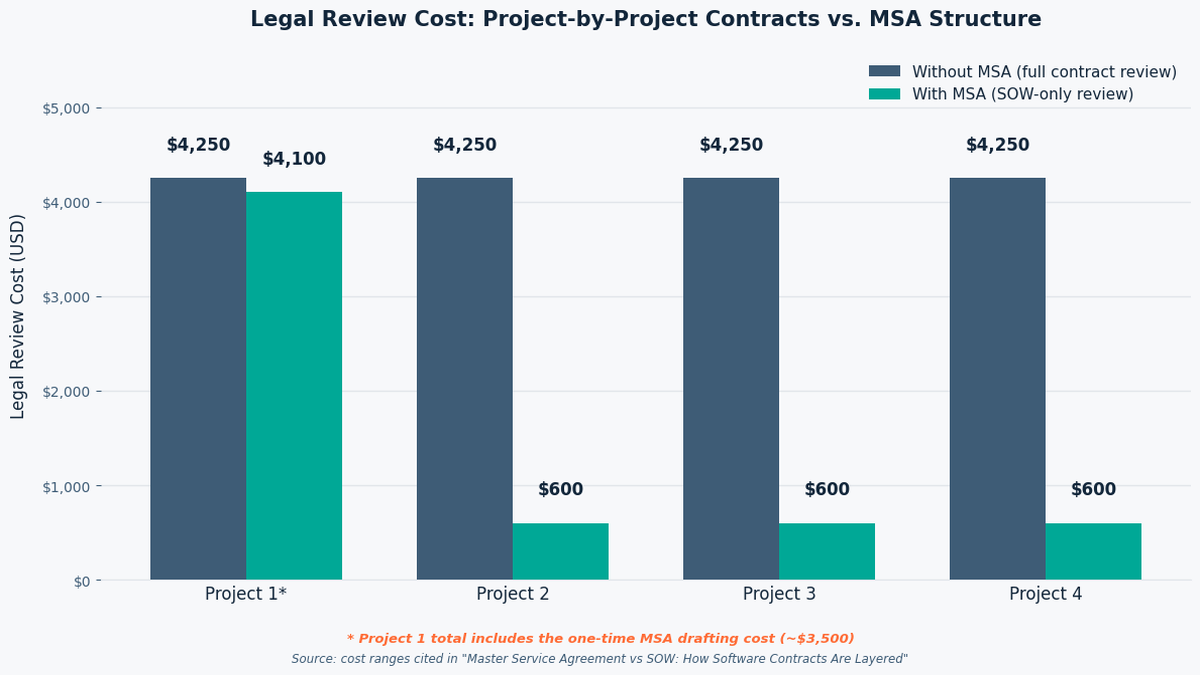
The direct cost of skipping a master service agreement software development structure isn’t the legal fee for drafting the MSA itself that typically runs $2,000–$5,000 for a properly negotiated agreement. It’s the accumulated legal spend on redundant reviews across every subsequent project. A company paying outside counsel $250–$400 per hour for 10–15 hours of review on each new contract spends $2,500–$6,000 per project on terms that, in an MSA structure, would already be settled.
Over four or five engagements with the same vendor, that gap alone often exceeds the cost of drafting the MSA in the first place before accounting for the operational cost of delayed project starts, or the harder-to-quantify risk of discovering red flags in a software development company only after you’re several contracts deep with them.
Case Study: Two Ways the Same Structure Plays Out
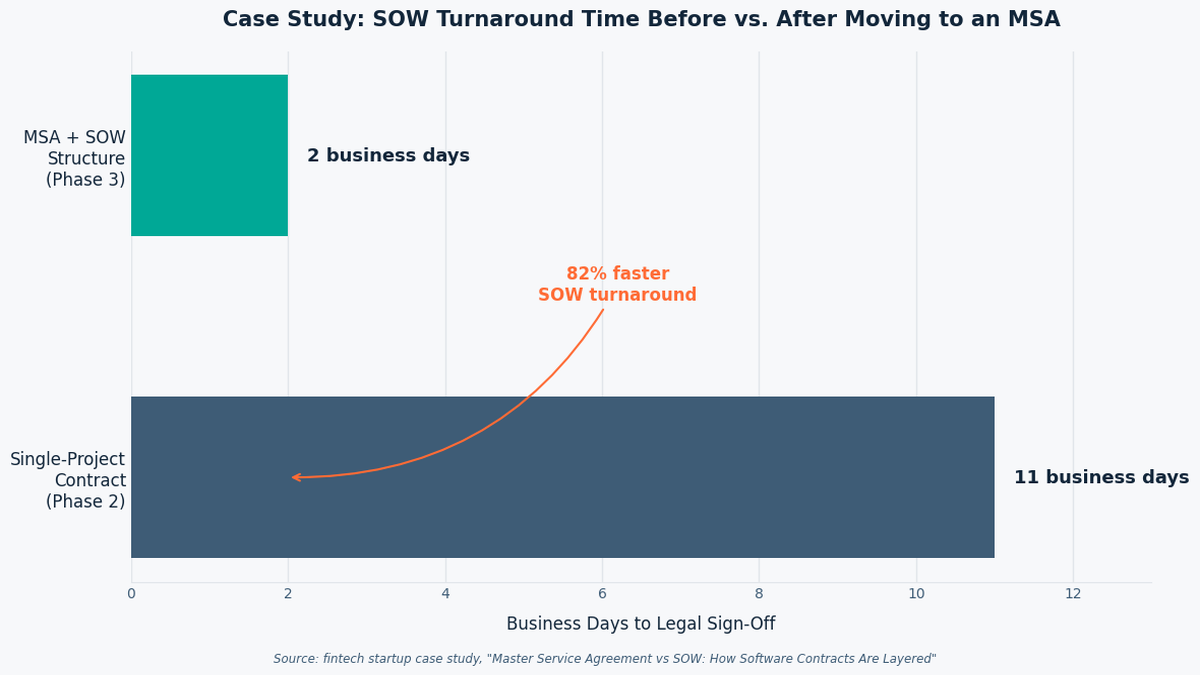
A mid-size fintech startup hired a development agency for an MVP build under a single project contract. Eighteen months later, when they needed a second phase, legal review took 11 business days because the original contract had to be fully renegotiated liability terms, IP language, and payment structure included. After switching to an MSA with the same vendor for phase three, SOW turnaround dropped to 2 business days.
An enterprise retailer running parallel engagements with three agencies standardized all three onto individual MSAs with matching liability caps and IP terms. Procurement reported a 60% reduction in legal hours spent on vendor contracting across the portfolio in the following year, freeing legal capacity for higher-value review work instead of repetitive redlines.
A B2B SaaS company sourcing a new development partner through a marketplace model negotiated its MSA terms before selecting a final agency, using the same liability cap and IP language as a baseline across every agency it evaluated. That lets procurement compare vendor quotes on price and timeline alone, without also normalizing for different legal terms in every proposal, a step that typically adds another 1–2 weeks to vendor selection when skipped, and one of the reasons agency marketplaces vs. direct matching has become a real decision point for buyers.
MSA vs SOW Software: Comparison Framework
Evaluating msa vs sow software contracts side by side clarifies what belongs in each document and prevents the two from being conflated during negotiation.
| Element | MSA | SOW |
| Governs | Liability, IP, confidentiality, payment terms | Scope, deliverables, timeline, price for one project |
| Signed | Once, at relationship start | Once per project or phase |
| Renegotiation frequency | Every 12–24 months (renewal term) | Every new project or major scope change |
| Legal review time | 1–3 weeks (first time only) | 1–3 business days once MSA exists |
| Changes handled by | Formal amendment | Change order |
Use this table as a starting checklist when a vendor proposes a single combined contract instead of a layered stack combined contracts almost always mean re-negotiating liability and IP every time scope shifts.
One detail worth flagging during vendor selection: agencies that primarily work project-to-project, without recurring clients, sometimes push back on signing an MSA before scope is defined, because they’re used to combined contracts. That’s not necessarily a red flag on its own, but it’s worth asking directly how the vendor has structured MSAs with other clients and how they’ve handled adjacent agreements like an NDA for software development projects before assuming they’ll accommodate a layered structure smoothly.
MSA Renewal Terms: What Most Teams Get Wrong
The most common mistake isn’t skipping an MSA, it’s letting msa renewal terms run indefinitely with no review trigger. Rate cards from three years ago quietly stay in force, liability caps that made sense at $50,000 in annual spend go untouched at $500,000, and nobody owns the calendar reminder to revisit the document.
The insider pattern is worth knowing: agencies rarely push for MSA renewal reviews themselves, because static terms usually favor whichever side negotiated the original rate card. Clients who build a mandatory 12–18 month review clause into the MSA, not just an auto-renewal, retain leverage that otherwise erodes silently.
A second pattern: teams treat change orders as informal email threads instead of signed documents. That’s how scope creep enters even inside a well-structured MSA-SOW stack. A change order needs the same signature discipline as the SOW it modifies, or the entire layered structure loses its enforceability.
A third pattern shows up specifically around the rate card. Teams lock rates at MSA signing and never revisit them, even as a vendor’s seniority mix or specialization shifts. A rate card that made sense for a junior-heavy team in year one can badly undervalue senior engineering time by year two if the vendor has since staffed the account with more experienced developers worth checking against current software developer hourly rates by country at each review cycle. Reviewing rate cards on the same cycle as the broader MSA renewal rather than letting them run on autopilot closes that gap before it compounds across dozens of invoices.
Comparing Vendors Under the Same Framework
Evaluating a master service agreement software development structure only helps if you’re comparing agencies on equal footing to begin with. Businesses sourcing tech partners often end up negotiating MSA terms differently with each vendor simply because they lack a consistent way to compare software development companies before contracting starts.
GetProjects addresses that earlier step matching businesses directly with verified IT agencies based on budget, expertise, and project history, without commission fees or bidding wars, so the contracting conversation starts with vendors already screened for fit. Verification happens before a profile goes live, which means the negotiation that follows is about contract terms, not about confirming the agency is legitimate in the first place.
If you’re evaluating a master service agreement software development structure and want to compare verified agencies before signing anything, post a project free at getprojects.ai and review matched agencies directly with no commission, no bidding war, no cost to connect.
Frequently Asked Questions
What is the difference between an MSA and a SOW?
An MSA sets the legal terms governing an entire vendor relationship liability, IP, payment, termination while a SOW defines the scope, deliverables, timeline, and price for one specific project under that MSA. The MSA is signed once; SOWs are signed repeatedly.
Is an MSA legally binding without a SOW?
Yes, but it typically has no operational effect on its own. An MSA establishes the framework and legal terms, while the SOW is what actually authorizes work, sets deliverables, and triggers payment obligations for a specific project.
What should be included in a software development MSA?
At minimum: liability caps, IP ownership and work-for-hire language, confidentiality terms, payment and invoicing terms, termination rights, indemnification, and a clause defining how SOWs and change orders attach to the agreement.
How often should an MSA be renegotiated?
Most msa renewal terms run 12–24 months before requiring formal review. Shorter cycles suit fast-scaling relationships where spend or scope is changing quickly; longer cycles suit stable, low-change vendor relationships.
Can a SOW override the MSA?
Only if the MSA explicitly allows it, usually through a precedence clause. Without that clause, the MSA’s terms control, and any conflicting SOW language is typically unenforceable which is why precedence should always be addressed directly in the MSA.
What happens if there’s no SOW under an MSA?
No work is authorized. An MSA without an active SOW is a dormant legal framework that defines how future work would be governed but doesn’t itself commit either party to deliverables, timelines, or payment. Some companies sign an MSA well before a project is scoped, specifically so the legal terms are already settled once a SOW is ready to move.
When do you need a change order instead of a new SOW?
Use a change order for scope adjustments within an existing project added features, extended timelines, revised deliverables. Use a new SOW when the work is a distinct project or phase with its own deliverables and budget.