
How to Post a UI/UX Design & Development Project and Get Matched With Verified Agencies in 24 Hours
Design work is rarely what delays a product launch. Finding the team to do it is.
Teams that post a UI/UX design project through a verified agency network compress that search from weeks into a single day. The rest of this article is how that flow works, and where the traditional alternatives lose the time.
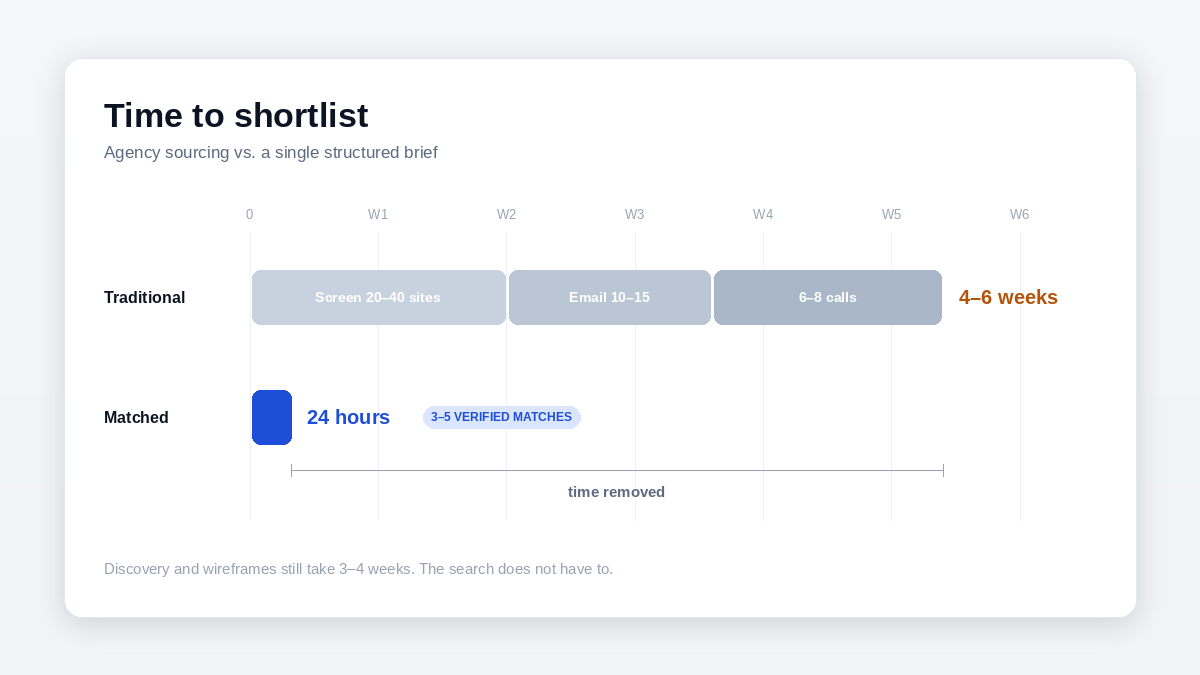
The build phase is measurable: 3–4 weeks for discovery and wireframes, 4–8 weeks for high-fidelity design and front-end handoff. The sourcing phase has no such discipline. Teams screen 20–40 agency websites, email 10–15 of them, and sit through 6–8 discovery calls before anyone is shortlisted. Four to six weeks evaporate before a single artboard exists, which is why shortlisting an IT agency in 72 hours reads as ambitious rather than routine.
The alternative is to submit one structured brief and let the network route it to firms that already match on budget, stack, and domain. Replies arrive inside a day, pre-filtered.
There is no shortage of agencies. Any search returns thousands of them. What is scarce is signal which firm has actually shipped a B2B SaaS dashboard, holds twelve or more designers in-house, handles React handoff rather than tossing Figma files over a wall, and can start in three weeks rather than eleven.
That signal problem is why sourcing cycles stretch. Every additional agency you evaluate adds an hour of review, a 45-minute call, and a week of calendar drag, while giving you no reliable way to separate a studio with fifty shipped products from a three-person team with a well-art-directed portfolio site.
Most teams respond by evaluating fewer agencies, not better ones, and end up choosing from a sample of two. Knowing how to post a UI/UX design project so that qualified firms come to you reverses that dynamic at the one point where it is still cheap to fix.
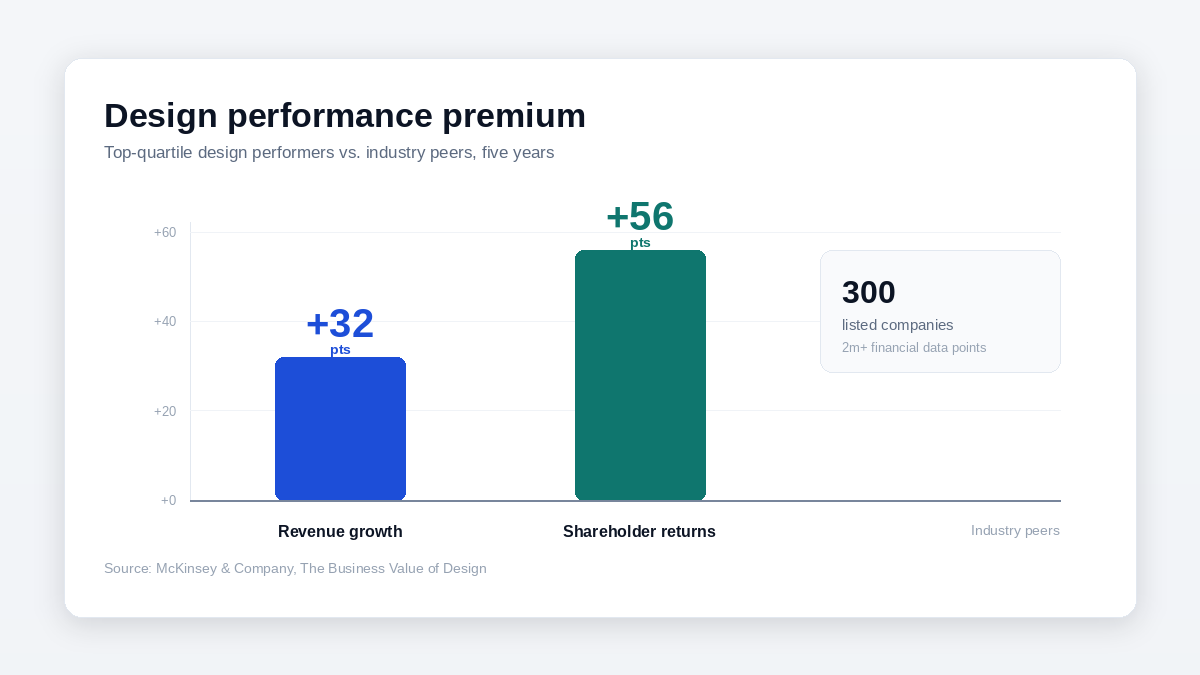
McKinsey tracked the design practices of 300 publicly listed companies over five years, collecting more than two million pieces of financial data. Top-quartile design performers recorded 32 percentage points higher revenue growth and 56 percentage points higher total returns to shareholders than their industry peers.
If design performance moves revenue at that magnitude, the partner-selection decision deserves better tooling than a bookmarked directory and a spreadsheet.
What It Means to Post a UI/UX Design Project
To post a UI/UX design project is to submit a structured brief scope, budget, timeline, and technical requirements to a marketplace or agency network that routes it to pre-vetted design and development firms, which then respond with portfolios, team composition, and pricing instead of requiring the client to find and contact each one individually.
The mechanism matters more than the label. In a directory, you do the searching. In a bidding marketplace, you receive proposals from whoever pays to see your listing. In a matched model, an algorithm compares your requirements against agency data and returns a short, qualified list, which is the core distinction in agency marketplaces versus direct matching.
Only the third model reduces your workload without reducing your options, which is the entire point of the exercise. It is also the only one where the effort is front-loaded into a single submission rather than spread across twenty inboxes, and the same logic holds whether you post a UI/UX design project or post a web development project.
Why Agency Sourcing Costs More Than the Design Itself
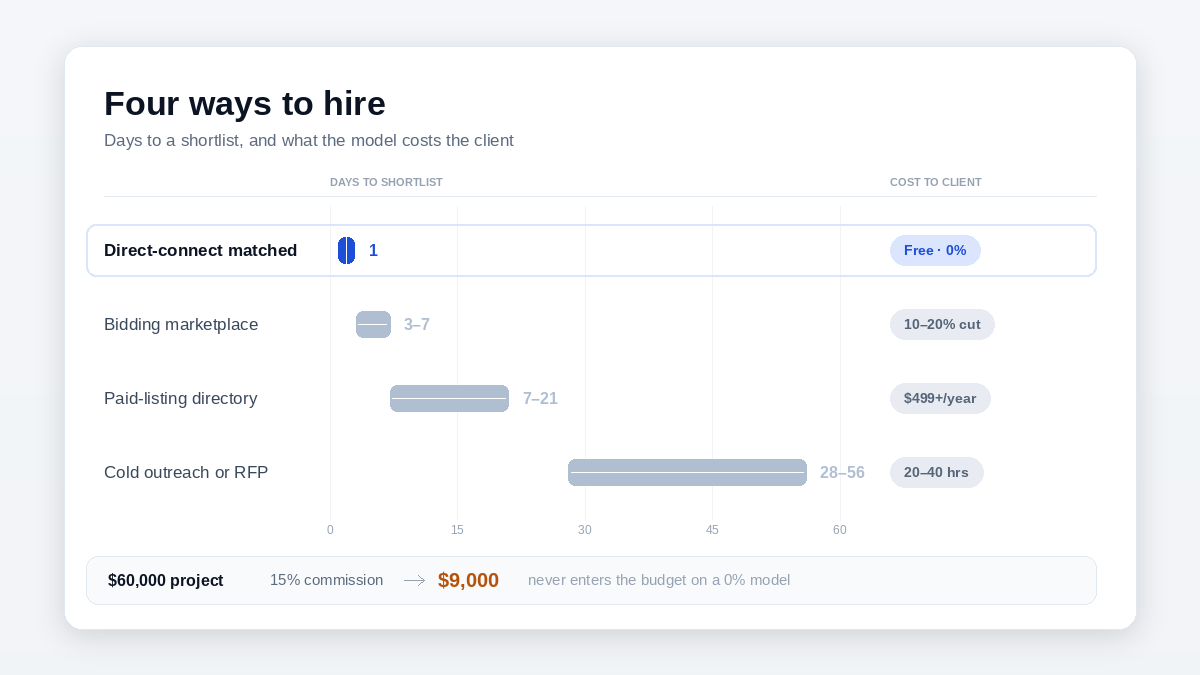
Four sourcing routes dominate, and each carries a cost that rarely appears on an invoice.
Paid-listing directories charge agencies $499 or more per year for placement, which means ranking correlates with marketing budget rather than delivery quality. Buyers who have worked through alternatives to DesignRush usually reach the same conclusion: you are reading a leaderboard of who paid, not who performs.
Bidding marketplaces take 10–20% of project value. On a $40,000 design brief, that is $4,000–$8,000 that either inflates your price or is absorbed out of the agency’s margin which usually means a junior designer on your account. Bidding also inverts the incentive: agencies optimise for proposal volume, and you receive fifteen templated responses that take four hours to read.
Cold outreach produces a 15–25% reply rate. Sending twenty emails yields four conversations, two of which will be with firms that cannot start for two months. Writing a formal software development RFP raises reply quality but adds two to three weeks, and it still fails because there is no structured way to post a UI/UX design project and compare the responses on equal terms.
Referrals are fast and carry genuine trust, but they give you a sample size of one. No comparison, no pricing leverage, no evidence that the agency that built your friend’s marketing site can build a permissions-heavy admin console. Every one of these routes asks you to trade speed for confidence, and that is exactly the trade a structured way to post a UI/UX design project removes.
The teams that get ui ux design quotes fast are not working harder at any of these. They have replaced the search step entirely, which is where the 4–6 weeks actually goes.
How to Post a UI/UX Design Project in Under Two Minutes
The five steps below describe what happens after you post a UI/UX design project on a direct-connect marketplace. Matching, verification, and shortlisting all run before you speak to anyone.
- Describe the project in plain language and let AI structure it into a complete brief.
- Receive 3–5 verified agency matches within 24 hours.
- Compare portfolios, team size, ratings, and past work before replying.
- Connect directly with the agencies you want, with no bidding round.
- Start the engagement and pay the agency directly, with zero commission.
All five run from a single submission. You post a ui ux design project online once, and distribution to the agencies that already fit the brief is handled for you, exactly as it works when you post an app development project.
Step 1 Describe the project and let AI structure the brief
Most sourcing failures start here. A brief that says “we need a redesign of our app” forces every agency to guess, and their quotes will vary by 400% because they are pricing different projects. The first real decision when you post a UI/UX design project is how much detail to commit up front, and the answer is more than feels comfortable.
AI-assisted briefing solves this by asking the questions a scoping lead would ask: platform, user roles, screen count, existing design system or none, research requirements, whether front-end development is in scope, integration constraints, and launch date. The result takes under two minutes to produce and gives every agency the same input.
A workable brief covers seven things: product and users, current state, scope boundary, approximate screen or flow count, budget band, start date, and the technical stack the design must hand off into. That last item eliminates a large share of mid-project renegotiations.
Step 2 Receive 3–5 verified agency matches within 24 hours
Matching compares your requirements against 50+ data points on each agency: domain expertise, budget fit, team size, historical client profile, delivery performance, and location. Three to five matches arrive within 24 hours. Because you post a UI/UX design project once rather than retyping it into a dozen contact forms, every agency is working from identical information.
The number is deliberate. Shortlists longer than five reliably add deliberation time without improving the decision, and in project scoping the pattern is familiar: eight agency conversations produce confusion, three produce a choice. Founders trying to find IT agencies for startup development hit that ceiling fastest, because every extra call competes directly with product work.
Step 3 Compare portfolios, team size, and ratings before you reply
Each match arrives with a profile: portfolio work, team composition, ratings, and past engagements. This is a portfolio review you can run in twenty minutes, before committing anyone’s calendar to a call. Nothing obliges you to reply to all of them: when you post a UI/UX design project you are buying a filtered list, not a commitment.
Read it for evidence of shipped systems rather than presentation screens. Dribbble-grade visuals prove art direction. A case study describing 60 screens, a component library, and a front-end handoff to a named framework proves capability, and the same signals apply when vetting a mobile app development company.
Step 4 Connect directly, without bidding
You contact the agencies you want to speak with. No proposal auction, no platform intermediary relaying messages, no waiting for a bid window to close.
Agencies also know the brief came from a client who chose to post a UI/UX design project rather than broadcast an RFP, which signals defined scope and a real budget. Direct connection changes the tone of the first discovery call. The agency is not competing against fourteen unknown bidders on price, so the conversation is about scope and constraints rather than discounting.
Step 5 Start the engagement with zero commission
Contracting happens between you and the agency. On a commission-free marketplace there is no percentage cut, which means the rate the agency quotes is the rate you pay and the amount they receive.
That is why clients post a UI/UX design project on a zero-commission platform even when they already have a preferred vendor in mind: the comparison costs nothing and the eventual contract carries no take rate. The difference compounds on retainers. A 15% commission on a twelve-month, $8,000-per-month design retainer is $14,400, which is roughly two additional months of senior design capacity, and it is the single clearest line item in the case for IT outsourcing versus hiring through an agency.
How Verification Works Before an Agency Reaches Your Shortlist
Teams that find verified ui ux design agencies through a matched model are relying on checks that happen before any profile goes live: website ownership, corporate email domain, published reviews, and team details, applied in layers and combined with manual review rather than a single automated pass. Clients who hire a UI/UX design company in India or anywhere else depend on that layer existing before the first call.
Before you post a UI/UX design project into any network, confirm what that network actually verifies. The word covers everything from a business-registration check to a logo upload. Verification at the platform level is necessary but not sufficient. Three checks are yours to run during the first call, and they take ten minutes:
- Ask who is actually assigned. Request the names and seniority of the designers on your account, not the agency’s headcount. A 60-person UI/UX design agency staffing you with one mid-level designer is a three-person agency for your purposes.
- Ask for the working file, not the case study. A Figma file with named layers, auto-layout, and a maintained component library is the strongest available proxy for engineering-friendly delivery.
- Ask what happened after launch. Agencies that stay engaged through two or three release cycles have shipped software. Agencies whose engagements end at handoff have shipped decks.
Compliance requirements add a fourth layer for regulated work. Healthcare, fintech, and enterprise procurement typically need a documented NDA for software development projects, data residency confirmation, and named subprocessors before wireframes and prototypes are shared. Raising this in the brief rather than at contract stage prevents a two-week legal delay in week six.
Two Sourcing Scenarios and What They Cost
These are representative of patterns common in agency sourcing rather than named accounts. Both show what changes when a team decides to post a UI/UX design project instead of running a search.
A Series-A fintech replacing a legacy dashboard. The internal estimate for finding a partner was four weeks, most of it spent manually screening fintech software development companies. Working from a structured brief instead, the team reviewed four matched agencies within 24 hours, ran three calls in six days, and signed a twelve-person studio with prior regulated-fintech work in nine days. The compressed sourcing cycle moved the launch date forward by roughly five weeks.
An enterprise procurement lead running a vendor refresh. A standard RFP cycle for a $60,000 design-and-build engagement runs 6–8 weeks across requirements, distribution, evaluation, and scoring. Replacing distribution and initial screening with a matched shortlist cut it to under two weeks. Technical evaluation still ran in full; what disappeared were the eleven days of sourcing that precede it when there is no pre-vetted pool to post a UI/UX design project into. Because contracting was direct, a 15% marketplace commission of $9,000 never entered the budget.
Comparing Four Ways to Hire a Design Agency
Each model optimises for something different, and the question is whether it optimises for you or for the platform. Read the table below by total cost of ownership rather than headline price, the same way a practical buyer framework for comparing development companies weighs internal hours alongside quoted rates: a free directory that consumes 30 hours of a product manager’s time is not cheaper than a platform where you post a UI/UX design project once and review five qualified profiles.
| Model | Cost to the client | Time to a shortlist | Vetting depth |
| Bidding marketplace | 10–20% commission on project value | 3–7 days, 10–20 unfiltered bids | Profile self-reported; ranking driven by bid activity |
| Paid-listing directory | Free to browse; agencies pay $499+/year | 1–3 weeks of manual research | Ranking reflects listing spend, not delivery record |
| Cold outreach or RFP | Internal time: 20–40 hours | 4–8 weeks | Entirely your responsibility |
| Direct-connect matched marketplace | Free to post; 0% commission | Within 24 hours, 3–5 matches | Layered verification before the profile goes live |
Clients who hire ui ux design company free of listing charges and commissions are not receiving a lesser service. The economics simply sit elsewhere: agencies gain qualified demand without paying a percentage of every contract, and that saving stays in the delivery budget instead of funding a platform’s take rate.
What Most Teams Get Wrong
They lead with a budget number before scope exists. A $20,000 figure attached to an undefined scope invites every agency to design a $20,000 project rather than price yours. Define screens, flows, and research depth first; the budget band then filters accurately instead of arbitrarily. Scope first, number second, every time you post a UI/UX design project.
They evaluate aesthetics and call it capability. Portfolio visuals are directed, retouched, and often unshipped. A component library in production, a documented handoff, and a second-phase engagement with the same client are harder to fake and far more predictive.
They optimise for hourly rate. A $35-per-hour team that requires 400 hours costs $14,000. A $75-per-hour team that requires 160 hours costs $12,000 and ships six weeks sooner. Comparing software developer hourly rates by country without comparing throughput is the most expensive habit in vendor selection.
They split design and development across two vendors by default. Sometimes correct, frequently not. Separated contracts push integration risk onto the client, and the choice between a dedicated team, time-and-material, or fixed-price structure matters more than the split itself when the re-scoping conversation arrives in week seven.
They stop evaluating once someone is responsive. Fast replies signal available capacity, which sometimes signals a thin pipeline. Responsiveness is a tiebreaker, never a criterion.
The teams that submit ui ux design requirements online with a tight scope and then run three structured comparisons consistently outperform teams that run eight unstructured ones. A vendor shortlist of three forces real comparison while a list of eight forces avoidance, which is also why browsing a service directory works better as a sanity check than as a sourcing method.
Start With a Brief, Not a Search
If you are evaluating design partners and want to compare verified agencies without paying commissions or bidding blind, the practical next step is a two-minute brief rather than another week of research. You can post a UI/UX design project today and have verified matches on your desk tomorrow. GetProjects matches businesses with verified IT and design agencies across 50+ cities, with layered verification before any profile goes live and 0% commission on every engagement.
Start Your Project → Post the brief, review your matches within 24 hours, and speak to as many of them as you want before committing to anyone.
Frequently Asked Questions
Is it free to post a UI/UX design project online?
On commission-free platforms, yes. There is no fee to post a UI/UX design project, no charge to view your matches, and no payment required to contact an agency. The client pays the agency they hire, directly, at the quoted rate. Platforms that charge a percentage or require paid listings operate on a different model, so confirm the fee structure before posting.
How long does it take to get matched with a UI/UX design agency?
Matched marketplaces return 3–5 agency profiles within 24 hours of the moment you post a UI/UX design project. Add 4–7 days for calls and comparison, and most teams reach a signed engagement in 7–12 days. Traditional routes directory research, cold outreach, or a formal RFP typically take 4–8 weeks to reach the same point.
How are UI/UX design agencies verified before they are matched?
Verification is layered and runs before a profile becomes visible: website ownership, corporate email domain, published reviews, and team details are checked automatically and reviewed manually. This confirms the agency is a legitimate operating business with a real team. It does not replace your own assessment of fit, which is what the first call is for.
Can I talk to multiple agencies before choosing one?
Yes, and you should. Speaking with all three to five matches costs about three hours and gives you comparative pricing, scoping, and timeline data. In a direct-connect model there is no bidding window and no exclusivity, so parallel conversations are expected. Agencies price more sharply when they know a comparison is happening, and parallel conversations are the main reason to post a UI/UX design project rather than accept a single referral.
How much does a UI/UX design project cost?
Ranges vary by scope and region. A focused MVP design runs $8,000–$25,000. A full platform redesign with a design system runs $25,000–$75,000. Hourly rates run $25–$75 in South and Southeast Asia and $100–$200 in North America and Western Europe. Design-plus-development engagements typically land 40–60% higher than design alone.
What should a UI/UX design project brief include?
Seven elements: the product and its users, the current state, an explicit scope boundary, approximate screen or flow count, a budget band, a target start date, and the technical stack the design hands off into. AI-assisted briefing tools assemble this in under two minutes. Settle these seven before you post a UI/UX design project and the quotes you receive become directly comparable, because every agency is pricing the same scope.