Best Fintech Software Development Companies in 2026 What Separates the Good From the Dangerous
Fintech is the most unforgiving category in software development. A consumer app with a bug ships a bad update and users are annoyed. A fintech app with a bug can lose customer money, expose PII, fail a compliance audit, or trigger a regulatory investigation. The consequences of poor development in financial services are not user experience problems, they are legal and financial liability problems.
This is why finding the right development partner matters more in fintech than in almost any other category. An agency that has never built a regulated financial product will make assumptions that are catastrophically wrong for a money-movement application. An agency that has built payment systems, lending platforms, and insurance applications understands from production experience what compliance architecture looks like, where the security vulnerabilities are, and what regulators actually look for.
That’s where identifying the best fintech software development companies becomes essential agencies with real experience in payments, lending systems, security, and regulatory compliance.
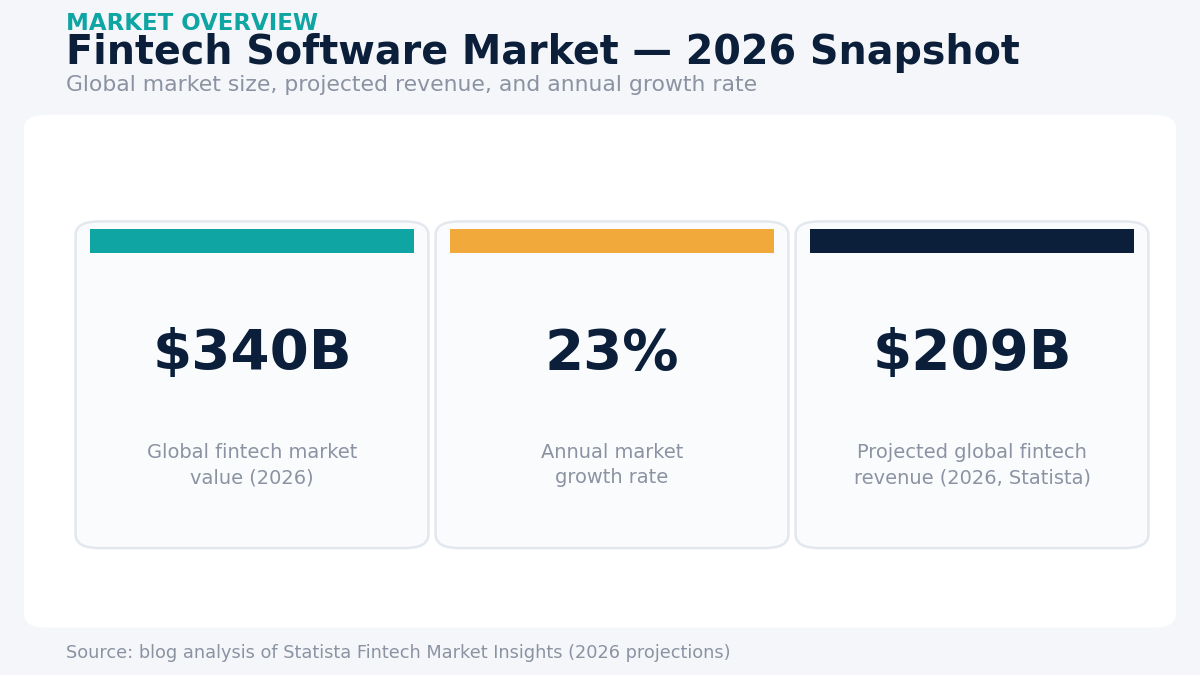
According to Statista Fintech Market Insights, global fintech revenue is projected to exceed $209 billion in 2026, driven by rapid adoption of digital payments and financial platforms. As demand grows, so does the gap between agencies that understand financial systems and those that don’t.
The global fintech market is valued at $340 billion in 2026 and growing at 23% annually. At the $5K to $30K budget level, the most common fintech builds are: payment-integrated applications, lending front-ends and dashboards, InsurTech MVPs, personal finance tools, and B2B financial management platforms. This guide covers how to find an agency that can build these correctly.
What Makes Fintech Development Categorically Different
Most software categories allow you to learn from mistakes in production. Fintech does not.
The specific requirements that make fintech development harder:
| Requirement | What It Means Technically | Why Generic Agencies Get It Wrong |
| Security-first architecture | Encryption at rest and in transit, parameterised queries, input validation, secure key management | Generic agencies add security as an afterthought rather than designing it in from the start |
| PCI DSS compliance | Card data never touches your servers Stripe and other processors handle it, but the implementation must be correct | Incorrect Stripe implementations that scope card data into the merchant’s environment are more common than they should be |
| KYC/AML integration | Identity verification, sanctions screening, and transaction monitoring built correctly | Non-compliant KYC flows that accept self-reported identity without verification |
| Audit logging | Every financial transaction and state change must be logged immutably | Log tables that can be edited or deleted after the fact |
| Regulatory data requirements | What data must be retained, for how long, in what format, and with what access controls | No understanding of data retention obligations for financial records |
| Double-entry bookkeeping | Financial state must be consistent debits equal credits, atomicity required | Application-layer money movement without transaction integrity |
| Rate limiting and fraud prevention | APIs that process payments must be protected against abuse | No rate limiting on payment endpoints |
An agency that has never built a fintech product won’t know to ask about most of these requirements before development even begins. Instead, they’ll ship a functionally correct application that still fails a security audit, a compliance review, or worst case a live fraud attack. These are exactly the kind of warning signs worth catching before you sign a contract, not after a breach.
What Fintech Projects at $5K–$30K Look Like
The $5K to $30K range does not build a full banking platform or a payment processor. It builds the specific layer of a fintech product that founders and SMEs actually need.
The most common fintech builds at this budget:
| Project Type | What It Is | What It Is Not | India Cost | Eastern Europe Cost |
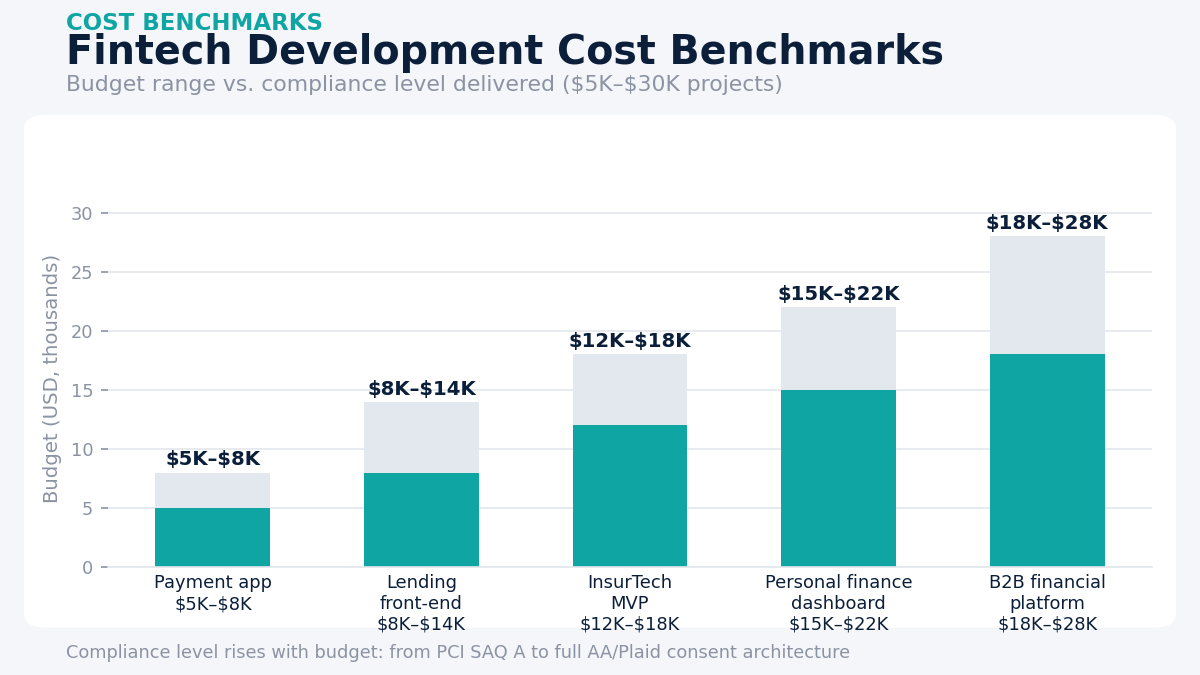
| Payment-integrated app | Application that accepts payments via Stripe/Razorpay/PayU subscriptions, one-time, invoicing | A payment processor you are using an existing one | $6K–$12K | $12K–$22K |
| Lending front-end | Loan application form, credit decision display, loan management dashboard | The credit decisioning engine that is separate | $8K–$15K | $16K–$28K |
| Expense management tool | Receipt capture, category classification, approval workflow, basic reporting | A full ERP or accounting system | $8K–$14K | $16K–$26K |
| Insurance quote and purchase | Product comparison, quote engine, application form, policy issuance | Actuarial modelling that comes from the insurer | $8K–$15K | $16K–$28K |
| Personal finance dashboard | Account aggregation display, transaction categorisation, spending analytics | Account aggregation infrastructure you use Plaid or AA API | $7K–$13K | $14K–$24K |
| B2B invoicing platform | Invoice creation, payment collection, reconciliation, basic reporting | Full accounting software | $9K–$16K | $18K–$30K |
| Crypto wallet / DeFi front-end | Wallet connection, token display, transaction history, basic swaps | Smart contract development that is a separate engagement | $8K–$16K | $16K–$30K |
The most important scope clarification for fintech projects:
At the $5K to $30K level, you are almost always building on top of regulated infrastructure Stripe for payments, Plaid or Account Aggregator for financial data, a licensed lender’s API for credit, an insurer’s API for insurance. You are not building the regulated core; you are building the experience layer and the business logic that connects to it, the same layer we break down when pricing out a payments-style build like Stripe. This distinction matters because the compliance obligation stays with the licensed entity Stripe, the bank, the insurer and your development requirements become significantly more tractable as a result.
How to Evaluate a Fintech Development Agency
The evaluation criteria for fintech agencies go beyond the standard portfolio and reference checks.
The fintech-specific questions to ask:
Have you integrated with payment processors (Stripe, Razorpay, PayU) in production? Not “have you used Stripe in a tutorial” have you built a production payment integration that processed real money for real customers? Ask them to describe the specific flow: how webhooks were handled, how failed payments were managed, how refunds were processed.
Have you built for a regulated financial use case before? Which regulation was relevant: PCI DSS, RBI guidelines, FCA rules, GDPR for financial data? How did you handle the compliance requirements technically?
How do you handle financial transaction atomicity in your applications? The answer to this question immediately separates developers who have thought about financial data integrity from those who have not. The correct answer involves database transactions, rollback logic, and idempotent API design. An answer about “testing the payment flow thoroughly” is not the right answer.
What security testing do you perform before delivering a financial application? The answer should include at minimum: input validation testing, authentication flow testing, and review of third-party integration security. For applications above $15,000, a proper answer includes a VAPT (Vulnerability Assessment and Penetration Testing) engagement.
These four questions work best as part of a broader evaluation paired with the practical framework for comparing development companies side by side before you commit to one.
The Compliance Layer What Your Agency Must Understand
Every fintech product operates within a regulatory context. The regulatory requirements depend on what you are building and where your users are, but the agency you hire needs to understand the relevant framework.
Key compliance contexts by fintech type:
| Fintech Type | Key Regulations | What the Agency Must Know |
| Payment acceptance (global) | PCI DSS | Card data scope how to use Stripe correctly without touching card data |
| Digital lending (India) | RBI NBFC guidelines, Digital Lending Guidelines 2022 | KYC requirements, interest rate disclosure, cooling-off period |
| Digital lending (US) | State money transmitter licenses, TILA, ECOA | Disclosure requirements, fair lending, interest rate caps by state |
| Insurance distribution (India) | IRDAI web aggregator / POSP rules | Product eligibility, disclosure, commission disclosure |
| Personal finance data (India) | Account Aggregator framework, PDPB | Consent architecture, data localisation |
| Personal finance data (US) | CFPB rules, Plaid API terms | Open banking compliance, data usage restrictions |
| Crypto (US) | FinCEN, state BitLicense where applicable | KYC/AML for financial activity thresholds |
You do not need the agency to be a compliance lawyer. You need them to understand the technical implementation implications of these regulations: what data cannot be stored, what must be encrypted, what disclosures must appear in the UI, what logging is required.
Cost Benchmarks Fintech Development at $5K–$30K
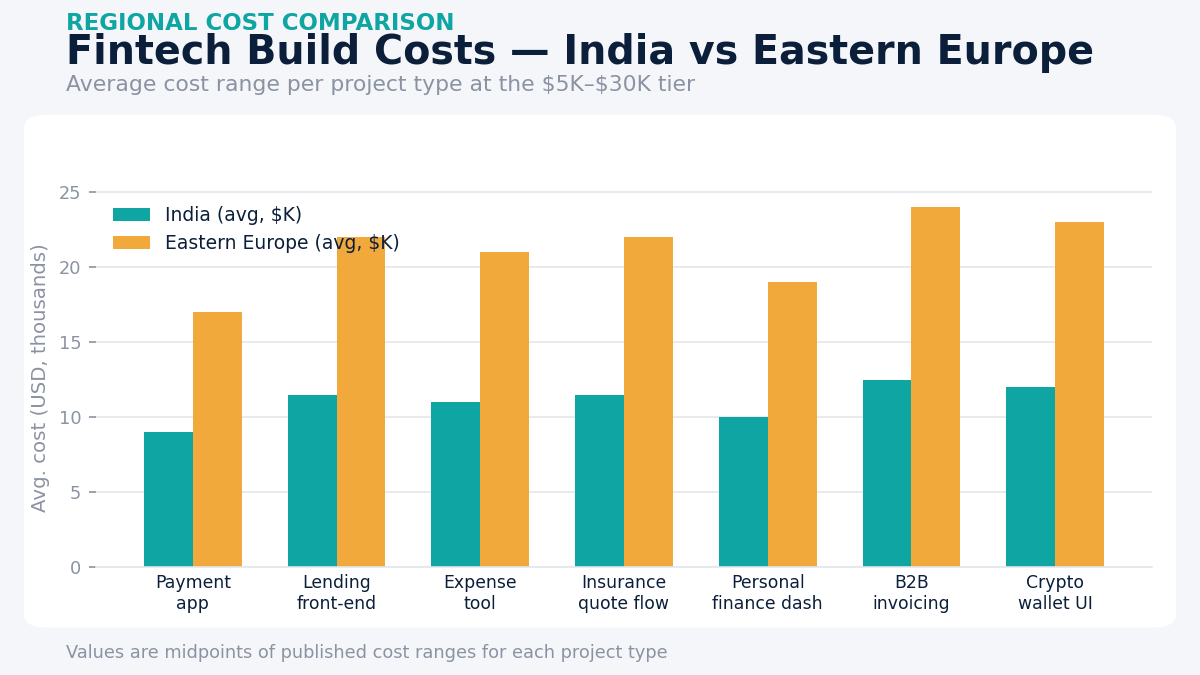
What your budget builds with a strong Indian fintech-experienced agency:
| Budget | Deliverable | Timeline | Compliance Level |
| $5K–$8K | Payment-integrated web application Stripe subscription billing, basic dashboard | 6–10 weeks | PCI SAQ A (Stripe JS) |
| $8K–$14K | Lending application front-end KYC form, credit decision display, loan management | 10–16 weeks | RBI digital lending UI requirements |
| $12K–$18K | Full InsurTech MVP product comparison, quote engine, application, policy display | 14–20 weeks | IRDAI disclosure requirements |
| $15K–$22K | Personal finance dashboard account aggregation (AA/Plaid), categorisation, analytics | 16–22 weeks | AA consent architecture |
| $18K–$28K | B2B financial management platform invoicing, collections, reconciliation, reporting | 20–28 weeks | Standard business financial data |
The security premium:
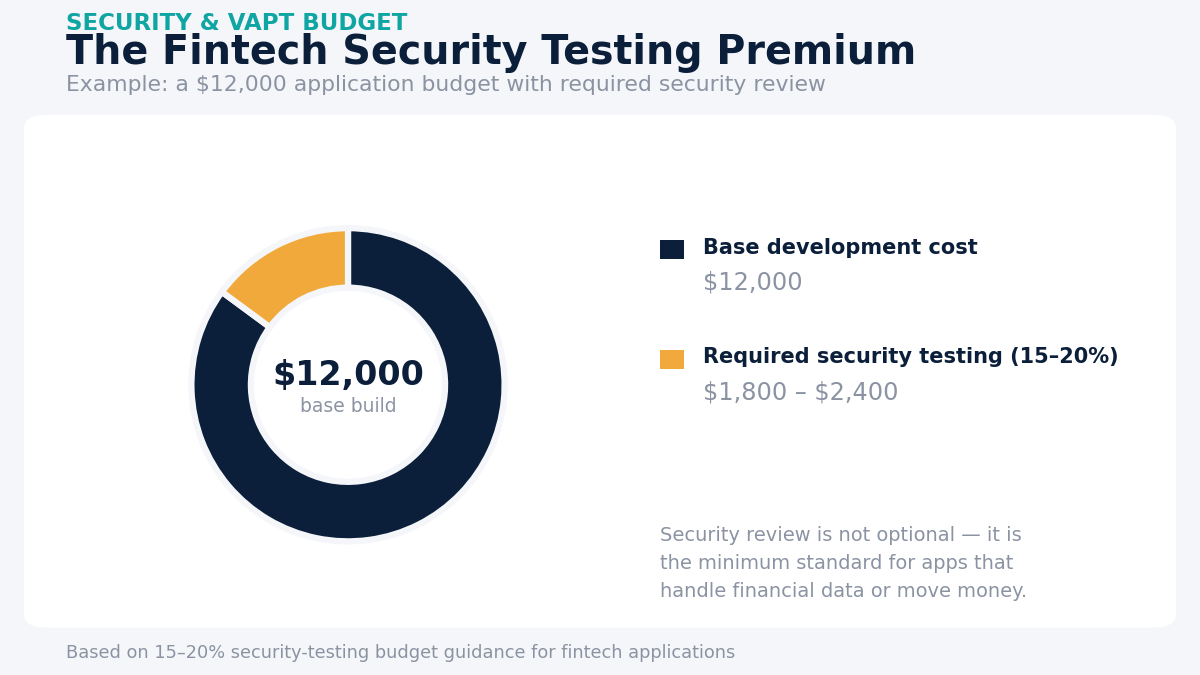
Fintech applications require more rigorous QA and security testing than standard applications budget an additional 15 to 20% of development cost for proper security review. A $12,000 fintech application needs $1,800 to $2,400 in additional security testing budget. This is not optional; it is the minimum standard for an application that handles financial data or money movement, which is why it’s worth understanding what a dedicated QA and testing engagement actually involves before you finalize your budget.
Conclusion
Finding the Right Fintech Development Partner
Fintech doesn’t leave room for on-the-job learning. The best fintech software development companies aren’t the ones with the flashiest portfolio they’re the ones who ask about webhook handling before you do, who default to database transactions and idempotent APIs without being prompted, and who treat security testing as a line item rather than an afterthought.
At the $5K–$30K level, you’re rarely building the regulated core itself; you’re building the experience layer on top of Stripe, Plaid, or a licensed lender’s API. That makes the right agency’s job more tractable, but it doesn’t make it optional to vet them properly.
Use the questions in this guide as your screening filter, budget for the 15–20% security premium from day one, and treat vague answers on compliance or atomicity as a disqualifier, not a detail to follow up on later.
If you’d rather skip the manual vetting, see how GetProjects matches you with pre-vetted fintech development teams based on your exact compliance and budget requirements or browse a curated shortlist of fintech app development companies in India already experienced in payments, lending, and InsurTech builds.
Frequently Asked Questions
Do I need a licensed development company to build a fintech application?
No software development companies need to hold financial licenses to build fintech applications. The license obligation rests with the entity offering the financial service to consumers: the bank, the NBFC, the payment aggregator, the insurer. A development company builds the technology that the licensed entity uses to deliver its services. What you need from a development company is not a license but demonstrated experience in building compliant fintech applications, understanding what technical decisions create compliance risk and what implementations satisfy regulatory requirements.
What is PCI DSS and do I need to comply with it for my application?
PCI DSS (Payment Card Industry Data Security Standard) applies to any entity that stores, processes, or transmits cardholder data credit and debit card numbers, CVV codes, expiration dates. If you use Stripe, PayPal, or another payment processor correctly never touching card data in your own servers, always using the processor’s hosted fields or SDK your compliance scope is minimal (SAQ A, the simplest self-assessment questionnaire). If your application touches card data directly which you should almost never do you face extensive PCI DSS requirements including annual audits by a Qualified Security Assessor. The practical message: use Stripe Elements or Stripe Checkout, never build your own card capture form, and your PCI exposure is minimal.
How do I know if a fintech development agency understands compliance requirements?
Three tests that take 20 minutes: ask them to describe how they would implement KYC (Know Your Customer) for a digital lending application; a genuine answer involves document verification, Aadhaar/eKYC API, and liveness detection, not just a “verify your email” flow. Ask them how they would ensure that card data never touches your servers in a payment integration. The answer should involve Stripe Elements or PaymentIntents, never a server-side card number capture. Ask them what logging they would implement for financial transactions the answer should include immutable audit logs with timestamps, user IDs, transaction IDs, and before/after states for every financial state change. If any of these answers are vague or incorrect, the agency does not have production fintech experience regardless of what their website says.
What is the minimum budget for a fintech MVP that a real investor would take seriously?
A fintech MVP built for investor validation at the seed stage needs to demonstrate three things: the user flow works end-to-end, the core financial mechanic functions correctly, and the compliance architecture is directionally correct even if not fully production-grade. This is achievable at $8,000 to $15,000 with a strong Indian fintech-experienced agency. The most important investment at this budget level is building the compliance architecture correctly from the start. It is significantly cheaper to implement proper security, KYC, and audit logging in the initial build than to retrofit them after a seed round when regulatory scrutiny increases.