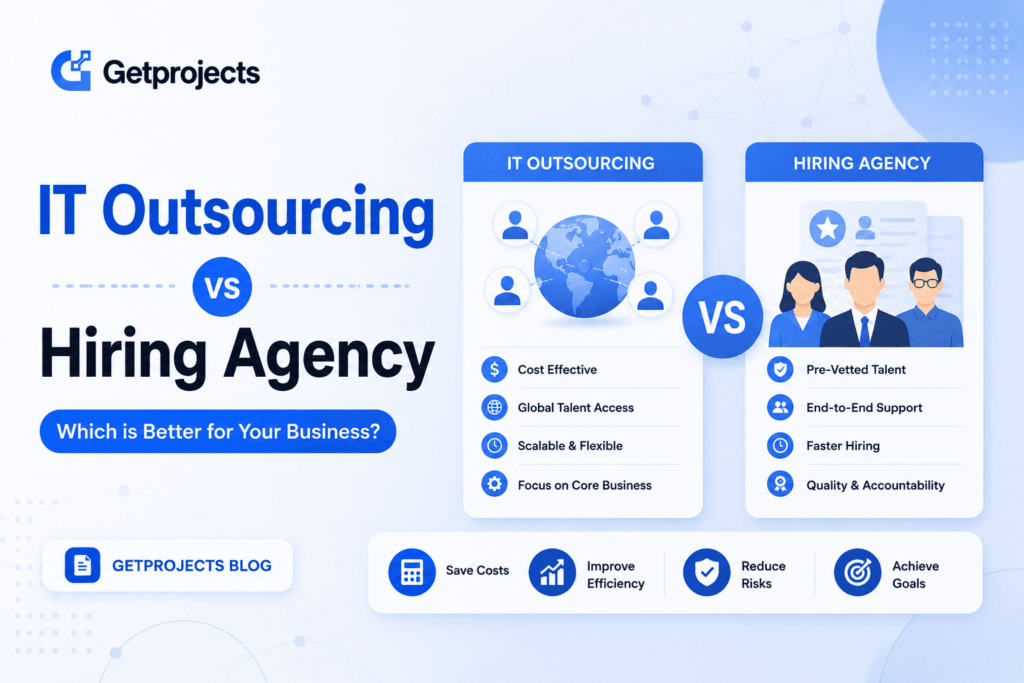
IT Outsourcing vs Hiring Agency: A Step-by-Step Guide to Picking the Right Model
Every project delay you have ever blamed on “the vendor” probably started with the wrong hiring decision, not the wrong vendor.
Businesses looking to build software, manage infrastructure, or scale a tech team usually land at the same fork in the road: IT outsourcing vs hiring agency.
Both promise access to talent without the overhead of full-time employees. Both come with tradeoffs that rarely get explained clearly before you sign a contract.
This guide breaks down the IT outsourcing vs hiring agency decision into concrete steps, so you pick based on facts instead of whichever sales call sounded more convincing.
What Each Model Actually Means
Before comparing IT outsourcing vs hiring agency, it helps to separate what these terms actually describe.
IT outsourcing means handing a specific project, function, or ongoing service to an external company that owns delivery. You are hiring a team, not a person, and that team typically works as an extension of your business under a defined scope.
Hiring through an agency means you are paying a staffing firm to source and place individual contractors or employees into your team. The agency finds the person, you manage the work. The distinction sounds small, but it changes everything about cost, control, and accountability.
Step 1: Compare the Real Cost Structures
Cost is where the IT outsourcing vs hiring agency debate usually starts, and the numbers are not close.
As per Upwork, staffing agencies typically charge markups between 15% and 25% of a hire’s annual salary and that is before you cover the actual employee’s pay. For a mid-level developer earning $110,000, the agency fee alone can run $16,500 to $27,500.
IT outsourcing works differently. You pay a fixed project rate, a monthly retainer, or an hourly rate that already includes the provider’s overhead. There is no separate placement fee stacked on top.
Businesses are outsourcing less for cheap labor and more for capability, which changes how you should evaluate providers in the IT outsourcing vs hiring agency comparison.
Step 2: Weigh Speed and Delivery Control
An agency finds you a person. It does not manage that person’s output.
Once an agency places a contractor, project delivery becomes entirely your responsibility. You handle onboarding, task assignment, quality checks, and performance management, on top of running your own business.
With IT outsourcing, the provider owns the delivery timeline. You define requirements and milestones, and the outsourcing team manages the day-to-day execution, including its own quality assurance and project management.
If your team already has strong technical leadership and just needs extra hands, agency hiring can work. If you need a group that ships a finished product with minimal oversight from your side, outsourcing wins the IT outsourcing vs hiring agency comparison on speed alone.
Step 3: Look at Talent Depth and Specialization
Agencies are built to fill roles fast. They are not built to guarantee the depth of a full engineering team.
An agency contractor is one person with one skill set. If your project needs a backend developer, a DevOps engineer, and a QA tester working together, you are running three separate agency placements and hoping they coordinate well.
An outsourcing partner already has that team structured and working together on other projects. Specialized skills like cloud architecture, cybersecurity, or AI integration are harder to source through a single agency placement than through a firm that has already built a practice around them.
When Agency Hiring Still Makes Sense
There are real scenarios where an agency beats outsourcing:
- You need one specific skill set for a short, well-defined task
- Your internal team already has strong technical management in place
- You want the option to convert a contractor into a full-time hire later
- The role requires close, daily collaboration inside your existing workflows
Step 4: Match the Model to Your Project Type
The IT outsourcing vs hiring agency decision should follow the shape of your project, not the other way around.
Choose outsourcing when:
- You need a full product built or maintained end to end
- Your internal team lacks the technical leadership to manage contractors directly
- The engagement spans months and needs consistent delivery ownership
- You want one point of accountability instead of managing multiple individuals
Choose an agency when:
- You need to fill a single, narrowly defined role
- The engagement is short term or seasonal
- You already have a project manager who can direct the work
- You want a direct path to a permanent hire
Step 5: Evaluate Risk and Accountability
This step decides who you call when something goes wrong.
With agency hiring, the agency’s job ends once the placement is made. If the contractor underperforms or leaves mid-project, the agency’s obligation is usually limited to finding a replacement, not fixing the damage to your timeline.
With IT outsourcing, the provider is contractually accountable for the deliverable itself. A well-structured outsourcing agreement includes milestone-based payments, defined scope, and penalties or remediation clauses if targets are missed.
That single difference, accountability for output versus accountability for placement, is often the deciding factor once businesses actually compare IT outsourcing vs hiring agency side by side.
Step 6: Run the Math Before You Decide
Before committing to either path, calculate your actual cost per outcome, not cost per hour.
Add up the agency’s placement fee, the time your team spends managing contractors, and the risk of a mid-project departure. Compare that total against an outsourcing provider’s project rate, which already bundles management, quality control, and delivery ownership.
For most multi-role, multi-month projects, outsourcing comes out ahead once management overhead is factored in. For narrow, short-term needs, an agency placement can still be the leaner choice.
Common Mistakes to Avoid
- Choosing based on hourly rate alone. A cheaper contractor who needs heavy oversight can cost more than a slightly pricier outsourcing team that needs none.
- Assuming agencies vet technical skill thoroughly. Most agencies screen for resume fit, not deep technical competence. Verify skills yourself regardless of which model you choose.
- Skipping a trial engagement. Whether you outsource or hire through an agency, start with a small scoped task before committing to a long contract.
- Ignoring who owns the code. Intellectual property terms need to be explicit in outsourcing contracts and agency placement agreements alike.
Final Word
The IT outsourcing vs hiring agency choice is not about which model is universally better. It is about matching the model to the shape of your project, your internal management capacity, and how much accountability you want written into the contract.
For full projects with unclear internal technical leadership, outsourcing typically delivers more for less friction. For narrow, well-managed roles, an agency still has a place. Run the numbers, define your scope clearly, and let the project decide the model, not the sales pitch.
FAQs
-
Is IT outsourcing more expensive than hiring through an agency?
Not usually. Outsourcing rates already include management and delivery overhead, while agency fees are added on top of the contractor’s own pay.
-
Can I outsource just one role instead of a full team?
Yes, many outsourcing providers offer staff augmentation for single roles, though this starts to resemble agency hiring in structure and cost.
-
Who owns the intellectual property in an outsourcing contract?
This should be explicitly stated in the contract. Reputable outsourcing providers transfer full IP ownership to the client upon payment.
-
How long does it take to start working with an outsourcing partner versus an agency?
Agencies can often place a contractor within one to two weeks. Outsourcing engagements typically take two to four weeks longer due to scoping and discovery phases, but that time reduces risk on longer projects.