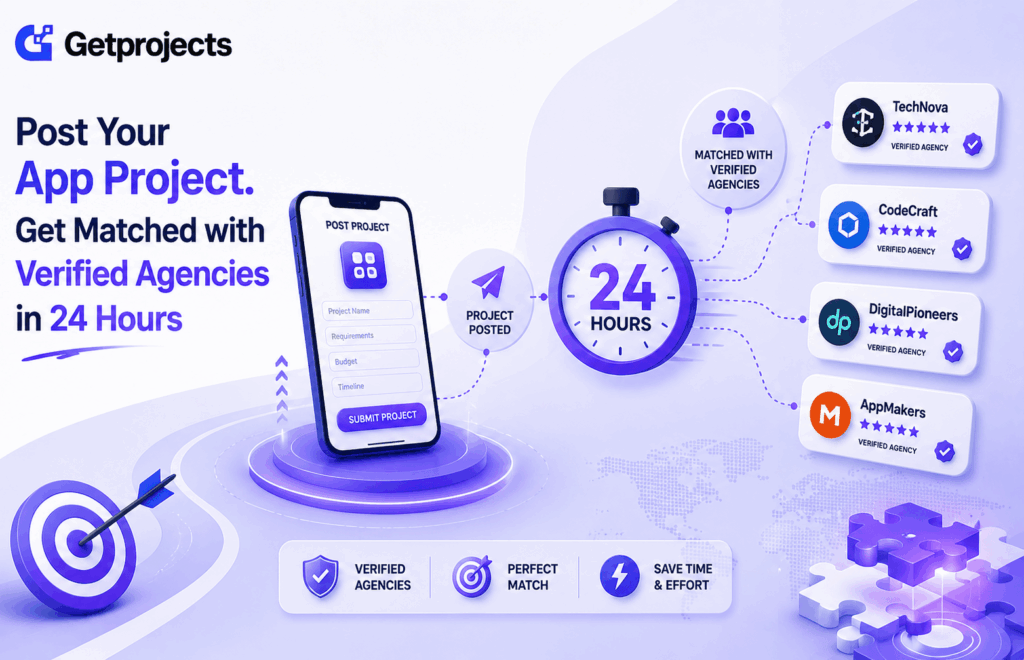
How to Post an App Development Project and Get Matched With Verified Agencies in 24 Hours
The 24-Hour Alternative to a 6-Week Agency Search
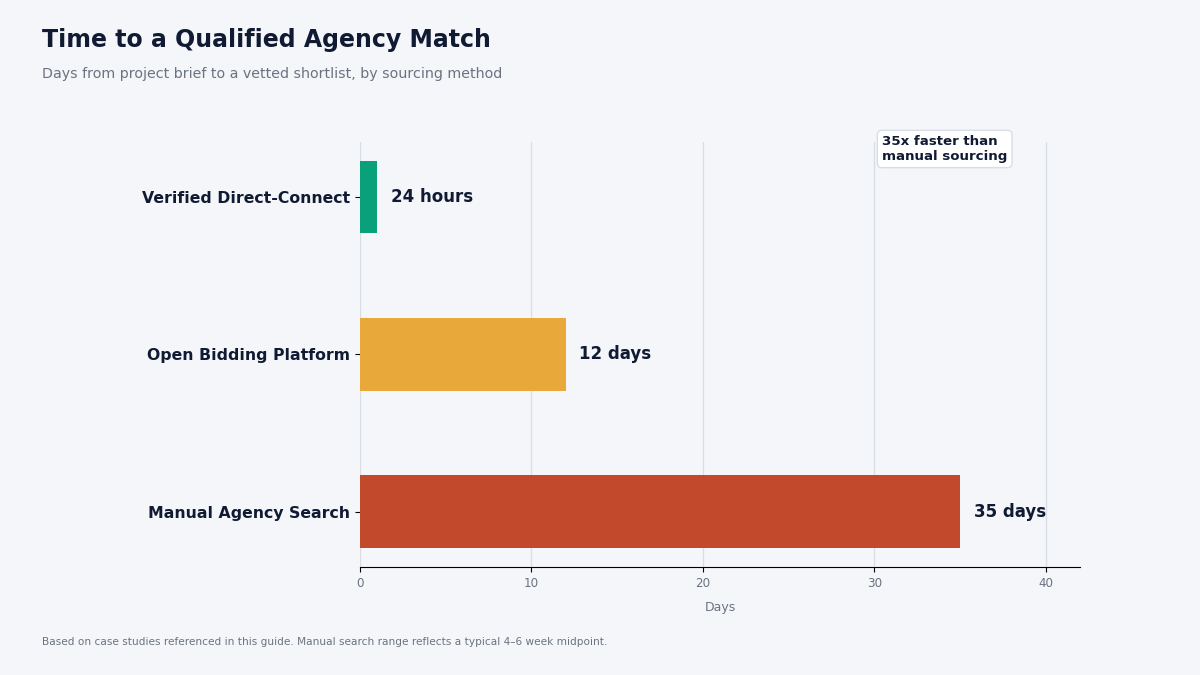
Businesses that hire an app development agency the traditional way spend an average of 4 to 6 weeks just narrowing a shortlist before a single proposal is compared. That number comes from how procurement teams actually behave: cold outreach, portfolio review, reference calls, and repeated scoping calls, all before anyone signs anything.
Most of that time isn’t spent building anything. It’s spent verifying that the agency on the other end of the email is who they say they are. A founder emails eight vendors found through a Google search, hears back from five, schedules four discovery calls, and eliminates two of them only after a call reveals the “team of 20” is actually three subcontractors. That’s a full week gone before the actual scoping conversation even starts.
There’s a faster, cleaner way to post an app development project: describe the work once, let verification and matching happen in the background, and start talking to agencies that have already been checked out. This guide walks through exactly how that process works, why it exists, and how to use it to submit app development requirements online without losing weeks to vetting.
According to Clutch’s B2B buyer research, only 28% of buyers cite an agency’s actual ability to deliver as a top deciding factor when hiring; the majority make the call based on marketing material, referrals, or a portfolio page they can’t fully verify.
That gap between what buyers can see and what they need to know is exactly what a structured, verified matching process is built to close. When the verification happens before a business ever sees a profile, not after a contract is signed, the entire risk profile of the hire shifts, which is worth understanding how it stacks up against other B2B agency marketplaces before committing to any single sourcing method.
What Does It Mean to Post an App Development Project?
To post an app development project is to submit a structured description of an app’s scope, budget, timeline, and technical requirements to a platform that routes it to qualified development agencies. Instead of individually researching and emailing vendors, a business publishes one brief and receives inbound, pre-qualified matches. The process typically takes minutes, not weeks, and requires no payment to initiate.
The Core Problem: Vendor Discovery Is Slower Than Anyone Admits
Most founders and CTOs underestimate how long agency discovery takes by 3 to 4x. They budget a week for “finding a dev shop” and end up spending a full month, because discovery isn’t one task it’s five: sourcing candidates, reading portfolios, checking references, running scoping calls, and negotiating scope creep out of the first quote.
Bidding-model marketplaces make this worse, not better. A project posted on an open-bid platform can attract 50 to 100 proposals, most from agencies that never read the brief closely. Filtering that volume manually can take longer than the vetting process it was supposed to replace; how open bidding compares to direct matching breaks down exactly why volume and fit tend to move in opposite directions. Add reference calls on the two or three finalists, and a business that budgeted a week for sourcing is now three weeks in without a signed contract.
Paid-listing directories solve a different problem: visibility for the agency, not verification for the buyer. A company can pay $499 or more per year to appear at the top of a directory category regardless of how many client projects it has actually delivered. Rank on those platforms often reflects marketing spend, not delivery quality, which means the buyer is still doing the verification work manually the directory just gave them a longer list to verify.
The actual bottleneck isn’t a shortage of agencies. Clutch alone lists more than 350,000 service providers across 157 countries; supply was never the constraint. The real gap is the absence of a fast, trustworthy way to tell a genuinely qualified app development agency from one that only looks qualified on paper, which is exactly what a complete agency-vetting checklist is built to close, before a contract is signed rather than after.
How to Post App Development Project Online and Get Verified Matches
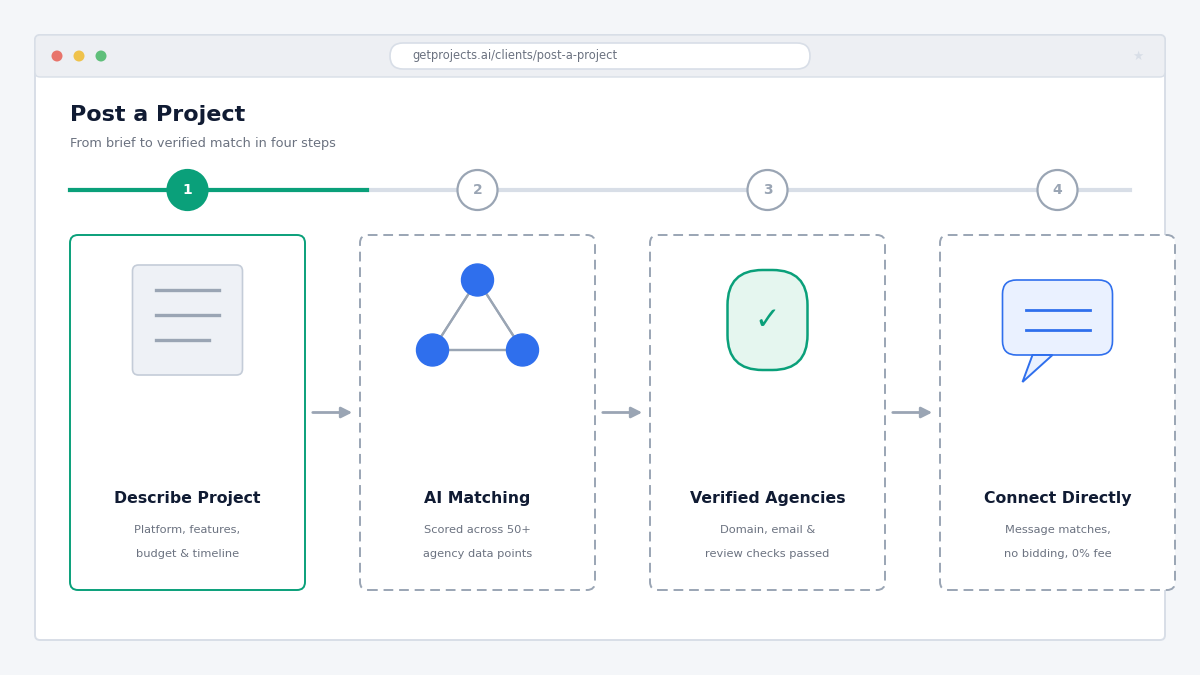
This is the process businesses actually follow when they post an app development project through a verified matching platform, broken into the stages that determine whether a hire goes well or badly. Each stage exists to remove a specific point of failure in traditional vendor search and each one is a step a business would otherwise have to do manually, one email at a time.
Why Manual Vetting Fails at Scale
Manual vendor vetting works fine for one or two candidates. It breaks down past that, because every additional agency adds a full round of research: website check, portfolio read, reference outreach, and a scoping call to confirm technical fit. At five candidates, that’s easily 10 to 15 hours of unpaid due diligence before a single quote is compared apples-to-apples. The discipline required looks a lot like shortlisting a qualified agency in 72 hours, just without the compressed timeline.
Structured matching compresses that work by doing the verification once, centrally, rather than asking every buyer to repeat it from scratch. That’s the operational reason a business can post an app development project online and receive pre-screened matches instead of a raw list of names to research independently.
Step 1: Build a Clear Project Brief in Under Two Minutes
A vague brief produces vague quotes. The first step in any serious attempt to post an app development project is defining scope precisely enough that an agency can price it without three rounds of clarifying emails.
A workable brief needs, at minimum:
- Platform target iOS, Android, cross-platform, or web app
- Core feature list the 5 to 8 features that define the MVP, not the full roadmap
- Budget range even a wide band (e.g., $15,000–$35,000) filters out mismatched agencies immediately
- Timeline launch date or development window
- Technical constraints integrations, compliance needs (HIPAA, SOC 2, PCI-DSS), or existing codebase details
AI-assisted brief builders can compress this from a 45-minute scoping document into a guided, two-minute questionnaire asking the right follow-up questions instead of leaving a blank text box that most founders abandon halfway through.
Step 2: Get App Development Quotes Fast from Vetted Agencies
Once a brief is submitted, matching should happen against hard data, not keyword overlap. A strong matching system compares the brief against 50-plus data points per agency: technical specialization, team size, historical budget range, industry experience, client retention, and delivery track record.
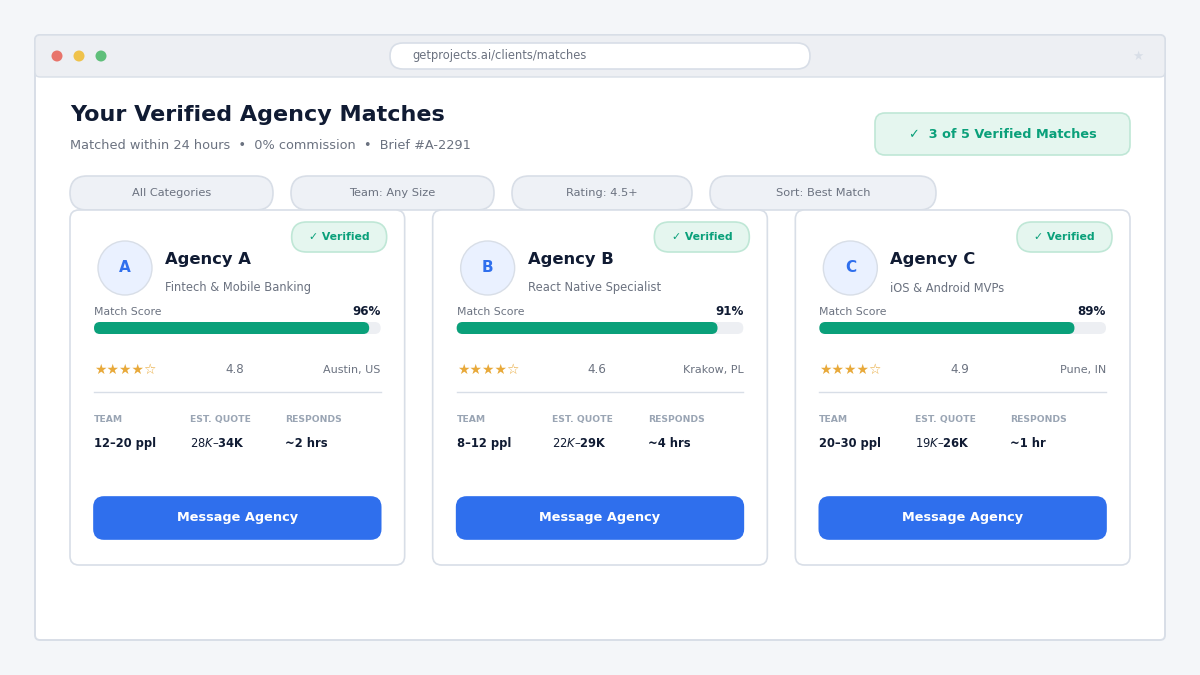
The output that matters here isn’t a list of 40 “maybe fits.” It’s 3 to 5 agencies that are actually positioned to deliver the specific project each with a visible portfolio, team size, average rating, and category of past work, so a founder can screen candidates in minutes rather than scheduling five discovery calls just to eliminate two of them. That screening step is really an exercise in comparing agency quotes side by side once the matches come back.
Step 3: Find Verified App Development Agencies Without Bidding Wars
Verification is the step most platforms skip or fake. A credible verification layer checks, at minimum:
- Website and domain legitimacy confirming the agency isn’t a shell profile
- Business email domain match ruling out freelancers posing as agencies
- Review authenticity cross-checking client feedback against delivered work
- Team composition confirming claimed headcount and specialization actually exist
This layered check combining automated (AI) screening with manual review is what separates a genuinely verified app development agency from a marketing slogan. Profiles that fail verification simply never go live, which is a meaningfully different bar than “any agency that pays a listing fee gets a page.” Once a shortlist clears that bar, a practical framework for comparing agencies is what turns 3–5 verified options into one final decision.
Step 4: Connect Directly and Start Without Commission Fees
The final step removes the two mechanisms that make traditional marketplaces expensive: bidding and commission. In a direct-connect model, a business message matches agencies directly no blind bid submission, no platform intermediary reading messages before they’re delivered.
Commission-based marketplaces typically take 10% to 20% of the total project value, charged either to the agency (who prices it into the quote anyway) or split across both sides. A hire app development company free of that markup means the quoted price is the actual price, not a number inflated to cover a platform’s cut.
Real-World Outcomes: From Requirement to Signed Agency
Both examples below follow the same shape: a team decides to post an app development project through a verified matching flow instead of running vendor discovery manually, and the timeline compresses accordingly.
Case 1 Seed-stage fintech startup. A two-person founding team needed a compliance-heavy mobile banking MVP and had already spent three weeks manually vetting seven agencies through cold outreach, with two failing basic domain-verification checks after initial calls. Their original plan was to shortlist five vendors and run a week of scoping calls before choosing a timeline that had already slipped once. After submitting a structured brief through a verified matching platform, they received five qualified matches within 24 hours all drawn from a pool of vetted fintech development agencies with relevant compliance experience held two scoping calls instead of seven, and signed an agency by day four, cutting their vendor-selection timeline by roughly 80% and freeing up close to three weeks of founder time that went straight back into fundraising.
Case 2 Mid-sized retail enterprise. A CTO needed a React Native inventory app built in under 90 days and had budgeted six weeks for agency selection alone, based on a prior RFP cycle that had taken almost that long. Using AI-driven matching against 50-plus data points including prior retail-sector delivery history and team specialization the team narrowed to four verified agencies with relevant experience in one business day, avoided an open bidding process entirely, and started development 11 days ahead of the original internal schedule. Understanding typical mobile app development costs beforehand also meant the CTO could tell the quoted range was reasonable before a single call happened. The agency ultimately selected quotes within 4% of the two other finalists, which let the CTO make the final call on technical fit rather than price alone.
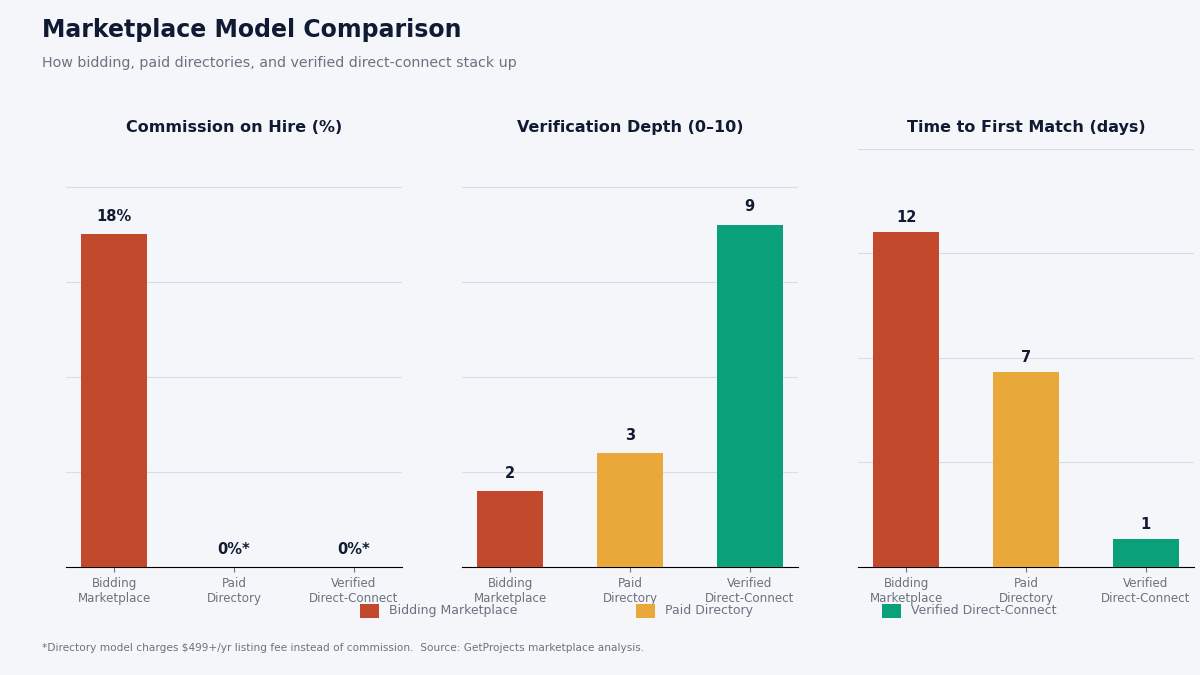
Marketplace Bidding vs. Paid Directories vs. Direct-Connect Matching
| Factor | Bidding Marketplaces | Paid-Listing Directories | Verified Direct-Connect |
| Cost to post a project | Free, but 10–20% commission on hire | Free to post, agencies pay $499+/yr to rank | Free, 0% commission |
| Vendor verification | Minimal or self-reported | Pay-to-appear, not delivery-based | Layered (domain, email, reviews, team) |
| Time to first qualified match | Days to weeks, high proposal noise | Immediate, but unfiltered by fit | Typically within 24 hours |
| Negotiation model | Open bidding, race-to-lowest-price | Direct, no built-in vetting | Direct, no bidding required |
The distinction that matters most is the middle column of most people’s mental model: free-to-post doesn’t mean cost-free. Commission gets built into the quote, and paid rank gets built into visibility, regardless of who actually delivers the best work. That’s the practical reason more businesses now post an app development project through a verified direct-connect model instead of defaulting to whichever platform ranks first in search results.
What Most Teams Get Wrong When They Hire an App Development Company Free of Bidding Pressure
The most common mistake isn’t picking the wrong agency, it’s treating agency selection as a pricing exercise instead of a fit exercise. Teams that anchor on “who quoted the lowest number” consistently end up with scope disputes by month two, because a rock-bottom bid usually means a scope built to be renegotiated later, once the agency realizes the original number doesn’t cover the real work.
The second mistake is skipping verification because a portfolio “looks solid.” Portfolio pages are marketing assets, curated to show only the wins. A layered verification process, domain checks, review cross-referencing, confirmed team size catches the gap between what an agency claims and what an agency has actually shipped, before a contract is signed rather than after. This is the difference between an agency that merely lists itself and one that had to clear a check before its profile ever went live, which is also why how a master service agreement protects both sides matters just as much as the vetting itself once work actually begins.
The third mistake is talking to exactly one agency. Comparing 3 to 5 verified options costs almost nothing in time when matching is automated, yet it’s the single biggest lever for catching pricing outliers, mismatched specialization, or a team that’s clearly overcommitted on other projects. Businesses that skip this step because “the first agency seemed fine” have no baseline to know whether the fine was actually competitive.
The fourth mistake, less obvious but just as costly: waiting to post an app development project until the brief is “perfect.” A rough brief with a clear budget range and platform target is enough to get useful matches; the clarifying questions that follow a first response usually sharpen scope faster than another week of internal debate ever would.
Start Your Project
Agency selection shouldn’t be the slowest part of shipping an app. If a bidding queue or a $499-a-year directory ranking is standing between a project brief and a qualified development partner, that’s a process problem, not a talent-shortage problem.
Businesses that are ready to post an app development project can do it in under two minutes, with no listing fee and no commission on the eventual hire. GetProjects exists to close that gap: describe the project, get matched with 3 to 5 verified agencies within 24 hours, and connect directly with zero commission on either side.
Start Your Project and compare verified agencies before committing to one.
FAQ
Is it free to post an app development project?
Yes. On a commission-free marketplace, submitting a project brief carries no listing fee, no payment to view matches, and no cost to message agencies directly. The only payment involved is whatever a business agrees to pay the agency it actually hires; there’s no platform cut layered on top of that quoted price, and no paid tier required to see full agency profiles.
How long does it take to get matched with an app development agency?
With AI-driven matching against verified agency data, most businesses receive 3 to 5 qualified matches within 24 hours of submitting a brief. That compares to 2 to 6 weeks for manual sourcing and vetting through cold outreach or unfiltered bidding platforms, where the delay comes from filtering volume rather than a shortage of candidates.
Are the agencies verified before I see their profile?
Yes, when using a platform with layered verification. That means checking website and business-email domain legitimacy, cross-referencing client reviews, and confirming team details combining automated screening with manual review before a profile is allowed to go live and appear in any match. Profiles that fail these checks simply don’t get published, rather than being flagged after the fact.
Can I talk to multiple agencies before choosing one?
Yes, and it’s recommended. A direct-connect model allows a business to message every matched agency, ask clarifying questions, and compare quotes side by side without submitting a project to an open bidding pool where dozens of unscreened vendors can see it and compete on price alone.
How is this different from bidding platforms like Upwork?
Bidding platforms let any vendor submit a proposal on any visible project, which produces volume but not necessarily fit, and typically carries a commission on the final contract that gets priced into the quote either way. A verified matching model limits visibility to a small number of pre-qualified agencies and charges no commission, which changes both the quality of matches and the cost structure of the hire.
What do I need ready before I submit an app development requirement online?
At minimum: target platform (iOS, Android, or both), a core feature list, a budget range, a rough timeline, and any compliance or integration requirements. An AI-guided brief builder can prompt for the rest, but starting with these five details produces noticeably more accurate agency matches and fewer clarifying-question rounds later.
Do verified agencies cost more than freelancers or unverified vendors?
Not inherently. Verification confirms legitimacy and track record; it doesn’t set pricing. Rates still vary by agency size, location, and specialization, and comparing 3 to 5 verified quotes side by side is what actually surfaces whether a given price is reasonable for the scope, rather than guessing based on a single data point.