What Is a Statement of Work in Software Development?
Roughly half of all software projects finish with a scope nobody agreed to at kickoff and in almost every case, the document meant to prevent that already existed. It was signed. It was filed. It just wasn’t written to be enforced.
That gap is the whole problem. Most scope documents are written to close a deal, not to govern delivery. They read like sales collateral with a signature line: warm language, a feature list, a start date, a number. Nothing in a statement of work software development proposal of that kind is testable. Six weeks in, the client asks for something the agency considers new work, the agency asks for a budget increase, the client considers padding, and neither side can point to a sentence that settles it.
A statement of work software development teams can actually enforce is a different artifact entirely. It is specific enough to be argued from, not just agreed to. It says what “done” means for each deliverable, who signs off, how long they have to sign off, what happens when they don’t, and what a change costs.
This matters more in outsourced engagements than in-house ones. When an internal team misreads a requirement, the fix is a conversation. When a vendor 8,000 kilometres away misreads one, the fix is a renegotiation and the leverage belongs to whoever wrote the clearer document.
What follows is the practical version: a plain definition, an annotated skeleton, a before-and-after deliverables clause, and a comparison of where a statement of work sits relative to an MSA and a proposal. If you are scoping a build with an external agency, this is the sequence that prevents the fourth-month argument.
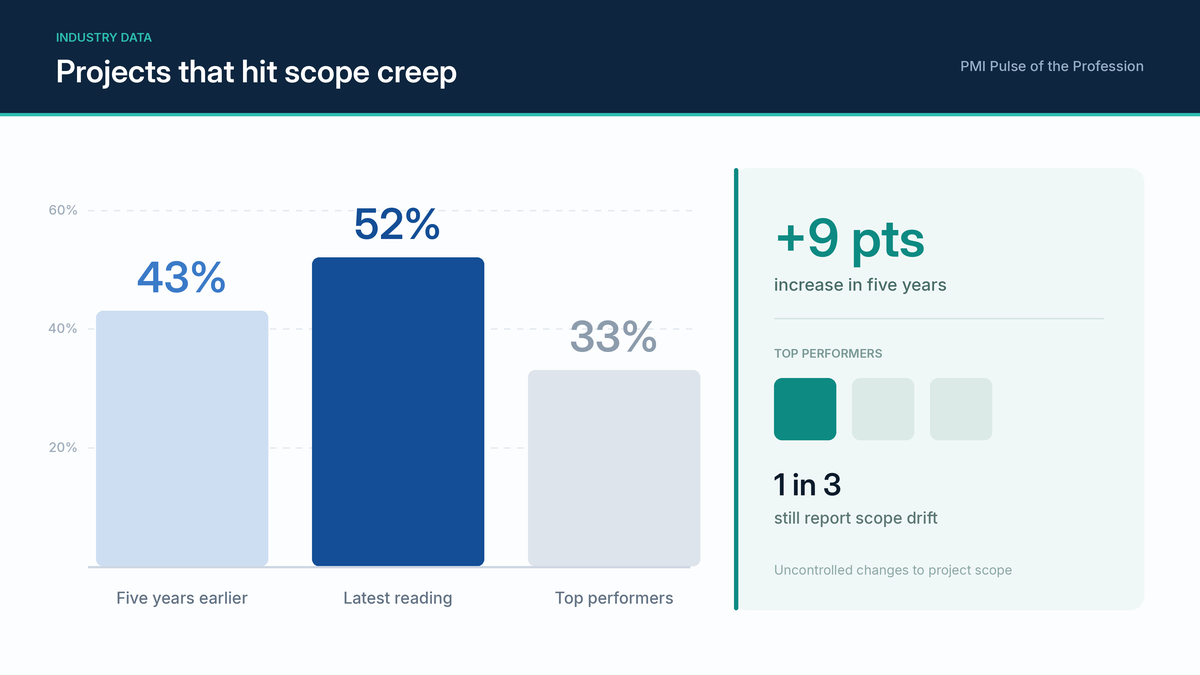
PMI’s Pulse of the Profession research found that 52% of projects completed in the prior 12 months experienced scope creep or uncontrolled changes to scope up from 43% five years earlier. Even among top-performing organizations, roughly a third of projects still saw scope drift.
What a Statement of Work Software Development Contract Actually Is
A statement of work software development contract is a binding document that defines the exact scope, deliverables, acceptance criteria, timeline, pricing model, and responsibilities for a specific engagement between a client and a development vendor. It converts an agreed intention into enforceable obligations, and it governs one project rather than the overall commercial relationship.
Two words in that statement of work software development definition carry most of the weight: specific and enforceable. A scope document that cannot be used to resolve a dispute is not doing its job, no matter how thorough it looks.
SOW Meaning in a Software Project vs. What Teams Actually Sign
The slow meaning software project stakeholders assume a shared summary of what’s being built is where most engagements go wrong. A summary describes; a statement of work software development agreement adjudicates. Those are different documents with different failure modes.
Consider the real timeline. A mid-sized product build runs 4–7 months and involves 30–60 discrete deliverables once you count screens, integrations, environments, and documentation. Across that span, a typical engagement generates 15–40 requests that sit somewhere between clarification and new work.
Without written acceptance criteria attached to each deliverable, every one of those becomes a judgement call. Agencies absorb the first few to protect the relationship, then push back around week ten usually once the client has already committed to a launch date.
The cost is measurable. A single ambiguous integration clause on a 60,000–120,000 build routinely produces 3–5 weeks of unplanned work, which lands as either margin loss for the vendor or a change order the client didn’t budget for. Multiply that across a portfolio and it explains why procurement teams distrust fixed-price quotes from agencies they haven’t worked with before.
There is a second-order effect. Vague scope documents make vendor selection harder, because every agency prices the same ambiguity differently; a quote spread of $45,000 to $190,000 for the “same” project usually reflects five different readings of one loose requirements list, not five quality tiers.
How to Write a SOW That Survives Delivery
The practical question is how to draft a scope document that holds up when the relationship is under pressure. The answer is structural: in any statement of work software development document, certain sections do the enforcement work and the rest is context. Get the enforcement sections right and the document earns its keep.
What Should a Statement of Work Include? The Annotated Skeleton
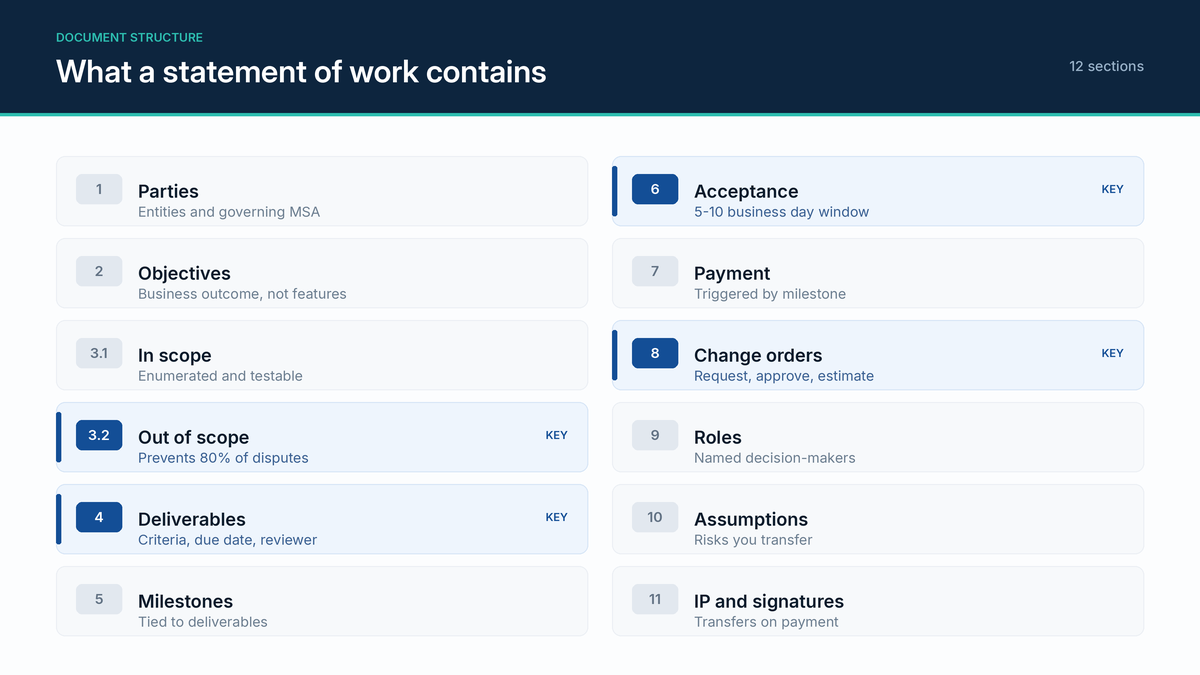
Below is a working structure and a statement of work example software buyers and agencies can both work from. The annotations in brackets explain what each section is actually for, which is the part most templates leave out.
- PARTIES AND EFFECTIVE DATE
[Names the legal entities and the governing MSA, if one exists.
Without this link, the SOW floats without dispute-resolution terms.]
- PROJECT BACKGROUND AND OBJECTIVES
[2-3 paragraphs. Business outcome, not features. This section is
read when someone asks “was this deliverable reasonable?”]
- SCOPE OF WORK
3.1 In Scope enumerated, numbered, testable
3.2 Out of Scope the section that prevents 80% of disputes
[Explicit exclusions are worth more than inclusions. If native
mobile apps, SEO migration, or data cleanup are not included,
name them.]
- DELIVERABLES
[Each row: deliverable | format | acceptance criteria | due date |
reviewer. A deliverable without acceptance criteria is a wish.]
- MILESTONES AND SCHEDULE
[Tie milestones to deliverables, not to calendar months. Include
client-side dependencies with dates content, API credentials,
access, approvals.]
- ACCEPTANCE PROCESS
[Review window in business days (5-10 is standard), what counts as
rejection, how many revision rounds are included, and the
deemed-acceptance rule if the client goes silent.]
- PRICING AND PAYMENT SCHEDULE
[Model (fixed-price / time and materials / capped T&M), currency,
invoicing cadence, and what triggers each payment.]
- CHANGE ORDER PROCESS
[Who can request, who must approve, turnaround for an estimate,
and whether work pauses pending approval. This is the pressure
valve; without it, the whole SOW cracks.]
- ROLES AND RESPONSIBILITIES
[Named individuals with decision authority on both sides. “The
client team” is not a decision-maker.]
- ASSUMPTIONS AND DEPENDENCIES
[Every assumption is a risk you’re transferring. State them:
third-party API stability, license availability, data quality.]
- IP, CONFIDENTIALITY, WARRANTY
[Usually inherits from the MSA. If there is no MSA, these must
live here including when IP transfers, typically on payment.]
- SIGNATURES
Sections 3.2, 4, 6, and 8 are the load-bearing ones in any statement of work software development template. If time is short, spend it there.
The SOW Deliverables Section: Vague vs. Specific
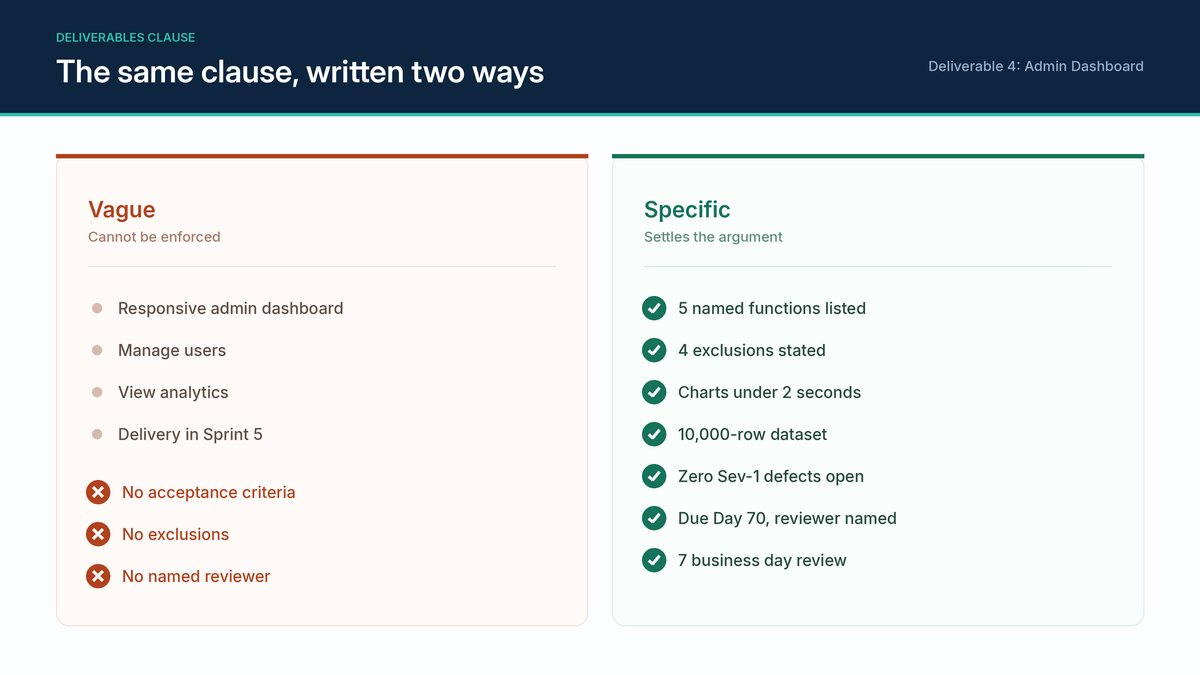
Nothing separates a usable scope document from a decorative one more clearly than how deliverables are written. Here is the same clause in both registers, drawn from a real statement of work software development engagement.
Before (vague unenforceable):
Deliverable 4: Admin Dashboard. The vendor will build a responsive admin dashboard allowing the client to manage users and view analytics. Delivery expected in Sprint 5.
After (specific enforceable):
Deliverable 4: Admin Dashboard (Web, responsive ≥768px).
Includes: user list with search and role filter; create/edit/deactivate user; role assignment across 3 predefined roles (Admin, Manager, Viewer); analytics view with 4 fixed charts (DAU, signups, churn, revenue) sourced from the existing PostgreSQL reporting schema; CSV export of the user list.
Excludes: custom report builder, role creation UI, real-time streaming data, mobile-native views.
Acceptance criteria: all 5 listed functions pass the agreed test cases in staging; charts render in under 2 seconds on a 10,000-row dataset; zero Sev-1 or Sev-2 defects open. Due: end of Sprint 5 (Day 70).
Reviewer: Priya S., Head of Product.
Review window: 7 business days.
The second version takes fifteen extra minutes to write and removes roughly a dozen future arguments from the statement of work software development lifecycle. Note that the exclusions do more work than the inclusions; a real-time data request now has a clear price tag instead of an implied obligation.
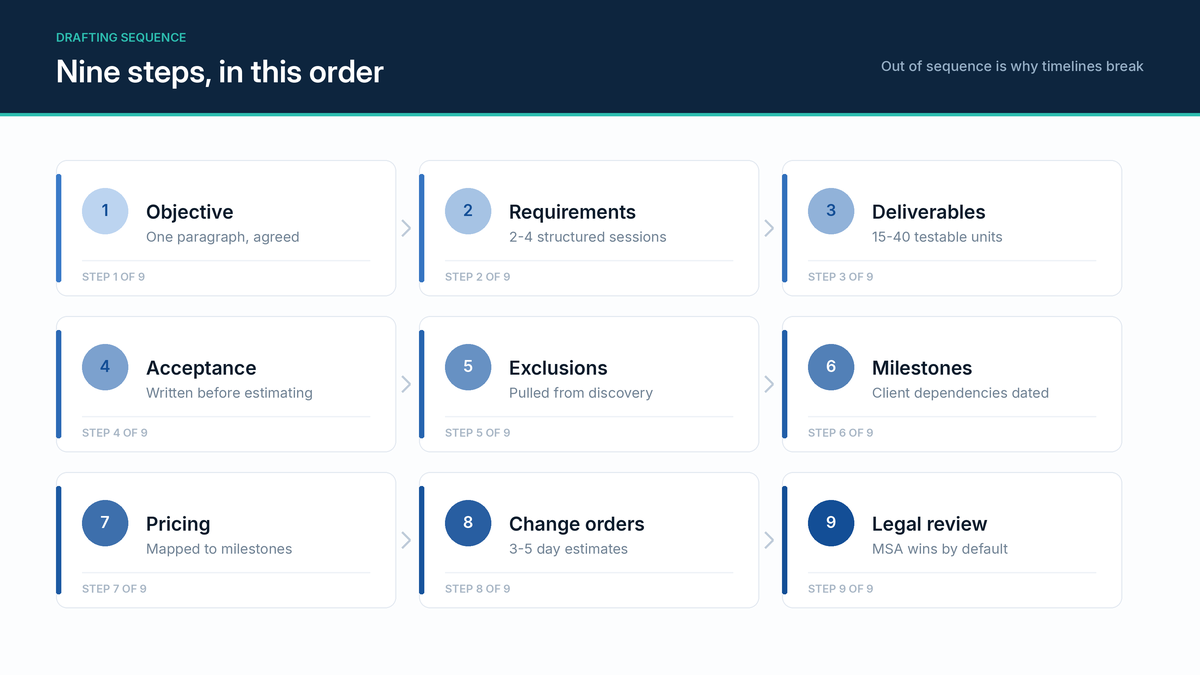
The Nine-Step Drafting Sequence
Follow this order when building a statement of work software development brief. Drafting out of sequence is why so many documents carry a confident timeline built on unconfirmed assumptions.
- Confirm the business objective in writing one paragraph, agreed by both sides before any feature list exists.
- Run structured requirements gathering 2–4 sessions, output as numbered requirements, each traceable to the objective.
- Enumerate deliverables break work into units small enough to test independently; 15–40 units is typical for a mid-sized build.
- Write acceptance criteria for each deliverable before estimating, so the estimate prices the real work.
- Draft the out-of-scope list pull directly from what came up in discovery and was set aside.
- Sequence milestones and client dependencies assign dates to what the client owes, not just the vendor.
- Select the pricing model and map payments to milestones never to calendar dates alone.
- Defining the change order process, including estimate turnaround 3–5 business days is a workable standard.
- Legal review against the master service agreement confirms no conflicting terms; the MSA should win by default.
Choosing the Pricing Model and Why It Changes the Document
The pricing model determines how much precision a statement of work software development scope section needs. A fixed-price contract demands the highest specificity, because every ambiguity becomes vendor risk that gets priced defensively often at a 20–35% contingency uplift you never see itemized.
A time and materials engagement tolerates looser scope but transfers risk to the client, so the controls move elsewhere: weekly burn reporting, a spend cap, and a defined re-planning cadence. Capped T&M sits between the two and is the most common structure for 3–6 month builds where discovery is partly complete.
Agile engagements are not exempt. What changes is the unit of commitment: instead of fixing every feature, the statement of work software development contract fixes the team composition, sprint cadence, definition of done, and a prioritized backlog that the client controls. The document is shorter, but the acceptance and change sections get more rigorous, not less.
SOW Template for Offshore Development Teams: Verification First
Before a scope document is worth anything, the counterparty has to be real. Layered agency vetting verified business registration, domain-matched email, checkable client references, named team members with traceable histories prevents the most expensive failure mode in IT outsourcing, which is a well-drafted document signed with an entity that cannot deliver.
Compliance clauses belong in a statement of work software development contract when they are project-specific: data residency for EU or Indian user data, HIPAA or SOC 2 obligations, subprocessor disclosure if the agency intends to use freelancers, and a clause requiring written approval before any work is subcontracted. Roughly one in four agency engagements involves undisclosed subcontracting; naming it in advance is cheaper than discovering it in month three.
How This Plays Out in Real Engagements
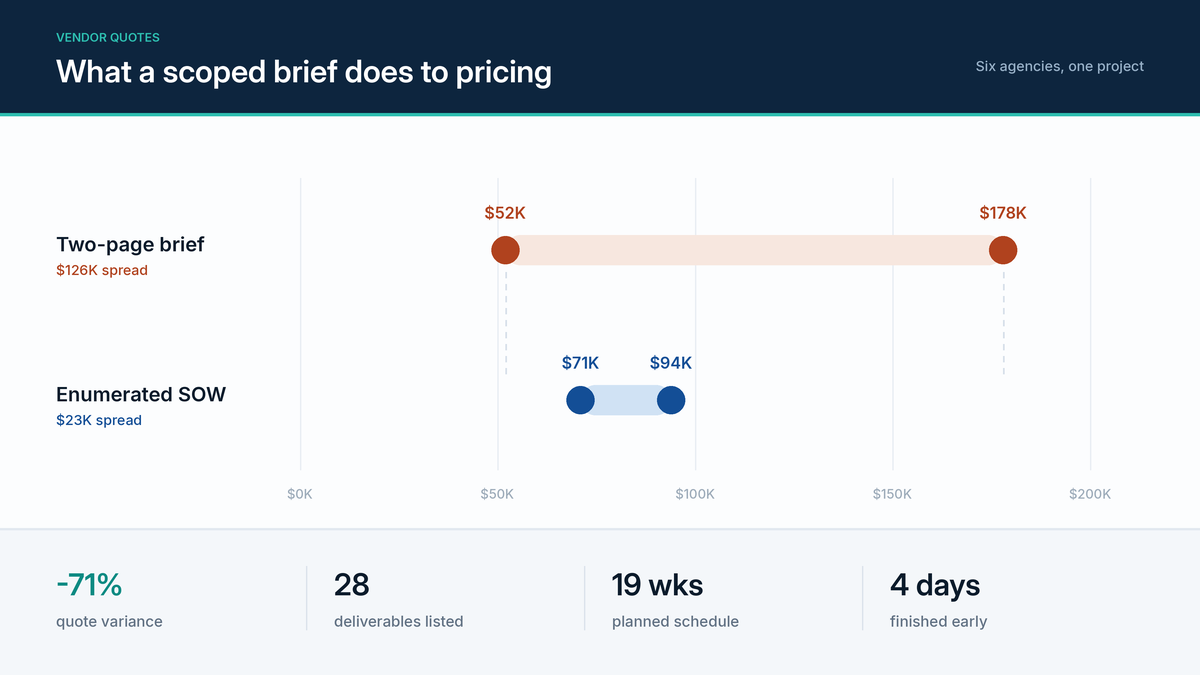
One pattern repeats across statements of work software development engagements. A Series A fintech company scoping a customer portal received quotes ranging from $52,000 to $178,000 from six agencies working off a two-page brief. After rewriting the brief into a proper scope document with 28 enumerated deliverables and explicit exclusions, the re-quoted spread narrowed to 71,000–94,000 a 71% reduction in variance and the eventual build finished 4 days ahead of a 19-week schedule.
In a second case, an enterprise procurement team running a data-platform migration added a deemed-acceptance clause and a 5-day review window after a prior vendor engagement had stalled for 11 weeks awaiting internal sign-offs. The same team, with the same reviewers, cleared all 14 milestone approvals inside the window on the following project, cutting roughly $40,000 of idle-team cost that the previous engagement had absorbed.
SOW vs MSA Difference and Where the Proposal Fits
Buyers confuse these three documents constantly, largely because agencies use the terms interchangeably in sales conversations. They are separate artifacts doing separate jobs, and every statement of work software development engagement touches at least two of them.
| Dimension | Proposal | Master Service Agreement (MSA) | Statement of Work (SOW) |
| Purpose | Win the deal | Govern the relationship | Govern one project |
| Legal weight | Non-binding unless referenced | Binding, ongoing | Binding, project-scoped |
| Typical contents | Approach, credentials, ballpark price | Liability, IP, confidentiality, dispute resolution, termination | Deliverables, acceptance, milestones, payment schedule |
| Rewritten when | Every pitch | Every 1–3 years | Every new project or phase |
| Who drafts it | Vendor | Vendor or client legal | Ideally both, jointly |
The practical sequence: MSA once, SOW per project, proposal only as a sales artifact that should never be the document you rely on. When an agency proposes skipping the MSA, the terms it would have contained must be absorbed into the statement of work software development agreement you sign which makes that document significantly longer and worth a legal review.
What Most Teams Get Wrong
Three failure patterns show up repeatedly in statements of work software development projects, and none of them are legal problems.
The first is treating the document as a vendor deliverable. Clients routinely ask the agency to draft the scope document and then sign it with light edits. The agency writes to protect the agency that’s rational so the exclusions get generous and the acceptance criteria stay soft. The strongest engagements come from a joint drafting session where the client owns Section 3.2 and Section 6, and the vendor owns the estimate.
The second is over-specifying features while under-specifying processes. Teams spend three weeks perfecting a 40-page requirements appendix and half a page on the change order process. When reality arrives and it always does the appendix is obsolete and the process section is the only part that still functions. In a statement of work software development document, precision in Section 8 is worth more than precision in Section 3.
The third is signing scope documents with unverified counterparties. A meticulously drafted statement of work software development agreement offers no protection if the other party is a two-person reseller subcontracting to a team you’ve never assessed. This is where the sourcing model matters more than contract language: platforms like GetProjects verify agencies before profiles go live precisely because verification is a precondition for scope discipline, not an alternative to it.
One more, quieter pattern: teams write the document, sign it, and never open it again. The engagements that stay on track reference the scope document at every milestone review literally reading the acceptance criteria aloud before sign-off. It takes four minutes and it is the single highest-leverage habit in outsourced delivery.
Before You Sign the Next One
Scope discipline is cheap at the statement of work software development drafting stage and brutally expensive at the delivery stage. If you’re preparing a statement of work software development engagement and want to compare verified agencies against the same enumerated brief without paying platform commissions or bidding blind GetProjects connects businesses directly with vetted IT companies at 0% commission, with project posting in under two minutes.
Write the exclusions list first. Everything else gets easier.
Frequently Asked Questions
Is a SOW legally binding?
Yes, in most cases. A statement of work is binding when it is signed by authorized representatives of both parties and contains the essential elements of a contract defined scope, consideration, and mutual assent. When it references a master service agreement, the SOW governs project-specific terms while the MSA governs liability, IP, and dispute resolution. Have counsel confirm enforceability in your jurisdiction.
What is the difference between a SOW and a contract?
A contract is the category; an SOW is one document within it. The master service agreement is typically the overarching contract covering the commercial relationship, while each statement of work software development project generates its own scoped agreement underneath it. In engagements with no MSA, the SOW functions as the complete contract and must carry all legal terms itself.
Who writes the SOW client or agency?
Agencies draft it roughly 80% of the time, which is convenient but not ideal. The strongest approach is joint authorship: the client owns objectives, out-of-scope items, and the acceptance process; the agency owns deliverable breakdown, estimates, and technical assumptions. Clients without in-house technical leadership should have a third party review the deliverables and acceptance sections before signing.
What happens if work falls outside the SOW?
It triggers the change order process defined in the document assuming one exists. A functioning clause specifies who may request changes, who approves them, how quickly the vendor must return an estimate, and whether existing work pauses. Without it, out-of-scope requests get absorbed informally until the vendor’s margin disappears and the relationship becomes adversarial.
Do agile projects need a SOW?
Yes, with a different commitment structure. Rather than fixing every feature, an agile scope document fixes team composition, sprint length, velocity assumptions, the definition of done, and the client’s authority over backlog prioritization. Acceptance and change-control sections become more important, not less, because the feature list is deliberately fluid.
How detailed should a SOW be for a fixed-price project?
Detailed enough that a developer who never attended a scoping call could build from it. For fixed-price work, that usually means 8–20 pages with enumerated deliverables, per-deliverable acceptance criteria, and an explicit exclusions list. Under-specifying a fixed-price engagement doesn’t save time; it moves the negotiation to month three, when your leverage is lowest.
How do I compare agencies before I write the SOW?
Shortlist on verified track record, relevant domain depth, and team composition rather than headline price, then send the same enumerated scope to every finalist so the quotes are actually comparable. If you want that comparison without commission cuts or bidding-war dynamics, posting a scoped project brief to a verified marketplace and reviewing matched agencies directly is usually faster than running the outreach yourself.