Best Agency Spotter Alternatives for Agency Search in 2026
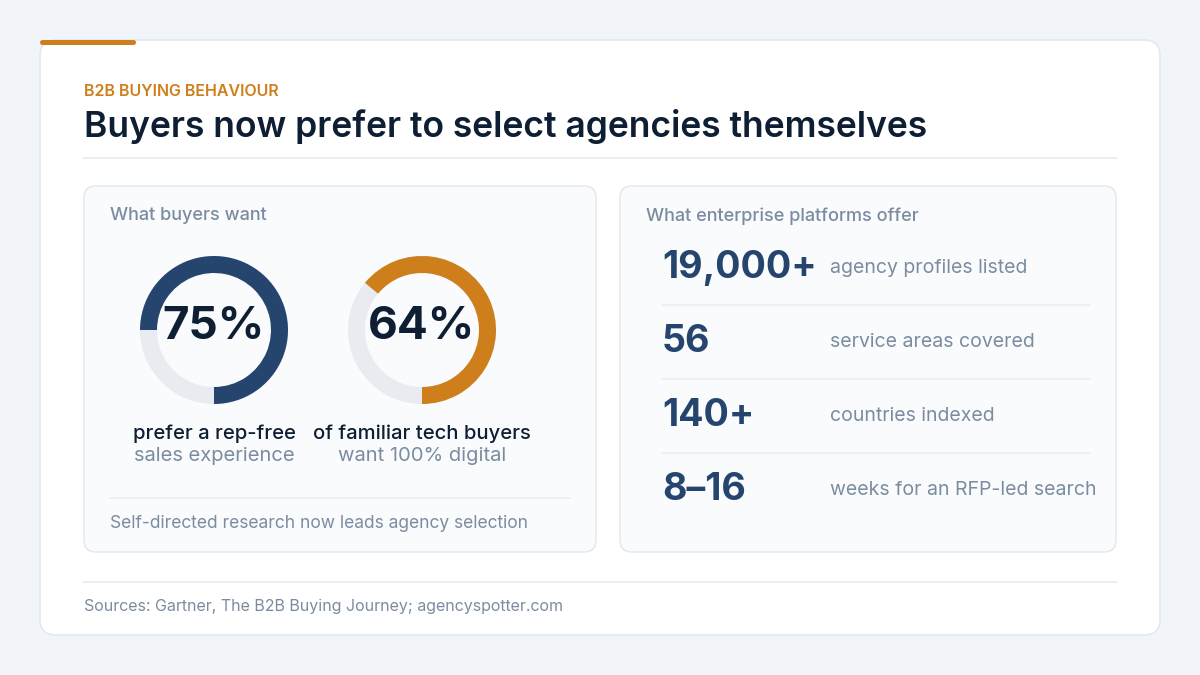
Agency Spotter carries more than 19,000 agency profiles across 56 service areas and 140+ countries, and its search team publicly states it has supported engagements from $200,000 up to $20 million. That scale is the entire value proposition and for most buyers, it is also the reason they end up searching for agency spotter alternatives.
The platform was designed around a specific buyer: an enterprise marketing or procurement team running a formal agency-of-record search. That workflow assumes an RFI sent to 10–15 agencies, an RFP narrowed to no more than eight, three to four weeks for responses, and stakeholder regroups to reach a final three-to-five shortlist.
For a $2M roster decision, that rigor is warranted. For a founder who needs a React Native build scoped at $45,000 and kicked off inside three weeks, a six-to-ten-week structured RFP process is not diligence, it is overhead.
Gartner research finds that 75% of B2B buyers now prefer a rep-free sales experience, and among technology purchase decision-makers already familiar with what they are buying, 64% preferred a 100% digital buying experience citing speed, convenience, and a preference for self-directed research.
That preference is the structural gap. Concierge-managed search was designed for buyers who wanted a moderated process. The majority of today’s buyers want to see qualified options, verify them independently, and open a direct conversation this week, not next quarter. That is precisely the demand the newer agency spotter alternatives were built to serve.
This guide breaks down the three operating models behind every serious contender among agency spotter alternatives, compares nine options by buyer profile, and gives you a shortlisting sequence you can run in ten days instead of ten weeks.
What Are Agency Spotter Alternatives?
Agency spotter alternatives are agency discovery platforms, directories, matchmaking services, and B2B marketplaces that help businesses find, verify, and shortlist marketing, design, and technology agencies. They differ primarily in how buyers reach vendors: browsing self-published profiles, receiving curated recommendations, or connecting directly after posting a project brief.
Why Enterprise Agency Search Platforms Slow Down Smaller Buyers
Most agency search platforms monetise one of two things: agency visibility or buyer hand-holding. Both introduce friction that scales badly downward, and most agency spotter alternatives inherit one form of it or the other, a pattern that becomes obvious once you compare the best platforms to find software development agencies side by side.
Reported premium placement tiers across the major directories run from roughly $200 per month at entry level to five figures annually for category-leading positions, with sponsored slots in competitive categories reported well into the thousands per month. The buyer never pays that fee but the buyer absolutely inherits its consequence. Ranking becomes a function of marketing budget rather than fit, so the agencies at the top of a category page are frequently the ones that could most afford to be there.
The second cost is time. A managed search adds intake calls, moderated RFI rounds, and stakeholder alignment sessions. Enterprise teams budget 8–16 weeks for this and treat it as a line item. A 15-person SaaS company with a Q3 launch date does not have 8–16 weeks, and it does not have a procurement lead to run the cycle.
The third cost is invisible: pitch attrition. When agencies are asked to produce unpaid speculative work for a $40,000–$75,000 project, the strongest specialist shops decline. Buyers running heavyweight processes on mid-sized budgets systematically self-select into a weaker candidate pool the exact opposite of the intended outcome, and largely avoidable if you write a software development RFP tight enough to respect an agency’s pre-sales time. Escaping that dynamic is the single most common reason teams start testing agency spotter alternatives at all.
How to Evaluate Agency Spotter Competitors: Matchmaking vs Marketplace vs Directory
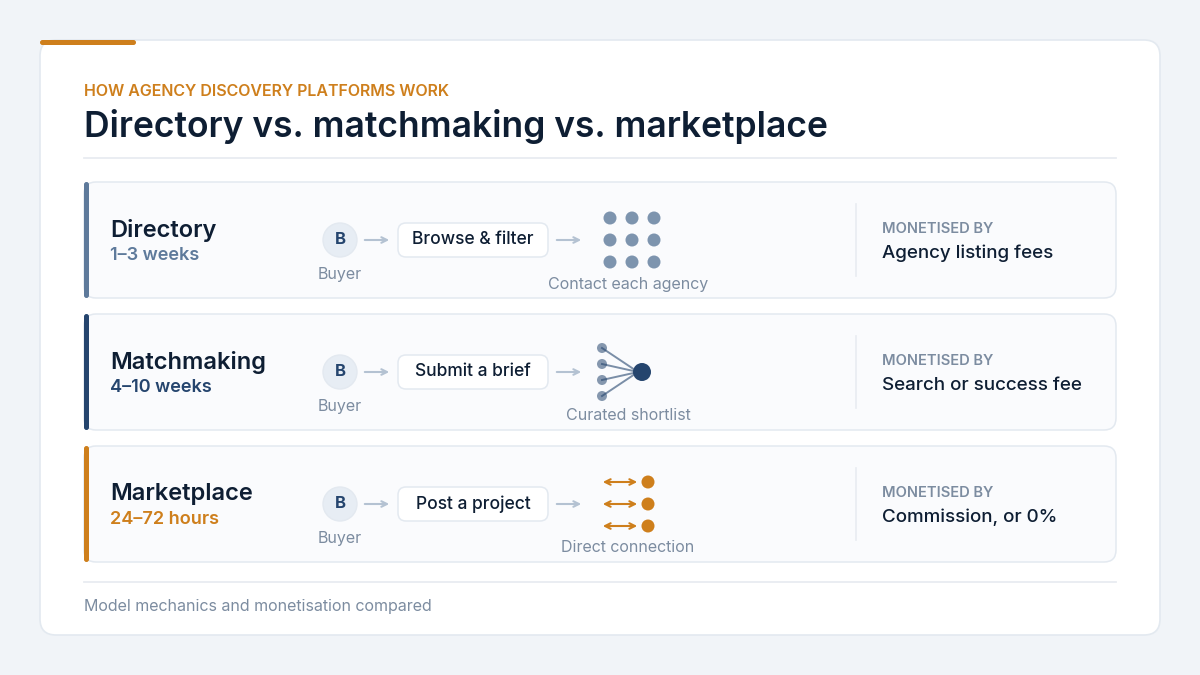
Every platform worth considering runs on one of three models, and naming the model tells you more about the buying experience than any feature list. Sorting agency spotter competitors this way is faster than comparing databases side by side.
Model 1: Directories Breadth Without Guidance
Directory-style agency spotter alternatives index the largest volume of profiles and are genuinely useful for market mapping. Their weakness is that client reviews and profile completeness are largely self-managed, and organic position is influenced by paid placement. Use directories to build a longlist of 20–30 names, the same discipline that applies when you find IT agencies for startup development not to pick a winner.
Model 2: Managed Matchmaking Rigor at Enterprise Pace
Matchmaking earns its keep on high-stakes, multi-stakeholder decisions where a defensible, documented selection trail matters: regulated industries, board-visible spend, multi-agency roster consolidation. The tradeoff is timeline and transparency. You rarely see the agencies that were filtered out, or why. Among agency spotter alternatives, this model is the slowest and the most thorough.
Model 3: Direct-Connect Marketplaces Speed With Data
Marketplace agency spotter alternatives invert the flow: the buyer publishes scope, budget, and timeline, and matching runs against structured data rather than a browsing session. Commission-based marketplaces take 10–20% of contract value, which quietly inflates agency quotes, the core distinction examined in agency marketplaces vs direct matching for hiring software teams. Commission-free models the category GetProjects operates in remove that markup and route on fit signals like domain expertise, budget alignment, and delivery history rather than bid volume.
How to Shortlist an Agency Without an RFP: A 7-Step Sequence
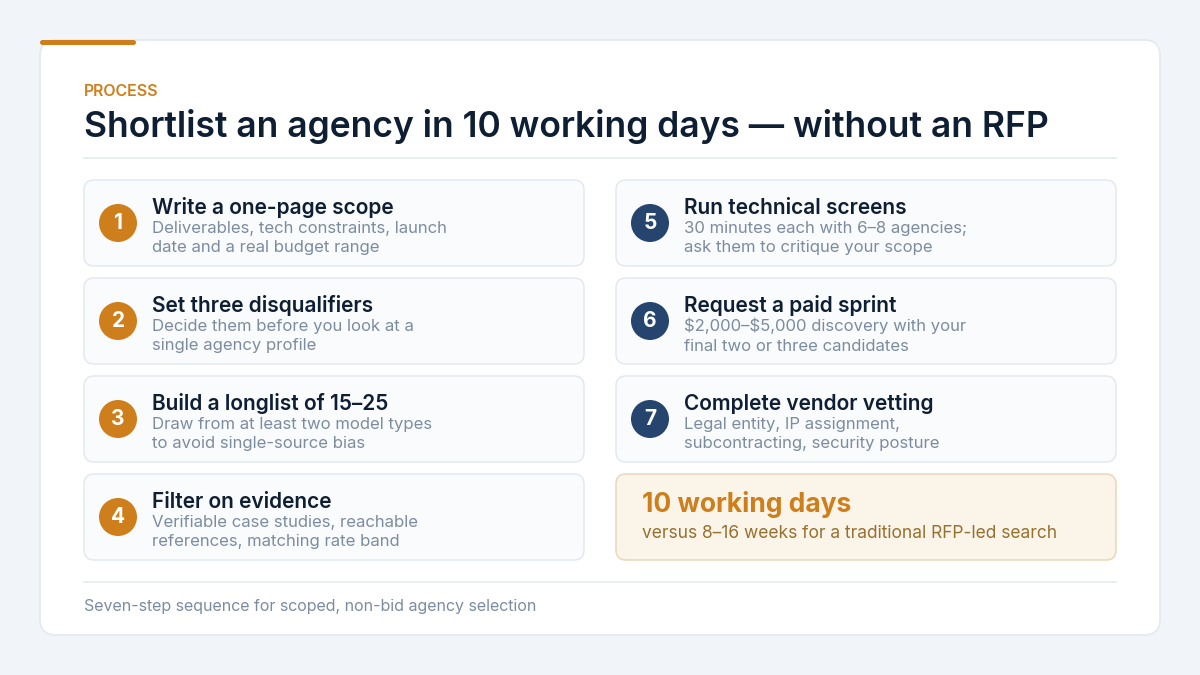
This sequence works across any of the agency spotter alternatives below, and compresses a traditional 8–16 week cycle into roughly 10 working days.
- Write a one-page scope, not a 12-page RFP. Deliverables, tech constraints, launch date, and a real budget range. Withholding budget is the single largest cause of wasted project scoping cycles.
- Define three disqualifiers before you look at anyone. No relevant vertical experience, no named delivery lead, no in-house QA pick yours and hold the line.
- Build a longlist of 15–25 from at least two model types. One directory, one marketplace. Single-source shortlists inherit that source’s bias.
- Filter on evidence, not claims. Verifiable case studies in your stack, references you can actually reach, and hourly rate filters that match your band.
- Run 30-minute technical screens with 6–8 agencies. Ask them to critique your scope. The ones who push back on your assumptions are the ones who have shipped before.
- Request a paid discovery sprint from your final 2–3. A $2,000–$5,000 scoped engagement is the highest-signal, lowest-risk diligence available. Free pitches select for sales capacity; paid sprints select for delivery capacity.
- Complete vendor vetting before signature. Legal entity, IP assignment, subcontracting disclosure, security posture, and continuity if your lead developer rolls off.
Cost Implications Buyers Consistently Miss
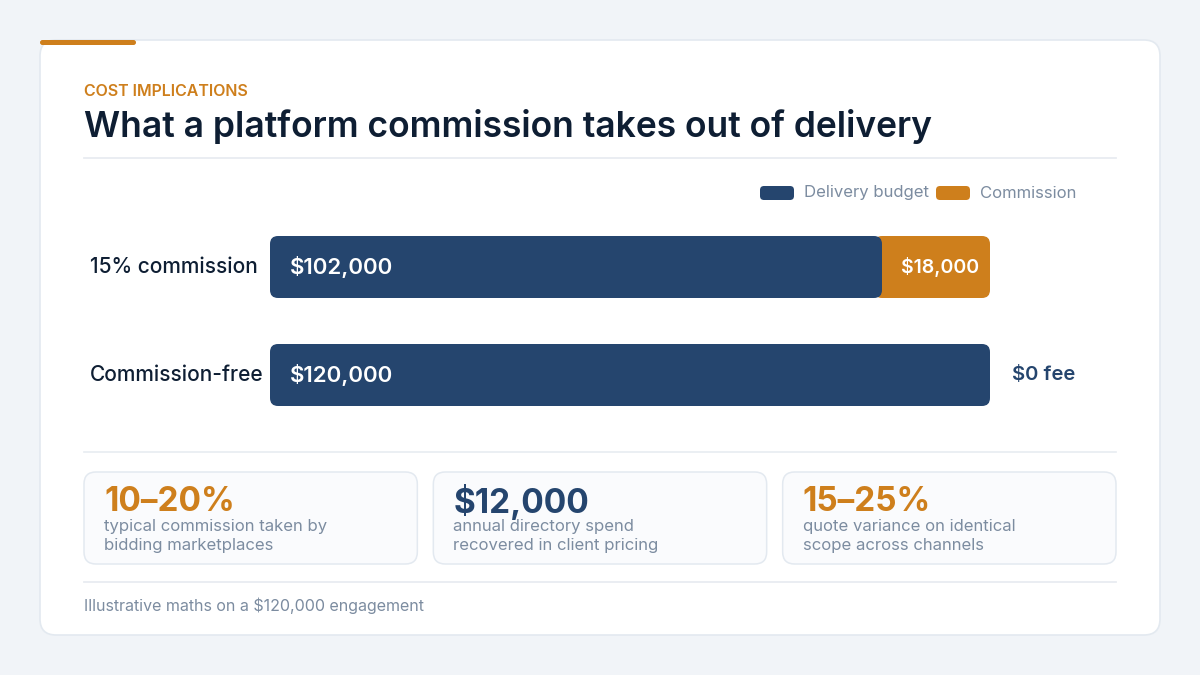
Commission structures are the least understood line item in this category. A 15% platform commission on a $120,000 engagement is $18,000 funded either by a higher quote to you or by a thinner delivery team on your project. Neither outcome appears on an invoice, which is exactly why buyers who compare software development quotes line by line find spreads they cannot explain from scope alone.
Paid listing fees behave similarly. When an agency spends $12,000 annually across directory placements, that acquisition cost is recovered inside client pricing. A commission-free marketplace removes both layers, which is why quotes sourced through different agency spotter alternatives on identical scope routinely vary by 15–25%.
Verification and Compliance: What Actually Reduces Risk
Verification depth varies more across agency spotter alternatives than any other dimension. Minimum standards worth insisting on before a profile earns your time: confirmed website and corporate email domain ownership, named team members with traceable professional histories, reviews attached to identifiable engagements, and stated company size that matches observable evidence.
For regulated or data-sensitive work, extend the check to data processing location, subprocessor disclosure, SOC 2 or ISO 27001 status, and whether the contracting entity matches the delivery entity. Entity mismatches between the company you sign with and the team that ships sit near the top of any list of red flags in a software development company, and they are the most common source of post-signature disputes in IT outsourcing partner relationships.
Sites Like Agency Spotter: 9 Agency Spotter Alternatives Worth Comparing
Grouped by the buyer each one actually serves. Buyers searching for sites like agency spotter are usually looking for one of these nine.
- Clutch The category’s most established review platform, strongest in software and IT development. Deep verified review base; visibility is heavily influenced by sponsorship. Best for: market mapping and reference-checking a name you already have.
- GoodFirms Broad IT and development coverage with a free-tier profile that remains functional. Review depth is thinner than Clutch. Best for: budget-conscious longlisting across development categories.
- DesignRush Design, development, and marketing focus with an editorial “best of” layer that drives discovery. Review verification is lighter and more self-reported. Best for: creative and web design discovery.
- Sortlist Brief-driven matchmaking with unusually strong European and multilingual coverage. Slower than self-service browsing. Best for: cross-border and EU-market sourcing.
- UpCity SMB-oriented with a strong local and regional service angle. Smaller database, less enterprise depth. Best for: local service businesses hiring regionally.
- The Manifest Company shortlists and how-to content built for early-stage research. Functions as a research layer rather than a transaction layer. Best for: buyers still defining requirements.
- Expertise.com Editorially curated local provider lists with a documented scoring methodology. Narrower agency-specific depth. Best for: buyers who want curation without a sales process.
- Toptal Vetted individual specialists and small pods rather than full agencies. Premium rates, fast placement. Best for: filling a specific senior skill gap, not delivering a full project.
- GetProjects Commission-free, no-bid marketplace matching businesses directly with verified agencies across 50+ cities, scoring 50+ data points including budget, expertise, and delivery history. Posting is free for buyers; listing is free for agencies, and the mechanics of how the GetProjects B2B marketplace works are documented in full. Best for: startups and mid-market teams that want verified options and direct contact without paying commission or waiting on a managed search.
Real-World Application
Two patterns recur when teams move between agency spotter alternatives mid-search. Both scenarios below are anonymised composites reflecting common sourcing patterns replaced with named, verified client outcomes before publishing.
Fintech Series A, mobile build. A 22-person payments startup spent five weeks in a directory-led search and collected four proposals ranging from $60,000 to $185,000 for the same scope, a spread driven largely by how each agency priced its own lead-acquisition cost. Re-running the search through direct project posting with a fixed scope document produced three comparably priced quotes within 72 hours and a signed SOW in 11 days.
Manufacturing ERP integration. A mid-market manufacturer disqualified its top-ranked directory choice during vendor vetting when the contracting entity turned out to be a two-person reseller subcontracting delivery offshore without disclosure, a structural risk that separates IT outsourcing from hiring an agency in practice. Layered verification at the platform level domain ownership, team traceability, entity confirmation surfaced that mismatch before commercial discussions, avoiding an estimated 6–8 weeks of rework.
Agency Shortlisting Tools Compared: A Decision Framework
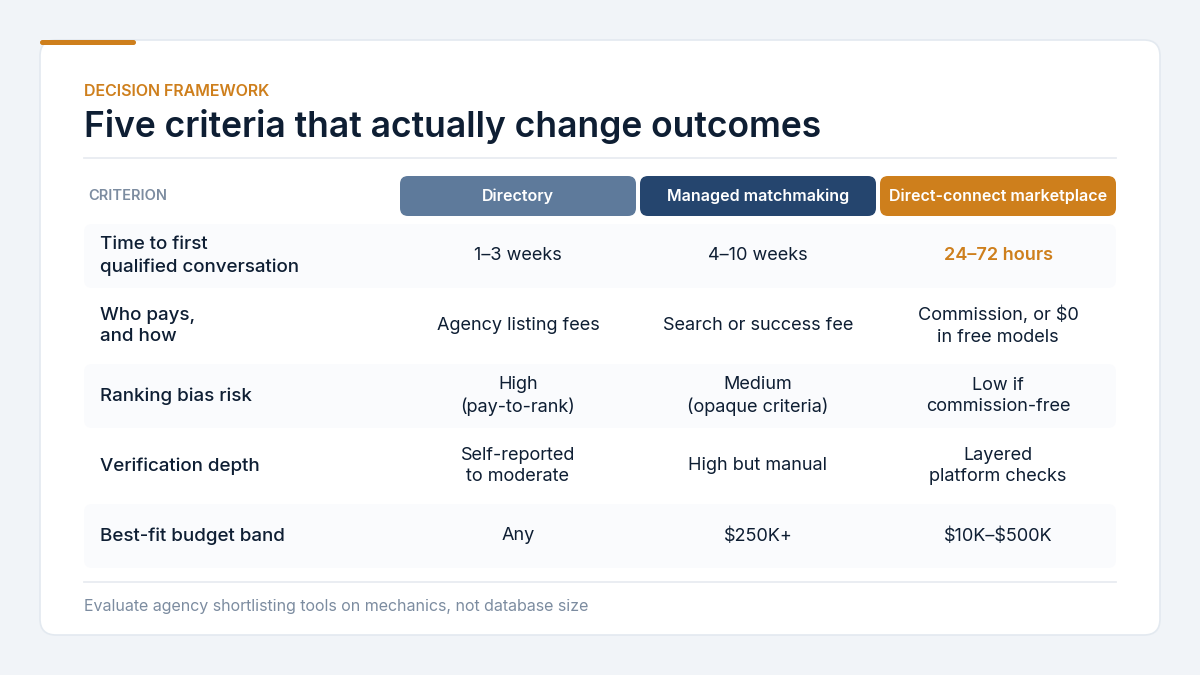
Judge agency shortlisting tools on the five dimensions that change outcomes, not on database size. The same grid applies to every one of the agency spotter alternatives above.
| Evaluation criterion | Directory model | Managed matchmaking | Direct-connect marketplace |
| Time to first qualified conversation | 1–3 weeks | 4–10 weeks | 24–72 hours |
| Who pays, and how | Agency listing fees | Search fee or success fee | Commission, or $0 in free models |
| Ranking bias risk | High (pay-to-rank) | Medium (opaque criteria) | Low if commission-free |
| Verification depth | Self-reported to moderate | High but manual | Varies; layered checks in stronger platforms |
| Best-fit budget band | Any | $250K+ | $10K–$500K |
Map your own constraint first. If a documented, defensible selection trail matters more than speed, managed matchmaking is the correct instrument. If time-to-launch is the binding constraint, it is the wrong one, and the faster agency spotter alternatives will serve you materially better.
What Most Teams Get Wrong When They Find Marketing Agencies
The dominant mistake in comparing agency spotter alternatives is treating platform choice as a discovery problem when it is almost always a scoping problem. Teams that find marketing agencies slowly are rarely short of options; they are short of a decision-ready brief. A one-page scope with a real budget range and a hard date outperforms a 12-page RFP every time, because it lets unqualified agencies self-select out in hours rather than weeks.
The second mistake is equating a long agency shortlist with rigor. Beyond six candidates, evaluation quality degrades: stakeholders lose the ability to hold distinctions in mind, comparison collapses to price, and the procurement cycle stretches until the strongest candidates take other work. Three well-screened agencies beat twelve loosely screened ones.
Third, and most expensive: buyers optimise for the cheapest sourcing channel while ignoring the cost embedded in the quote. Free-to-browse platforms are not free; their monetisation is priced into what agencies charge you, a trade-off worth understanding before you settle on an alternative to Clutch for your business. Ask an agency directly what it pays to reach you. The answer is frequently 10–20%, and it is negotiable once you know it exists.
Finally, teams over-index on verification badges without asking what was verified. A badge confirming an email domain is not a badge confirming delivery capability. Treat verification on any of the agency spotter alternatives you use as a filter that removes obvious risk, never as a substitute for your own technical screen, the kind built into a disciplined step-by-step process for hiring a software development company.
Where to Go From Here
If you are comparing agency spotter alternatives because the enterprise RFP path does not match your budget or your launch date, the fastest correction is structural rather than tactical: stop browsing and start scoping. Write the one-page brief, set your three disqualifiers, and post it to a channel that connects you to verified agencies directly rather than routing you through a bidding queue or a managed intake process.
GetProjects was built for that buyer to post a project in under two minutes, receive matches scored across 50+ data points, and talk to verified agencies with zero commission taken from either side. Post your scope free at getprojects.ai and see which agencies genuinely fit before you commit to a single call. The right choice among agency spotter alternatives is simply the one that gets a qualified conversation started this week.
Frequently Asked Questions
Is Agency Spotter free to use?
Agency Spotter is free for buyers to search, build a shortlist, and read verified client reviews. Its revenue comes from the agency side and from paid search-support services for enterprise buyers running formal RFPs. Buyers pay nothing to browse, but the agency-side economics still shape which profiles are most visible, which is why anyone comparing agency spotter alternatives should look at agency-side pricing rather than buyer-side cost alone.
What is the best alternative to Agency Spotter?
There is no single winner, it depends on budget, band and timeline. Among agency spotter alternatives available in 2026, Clutch and GoodFirms are strongest for broad IT longlisting, Sortlist for European coverage, and commission-free marketplaces for teams that need direct contact with verified agencies inside a week. Match the model to your constraint, not to database size.
How do agency matching platforms make money?
Agency spotter alternatives monetise three ways: agency listing or sponsorship fees, buyer-side search and concierge fees, or a commission of 10–20% on matched contract value. A small number operate commission-free. Ask every platform this question directly, because the answer predicts whose interests its matching logic actually serves.
Are agency directories actually worth it?
Yes, for one specific job: understanding who exists in a category and at what rate band. Directory-style agency spotter alternatives are poor tools for final selection, because ranking correlates with marketing spend rather than delivery quality. Use them to build a longlist, then verify independently and screen technically before shortlisting.
How do you verify an agency before signing a contract?
Confirm the legal contracting entity matches the delivery entity, get named delivery leads with traceable histories, reach at least two references from comparable projects, and require written disclosure of any subcontracting. For data-sensitive work, add processing location, subprocessor lists, and SOC 2 or ISO 27001 status.
How long does agency selection take from search to signed SOW?
Enterprise RFP-led searches typically run 8–16 weeks. A scoped, non-bid process with a clear brief and three disqualifiers closes in 10–14 days on most agency spotter alternatives. The variable is rarely agency availability; it is how long the buying team takes to agree on scope and budget internally.
What should a startup check before paying for a discovery sprint?
Confirm the sprint produces artefacts you own and can hand to another vendor: a technical architecture document, an estimate breakdown, and a risk register. A $2,000–$5,000 sprint that leaves you with transferable documentation is diligence. One that leaves you with a sales deck is a pitch you paid for.