
Best Staff Augmentation Companies in 2026 How to Find the Right One for Your Team
Done correctly, staff augmentation means adding pre-vetted, senior developers to your existing engineering team who integrate into your processes, use your tools, report to your technical lead, and contribute to your codebase as if they were full-time employees. Done incorrectly, it means adding bodies to a project who need as much management as the output they produce.
That’s why choosing the best staff augmentation companies is about more than filling seatsit’s about finding vetted talent that integrates seamlessly with your team, processes, and delivery goals.
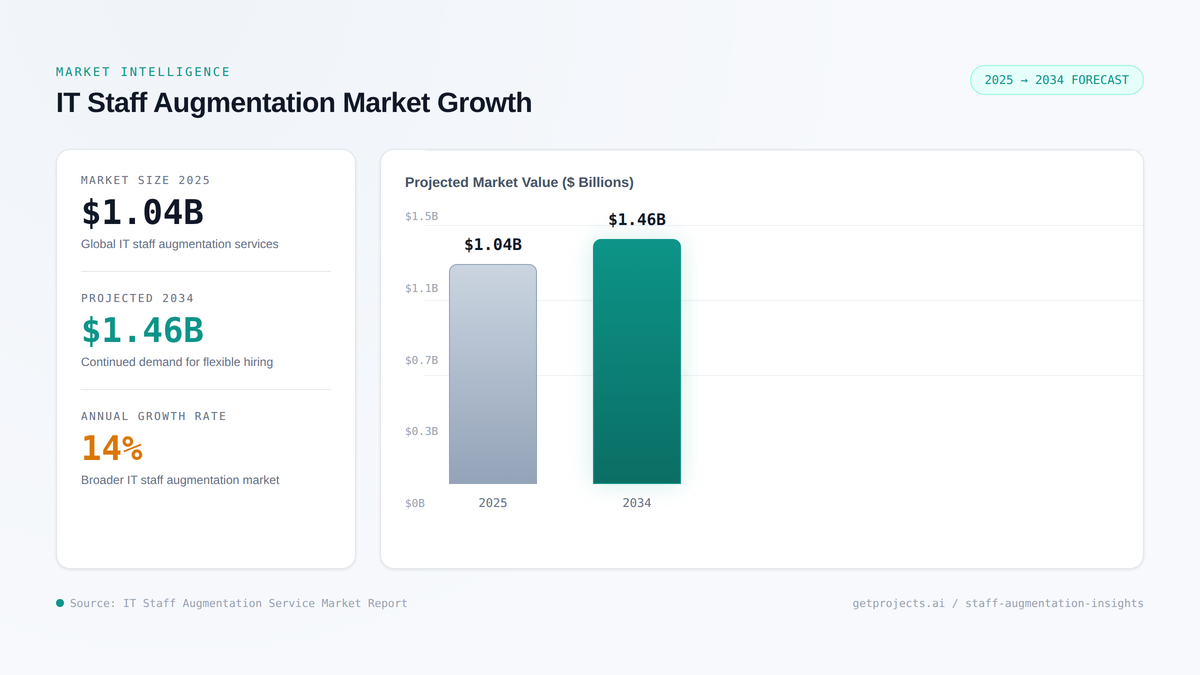
According to IT Staff Augmentation Service Market Report, the global IT staff augmentation services market is projected to grow from $1.04 billion in 2025 to $1.46 billion by 2034, reflecting continued demand for flexible hiring models and specialized technology talent. As businesses face increasing pressure to scale engineering capacity faster, staff augmentation has become a preferred strategy for bridging critical skill gaps.
The global IT staff augmentation market is valued at $245 billion in 2026 and growing at 14% annually. The buyers are engineering managers and CTOs who have a specific technical skill gap, a temporary capacity need, or a permanent headcount constraint. This guide covers how to find the right staff augmentation partner and structure the engagement correctly.
Staff Augmentation vs Outsourcing The Distinction That Matters
The terminology is used interchangeably in the market and should not be. Getting this wrong produces the wrong engagement model and the wrong expectations.
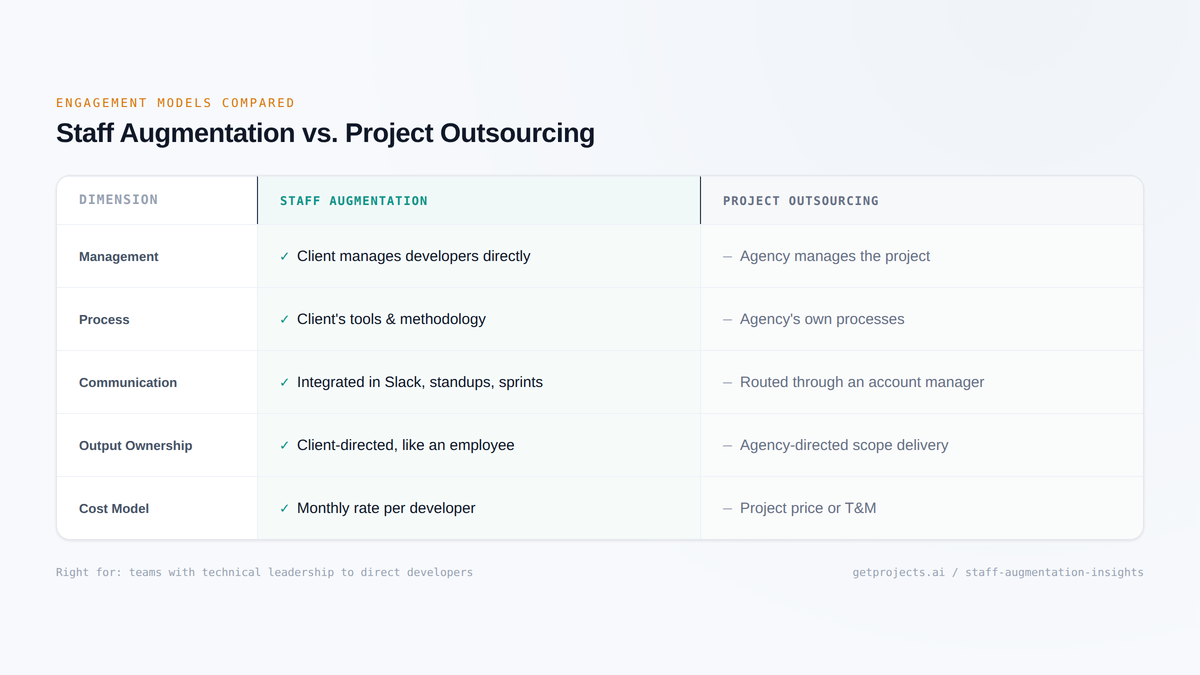
The key differences:
| Dimension | Staff Augmentation | Project Outsourcing |
| Management | Client manages the augmented developers directly | Agency manages the project |
| Process | Client’s processes, tools, and methodology | Agency’s processes |
| Communication | Developers integrate into client’s Slack, standups, sprints | Communication goes through an account manager or PM |
| Output ownership | Client-directed output, similar to an employee | Agency-directed output, delivered as a scope |
| Risk | Client bears the output risk you direct the work | Agency bears the scope risk they defined the deliverable |
| Cost model | Monthly rate per developer | Project price or T&M |
| Right for | Teams with technical leadership who can direct additional developers | Buyers without internal technical management |
The most common mistake in staff augmentation is buyers without strong technical leadership trying to use augmented developers as a substitute for project management. Augmented developers are developers who need technical direction, architecture decisions, and backlog prioritisation from someone on your side.
An engineering manager or CTO who can provide this gets excellent value from staff augmentation. A non-technical founder who wants someone to “just build the product” gets confused and poor output. If you’re a founder without that technical leadership in place yet, it’s worth building that foundation first. Our guide on how startups should build their first tech team walks through exactly how to get there before bringing augmented developers onto the roster.
What Good Staff Augmentation Companies Actually Provide
The quality difference between staff augmentation companies is most visible in pre-vetting rigour. The best companies send you developers who are genuinely ready to contribute on day one. The worst is to send you to whoever is available and let you do the evaluation.
What strong staff augmentation companies do:
| Capability | What It Looks Like |
| Technical pre-screening | Developers pass a multi-stage technical assessment not just a CV review before being presented to clients |
| Skill-specific matching | They match developers based on your specific tech stack, not just “we have React developers” |
| Trial periods | They offer 1–2 week paid trial periods to verify fit before long-term commitment |
| Replacement guarantees | If a developer is not working out, they provide a replacement within defined SLA typically 1–2 weeks |
| Transparent developer profiles | You see actual LinkedIn profiles, GitHub portfolios, and technical assessment results before commitment |
| Communication standards | English proficiency is assessed alongside technical skills communication quality matters as much as code quality |
What weak staff augmentation companies do:
They present CVs from a database of available developers without project-specific vetting. They guarantee availability but not quality. They resist trial periods or have long commitment minimums. They make replacement difficult or expensive. They send developers who are “available” rather than matched to your requirements. These patterns aren’t unique to staff augmentation; they show up across outsourcing engagements generally, and our breakdown of red flags to watch for in a software development company covers the warning signs in more depth.
Staff Augmentation Cost at the $5K–$30K Budget Range
Staff augmentation is a monthly cost model you are paying for a developer’s time on a retainer basis. The $5K to $30K budget range covers 1 to 3 months of a single developer depending on the region. If you want to sanity-check these numbers against broader market rates before committing to a region, our guide on software developer hourly rates by country breaks down what different budgets buy across geographies.
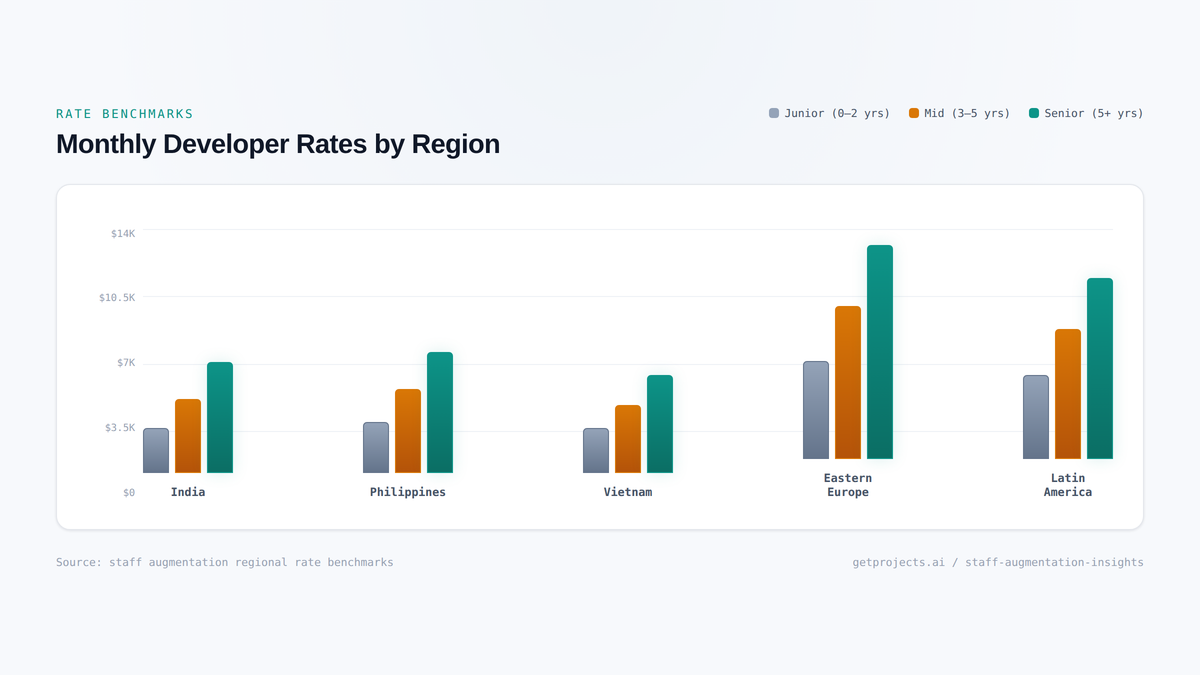
Monthly rates for staff augmentation developers by region and level:
| Region | Junior (0–2 yrs) | Mid-Level (3–5 yrs) | Senior (5+ yrs) | Full-Stack Senior |
| India | $1,800–$3,000 | $3,000–$5,000 | $4,500–$7,500 | $3,500–$6,000 |
| Philippines | $2,000–$3,500 | $3,500–$5,500 | $5,000–$8,000 | $4,000–$6,500 |
| Vietnam | $1,800–$3,000 | $2,800–$4,500 | $4,000–$6,500 | $3,200–$5,500 |
| Eastern Europe | $4,000–$6,500 | $6,500–$10,000 | $9,000–$14,000 | $7,500–$12,000 |
| Latin America | $3,500–$5,500 | $5,500–$8,500 | $7,500–$12,000 | $6,500–$10,000 |
What $5K–$30K buys in staff augmentation:
| Budget | Staff Augmentation Usage |
| $5K | 1–2 months of a junior Indian developer, or 3–4 weeks of a mid-level Indian developer |
| $10K | 2–3 months of a mid-level Indian developer, or 1–2 months of a senior Indian developer |
| $20K | 4–5 months of a mid-level Indian developer, 3–4 months of a senior Indian developer, or 2–3 months of a mid-level Latin American developer |
| $30K | 6 months of a mid-level Indian developer, 4–5 months of a senior Indian developer, or 3–4 months of a mid-level Latin American developer |
The minimum viable commitment:
Most staff augmentation companies require a minimum commitment of 1 to 3 months. This is appropriate: a developer needs 2 to 3 weeks to onboard, understand the codebase, and get to productive contribution. One-month engagements rarely produce the ROI of a 3 to 6 month engagement. If your need is shorter than 2 months, project outsourcing is probably the right model.
The Five Types of Staff Augmentation Needs
Understanding which type of need you have determines what kind of augmentation company to look for.
Type 1 Skill gap filling:
Your team has a specific technical skill that is missing or undersupplied: a mobile developer when your team is web-focused, a data engineer when your team is application-focused, a DevOps engineer when your team has no infrastructure expertise. You need someone who can contribute immediately in this specific domain without significant onboarding. The vetting bar matters most here, since a stack-specific hire has less runway to ramp up our guide on how to vet a mobile app development company walks through the same evaluation questions you should be asking a specialist developer or team before committing.
Best sourced from: specialist staff augmentation companies that pre-vet for specific technology stacks.
Type 2 Capacity expansion:
Your team has the right skills but not enough people. You are trying to ship a roadmap faster than your current team can execute. You need more developers who can work within your existing architecture and processes.
Best sourced from: staff augmentation companies with a broad pool of developers in your tech stack who can be matched and onboarded quickly.
Type 3 Trial before hire:
You want to evaluate a developer for a potential permanent hire through a 3 to 6 month contract engagement before offering full-time employment. This is increasingly common for senior hires; the cost of a wrong full-time hire is significant enough to justify the contract period.
Best sourced from: staff augmentation companies that explicitly support contract-to-hire transitions with clear terms.
Type 4 Project surge:
You have a specific time-bounded increase in workload, a major feature launch, a data migration, a platform rebuild that requires more developers for 3 to 6 months. After the project, you return to your standard team size. Because the engagement is temporary and scope can shift mid-project, it’s worth understanding how the underlying commercial model affects your flexibility. Our comparison of dedicated team vs time & material vs fixed price breaks down which model actually supports ramping up and down.
Best sourced from: staff augmentation companies with flexible commitment terms and the ability to ramp a team up and down as needed.
Type 5 Offshore team building:
You want to build a permanent offshore development presence without the overhead of direct employment in another country. A staff augmentation company in India or Eastern Europe provides the legal entity, HR, and infrastructure while the developers work as your dedicated team indefinitely. Since rates, talent depth, and time zone overlap vary significantly by region, our breakdown of offshore development in India vs Eastern Europe vs LatAm is worth reviewing before you commit to a single location.
Best sourced from: staff augmentation companies with proven experience building long-term dedicated offshore teams not just contract staffing.
How to Evaluate a Staff Augmentation Company
The technical assessment question:
Ask the company to describe their developer vetting process in detail, specifically what technical assessment they run, who administers it, what pass rate they see, and how recently the developers they would present to you have completed the assessment. A company that says “we review CVs and do a 30-minute call” is not pre-vetting developers. A company that describes a 3 to 5 hour technical assessment covering their stack-specific knowledge, code quality, problem-solving, and system design is actually screening.
The matching quality question:
Send the company your specific requirements: tech stack, experience level, what the developer will be working on and ask them to present two to three candidate profiles within 48 hours. The quality of these profiles tells you more than any sales conversation. Are the profiles specific to your requirements or generic? Do the GitHub profiles show recent, relevant work? Are the LinkedIn profiles verifiable with relevant experience? A fast, high-quality turnaround here is itself a signal worth testing systematically. Our framework on how to shortlist an IT agency in 72 hours covers how to structure this kind of rapid evaluation without cutting corners.
The replacement SLA question:
Ask specifically: if the developer is not performing adequately after 4 weeks, what is your replacement process and timeline? A strong staff augmentation company has a clear answer typically a 1 to 2 week replacement timeline with no additional cost. A weak one deflects or makes replacement sound difficult.
Red Flags Specific to Staff Augmentation
An agency that resists a 1 to 2 week paid trial period before long-term commitment is not confident in their developers’ quality. A trial period costs them nothing if the developer is good; they only resist trials when they are uncertain the developer will pass your evaluation.
An agency that presents “available” developers rather than “matched” developers is operating a bench placement service rather than a genuine staff augmentation model. You do not want whoever is currently unassigned, you want whoever is best suited for your specific requirements.
An agency that cannot show you a developer’s actual code, GitHub profile, a code sample, or a live technical interview before commitment is hiding quality information. Every developer who joins your team will be writing code in your production codebase. You have the right to evaluate that code quality before the engagement starts. This right extends beyond the hiring stage to our guide on owning your code completely when outsourcing covers what you should confirm contractually so that code quality and ownership stay protected for the life of the engagement.
Frequently Asked Questions
What is staff augmentation and how is it different from hiring a freelancer?
Staff augmentation through a company and hiring an individual freelancer both involve adding a developer to your team on a contract basis. The differences are: a staff augmentation company has already vetted the developer’s technical skills and background, takes responsibility for the relationship if the developer does not work out (providing replacement), handles the legal and administrative aspects of the employment relationship in the developer’s country, and typically provides some level of ongoing support and management. An individual freelancer is self-managed; you handle the vetting, the contract, and the replacement risk entirely. For longer engagements above 3 months, staff augmentation companies typically provide better risk management. For short, specific tasks, an individual freelancer may be more cost-efficient.
How many developers should I add through staff augmentation at one time?
The practical maximum for effective staff augmentation is one new developer for every two to three existing team members. This ratio ensures that onboarding overhead does not overwhelm the existing team and that each augmented developer gets adequate technical context and direction. Adding more augmented developers than your team can onboard simultaneously creates the opposite of the intended effect: slower overall velocity as experienced developers spend their time answering questions instead of building. If you need to scale rapidly, add one developer, measure the onboarding and contribution quality, and add the next only after the first is productive.
What is a typical notice period for ending a staff augmentation engagement?
Most staff augmentation contracts include a 2 to 4 week notice period for termination by either party. This notice period allows both sides to transition gracefully. You have time to document knowledge the departing developer holds, the developer has time to complete in-progress work to a handoff point. When evaluating staff augmentation companies, confirming the notice period in the contract before signing an unusually long notice period (8 to 12 weeks) limits your flexibility to end an engagement that is not working.