10 Best G2 Alternatives for Finding Agencies & Service Providers
G2 hosts more than 3.5 million verified reviews and draws over 5 million monthly buyers but almost none of them are there to hire an agency. They’re comparing CRM tools, HR platforms, and marketing automation software. If you’re a founder or procurement lead trying to vet a development shop, a design studio, or an IT outsourcing partner, you’re searching the wrong database, and every hour spent filtering software reviews for agency signals is an hour you don’t get back.
That mismatch is why so many buyers eventually go looking for G2 alternatives. G2 was built to compare products. Hiring an agency means comparing people, process, and delivery track record of a completely different evaluation problem that a software review site was never designed to solve.
G2’s own 2026 Buyer Behavior Report found that eight in ten B2B buyers have sourced purchase recommendations from AI chatbots like ChatGPT in the past two years, a sign that the entire research phase of B2B buying has compressed and moved off traditional review sites entirely.
This guide breaks down 10 g2 competitors and adjacent platforms, split into two categories that most buyers conflate: software-review sites and agency-discovery marketplaces. If you’re hiring a service provider rather than buying a SaaS license, the second category is where you actually belong.
What Are G2 Alternatives?
G2 alternatives are platforms that let B2B buyers research, compare, and select either software products or service providers outside of G2’s ecosystem. Some, like Capterra and TrustRadius, compete directly with G2 on software reviews. Others, like Clutch, UpCity, and GoodFirms, serve an entirely different buyer: one hiring an agency, not licensing a tool.
The Core Problem: Buyers Are Vetting Agencies on a Software Review Site
Most procurement teams underestimate how mismatched G2 is for agency hiring not by a small margin, but by roughly 3-4x in wasted research time, based on how many filtering and cross-referencing steps buyers report needing when they try to force agency comparisons through a software review platform. Most of that time disappears before a buyer even reaches a structured framework for comparing agencies that actually fits the decision they’re making.
G2’s review structure is organized around product categories: CRM, marketing automation, ERP. An IT outsourcing firm doesn’t fit that taxonomy, so its listing if one even exists gets buried under generic “IT services” tags with no way to filter by delivery model, team size, or hourly rate.
The result is a two-step workaround that most buyers don’t realize they’re doing: they search G2 for a category that loosely fits, get frustrated by irrelevant results, then quietly pivot to Google, LinkedIn referrals, or a dedicated b2b service review site. That second step is where the real vetting happens G2 was only ever the false start.
There’s also a trust gap specific to agencies that software reviews don’t have. A CRM either integrates with your stack or it doesn’t; the risk is largely functional. An agency relationship involves scoping accuracy, communication cadence, and delivery discipline over months variables that a five-star software rating badge simply doesn’t capture, which is why it’s worth knowing the red flags that predict delivery risk before a contract is signed rather than three weeks into one.
The Hidden Cost of Miscategorized Search
The real damage isn’t the wasted search time itself, it’s what happens afterward. Buyers who give up on G2 mid-search often default to the first agency that shows up in a paid ad or a cold LinkedIn message, skipping structured comparison entirely. That shortcut is how a $30,000 development project ends up with an unvetted vendor, a vague statement of work, and a scope dispute three weeks into the engagement.
Procurement teams at larger organizations feel this differently. A mismatched platform doesn’t just cost research hours; it produces a shortlist that can’t survive an internal audit. If the only documentation of vendor comparison is a screenshot of unrelated software ratings, that’s a compliance gap procurement will have to explain later, not just an inconvenience which is why enterprise and GCC teams tend to follow a more structured vendor-selection process built for their scale rather than an ad hoc directory search.
Where to Actually Look: 10 Platforms to Evaluate Instead
Not every alternative on this list solves the same problem. Sites like Capterra and TrustRadius are sites like g2 in the truest sense direct software-review competitors. The rest are agency discovery marketplaces built specifically for sourcing service providers, which is the more relevant category for most readers here.
Software-Review Alternatives (Compete Directly With G2)
- Owned by the same parent company as G2, Capterra overlaps heavily on software categories but skews toward SMB buyers researching lighter-weight tools.
- TrustRadius Known for longer-form, more detailed reviews than G2’s format, useful for enterprise buyers who want implementation depth over review volume.
- PeerSpot Enterprise-focused, with over 80,000 product comparisons concentrated in cybersecurity, cloud infrastructure, and data management categories where G2’s SMB-heavy review base is thinner.
Agency & Service-Provider Discovery Platforms (The Real G2 Alternative for Services)
- GetProjects A commission-free marketplace where clients post a project in under two minutes and get matched against 50+ data points budget, expertise, client history, and delivery performance with verified IT companies and agencies, without a bidding process or a percentage cut on either side.
- Clutch.co The largest B2B services directory by review volume, but sponsored placements run $1,500-$1,800+ per year for baseline visibility and can exceed $2,000 per month in competitive categories, making free listings close to invisible.
- UpCity Mid-tier pricing starts around $39 per month for basic visibility, scaling into several hundred dollars monthly for agency or enterprise tiers, with a heavier focus on U.S.-based local marketing firms.
- GoodFirms combines user reviews with analyst research and international buyer traffic, particularly strong across Asia, the Middle East, and Europe, at a lower price point than Clutch.
- DesignRush Curated toward creative, design, and digital marketing agencies, with editorial spotlights layered on top of standard directory listings.
- Agency Spotter Niche marketplace focused on marketing and creative agencies, with lighter review volume than Clutch or GoodFirms but simpler self-service onboarding.
- Sortlist European-rooted marketplace connecting buyers with digital agencies, popular for cross-border sourcing across the EU and UK.
Decision Criteria: How to Actually Choose Among These
Picking between a software review platform and an agency discovery marketplace comes down to five questions, in this order:
- Are you buying a license or hiring a team? If it’s a license, stay on G2, Capterra, or TrustRadius. If it’s a team, move to a service-provider marketplace.
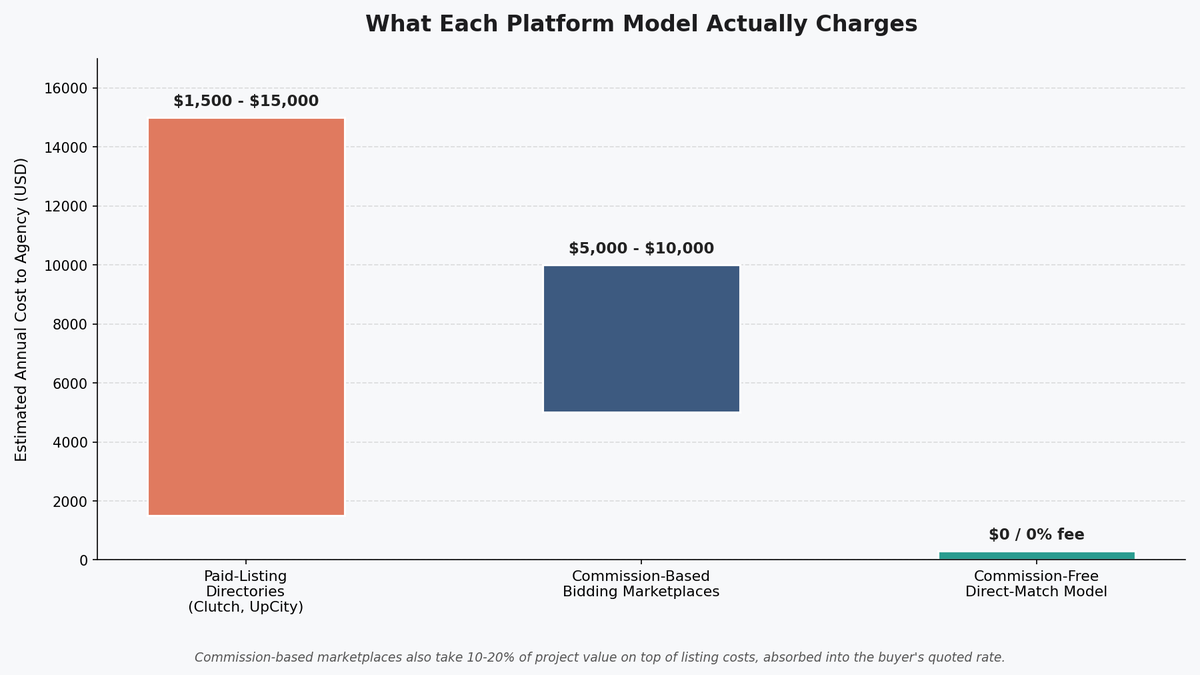
- What’s the fee structure? Commission-based platforms typically take 10-20% of project value; paid-listing directories charge the agency $499 to $15,000+ per year depending on category competitiveness; commission-free direct-connect models charge neither side to browse or post.
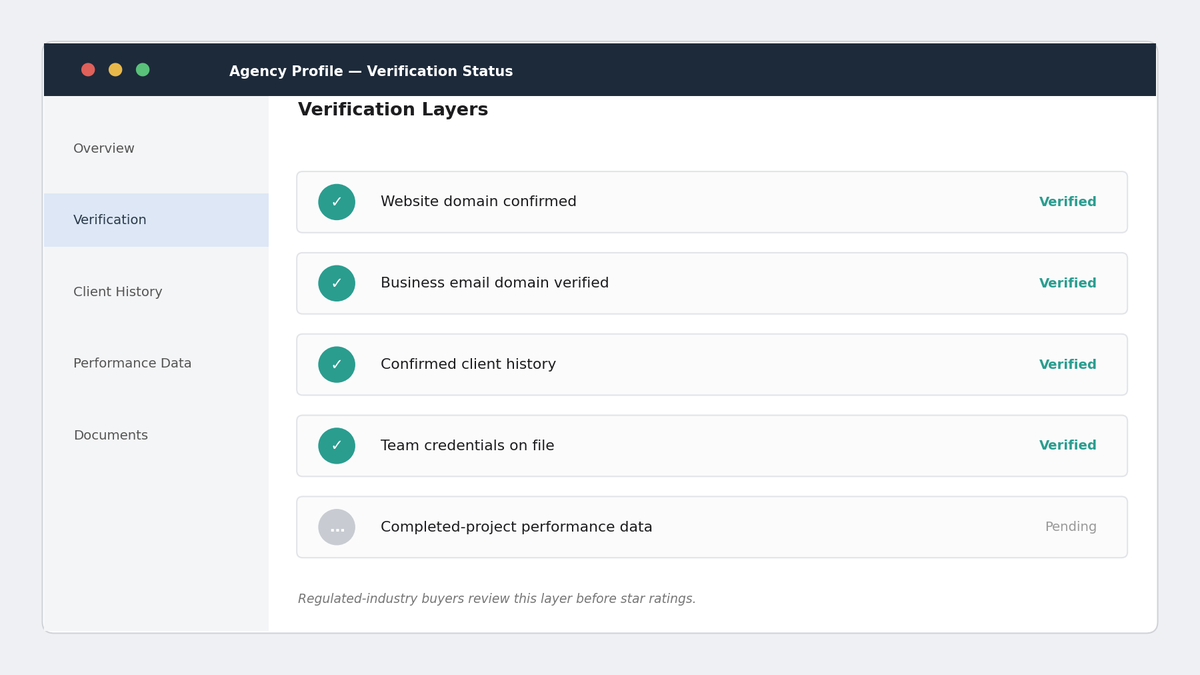
- How deep is the verification? Domain and email verification is baseline; the stronger platforms layer in team credentials, client history, and performance data before a profile goes live.
- Is it a bidding model or a matching model? Bidding platforms surface the loudest or highest-paying agency; matching models surface the best-fit agency based on stated criteria.
- Does it cover your geography and specialty? A platform strong in North American marketing agencies may have thin coverage for, say, a fintech-focused dev shop in Southeast Asia checking category depth before committing time to a profile.
Cost Implications: What Each Model Actually Charges
The fee structure differences here aren’t cosmetic; they change who absorbs the cost and when. Paid-listing directories bill the agency upfront, regardless of whether the listing produces a hire, which is why competitive categories on Clutch run $1,500-$1,800+ per year at minimum and climb past $2,000 per month for sponsored placement in crowded verticals like custom software development.
Commission-based bidding marketplaces flip the timing: the agency pays nothing upfront, but hands over 10-20% of the project value once hired. That fee doesn’t disappear; it gets folded into the quoted rate before the buyer ever sees a number, which means the buyer is effectively paying the platform’s commission without a line item showing it a trade-off worth understanding through how bidding marketplaces compare to direct-matching models before posting a project either way.
Commission-free, direct-match models charge neither side to browse, post, or connect, monetizing instead through optional premium features on the agency side. For a buyer comparing total cost of ownership on a project, that structural difference alone can be worth tens of thousands of dollars depending on project size, which is easier to see once you break down the true cost of hiring an IT company directly against what a commission or listing fee would have added on top.
Verification and Compliance Considerations
Verification depth varies more than most buyers assume. A basic listing typically confirms a working website and a business email domain enough to filter out spam profiles, but not enough to confirm delivery capability. Stronger platforms add a second layer: confirmed client history, team credentials, and in some cases performance data pulled from completed projects rather than self-reported claims.
For regulated industries fintech, healthcare, and government-adjacent work this layer matters more than star ratings. A vendor’s data-handling practices, past compliance certifications, and documented client references are the details procurement will ask for in a vendor-risk review, and a platform that surfaces them upfront saves a full round of due-diligence emails later.
Real-World Application: Two Vendor-Sourcing Scenarios
A Series A fintech startup needed a backend engineering partner for a compliance-heavy rebuild. The founder initially posted the project on a bidding-based directory and received 40+ generic proposals within 48 hours, almost none scoped to the compliance requirement. Switching to a direct-match model narrowed that to 4 pre-vetted agencies within budget and domain expertise, cutting the vendor-selection cycle from roughly 6 weeks to 9 days, a pattern that shows up consistently when founders vet fintech-focused software development companies instead of generic full-stack shops.
An enterprise procurement lead sourcing a UI/UX overhaul had budgeted for a 15% platform commission on top of the agency’s quoted rate standard on bid-heavy marketplaces. Moving the search to a commission-free model removed that markup entirely, redirecting roughly $18,000 of what would have been platform fees back into the actual project scope, the same margin most teams lose by skipping a structured process for hiring a UI/UX design company in the first place.
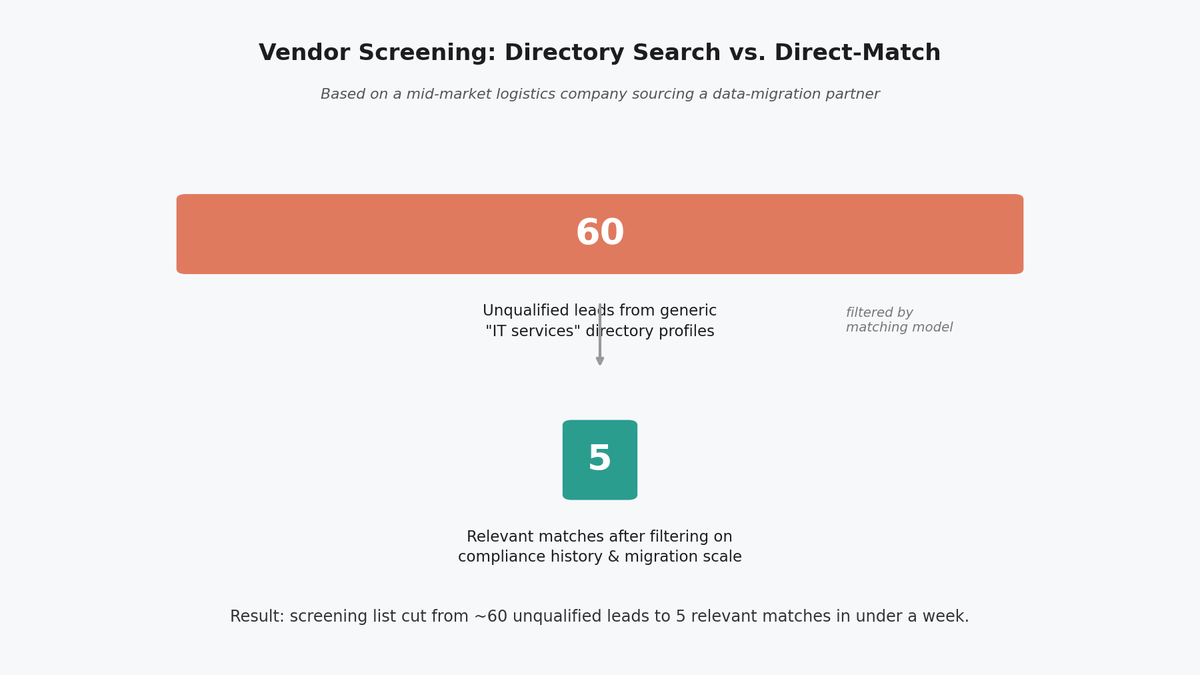
A mid-market logistics company needed a data migration partner with specific compliance experience, a category too narrow for most general-purpose directories to filter cleanly. Rather than manually screening dozens of generic “IT services” profiles, the team used a matching model that filtered candidates against stated compliance history and prior migration scale before any conversation started, reducing the initial screening list from roughly 60 unqualified leads to 5 relevant ones in under a week the kind of narrow, domain-specific fit that matters most in supply chain and logistics software development.
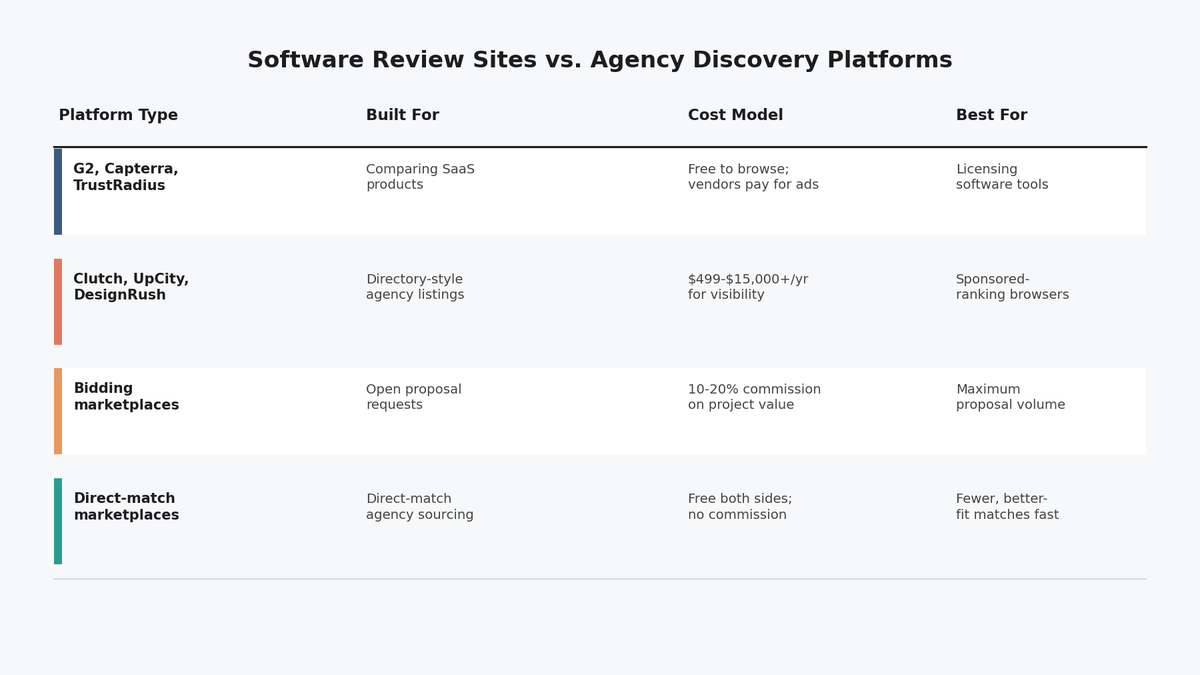
The table below isn’t meant to rank platforms against each other directly; a directory and a direct-match marketplace solve different problems, so a side-by-side score would be misleading. It’s meant to show which category actually matches your buying scenario before you spend time building a profile or posting a project on the wrong type of platform, which is also why it helps to compare software development quotes side by side once you’ve picked the right platform type.
Comparison: Software Review Sites vs. Agency Discovery Platforms
| Platform Type | Built For | Typical Cost Model | Best For |
| G2, Capterra, TrustRadius | Comparing SaaS products | Free to browse; vendors pay for ads/placement | Licensing software tools |
| Clutch, UpCity, DesignRush | Directory-style agency listings | Agency pays $499-$15,000+/year for visibility | Buyers who don’t mind sponsored rankings |
| Bidding marketplaces | Open proposal requests | 10-20% commission on project value | Buyers who want maximum proposal volume |
| Direct-match marketplaces | Direct-match agency sourcing | Free for both sides; no commission | Buyers who want fewer, better-fit matches fast |
What Most Teams Get Wrong
The most common mistake isn’t picking the wrong platform, it’s assuming review volume equals fit. An agency with 200 reviews on a directory isn’t necessarily a better match than one with 12; it may just have paid for a listing longer or serve a higher-volume, lower-complexity segment of the market, which is why selecting a partner on fit rather than review count tends to produce better outcomes than sorting by star rating alone.
The second mistake is treating b2b service review sites as neutral. Paid-listing directories rank sponsored profiles above organic ones by design; that’s the revenue model. Buyers who don’t know this treat position on the page as a proxy for quality, when it’s frequently a proxy for ad spend.
This isn’t a criticism of directories as a category sponsored ranking is a disclosed business model, not a deception. The mistake is entirely on the buyer’s side: skipping the fine print that explains how the rankings work, then treating page position as an independent quality signal it was never designed to be.
The third, and most expensive, mistake is not accounting for commission stacking on bidding platforms. A 15-20% platform cut gets quietly absorbed into the agency’s quoted rate, meaning the buyer pays it either way; it’s just invisible on the invoice. Reviewing a marketplace’s fee structure before posting a project matters as much as reviewing the agency itself, which is exactly the comparison laid out in outsourcing vs. hiring an agency directly.
Choosing the Right Path Forward
If you’re evaluating g2 alternatives because you’re licensing software, Capterra and TrustRadius are the closer substitutes. If you’re hiring an agency, which is the more common reason readers land here, the better comparison set is Clutch, UpCity, GoodFirms, and direct-match marketplaces that skip commissions and bidding altogether.
If you want to compare verified agencies without paying commissions or bidding blind, GetProjects has helped businesses connect with vetted technology partners across 50+ cities globally, with project posting that takes under two minutes and no cost to either side until a hire is actually made. Post a project
FAQ
What is a good alternative to G2 for hiring an agency?
Clutch, UpCity, GoodFirms, and commission-free matching marketplaces are the most commonly used g2 alternatives for services options. Each verifies agencies differently, so compare verification depth and fee structure, not just review counts, before committing to a shortlist.
Does G2 review agencies, or only software?
G2 is built around software product categories, not service providers. Some agencies maintain thin listings there, but the platform’s review structure, filters, and comparison tools are designed for SaaS buyers, not vendor vetting.
Are there free alternatives to G2 for finding agencies?
Yes. GoodFirms and GetProjects both offer free profiles for agencies and free project posting for buyers, with no commission charged on either side once a project is awarded.
How is Clutch different from G2?
Clutch focuses on IT, marketing, and business service providers with a paid-placement model, while G2 focuses on software product comparisons with a mix of organic and sponsored listings. Neither uses direct AI-based matching between buyer requirements and vendor capabilities.
What is the best site for finding IT outsourcing partners specifically?
Platforms built around verified profiles and direct matching rather than open bidding tend to produce better-scoped shortlists for IT outsourcing, since the buyer’s requirements are matched against vendor data points instead of attracting mass proposals.
Do agency marketplaces charge buyers to post a project?
It varies. Bidding platforms are typically free for buyers but built on agency-side commissions that flow into pricing. Directory platforms are free for buyers but paid for agencies. Commission-free marketplaces keep both sides free and monetize differently.
Is a higher review count always a sign of a better agency?
No. Review count often correlates with how long an agency has paid for listing visibility, not with delivery quality. Client history, verified performance data, and scope-specific fit are stronger signals than raw review volume.