Top TopDevelopers.co Alternatives to Find Development Companies in 2026
Roughly 9 out of 10 B2B buyers now research a vendor on at least one independent review site before ever booking a call. Yet most teams still shortlist agencies from a single directory, close the tab after three profiles, and hope the fourth or fifth listing down the page wasn’t the better fit. That gap between how buyers actually vet vendors and how narrowly most of them search is exactly where a wider set of topdevelopers alternatives earns its place in the process.
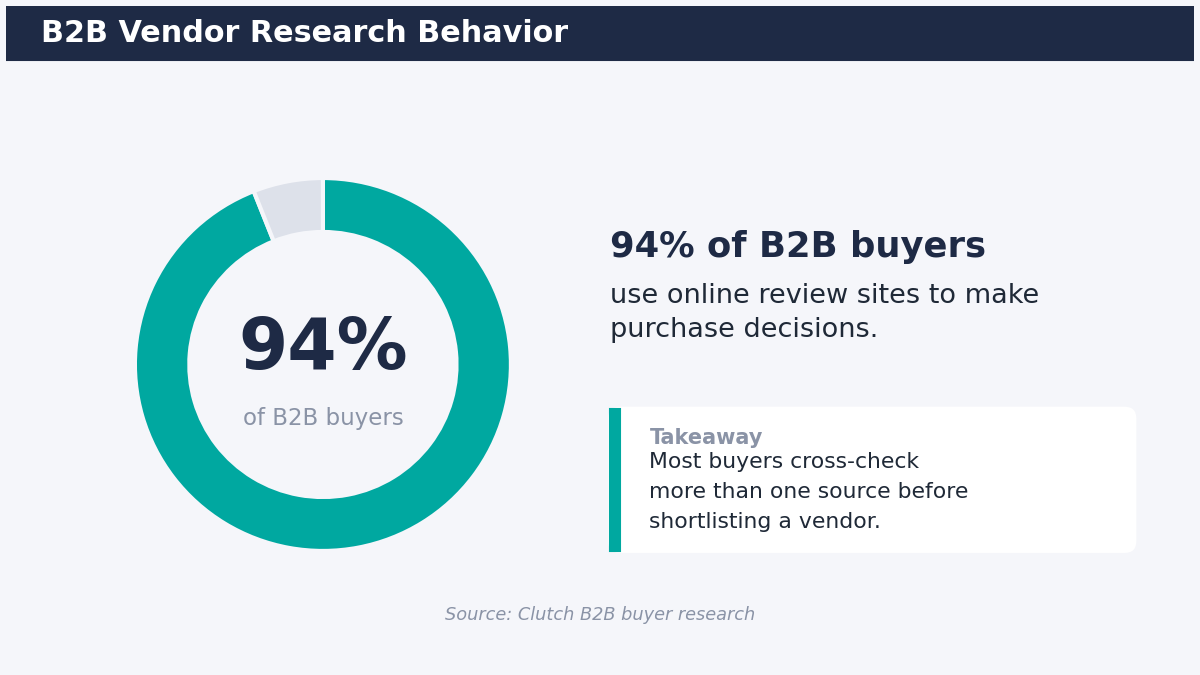
Clutch research shows that 94% of B2B buyers use online review sites to make purchase decisions, and the pattern holds just as strongly for software and app development hires. TopDevelopers.co is a solid entry point for that research but it’s still one lens on a fragmented market of listing sites, review platforms, and marketplaces that all rank agencies differently, verify them differently, and monetize differently. Relying on one source means missing agencies that simply chose not to list there, or paid to rank on a different one.
This guide breaks down eight credible topdevelopers competitors, what each one actually does well, where each falls short, and a repeatable framework for choosing between them based on your project, not just whichever site ranks first for your search.
What Are TopDevelopers Alternatives?
TopDevelopers alternatives are directories, review platforms, and marketplaces that help businesses discover, compare, and vet development companies outside of TopDevelopers.co’s own listings. They range from paid-placement directories to commission-based bidding marketplaces to verified, no-bid platforms each using a different model to rank and surface agencies.
The Core Problem With Relying on a Single Directory
Most procurement leads underestimate how much a single directory’s business model shapes what they see. A platform that earns revenue from paid listings has a structural incentive to surface agencies that bought placement, not necessarily the agencies best suited to a $40,000 mobile app build or a 6-month enterprise migration.
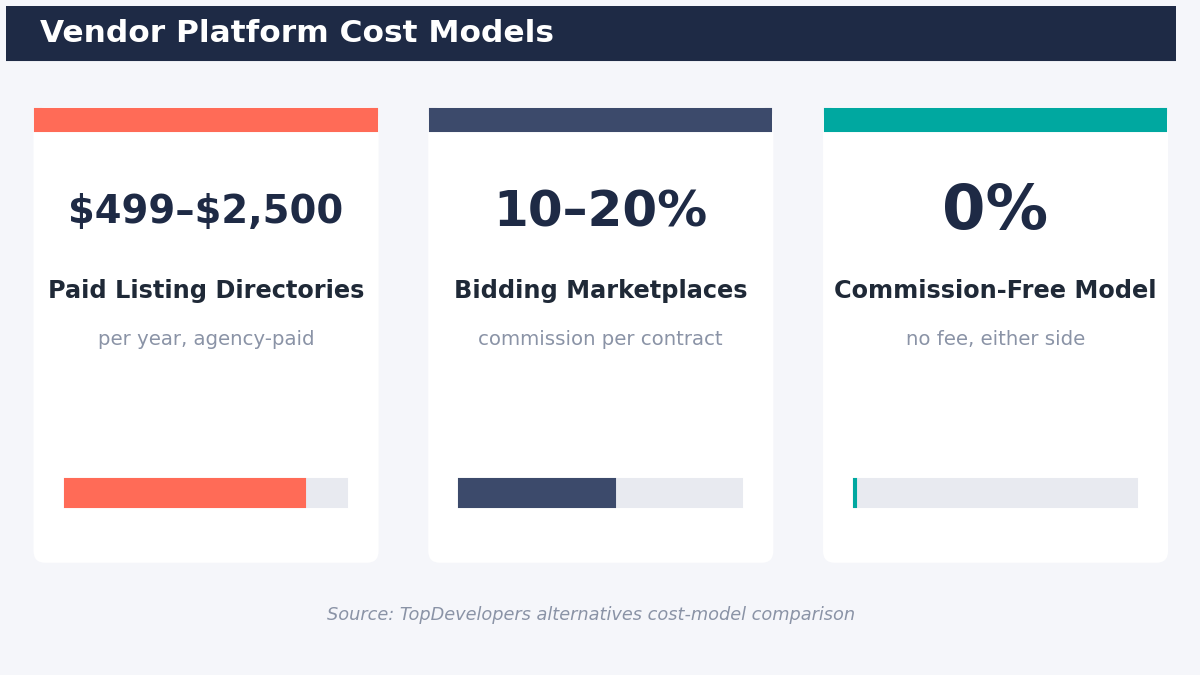
The numbers make the gap concrete. Paid-listing directories commonly charge agencies $499 to $2,500+ per year for featured placement, and bidding marketplaces typically take a 10% to 20% commission on the final contract value, a cut that either gets built into the agency’s quoted rate or eats into their margin on your project. Buyers rarely see that cost line item; they just see a ranked list that looks neutral. Understanding what it actually costs to hire an IT company directly makes this hidden markup much easier to spot before you sign anything.
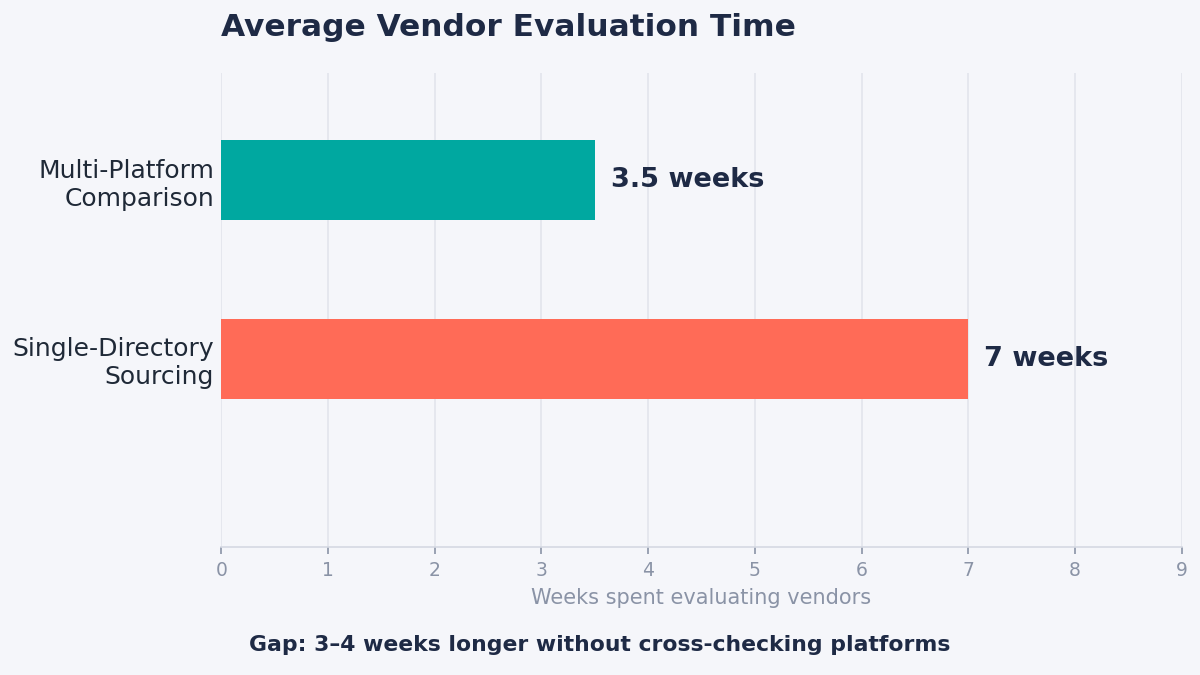
Timeline risk compounds the problem. Teams that source from only one directory report spending 3 to 4 weeks longer in vendor evaluation than teams that compare shortlists across two or three platforms, largely because the first list rarely surfaces the agency with the right domain expertise forcing a second search cycle later. Most teams underestimate this by 3–4x when they scope the initial hiring timeline. Tightening this window is entirely possible. Some buyers manage to shortlist a qualified IT agency in as little as 72 hours once they know which signals actually matter.
There’s also a mismatch problem that rarely shows up until scoping is already underway. A directory ranked by review volume alone will happily surface a 200-person agency with a strong marketing-services track record for a narrow, 3-person engineering sprint because volume and star rating don’t measure specialization. The buyer only discovers the mismatch during the first technical scoping call, after a week or two has already been spent on outreach and proposal review.
How to Evaluate Developer Directories and Marketplaces (Deep Dive)
Not all developer directories deserve equal trust. Before you shortlist a single agency, run the platform itself through a short evaluation process.
Step 1: Identify the Ranking Model
Ask whether placement is earned (reviews, verified project history, portfolio depth) or purchased (subscription tiers, featured badges, sponsored slots). Most platforms disclose this somewhere in their footer or “advertise with us” page if they don’t disclose it at all, treat that as a warning sign.
Step 2: Check the Verification Layer
A credible IT research platform verifies more than a company name. Look for confirmation of business domain ownership, team size, past client identity, and review authenticity not just a self-submitted profile form.
Step 3: Compare Cost Structure
Some platforms are free for buyers but charge agencies a commission on the deal (which agencies price into their rate). Others are free on both sides and monetize elsewhere (data insights, premium analytics, enterprise tools). Knowing which model you’re using tells you whether the price you’re quoted is the real price, a distinction that becomes obvious once you actually compare software development quotes side by side and start noticing which line items shift depending on the platform an agency came from.
Step 4: Cross-Reference at Least Two Sources
Because ranking algorithms differ, the same agency can appear in the top 5 on one platform and the top 40 on another. A five-minute cross-check against a second source catches agencies that a single algorithm buried.
Step 5: Weight Recency and Volume of Reviews
A profile with 40 reviews from 2021–2022 tells you less than one with 12 reviews from the last nine months. Prioritize recency alongside raw volume.
Step 6: Confirm Compliance and Data-Handling Fit Before Scoping
For regulated industries healthcare, fintech, or anything touching personal data check whether the platform’s verification layer confirms compliance history at all, or only business legitimacy. A directory that verifies domain ownership and team size is not the same as one that confirms an agency has actually shipped a SOC 2 or HIPAA-compliant build. Ask directly and request documentation before the first scoping call, not after a contract is signed. The HIPAA-compliant healthcare app requirements checklist is a useful reference point for exactly which documentation to ask for.
Here’s the process condensed into a repeatable checklist:
- Confirm how the platform ranks listings (earned vs. paid)
- Check what identity and history verification is actually performed
- Identify who pays the buyer, the agency, or both and how much
- Pull a shortlist from at least two platforms before comparing
- Filter for review recency, not just star rating
- Confirm compliance and data-handling history for regulated projects
- Request 2–3 reference calls directly with past clients
- Confirm the agency’s actual team availability before signing scope
Real-World Application: Two Vendor-Sourcing Scenarios
A Series B fintech startup needed a compliance-heavy mobile banking app rebuilt in 4 months. Sourcing only from a single paid-listing directory, their first shortlist skewed toward agencies that had simply paid for the “Fintech Development” category badge; none had shipped a PCI-DSS compliant app before. A second pass across a verified, no-bid marketplace surfaced a mid-size agency with three prior fintech builds the project shipped in 4.5 months instead of a projected 7.
A mid-market logistics company needed a warehouse-management platform overhaul and had budgeted for a 12% commission built into their bidding-marketplace quote. Switching to a commission-free, direct-connect model for the second phase of the project cut the effective vendor cost by roughly $18,000 on a $150,000 engagement, with no change in the agency’s day rate a pattern that shows up often enough in logistics app development projects that it’s worth budgeting for the commission variable upfront rather than discovering it mid-engagement.
Both scenarios point to the same underlying lesson: the platform’s business model shapes the shortlist before a single proposal is ever reviewed. Teams that factor cost structure into their sourcing decision not just review scores consistently end up negotiating from a stronger position.
Comparison: 8 Top TopDevelopers Alternatives
Each of these sites like topdevelopers takes a different approach to ranking, verifying, and monetizing agency listings. Some lean on decades of accumulated review volume; others focus on a narrow technical niche; a smaller group has rebuilt the model entirely around direct matching instead of ranked browsing. None of them is universally “best” ; the right pick depends on project size, industry, and how much weight you put on review depth versus verification rigor, which is why it’s worth reviewing the best platforms to find software development agencies as a broader baseline before narrowing in on any single directory below.
1. Clutch
Clutch is the largest B2B ratings platform for IT, marketing, and business services, built around verified client interviews rather than self-submitted reviews.
Pros: Deep review verification through analyst phone interviews; broad category coverage beyond development; strong brand recognition with enterprise buyers. Cons: Featured placement is paid, which can push budget-tier agencies above better-fit ones; interview-based reviews take longer to accumulate for newer agencies.
2. GoodFirms
GoodFirms combines client reviews with independent research scoring across quality, reliability, and ability to deliver.
Pros: Large volume of listed companies; transparent scoring methodology; strong coverage for software development, e-commerce, and mobile categories. Cons: Free listings are common but visibility skews toward paid tiers; review depth varies significantly across categories.
3. DesignRush
DesignRush focuses on design-forward agencies but has expanded into broader technology and development listings with an editorial ranking layer.
Pros: Strong for creative-and-development hybrid projects; editorial curation adds a layer beyond raw review counts; useful award and recognition badges. Cons: Less specialized for pure back-end or enterprise software development; ranking weight given to editorial picks over pure client feedback.
4. UpCity
UpCity uses a proprietary “Recommendability Score” that blends reviews, certifications, and confirmed business data into a single ranking.
Pros: Transparent, published scoring formula; strong for local and regional agency searches; useful confirmed-data badges for legitimacy checks. Cons: Smaller pool of pure software development listings compared to marketing-agency coverage; premium tiers still influence visibility.
5. AppFutura
AppFutura specializes almost exclusively in mobile app and software development companies, with a ranking algorithm tuned for that niche.
Pros: Sharp focus on mobile and app-specific buyers; less noise from unrelated service categories; solid filtering by technology stack and region. Cons: Smaller overall agency pool than generalist platforms; less useful for buyers seeking marketing or design-adjacent services alongside development.
6. FindBestFirms
FindBestFirms positions itself as a broad B2B agency directory with an emphasis on separating paid promotion from organic ranking.
Pros: Clear separation between sponsored and organic placement; wide category range; frequent “best of” roundups useful for quick shortlist-building. Cons: Review volume per individual agency can be thinner than more established platforms; newer brand recognition among enterprise buyers.
7. SelectedFirms
SelectedFirms focuses on software development, IT services, and digital marketing agencies with a research-driven ranking approach.
Pros: Detailed company profiles with case study depth; decent filtering by budget range and project size; niche categories for emerging technology (AI, blockchain). Cons: Smaller review base than Clutch or GoodFirms; less brand familiarity outside IT-specific searches.
8. GetProjects
This platform takes a different structural approach: a commission-free, no-bid marketplace that connects businesses directly with verified IT companies, using AI-driven matching across more than 50 data points budget, expertise, client history, and performance instead of a paid-ranking model. Rather than browsing hundreds of self-submitted listings, buyers post project requirements and receive a matched shortlist of pre-verified agencies across more than 50 cities globally. You can see exactly how the matching process works end to end before deciding whether it fits your project.
Pros: Free project posting for clients with no listing fees; free agency listings with no commission cut on the contract; layered verification (website, email domain, reviews, team details) before any profile goes live; direct-connect model that skips bidding wars and manual back-and-forth; project posting in under two minutes.
Cons: Newer platform with a smaller historical review archive than decade-old directories; best suited to buyers who want a matched shortlist rather than browsing an open-ended listing pool.
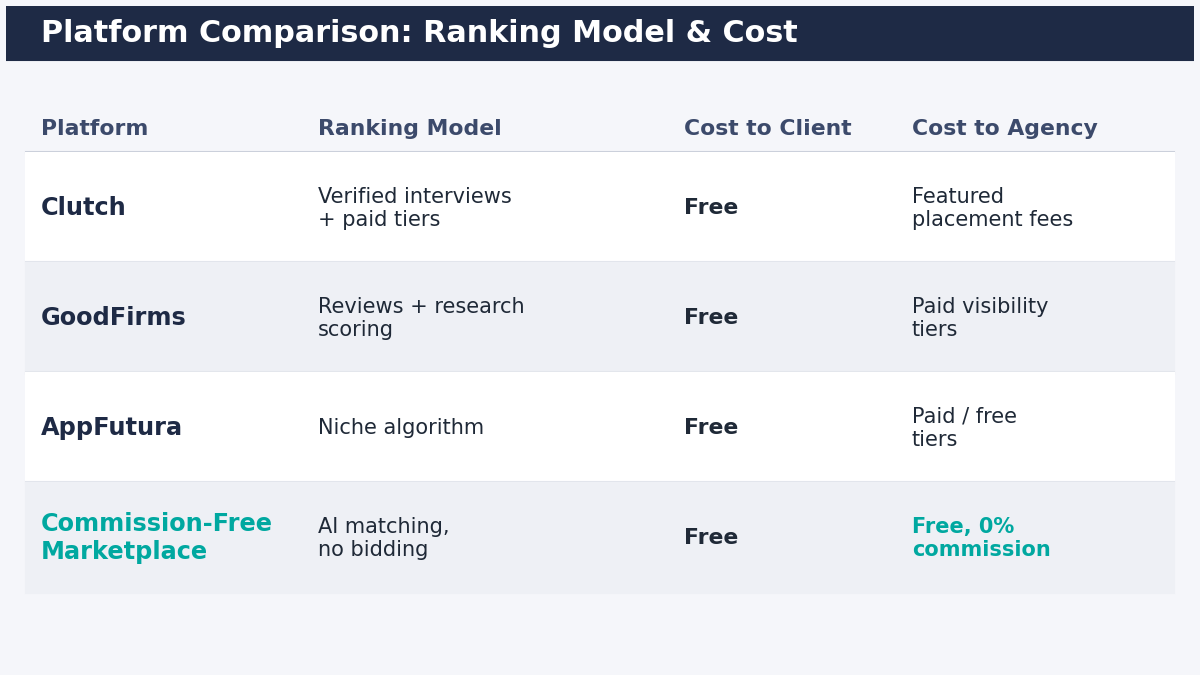
| Platform | Ranking Model | Cost to Client | Cost to Agency | Best For |
| Clutch | Verified interviews + paid tiers | Free | Featured placement fees | Enterprise brand research |
| GoodFirms | Reviews + research scoring | Free | Paid visibility tiers | Broad category comparison |
| AppFutura | Niche algorithm | Free | Paid/free tiers | Mobile-specific buyers |
| Commission-free marketplace (e.g., option 8 above) | AI matching, no bidding | Free | Free, 0% commission | Direct, commission-free hiring |
What Most Teams Get Wrong
Most procurement teams treat directory rank as a proxy for quality it isn’t. Rank frequently reflects marketing spend, not delivery track record, and the agencies willing to pay the most for placement aren’t always the ones with the right domain expertise for a specialized build. Knowing the red flags to watch for in a software development company is a far more reliable filter than trusting where an agency happens to sit on a ranked list.
The second mistake is stopping the vetting process at the review score. A 4.8-star rating tells you almost nothing about whether an agency has shipped a HIPAA-compliant health app or scaled a Shopify Plus storefront through a Black Friday traffic spike. Star ratings measure satisfaction, not capability match and the two are only loosely correlated.
The third, quieter mistake: buyers rarely ask who’s paying for the platform they’re using. A commission-based bidding marketplace has a financial incentive to keep bidding wars competitive (more bids, more commission), which can push agencies to underquote scope just to win the deal, a pattern that shows up later as change orders and scope creep.
A fourth pattern worth naming: teams often treat the first shortlist as final, closing the search the moment three plausible-looking agencies reply. In practice, the strongest-fit agency for a specialized build, say, a healthcare data platform requiring HL7 integration experience, often isn’t the fastest to respond. Agencies with deep, specific expertise tend to be more selective about which inbound inquiries they prioritize, which means the quickest reply isn’t always the best signal. A well-structured software development RFP tends to surface exactly these selective, higher-expertise agencies instead of just the fastest responders.
Choosing the Right Platform for Your Next Hire
The right topdevelopers alternatives depends less on which platform has the biggest agency pool and more on how that platform makes money, verifies its listings, and whether its ranking model rewards fit or spend. Cross-checking two or three sources before you shortlist costs a few extra minutes and consistently surfaces better-matched partners than trusting a single ranked list.
If you’re evaluating vendor-sourcing platforms and want to compare verified agencies without paying commission or bidding blind, GetProjects connects businesses directly with vetted IT partners across more than 50 cities, with project posting that takes under two minutes. Post a project on GetProjects to see matched agencies without a listing fee.
Frequently Asked Questions
Is TopDevelopers.co free to use for businesses looking to hire?
Yes, browsing listings and contacting agencies through TopDevelopers.co is free for buyers. Like most directories in this space, the platform generates revenue from agencies through paid placement and premium listing tiers rather than charging the businesses searching for a vendor.
What is the most accurate alternative to Clutch for software development specifically?
AppFutura and SelectedFirms are the closest niche alternatives, since both concentrate specifically on software and mobile app development rather than the broader marketing-and-IT mix Clutch covers. Buyers who also want a commission-free, direct-connect model instead of a review-ranked list have that option too; it’s worth comparing alongside the two niche directories above.
How do I verify a development agency before hiring, beyond checking its directory profile?
Confirm the agency’s business domain matches their claimed website, request 2–3 direct reference calls with past clients, check review recency (last 6–9 months), and ask for a sample of comparable past project scope documents before signing.
Do B2B directories and marketplaces charge commission on the project?
It depends on the platform. Bidding-style marketplaces commonly charge agencies 10–20% commission on the contract value, which usually gets priced into the buyer’s quote indirectly. Paid-listing directories charge agencies an upfront subscription fee instead. No-bid, commission-free models charge neither side a transaction fee.
What’s the real difference between a directory and a marketplace?
A directory is primarily a searchable list you browse and filter yourself. A marketplace typically adds active matching recommending specific agencies based on your project details and often facilitates the connection or contract process directly, rather than leaving buyers to cold-outreach every listing.
Should I use more than one platform when sourcing a development partner?
Yes. Cross-referencing at least two platforms takes minutes and consistently surfaces agencies that one platform’s ranking algorithm buried, particularly for specialized or emerging technology categories.
How long should vendor research realistically take before I contact an agency?
For a mid-sized project, budget roughly one week for initial research: reviewing 2–3 platforms, shortlisting 5–8 agencies, and checking review recency and verification depth. Rushing this stage is the most common cause of the 3–4 week delays that show up later in scoping and re-evaluation.