
Best Blockchain Development Companies in 2026 What Separates Genuine Web3 Developers From Marketing Noise
Blockchain development has a signal-to-noise problem more severe than almost any other category in software development. The combination of technical complexity, rapidly evolving tooling, and significant financial stakes has produced a landscape where the gap between the best and worst agencies is enormous and where the consequences of hiring the wrong one are uniquely severe. A smart contract with a vulnerability is not a software bug. It is an exploitable vulnerability that can drain a project’s treasury in minutes. Multiple $100M+ DeFi exploits in 2023 and 2024 traced back to smart contract code quality.
That’s why choosing the best blockchain development companies requires more than reviewing portfolios. It means evaluating smart contract expertise, security practices, audit experience, and proven Web3 delivery capabilities.
According to Grand View Research Blockchain Technology Market Report, the global blockchain technology market is projected to reach $87.7 billion in 2026, driven by growing enterprise adoption, DeFi innovation, and Web3 development. As demand grows, distinguishing genuine blockchain specialists from marketing-driven agencies becomes increasingly important.
The global blockchain development services market is valued at $14.2 billion in 2026. At the $5K to $30K budget level, the most common builds are: smart contract development for token launches or simple DeFi protocols, NFT marketplace front-ends, DApp (decentralised application) MVPs, Web3 wallet integration for existing applications, and blockchain-integrated business applications. This guide covers how to find an agency that can deliver these correctly.
The Blockchain Capability Spectrum What Agencies Actually Offer
Like AI development, the term “blockchain development” covers a capability spectrum so wide that two agencies describing themselves identically may be offering completely different services.
The blockchain capability levels:
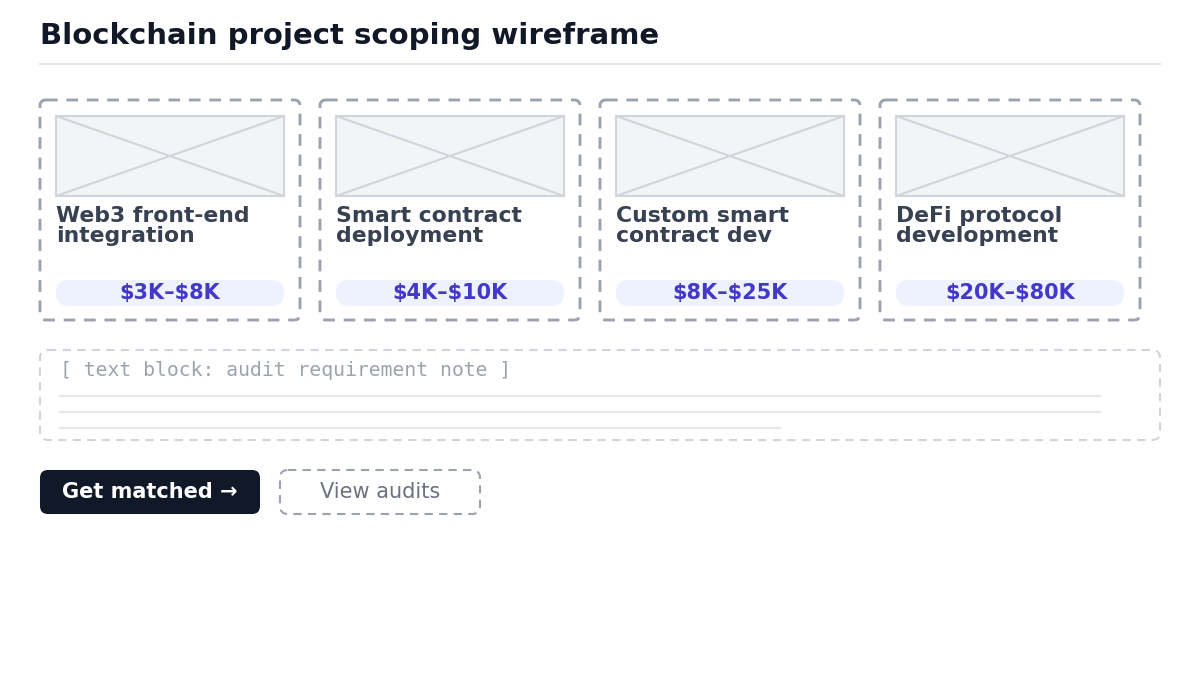
| Level | What It Involves | Who Can Do It | Budget Range |
| Web3 front-end integration | Connecting existing web app to wallets (MetaMask, WalletConnect), reading blockchain data | Most competent web developers | $3K–$8K |
| Smart contract deployment | Deploying existing/template contracts (ERC-20, ERC-721) with minimal customisation | Developers with basic Solidity knowledge | $4K–$10K |
| Custom smart contract development | Writing custom business logic in Solidity or Rust token mechanics, staking, governance | Solidity developers with 2+ years production experience | $8K–$25K |
| DeFi protocol development | Automated market makers, lending protocols, yield strategies | Senior DeFi engineers + security review | $20K–$80K |
| Layer 1/Layer 2 infrastructure | Custom blockchain, rollup development | Elite blockchain infrastructure teams | $50K+ |
| Security audit | Reviewing smart contract code for vulnerabilities | Specialised security firms (Trail of Bits, OpenZeppelin, Hacken) | $5K–$30K |
For the $5K to $30K buyer, the realistic deliverables are front-end integration, template contract deployment, custom smart contracts for specific use cases, and DApp MVPs the same scoping discipline that applies to any early-stage cryptocurrency exchange app build, where cost tiers are shaped by feature complexity rather than headline hype. Full DeFi protocol development and infrastructure work requires budgets above this range.
The Smart Contract Security Problem Why This Category Requires Extra Caution
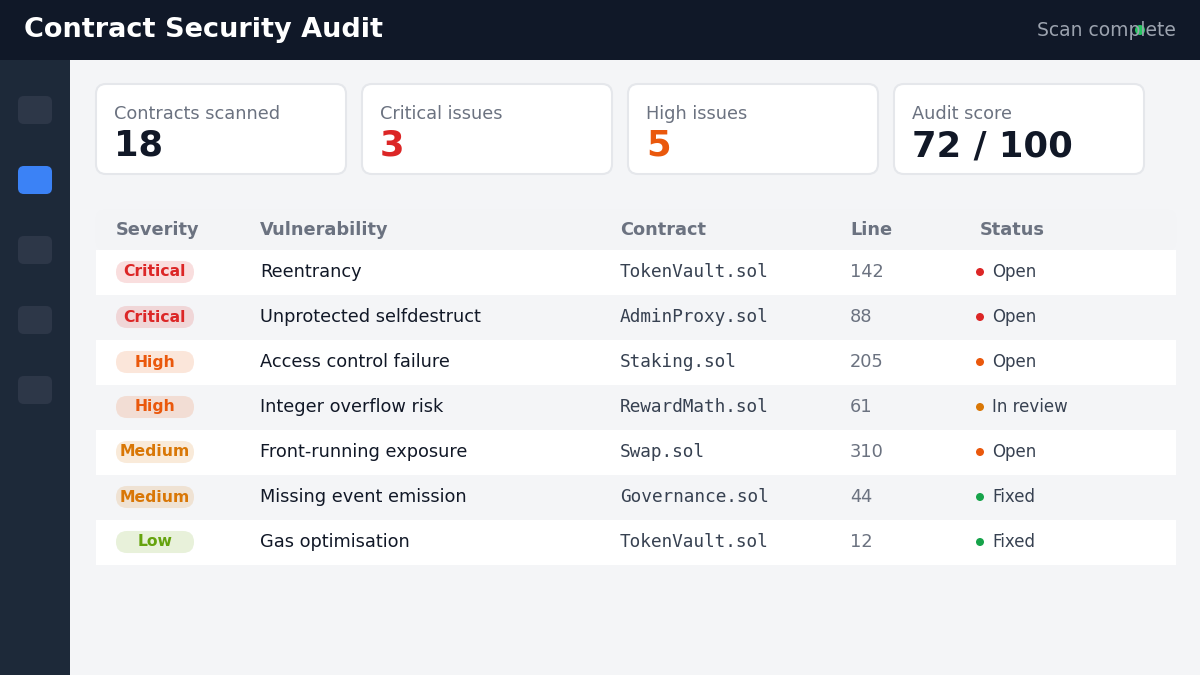
Smart contracts are immutable. Once deployed to a blockchain mainnet, a contract cannot be patched like a web application. If there is a vulnerability in your smart contract, fixing it requires deploying a new contract and migrating state or accepting the vulnerability. This immutability makes pre-deployment security review non-negotiable for any contract handling real value, and it’s exactly the kind of risk that separates a solid blockchain partner from one showing the red flags worth screening out before you sign a contract.
The most common smart contract vulnerabilities:
| Vulnerability | What It Allows | Famous Example |
| Reentrancy | Attacker recursively calls contract before state updates | The DAO hack $60M lost in 2016 |
| Integer overflow/underflow | Arithmetic wraps around creating unexpected values | Multiple ERC-20 token exploits |
| Access control failures | Unauthorised users call privileged functions | Parity wallet freeze $150M locked permanently |
| Flash loan attacks | Attacker borrows and repays in one transaction to manipulate price oracles | Multiple DeFi protocol exploits |
| Front-running | Miners/validators order transactions to extract value | Ubiquitous in DeFi |
| Unprotected selfdestruct | Attacker destroys contract, sending all ETH to their address | Parity multisig hack $31M stolen |
The smart contract security standard:
For any smart contract handling real value any production deployment that users will deposit tokens into a security audit by a recognised firm is required. The cost of an audit ($5,000 to $30,000 depending on complexity) is not optional overhead; it is the minimum standard for responsible deployment. An agency that proposes deploying a value-holding smart contract without an audit is either naive about security or proposing a project below the budget required to do it responsibly.
Common Blockchain Project Types at $5K–$30K
What your budget realistically builds:
| Project Type | What It Is | India Cost | Eastern Europe Cost | Timeline |
| ERC-20 token launch | Standard fungible token with custom tokenomics, simple staking | $5K–$10K | $10K–$18K | 4–8 weeks |
| NFT collection (ERC-721/1155) | Custom NFT contract with minting, metadata storage (IPFS), basic mint site | $6K–$12K | $12K–$22K | 6–10 weeks |
| NFT marketplace front-end | Browse, buy, sell interface on top of existing marketplace contract (OpenSea Seaport) | $8K–$16K | $16K–$30K | 10–16 weeks |
| DApp MVP | Simple smart contract + React front-end with wallet connection | $8K–$15K | $16K–$28K | 10–16 weeks |
| Token vesting/distribution | Smart contract for team token vesting, investor distribution, cliff and linear vesting | $5K–$10K | $10K–$18K | 4–8 weeks |
| Web3 wallet integration | Adding MetaMask/WalletConnect to existing web application, reading user balances, signing messages | $4K–$8K | $8K–$15K | 4–8 weeks |
| Blockchain certificate/credential system | On-chain credential issuance, verification, soul-bound token | $8K–$15K | $16K–$28K | 10–14 weeks |
How to Evaluate a Blockchain Development Agency
The portfolio signals that matter:
Deployed contracts on mainnets Etherscan or equivalent explorer links to contracts they have deployed on real networks handling real value. Not testnet contracts, not “we can build this” deployed, verifiable, on-chain evidence of production work.
Audit history: has their code been audited by a recognised security firm? An agency whose contracts have been audited by Trail of Bits, OpenZeppelin, Hacken, or ConsenSys Diligence has passed a significant quality bar.
GitHub has open-source code they have written that the developer community can review. Blockchain developers who contribute to open-source projects are typically more current with the ecosystem than those who only do private client work. These three checks mirror the same due-diligence process worth running on any technical vendor before you commit budget on-chain proof simply replacing the app-store listing or client references as the trust signal.
The technical questions that reveal genuine expertise:
Ask them to explain the reentrancy vulnerability and how they protect against it in their smart contract code. Correct answer: checks-effects-interactions pattern, reentrancy guards (OpenZeppelin ReentrancyGuard), and no external calls before state updates. An agency that cannot explain this clearly has not thought seriously about smart contract security.
Ask what network they recommend for your project and why. A thoughtful answer considers: transaction costs (Ethereum mainnet vs Polygon vs Arbitrum vs Base), security (more decentralised = more secure = usually more expensive), ecosystem compatibility, and user experience. An agency that reflexively says “Ethereum” for every project without considering alternatives has not kept up with the layer-2 ecosystem that has matured significantly since 2022.
Ask how they handle upgradability, do they use proxy patterns, and what are the trade-offs? Proxy patterns allow “upgrading” a smart contract by pointing to a new implementation while preserving the stored state. They introduce complexity and centralisation risk. A thoughtful developer can explain the trade-offs and recommend the right approach for your specific project. Questions like these belong in the same document as your technical requirements see how to structure a software development RFP so vendors are answering to a written brief, not improvising on a call.
The Network and Gas Cost Reality
Gas fees and the cost of executing transactions on a blockchain network are a user experience and economic factor that every blockchain application must account for.
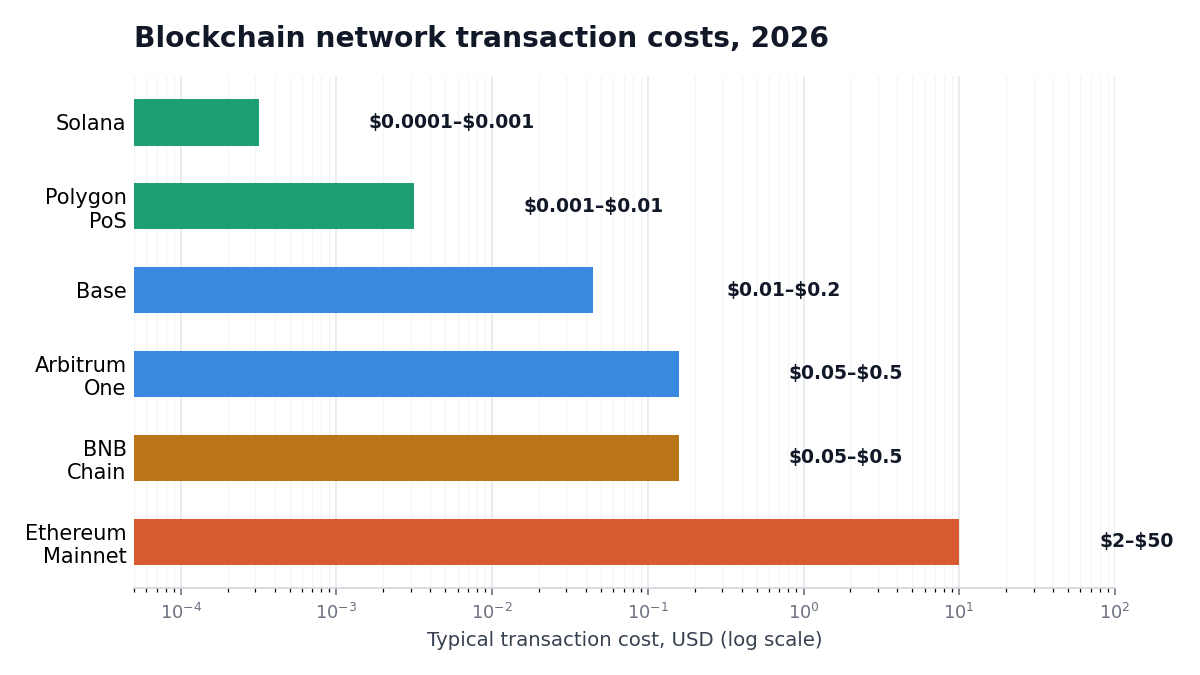
Network comparison for typical DApp use cases in 2026:
| Network | Transaction Cost | Security | Ecosystem | Best For |
| Ethereum Mainnet | $2–$50 per transaction | Highest | Largest | High-value DeFi, NFTs targeting serious collectors |
| Polygon PoS | $0.001–$0.01 | Good | Large | Gaming, NFTs for mass market, high-frequency interactions |
| Arbitrum One | $0.05–$0.50 | High (Ethereum L2) | Large and growing | DeFi, consumer applications needing lower fees than mainnet |
| Base | $0.01–$0.20 | High (Coinbase L2) | Growing rapidly | Consumer crypto applications, Coinbase user base |
| Solana | $0.0001–$0.001 | Good | Large | High-frequency trading, gaming, mass-market NFTs |
| BNB Chain | $0.05–$0.50 | Medium | Large | Asian market DeFi, BSC ecosystem |
For most $5K to $30K blockchain projects targeting mainstream users, Polygon, Arbitrum, or Base are better choices than Ethereum mainnet they provide Ethereum-compatible security at costs that make the user experience viable for non-crypto-native users who would be unwilling to pay $20 to complete a transaction. This is the same trade-off worth weighing against your overall scope when choosing an MVP development partner; the cheapest technical choice only pays off if it doesn’t compromise the product experience you’re validating.
Frequently Asked Questions
What is a smart contract audit and is it required for my project?
A smart contract audit is a systematic security review of your smart contract code by specialised security engineers who look for vulnerabilities reentrancy, access control failures, integer overflow, logic errors, and other attack vectors. For any smart contract that holds or handles user funds, any DeFi protocol, any token with value, any NFT contract where users spend ETH to mint a security audit is not optional. It is the minimum standard for responsible mainnet deployment. The cost of an audit ($5,000 to $30,000 depending on contract complexity) is always less than the cost of a successful exploit. For informational or non-value-holding contracts (on-chain credentials, voting systems with no financial component), a full audit is less critical but a code review by a senior Solidity developer is still recommended.
What blockchain should I build on Ethereum, Polygon, or Solana?
The right network depends on your specific use case, target audience, and transaction frequency. Ethereum mainnet is the right choice when: security is paramount, you are building DeFi with significant value at stake, and your users are experienced crypto users comfortable with higher gas fees. Polygon is the right choice when: you want Ethereum compatibility but lower transaction costs, your application has frequent user interactions, and you want to target users who are less comfortable with high gas fees. Solana is the right choice when: transaction speed and very low cost are critical (gaming, high-frequency trading), and you are willing to work in Rust rather than Solidity. For most $5K to $30K projects targeting mainstream users, Polygon, Arbitrum, or Base provide the best balance of security, cost, and user experience.
Do I need a token for my blockchain application?
Most blockchain applications do not need a token. Adding a token to a project that does not have a fundamental reason for one typically creates regulatory complexity (tokens may be securities), community management overhead, and speculative dynamics that distract from product development. The questions to ask before adding a token: does the token create genuine utility that the product cannot provide without it? Is the token the mechanism by which value flows within the ecosystem in a way that a traditional currency cannot replicate? If the honest answers are no, the application can be built as a blockchain application without issuing a token using existing ETH or stablecoins for any payment or incentive mechanics.