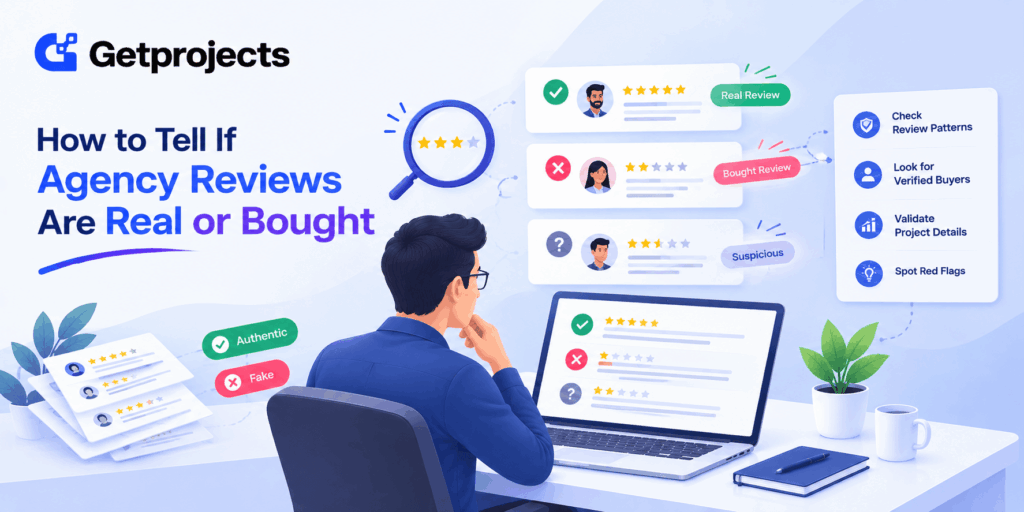
How to Tell If Agency Reviews Are Real or Bought
Between 10% and 30% of reviews on major B2B software platforms including sites agencies use to build credibility are now estimated to be AI-generated, according to an analysis of 245,000 reviews across Capterra, G2, and TrustRadius. That number was close to zero before 2023. If you’re reading agency reviews the same way you did three years ago, you’re already behind.
This matters more in agency hiring than almost anywhere else in B2B. A software review is one data point among dozens. An agency review is often the only independent signal a buyer has before signing a contract worth $15,000 to $150,000. When that signal can be manufactured, the entire vetting process breaks down.
An Originality.ai study analyzing 245,000 B2B software reviews across Capterra, G2, and TrustRadius found that 10% to 30% of reviews published since the launch of ChatGPT show signs of AI generation, depending on the platform.
This isn’t a fringe problem affecting obscure directories. It’s happening on the platforms procurement teams treat as the gold standard. How to verify agency reviews are real has quietly become a required skill for anyone hiring an outsourced dev shop, design agency, or IT partner, not an optional extra step.
The good news: fake and bought reviews leave patterns. Once you know what to look for, spotting them takes minutes, not hours.
What Is Agency Review Verification?
Agency review verification is the process of confirming that a published review reflects a real client relationship, a real project outcome, and a reviewer who has no financial incentive to inflate their rating. It combines platform-level checks (identity confirmation, employment verification) with buyer-side pattern analysis (timing, language, reviewer history) to separate authentic feedback from manufactured praise.
The Core Problem: Buyers Are Trusting a Broken Signal
Most procurement teams still treat a 4.8-star rating with 40 reviews as a green light. That instinct made sense five years ago. It doesn’t hold up anymore, for three structural reasons.
First, review-buying has become a paid reviews B2B directories business model in its own right. Agencies on commission-based marketplaces routinely spend $2,000 to $8,000 a year on review-generation services, because a listing’s review count directly affects its ranking and lead volume. The incentive to inflate is baked into the platform economics.
Second, generative AI has collapsed the cost of producing convincing text. Writing 20 fake reviews used to take a human contractor a full day. Now it takes a script and a prompt template roughly 15 minutes.
Third, most directories still rank agencies primarily by review volume and star average, not verification depth. That means the agencies most willing to manufacture reviews often outrank the ones that didn’t bother a bad-actor advantage most buyers never notice until after the contract is signed. Inflated reviews are rarely the only issue with a listing, so it’s worth checking for other vendor warning signs before you shortlist based on ratings alone.
Teams that skip review authenticity checks typically discover the mismatch 3 to 4 weeks into a project, when the agency’s actual delivery quality doesn’t match the profile that sold them. By then, the sunk cost deposit paid, timeline started, internal stakeholders briefed and made switching vendors expensive.
How to Verify Agency Reviews Are Real: A Practical Framework
This is the part most buyers skip, and it’s the highest-leverage 20 minutes in the entire vendor-selection process. Fake agency reviews spotting comes down to pattern recognition across four dimensions: timing, language, reviewer profile, and platform verification method.
1. Review Clustering by Date
Authentic reviews accumulate unevenly, tracking real project completions. A cluster of 8 to 12 five-star reviews posted within a 5- to 10-day window is the single most reliable red flag in agency vetting. It almost always indicates a coordinated review-generation push, either self-run or outsourced to a reputation agency.
Check the date distribution, not just the average rating. An agency with 40 reviews spread evenly over 3 years reads very differently from one with 35 reviews posted in the last 60 days. This is the same instinct that matters when running a reference check on a software vendor: a clustered reference list is as telling as a clustered review list.
2. Identical or Near-Identical Phrasing
Fake review campaigns, whether human-written or AI-generated, tend to reuse structural templates. Watch for:
- The same three adjectives (“professional,” “responsive,” “on time”) appearing across multiple unrelated reviewers
- Reviews that open with the same sentence structure (“We hired [Agency] to build…”)
- Paragraph lengths that are suspiciously uniform (AI-generated batches often land within 5–10 words of each other)
One or two similar reviews is coincidence. Five or more sharing sentence-level structure is a review pattern red flag worth escalating alongside verifying the agency’s portfolio claims independently, since fabricated reviews and inflated portfolios tend to travel together.
3. Reviewer Profiles With Exactly One Review
Genuine B2B buyers who leave a review often have some digital footprint: other reviews, a completed LinkedIn profile, a company that can be independently verified. A reviewer account created the same week as the review, with no other activity and a generic or unverifiable job title, is a strong indicator of a paid or fabricated review.
Cross-reference the reviewer’s stated company against LinkedIn or the company’s own website in under 60 seconds. If the company doesn’t exist, doesn’t do the described work, or the reviewer’s title doesn’t match anyone on the team page, treat the review as unverified. If you want a shortcut, the same direct questions worth asking a development company will usually surface who their real clients are.
4. All Five-Star Ratings With No Specific Detail
Real client feedback, even overwhelmingly positive feedback, usually mentions at least one specific friction point: a delayed milestone, a scope adjustment, a communication gap that got resolved. Reviews that are uniformly glowing with zero texture, no project name, no timeline, no named deliverable read as manufactured, even when the star rating is technically real.
Verified reviewer profiles on higher-integrity platforms typically require the reviewer to confirm employment (via corporate email or LinkedIn) and disclose whether the review was incentivized. Treat platforms that skip this step as lower-trust by default, and run it alongside a broader mobile or software agency vetting checklist rather than as a standalone check.
How Major Platforms Actually Verify Reviews
Verification depth varies significantly by platform, and most buyers assume more rigor exists than actually does.
- Clutch requires reviewers to complete a phone or video interview with a Clutch analyst before a review is published, the highest verification bar among major B2B directories, though it still can’t fully eliminate coached or rehearsed answers. If Clutch’s format or pricing doesn’t fit your search, it’s worth comparing it against other Clutch alternatives built around different verification models.
- G2 verifies reviewers through LinkedIn authentication or a corporate email address, and flags (but doesn’t always remove) reviews from accounts with no other platform activity. Buyers frustrated with G2’s review-gated discovery model sometimes look at G2 alternatives for agencies that verify the agency itself rather than relying on volume of reviews.
- TrustRadius publicly discloses that a majority of its reviews are incentivized, and runs a dedicated fraud-detection team, but incentivized does not mean fake the platform argues, with supporting research, that incentives reduce extreme-response bias rather than manufacture false praise.
- Capterra, owned by Gartner, applies automated screening but has faced criticism for lighter manual review compared to Clutch’s interview model. Teams that have been burned by pay-to-rank listings there often compare it against other Capterra alternatives with different vetting depth.
So are Clutch reviews verified? More rigorously than most alternatives, thanks to the analyst-interview requirement, but “verified” here means “confirmed to be a real person describing a real engagement,” not “confirmed to be unbiased.” No platform fully solves that second problem.
Case Studies: What This Looks Like in Practice
A mid-market fintech company shortlisted three agencies from a bidding marketplace, all showing 4.7+ ratings. Running the four-point check above on the top pick revealed 14 of its 22 reviews were posted within an 8-day span, and 9 reviewer profiles had no other platform activity. The buyer dropped that agency and selected an alternative with fewer but more evenly-distributed reviews, using a version of this 72-hour agency shortlisting process; the resulting project shipped on its original 14-week timeline with zero scope disputes.
A Series B startup evaluating outsourced QA vendors found one agency’s reviews on a paid directory used near-identical phrasing across six separate reviews (“exceeded expectations,” “true partner,” “highly recommend without hesitation”). A quick LinkedIn cross-check showed two of the six reviewer accounts belonged to people with no professional connection to the companies named in their reviews. The startup flagged the listing to the platform and shifted its search to directories with mandatory identity verification, running the same discipline it used when it began comparing software development quotes side by side.
Comparison: Review Trust by Platform Model
Review integrity is really just one symptom of a platform’s broader incentive structure, which is why it’s worth understanding how agency marketplaces compare to direct-matching models before trusting any single trust signal in isolation.
| Platform Type | Review Verification | Cost to Agency | Primary Risk to Buyer |
| Commission-based bidding marketplace | Automated, minimal manual review | 10–20% of project value | Review volume rewarded over authenticity |
| Paid-listing directory ($499+/year) | Varies; often self-reported | Flat annual fee | Pay-to-rank incentivizes review inflation |
| Interview-based directory (e.g., Clutch) | Analyst phone/video interview | Free to low-cost | Slower review accumulation, smaller sample size |
| Verified-profile, no-bid marketplace | Multi-point check before listing goes live (domain, email, team, reviews) | Free, no commission | Newer model; fewer total reviews per agency |
No model is immune to manipulation. The meaningful difference is how many independent checks stand between an agency and a published five-star review.
What Most Teams Get Wrong
Most buyers treat the star rating as the verification step. It isn’t. A 4.9-star average tells you almost nothing about whether the underlying reviews are real; it only tells you if the agency (or someone paid by the agency) successfully got positive numbers published.
The teams that get burned almost always skip one specific step: checking reviewer profiles individually rather than reading the aggregate score. It takes under five minutes per agency and catches the overwhelming majority of manufactured review campaigns. Buyers skip it because it feels like busywork until the agency they hired based on “great reviews” turns out to have bought most of them.
The second mistake is assuming platform verification equals review authenticity. Verification (confirming a reviewer is a real person at a real company) and authenticity (confirming the review reflects genuine sentiment, not a paid arrangement) are different problems. A platform can solve the first without solving the second which is exactly why it helps to run reviews through a practical buyer framework for comparing software companies instead of relying on any one signal.
Where to Go From Here
If you’re actively vetting IT or development agencies and want fewer unverified listings to sift through, GetProjects runs a layered check website, email domain, team details, and review history before any agency profile goes live, and posting a project or browsing verified agencies costs nothing either side of the table. You can compare vetted agencies directly at getprojects.ai without a bidding process or a commission cut.
FAQ
Are Clutch reviews verified?
Yes, Clutch requires each reviewer to complete a phone or video interview with a Clutch analyst before publication, making it one of the more rigorous verification processes among major B2B directories. This doesn’t guarantee unbiased sentiment, but it does confirm the reviewer is a real person describing an actual engagement.
How do you know if an online review is fake?
Look for review clustering (many reviews posted in a short window), near-identical phrasing across reviewers, single-review accounts with no other activity, and ratings with no specific project detail. Any one of these alone isn’t conclusive, but two or more together are a strong signal.
Can agencies pay for reviews on Clutch or G2?
Both platforms prohibit paid or incentivized reviews that aren’t disclosed, and both have enforcement processes, but neither can catch every violation. Buyers should still run their own checks rather than relying entirely on platform policy.
What percentage of B2B software reviews are fake or AI-generated?
Research analyzing 245,000 reviews across Capterra, G2, and TrustRadius found that 10% to 30% show signs of AI generation, varying by platform. That figure has risen since generative AI tools became widely available.
What are the biggest red flags of paid reviews?
The clearest signals are date clustering, repeated phrasing across multiple reviewers, brand-new reviewer accounts with a single review, and uniformly positive feedback with no specific detail about timelines, deliverables, or friction points.
Does a high star rating mean an agency is trustworthy?
Not on its own. A star rating reflects how many positive reviews were published, not whether those reviews are authentic. Trustworthiness requires checking the reviews individually, not just the average.