Software Escrow Agreements Explained: When You Actually Need One
More than half of the U.S. software and information-sector businesses that opened in the year to March 2020 had stopped operating by March 2025. Software vendors sit inside that distribution, not outside it and the ones that fail almost never send a 90-day warning email before the repository goes dark.
That is the exact fear a software escrow agreement is sold against. Your vendor collapses, gets acquired and sunset, or simply stops answering, and the source code your operations depend on vanishes with the company. The risk is real. The standard response to it is frequently oversized.
Gartner estimates that up to $234 billion of enterprise application spending is exposed to “agentic arbitrage” between now and 2030 about 20% of enterprise application SaaS spending as AI agents execute tasks across systems and break the link between user growth and vendor revenue growth.
Here is the part that rarely gets written down: escrow is marketed by escrow companies and recommended by counsel whose job is to eliminate tail risk, not to price it against your budget. Both are doing exactly what they should. Neither is running your cost-benefit analysis.
For a large share of mid-market custom development work the $40,000 to $200,000 builds that make up most agency engagements a shared private repository under client ownership delivers around 80% of the protection of a software escrow agreement at close to zero incremental cost. For regulated buyers, enterprise licensees, and anyone depending on a vendor’s proprietary binary, that math inverts completely.
This guide covers what a software escrow agreement actually does, which triggers hold up when a vendor files for bankruptcy, what the whole thing costs across deposit and verification tiers, and how the answer fits into the broader outsourcing decision you are already making.
Source Code Escrow Explained: What You Are Actually Buying
A software escrow agreement is a three-party contract between a software vendor, a licensee, and a neutral escrow agent. The vendor deposits source code, build scripts, and documentation with the agent, who holds the materials in a secure vault and releases them to the licensee only when a pre-defined trigger event such as vendor insolvency, abandonment, or material breach is verified.
Source code escrow explained in one line: it converts a promise about code access into a contractual instrument a third party is obliged to execute.
The critical word is neutral. The agent is not your lawyer and not the vendor’s. They confirm that a release condition has been met, then hand over the deposit. That neutrality is also the limitation of every software escrow agreement an agent will not interpret an ambiguous trigger on your behalf, which is why weakly drafted release clauses fail at exactly the moment they are needed.
Two structures exist. A single-beneficiary software escrow agreement covers one licensee and one product. A multi-beneficiary arrangement is held by the vendor and registered to many customers, which lowers per-client cost but gives you no influence over deposit frequency or scope — the same trade-off you weigh when a vendor pushes a standard master service agreement instead of negotiating terms.
The Continuity Gap: Why Vendor Risk Gets Mispriced
Most buyers do not discover their vendor lock-in exposure during procurement. They discover it during a dispute, an acquisition, or a support outage, when they ask for the code and learn the master branch has always lived in the agency’s private organisation.
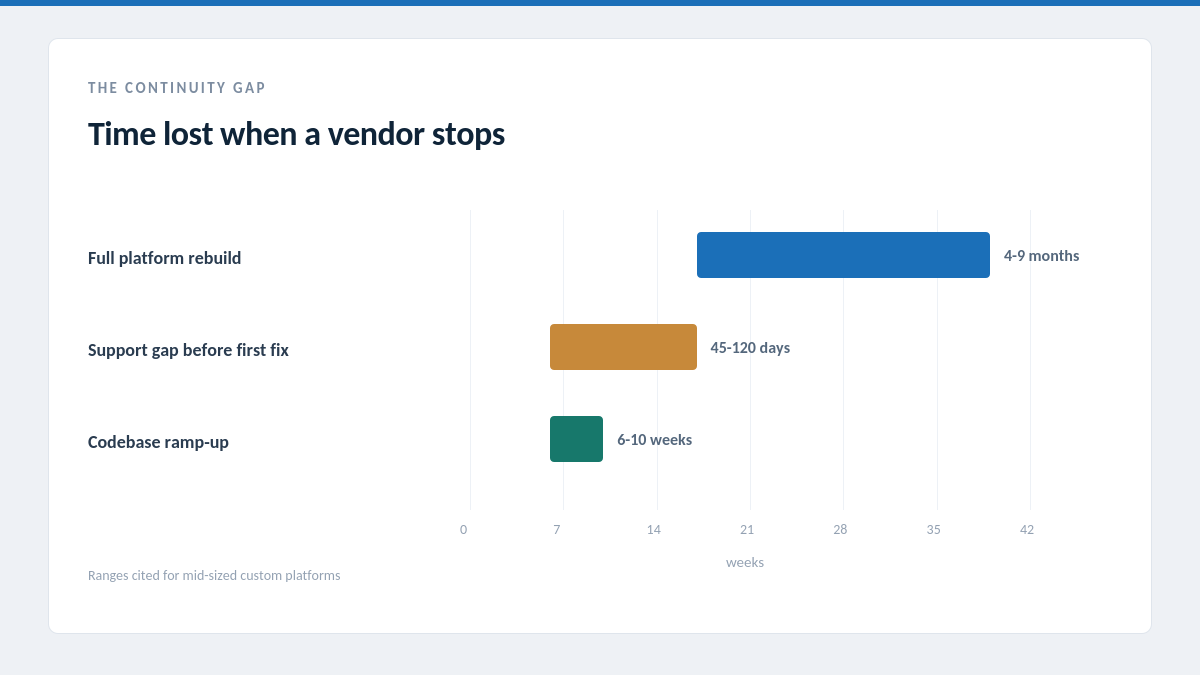
Rebuilding a mid-sized custom platform from scratch typically runs 4 to 9 months and $80,000 to $250,000 — and that is with clean requirements. Reverse-engineering an undocumented system adds another 30% to 50% on top, because a replacement team spends its first six to ten weeks reading code instead of writing it.
The business continuity exposure is rarely the code alone. It is the gap between the day support stops and the day a new team ships its first production fix. In practice that gap runs 45 to 120 days for a system of moderate complexity, and every day of it is absorbed by your operations staff.
Three structural realities make this worse than teams expect. Small agencies concentrate system knowledge in one or two engineers, so a single departure degrades support quality long before the company formally fails. Proprietary product vendors have a legitimate commercial reason never to hand over source, so the repository route simply is not available. And intellectual property rights in most standard agency contracts assign deliverables, not the build environment — you own the output without owning the means to rebuild it.
A software escrow agreement addresses the second case well, the third case partially, and the first case only if deposits are kept current.
When to Use Code Escrow: A Decision Process That Holds Up
Deciding when to use code escrow is a question of what you cannot otherwise obtain. If the vendor will hand over the repository, a software escrow agreement adds administrative overhead and cost for protection you already hold. If they will not because the code is their product, not your deliverable escrow is the only mechanism that puts a usable copy within reach.
Four conditions justify the expense, and they tend to appear together:
- The software is operationally critical, meaning an unsupported outage costs more per week than the annual fee
- The vendor retains source ownership and will not grant repository access under any commercial terms
- You are regulated, and a supervisor, auditor, or enterprise customer requires a documented continuity plan
- Switching costs exceed roughly $75,000, making rebuild-from-scratch an unattractive fallback
If fewer than two of those apply, a software escrow agreement is insurance against an event whose cost you could absorb.
Escrow Release Conditions That Survive a Bankruptcy Filing
Escrow release conditions are where most agreements quietly fail. Vague triggers give the agent no basis to act, and a contested release stalls for months while lawyers argue over whether a condition was met — which is why the clauses that carry this weight deserve review before signature, not after.
Draft triggers that a neutral third party can verify from documents alone:
- Insolvency or bankruptcy filing verifiable from public court records, the cleanest trigger available
- Cessation of business or product discontinuation tie it to a formal end-of-life notice or 60 consecutive days without support response
- Material breach of maintenance obligations define it numerically, such as failure to remediate a severity-one defect within 30 days
- Failure to deposit a vendor missing two consecutive scheduled deposits should itself be a release event
- Change of control relevant when acquisition risk is the real concern, though vendors resist this one hardest
One legal point worth raising with counsel: in the United States, Section 365(n) of the Bankruptcy Code lets a licensee retain its rights under an intellectual property licence even if a bankrupt debtor rejects the contract. That provision materially strengthens a software escrow agreement in a US filing and has no automatic equivalent in many other jurisdictions, so governing law matters as much as the trigger list itself.
Choosing an Escrow Agent and Evaluating Escrow Agent Software
Selecting an escrow agent software platform is a vendor-vetting exercise in its own right, and the diligence you would apply to a development partner applies here too. Weigh five criteria:
- Jurisdiction and governing law the agent should sit where you can actually enforce against an insolvent counterparty
- In-house verification capability agents who subcontract technical verification add cost and lose accountability
- Deposit automation direct integration with GitHub, GitLab, Bitbucket, or your CI pipeline is the single best defence against stale deposits
- Release arbitration mechanism a defined expert-determination process resolves contested releases in weeks rather than litigation timelines
- The agent’s own financial stability a provider holding your software escrow agreement is a company too, subject to the same survival statistics as everyone else
Ask every shortlisted provider one question before signing: how many releases have you executed, and what was the median time from request to delivery? Providers who cannot answer are storing files, not managing risk.
Escrow Cost: Software Deposits, Verification, and Renewal Fees
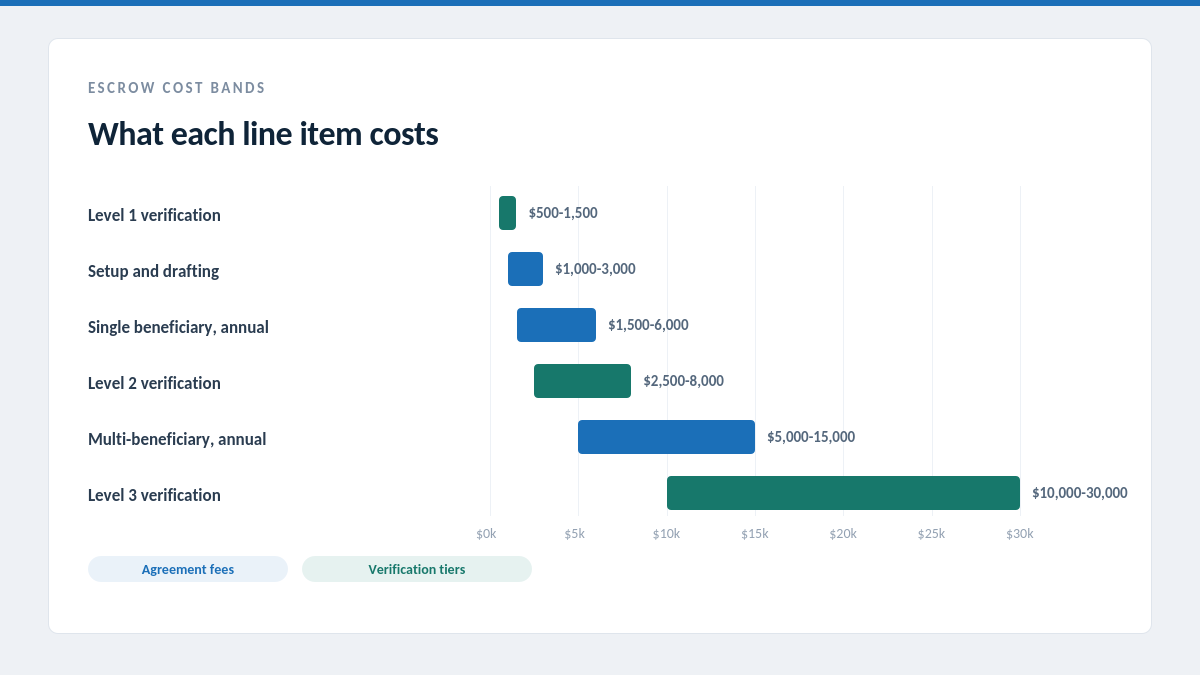
Published market pricing for escrow cost software arrangements clusters in predictable bands, though quotes vary by region, deposit size, and beneficiary count:
- Single-beneficiary annual fee: $1,500 to $6,000
- Multi-beneficiary or vendor-side master agreement: $5,000 to $15,000 annually
- One-time setup and legal drafting: $1,000 to $3,000
- Level 1 verification, file inventory and integrity check: $500 to $1,500
- Level 2 verification, compile and build test: $2,500 to $8,000
- Level 3 verification, full functional testing against a deployed instance: $10,000 to $30,000 and up
The line item teams cut first is verification, and it is the only one that determines whether a software escrow agreement produces anything usable. An unverified deposit is a set of files nobody has ever attempted to build. Budget for at least a compile test at initial deposit, then re-verify after any major architectural change.
The Deposit and Verification Workflow
Engaging a third-party escrow provider follows a consistent sequence. Run it in this order:
- Define release triggers and deposit scope inside the licence agreement before signing, not afterwards
- Select and contract the agent, with all three parties executing the same instrument
- Make the initial deposit source code, build scripts, dependency manifests, environment configuration, database schemas, and documentation
- Commission verification at the level your risk profile justifies, and read the report rather than filing it
- Set a deposit schedule quarterly for actively developed systems, semi-annually for stable ones, automated from the repository wherever possible
- Audit deposit currency annually, comparing the deposited version against your production release number
- Rehearse the release path once: confirm who is authorised to request release and what evidence they must submit
Step seven is skipped almost universally and costs nothing. A 30-minute internal disaster recovery walkthrough surfaces the gap between what a software escrow agreement holds and what your team would actually need on day one.
Real-World Application: Two Procurement Patterns
The following are composite examples drawn from common vendor-selection patterns rather than named clients, but the structure and economics reflect what regulated and SMB buyers routinely encounter.
Regulated buyer, escrow justified. A European payments company licensed a reconciliation engine from a 40-person vendor, with its supervisor requiring documented continuity provisions — standard practice for regulated financial platforms. The software escrow agreement ran roughly $9,800 per year including quarterly automated deposits and annual compile verification. The vendor was acquired in year two and the product line repositioned; release was never triggered, but the continuity file cleared two enterprise security reviews and shortened downstream procurement cycles by about six weeks each.
SMB buyer, escrow declined. A 25-person logistics operator commissioning a custom dispatch portal at $60,000 was quoted $4,200 annually for escrow. Instead they negotiated full IP assignment plus a client-owned private repository with the agency added as collaborator — incremental cost effectively zero. When the agency wound down 14 months later, a replacement team cloned the repository and shipped its first production fix in nine days.
Decision Framework: Escrow, Repository Access, or Full Ownership
Compare the realistic options against what you are actually trying to protect:
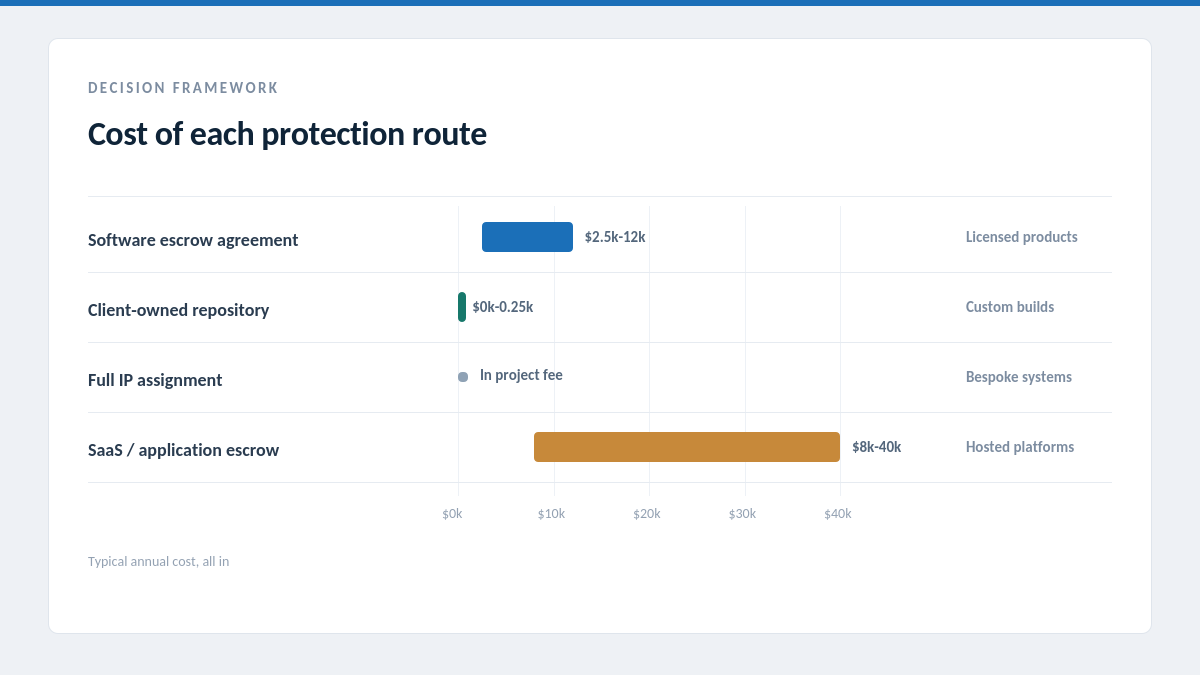
| Approach | What it protects | Typical annual cost | Best fit |
| Software escrow agreement | Access to code you will never otherwise hold | $2,500–$12,000 all-in | Licensed proprietary products; regulated buyers |
| Client-owned private repository | Continuous access plus full build history | $0–$250 | Custom agency builds with IP assignment |
| Full IP assignment and code ownership | Legal and practical control of the asset | Negotiated into project fee | Any bespoke build you intend to maintain |
| SaaS or application escrow | Hosted environment, data, and infrastructure config | $8,000–$40,000 | Business-critical hosted platforms |
The table exposes the core asymmetry. For custom development, ownership is cheaper and stronger than a software escrow agreement; for licensed product software, ownership is unavailable at any price, which is why the more useful exercise is often to compare the vendors themselves before comparing protection instruments.
What Most Teams Get Wrong About Software Escrow Agreements
Teams treat the signature as the deliverable. It is not a usable deposit. Five failure patterns account for most of the disappointment.
Deposits go stale. A software escrow agreement signed in 2023 with a single initial deposit protects a version of the system that no longer resembles production. Automate deposits from the repository, or accept that the arrangement is largely ceremonial.
Nobody tests whether the code builds. Without verification, a release hands your engineers an archive with missing dependencies, undocumented environment variables, and no infrastructure definitions. Level 2 verification typically costs 20% to 40% of one year’s fee and is the difference between an asset and a folder.
The deposit omits everything around the code. Secrets management, third-party licence keys, CI configuration, and data migration scripts are routinely excluded. Name them in the deposit schedule explicitly; agents hold exactly what the contract specifies.
Escrow substitutes for vendor diligence. Paying $4,000 a year to insure against a partner whose financials, client history, and team stability were never verified is expensive risk transfer. Proper due diligence during selection lowers the probability of the trigger event, which is worth more than improving your position after it fires.
SaaS gets the wrong instrument. A source code software escrow agreement for a hosted product is close to useless if you receive an application with no data, no infrastructure, and no operational runbook. Where the risk is a hosted platform disappearing, SaaS continuity escrow covering environment and data is the correct product, and it costs several times more.
Deciding Your Next Step
If you are scoping a build and weighing a software escrow agreement against direct repository ownership, run the four-condition test above first. Two or more matches means the fee is defensible. Fewer than two means the money is better spent on IP assignment terms and a partner you have properly vetted.
That second half removes more continuity risk than any clause. GetProjects connects businesses directly with verified IT companies across 50+ cities, with layered checks on website, email domain, reviews, and team details before a profile goes live and no commission on the work you award. Posting a project takes under two minutes and costs nothing; you pay only the agency you hire.
Compare verified agencies at getprojects.ai before drafting escrow clauses for a vendor whose stability you have not yet confirmed.
Frequently Asked Questions
How much does a software escrow agreement cost?
Expect $1,500 to $6,000 per year for a standard single-beneficiary arrangement, plus $1,000 to $3,000 in setup and drafting. Verification is priced separately: a compile test runs $2,500 to $8,000, full functional verification $10,000 upward. Multi-beneficiary agreements held by the vendor cost more overall but spread across licensees.
What triggers a source code escrow release?
The most enforceable triggers are insolvency or bankruptcy filing, formal product discontinuation, and defined maintenance failure for example, no response to a severity-one defect within 30 days. Weak triggers built on subjective language such as “failure to adequately support” stall at the agent’s desk, because nobody can verify them from documents.
Do startups need a software escrow agreement, or is a shared private repository enough?
For custom builds, a client-owned repository with IP assignment is stronger and cheaper. Escrow becomes necessary when the vendor owns the software as a product and will not release source under any terms. Startups buying escrow for work they commissioned are usually solving a contract problem with a financial instrument.
Is a software escrow agreement legally enforceable in a bankruptcy?
Generally yes, though it depends on jurisdiction. In the US, Section 365(n) of the Bankruptcy Code allows licensees to retain intellectual property licence rights when a debtor rejects the contract, which strengthens escrow considerably. Elsewhere the position varies, so confirm governing law with counsel before signing rather than after a filing.
What is the difference between source code escrow and SaaS escrow?
Source code escrow delivers code and build materials. SaaS escrow covers a running hosted service environment configuration, infrastructure-as-code, and periodic data snapshots so the service can be stood up elsewhere. For hosted platforms, code alone rarely restores operations, which is why the SaaS variant carries a materially higher fee.
Who pays for a software escrow agreement, the client or the vendor?
Whoever wants it usually pays, though cost is negotiable and frequently absorbed into the licence fee. Vendors serving multiple enterprise clients often maintain a multi-beneficiary arrangement and charge each licensee a registration fee of $500 to $1,500. Raise it during contract negotiation, because retrofitting escrow after signature removes your leverage entirely.
When should we vet the vendor instead of insuring against them?
If the trigger you fear most is vendor failure, the highest-return intervention happens before the contract. Verified vendor histories, reviewed client outcomes, and documented team stability reduce the probability of the event. A software escrow agreement only improves your position once that event has already occurred.