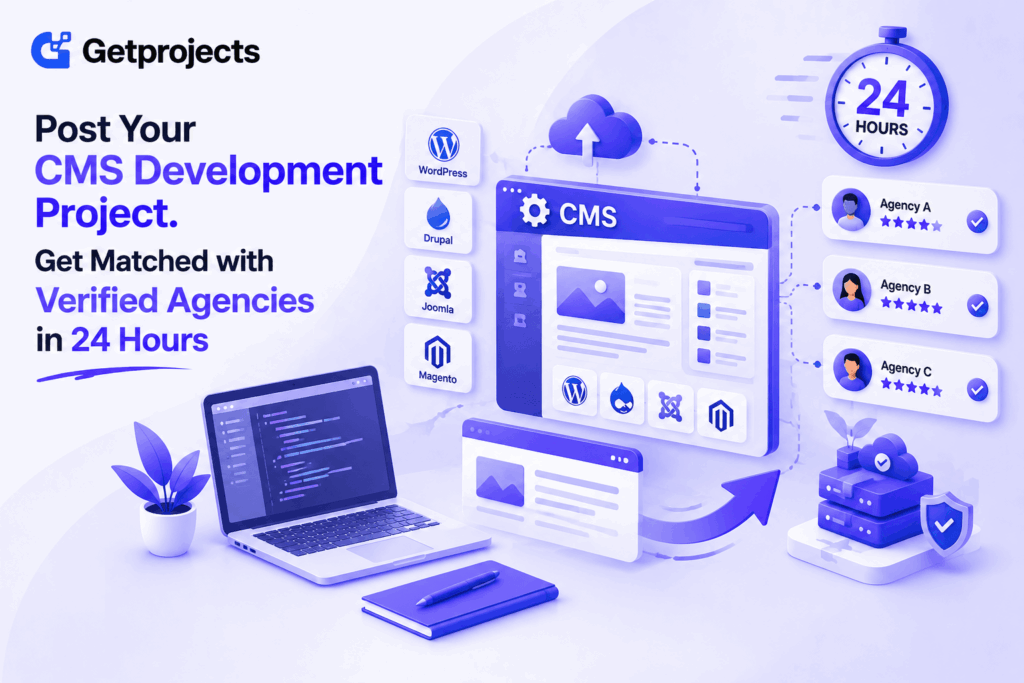
How to Post a CMS Development Project and Get Matched With Verified Agencies in 24 Hours
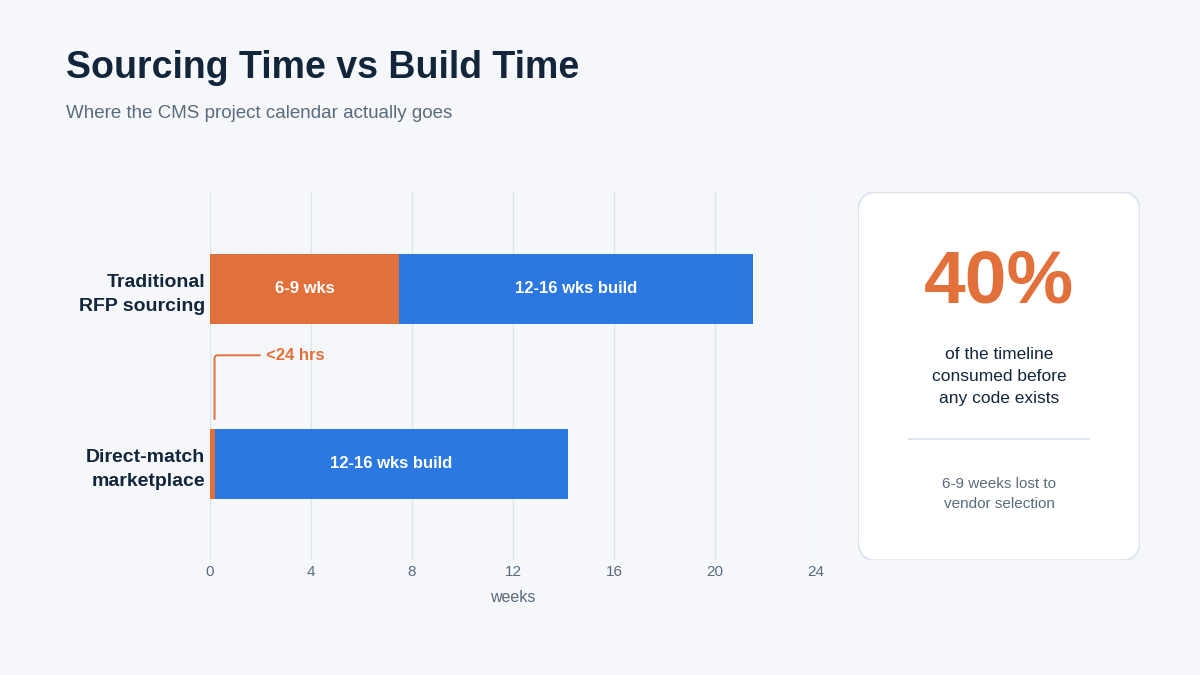
Vendor selection now takes longer than the first development sprint. Procurement and engineering teams routinely burn six to nine weeks shortlisting content management system partners for builds that ship in twelve to sixteen weeks which means roughly 40% of the total timeline is consumed before a single line of code is written.
That imbalance is the reason the fastest-moving teams have quietly abandoned the traditional RFP. They post a CMS development project once, receive a filtered shortlist inside a day, and start technical conversations while slower competitors are still formatting a request for proposal (RFP) document.
W3Techs reports that roughly 71% of all websites now run on a content management system, and WordPress alone accounts for close to 59–60% of that CMS market.
When most of the web runs on a handful of platforms, thousands of agencies can credibly claim CMS expertise and the hard part shifts from finding vendors to filtering them.
The old filtering method was volume: send the brief to fifteen agencies, field forty emails, sit through eight discovery calls, and hope the surviving shortlist is the right one. The direct-matching model inverts it. You describe the requirement once, an AI matching layer scores agencies against structured criteria, and three to five pre-verified firms come back with portfolios, team size, ratings, and comparable past work attached.
This guide walks through that flow end to end: what a usable brief contains, how verification actually works, how to compare proposals without a bidding war, and where most teams still lose four weeks they did not need to lose. If you are about to post a CMS development project this quarter, the sequence below is the one that removes the most calendar time.
What It Means to Post a CMS Development Project
To post a CMS development project is to publish a structured requirement platform, scope, budget band, and timeline on a B2B marketplace so verified agencies can be matched against it algorithmically. Instead of contacting vendors one by one, the brief is submitted once and returns a filtered shortlist of qualified CMS development partners, usually within 24 hours.
The distinction from a job board matters. A job board broadcasts; a matching platform filters. On a broadcast model, 60 agencies see the listing and 22 respond, and the client absorbs the cost of sorting. Post a CMS development project on a matching model instead, and the platform absorbs that sorting cost, delivering a shortlist that has already cleared verification.
The Real Cost of Slow CMS Vendor Selection
Teams consistently underestimate sourcing effort by 3–4x. A mid-sized build says a WordPress-to-headless migration budgeted at $40,000–$80,000 typically involves 25–40 hours of internal time spent on outreach, screening calls, reference checks, and proposal comparison. At a blended internal cost of $75–$120 per hour, that is $2,000–$4,800 spent before the contract is signed.
The delay costs more than an hour. A CMS replatform that slips six weeks pushes an SEO migration into a competitor’s launch window, delays a paid campaign that was scoped around new landing page templates, and often forces an extension on legacy hosting. Teams that post a CMS development project through a matching layer recover most of that lost runway.
Speed is the reason clients now get cms development quotes fast rather than running sequential outreach parallel evaluation compresses a six-week cycle into four or five days without reducing the number of firms considered.
There is a second problem underneath the timeline problem: verification. Anyone can build an agency website in an afternoon. Portfolio screenshots are trivially borrowed, team pages are frequently aspirational, and review counts on directory sites correlate loosely with delivery quality.
Teams that skip a structured agency vetting process discover the gap in week three of the build, when the “senior Drupal architect” turns out to be a subcontractor in a different timezone. Platforms that verify before listing shift that risk off the client, which is a large part of why buyers now post a CMS development project rather than cold-email a longlist.
How to Post a CMS Development Project Online: The Five-Step Flow
The practical version of this process runs on the /clients side of a direct-connect marketplace such as GetProjects. Below is what each step actually requires from you when you post a CMS development project, and what each step produces.
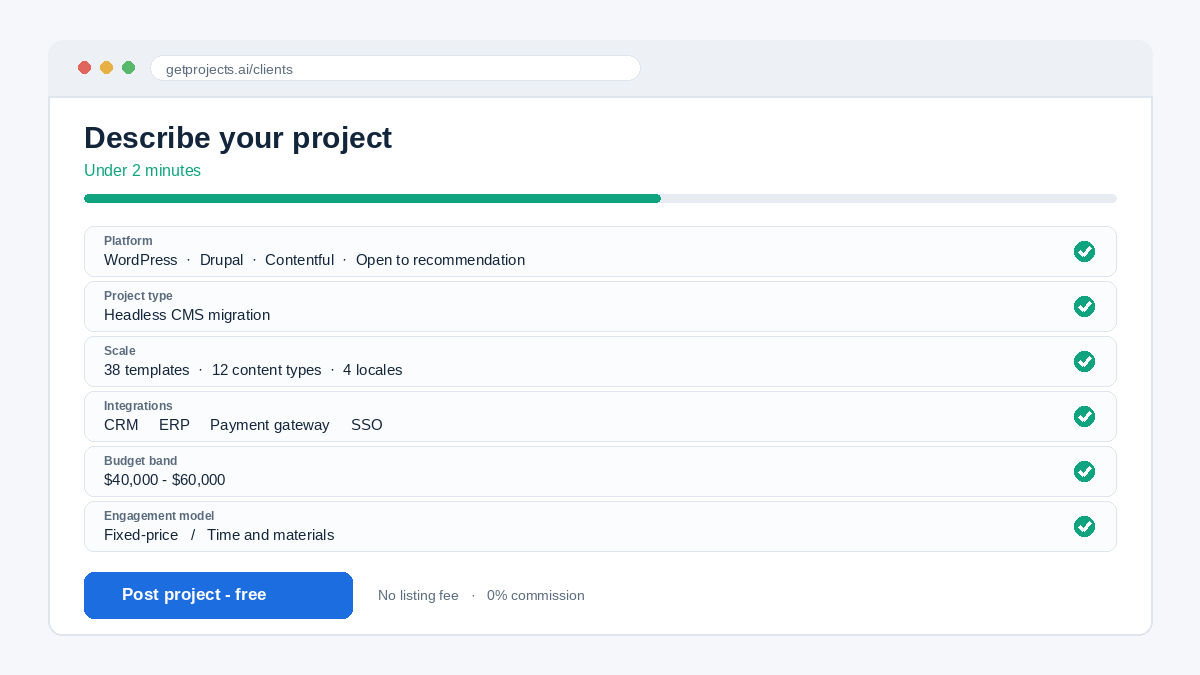
Clients who post cms development projects online through a structured flow typically finish the brief in under two minutes, because the platform’s AI converts plain-language answers into a formatted requirement rather than asking for a finished specification document.
Step 1: Describe the Build What to Include in a CMS Development Project Brief
The brief is the highest-leverage artifact in the entire process, and it is where most teams over-invest in the wrong details. A 14-page technical requirements document does not improve match quality. Six clear constraints do.
A brief that produces accurate matches specifies:
- Platform and direction WordPress, Drupal, Contentful, Sanity, Strapi, Adobe Experience Manager, or “open to recommendation” if CMS platform selection is still undecided
- Project type new build, replatform, headless CMS migration, module or plugin development, performance remediation, or ongoing maintenance
- Scale markers number of templates, number of content types, page count, number of locales, expected monthly traffic
- Integrations CRM, ERP, payment gateway, marketing automation, DAM, SSO
- Budget band and timeline a range is enough; “$40,000–$60,000, live by Q1” filters better than “competitive budget”
- Engagement model preference fixed-price vs time-and-materials, plus whether you need a dedicated team or a project pod
Vagueness in the budget field is the single most common cause of mismatched shortlists when teams post a CMS development project. An agency that builds $150,000 enterprise AEM implementations and an agency that builds $18,000 WordPress sites will both technically qualify for “we need a CMS site,” and only one of them is a fit.
Step 2: Let the Matching Layer Do the Filtering
Once you post a CMS development project, the matching engine compares the requirement against 50+ data points per agency: domain expertise, platform-specific delivery history, budget range served, team size, past client profile, geography, hourly rate band, and performance signals from previous engagements on the platform.
This is the step that replaces the manual longlist. Rather than screening 40 profiles down to 5, the scoring layer returns 3–5 firms whose historical work sits closest to your scope and budget.
Match quality tracks brief quality almost linearly. Teams that submit cms development requirements online with a defined budget band and a named platform get materially tighter shortlists than teams that leave both open.
Step 3: Review Verified Matches Within 24 Hours
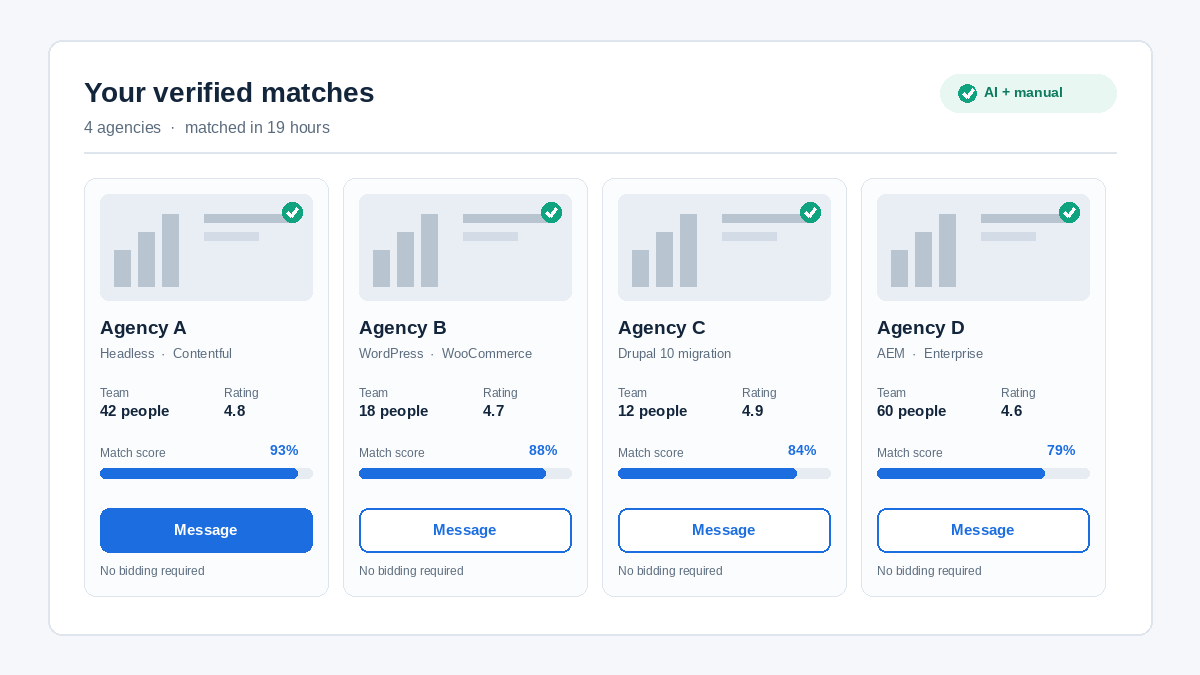
Matches arrive inside a day, each with portfolio work, team size, ratings, and past project history attached so the first pass is a document review, not a calendar exercise. You can eliminate a poor fit in ninety seconds without booking anything, which is the practical payoff of choosing to post a CMS development project instead of scheduling exploratory calls.
What to check in that first pass:
- Does the portfolio include the same project type, not just the same platform? A team with eight WordPress brochure sites is not a headless migration team.
- Does the team size match the delivery window? A four-person shop cannot compress a 16-week build into 8.
- Is the past client profile comparable in scale? Agencies that serve $5M-revenue businesses operate differently from those serving $500M enterprises.
- Does the hourly rate band reconcile with the quoted total? A $30,000 quote at $85/hour implies roughly 350 hours to check that against your scope.
Step 4: Connect Directly No Bidding, No Intermediary
Direct connection is the structural difference between a matching marketplace and a bidding platform. There is no auction, no proposal race, and no account manager relaying messages. You message shortlisted agencies, run discovery call conversations in parallel, and engage the delivery team directly to negotiate scope.
Bidding models create a predictable distortion: agencies price to win the bid, then recover margin through change orders. Removing the auction removes the incentive to underquote one reason a no-bid model is the better place to post a CMS development project.
Step 5: Award the Work and Start at Zero Commission
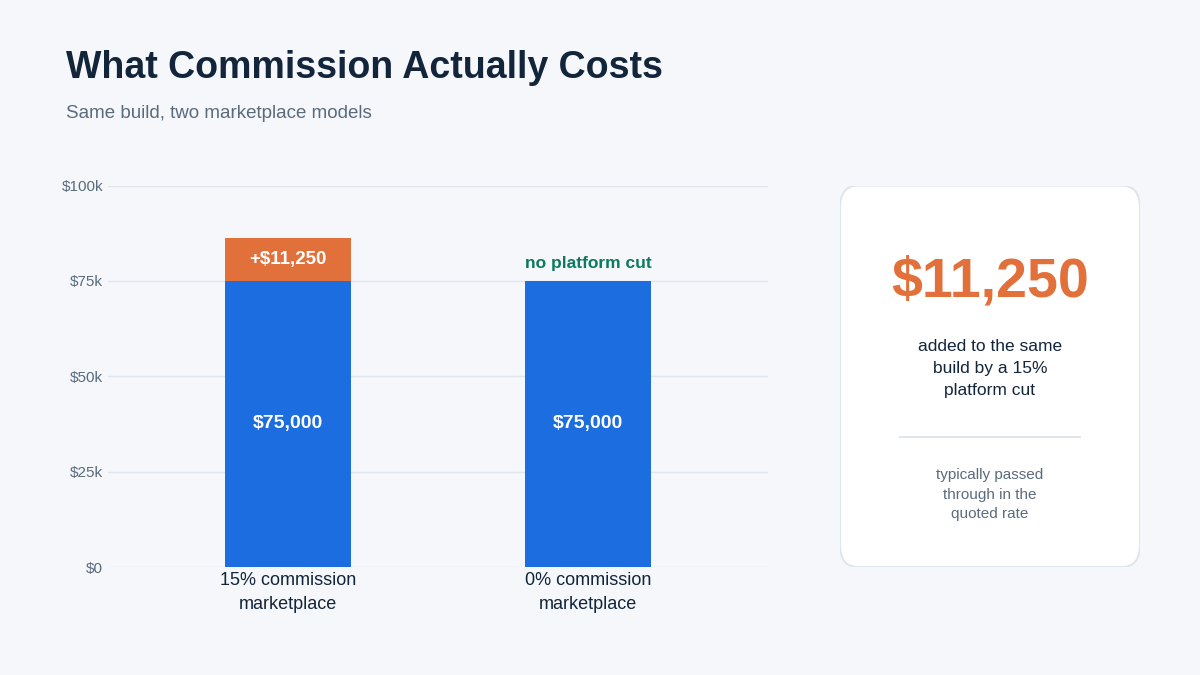
Contracting happens directly between you and the agency. On a commission-free marketplace, there is no platform cut layered onto the invoice which is not a rounding error. On a $75,000 build, a 15% marketplace commission adds $11,250, and that cost is almost always passed through to the client at the quoted rate.
The full sequence to post a CMS development project, condensed:
- Describe the requirement in plain language (under 2 minutes)
- AI structures it into a formatted brief
- Matching engine scores agencies across 50+ data points
- 3–5 verified matches delivered within 24 hours
- Review portfolios, ratings, team size, and past work
- Connect directly with as many matched agencies as you want
- Run parallel discovery calls and compare scope, not sales pitches
- Award the project and pay the agency directly zero platform commission
How to Find Verified CMS Development Agencies (And What Verification Actually Checks)
Verification is the part of the process buyers rarely see and most depend on. Teams that want to find verified cms development agencies without running their own background checks need to understand what “verified” means on a given platform, because the term is used loosely across the industry.
How Are CMS Development Agencies Verified?
A layered check runs before any profile goes live, combining automated signals with manual review:
- Domain and website verification confirming the agency controls the domain it claims, with a real operating history rather than a three-week-old registration
- Business email domain validation no free-mail-only operations posing as established firms
- Review and reputation cross-referencing external ratings checked against claimed delivery history
- Team and capability confirmation headcount, role composition, and named platform expertise reviewed rather than accepted at face value
The purpose is not to guarantee outcomes. It is to remove the category of failure where the client discovers, in week two, that the “agency” is a two-person reseller subcontracting the entire build.
Verification also changes how a vendor shortlist should be used. When the baseline check has already been done, your evaluation time moves from “is this company real?” to “is this company right?” a substantially better use of a CTO’s afternoon. That shift is the main reason enterprise buyers post a CMS development project on verified platforms and skip open directories entirely.
Real-World Application
Case study 1 D2C retail brand, WooCommerce to headless. A 40-person retail company needed a headless front end over an existing WooCommerce catalogue, with a hard deadline tied to a Q4 campaign. After deciding to post a CMS development project rather than run a formal RFP, the team received four matched agencies in under 20 hours, ran three discovery calls in a single week, and signed on day six. Sourcing time dropped from an estimated seven weeks to under one, and the absence of a 15% platform commission on a $62,000 contract kept roughly $9,300 inside the build budget.
Case study 2 B2B SaaS, Drupal 7 end-of-life migration. A software company facing an unsupported Drupal 7 installation had already spent five weeks screening vendors through referrals and directory listings, with two of three candidates unable to evidence Drupal 10 delivery work. The decision to post a CMS development project on a matched platform returned five agencies with verified Drupal migration portfolios; the company compared three, selected one with a 12-person team and prior 200+ content-type migrations, and moved into project scoping within four business days.
Decision Framework: Comparing Ways to Source a CMS Partner
Not every sourcing model is wrong; they optimize for different things. The question is what you are willing to trade.
| Sourcing method | Time to usable shortlist | Cost to client | Depth of vetting |
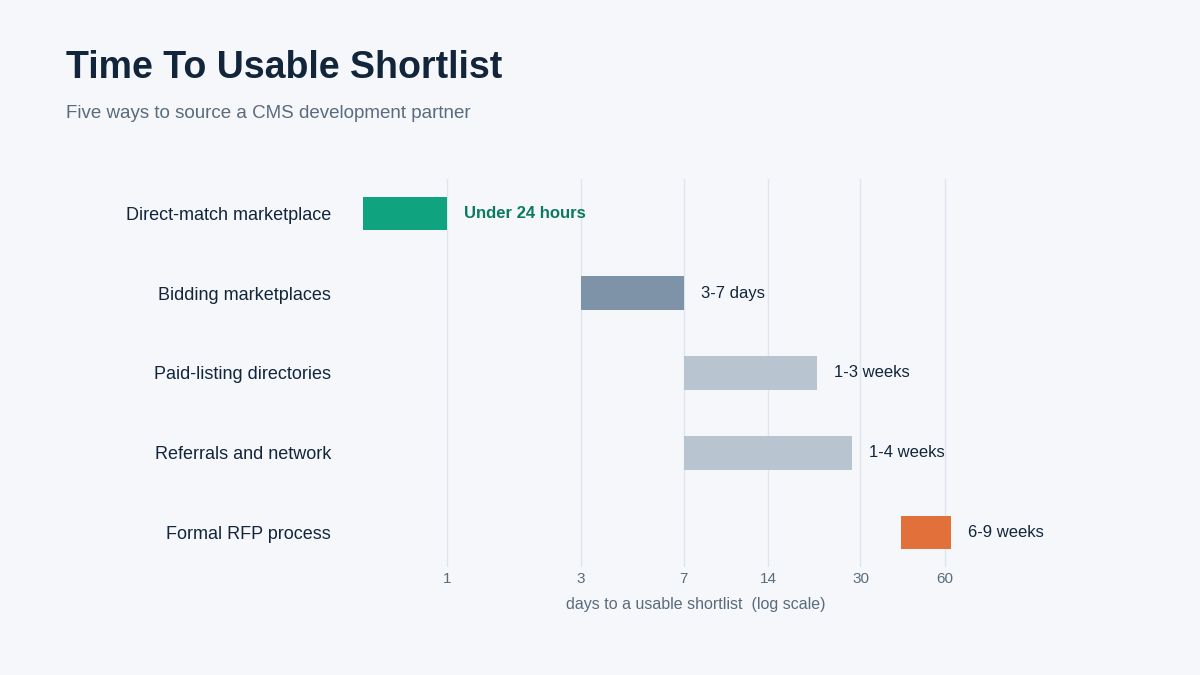
| Formal RFP process | 6–9 weeks | $2,000–$4,800 internal time | High, but entirely self-run |
| Bidding marketplaces | 3–7 days | 10–20% commission, usually priced in | Low; volume-driven, race-to-bottom pricing |
| Paid-listing directories | 1–3 weeks | Free to browse; agencies pay $499+/year for placement | Ranking correlates with spend, not delivery |
| Referrals and network | 1–4 weeks | Free | Variable; limited to who you already know |
| Direct-match marketplace | Under 24 hours | Free to post; 0% commission | Layered AI + manual verification pre-listing |
Read the table as a trade-off map, not a ranking. If you need a $6,000 plugin fix, a bidding platform is fine. For a revenue-generating replatform, the vetting column decides the project and it is the strongest argument for choosing to post a CMS development project where verification happens before listing, not after a dispute.
What Most Teams Get Wrong When Sourcing a CMS Partner
Over-specification is the most expensive mistake in this process, and it looks like diligence. Teams arrive with a 20-page requirements document written before any agency has seen the problem, which locks in architectural decisions made by people who will not build the system. The strongest IT outsourcing partner relationships start with a constrained problem statement and let the agency propose the architecture that is what you are paying for.
The second error is treating quote volume as leverage. Collecting nine proposals does not produce a better decision than collecting four; it produces decision fatigue and a three-week delay. Beyond five, additional proposals almost never change the outcome which is why matched shortlists cap at three to five when you post a CMS development project.
Third: teams evaluate agencies on portfolio aesthetics rather than delivery evidence. A beautiful case study page tells you the agency has a good designer. Ask instead for the Core Web Vitals scores of shipped sites, the content-editor training approach, and who owns the repository after handoff. A WordPress development agency that cannot answer the third question quickly is not one you want owning your production environment.
The last one is subtler. Many teams assume that paying a platform commission buys accountability arbitration, guarantees, and recourse. In practice, the commission usually buys payment escrow, and the cost lands in the agency’s rate card. Understanding what you are actually buying is the difference between a 15% premium and a 15% expense.
Start Your CMS Project With a Verified Shortlist
If a CMS build or replatform is on your roadmap this quarter, the sourcing decision is worth four days, not four weeks. Post a CMS development project once, review 3–5 verified agencies with portfolios and delivery history attached, talk to all of them, and contract directly with the one that scopes the problem best.
GetProjects runs this as a free, no-bid, zero-commission process AI-assisted brief creation in under two minutes, layered verification before any agency profile goes live, and no platform cut on the work you award.
Frequently Asked Questions
Is it free to post a CMS development project online?
On commission-free platforms, yes there are no listing fees, no charge to review matches, and no cost to connect with agencies. Clients pay only the agency they hire, directly. This differs from directory models, where agencies pay for placement, and from bidding platforms, which take a percentage of the contract value.
How do I find a reliable CMS development company?
Reliability shows up in evidence, not claims. Prioritize agencies that can produce platform-specific delivery history, named team members with relevant seniority, references at comparable scale, and clear answers on code ownership. Verified profiles compress this by confirming domain, business identity, reviews, and team details before publication.
How much does CMS development cost in 2026?
Ranges vary by platform and scope. A standard WordPress business site typically runs $8,000–$25,000; a mid-market replatform with custom templates and integrations runs $35,000–$90,000; enterprise headless implementations with multi-locale content operations commonly exceed $120,000. Hourly rates range from roughly $25–$60 in South and Southeast Asia to $110–$200 in North America and Western Europe.
How long does it take to get CMS development quotes?
Matched shortlists typically arrive within 24 hours of the moment you post a CMS development project, with detailed proposals following two to five business days after initial discovery calls. The variable is not the platform, it is scope clarity. Briefs with a defined budget band, named platform, and template count get quoted materially faster than open-ended requirements.
Can I talk to multiple CMS agencies before choosing one?
Yes, and you should. Speaking with three to five matched agencies in parallel is the point of the model. When you post a CMS development project there is no exclusivity, no obligation to proceed with any match, and no penalty for declining all of them. Most teams find that comparing how differently agencies scope the same problem is more revealing than comparing the prices themselves.
How do I compare CMS development agency proposals fairly?
Normalize before you compare. Convert every proposal to the same units total hours, hourly rate, deliverables per phase, and what triggers a change order. Then check three things: whether the assumptions differ, whether QA and content migration are included or excluded, and who holds the repository. Two quotes $20,000 apart often describe two different projects.
Can I hire a CMS development company for free through a marketplace?
You can hire a cms development company free of any platform fee on a zero-commission model; the marketplace charges nothing to post, match, or connect, and you contract and pay the agency directly. The agency’s own fees, of course, still apply; what disappears is the intermediary layer that would otherwise take 10–20% off the top.