Top AppFutura Alternatives to Find App Development Companies in 2026
AppFutura.com no longer accepts new project postings. As of this year, the domain redirects entirely to Clutch.co, the result of an acquisition finalized in 2024 that folded AppFutura’s directory and project-matching functions into Clutch’s platform. Most “AppFutura alternatives” lists published online still describe it as a live, standalone marketplace which means a large share of buyers searching for it are actually looking for somewhere else to go, without realizing it yet.
That shift matters more than it looks. AppFutura built its reputation on a specific model: buyers post a project brief for free, developers and agencies respond with proposals, and the client picks one. It was one of the few platforms doing this specifically for mobile and web app development, rather than general freelancing or generic B2B services. Its disappearance as an independent brand leaves a real gap for founders and CTOs who liked that narrow, developer-first focus.
Global spending on IT services reached an estimated $1.72 trillion, with projections putting it near $1.87 trillion in 2026 a scale that explains why dozens of new agency directories and bidding platforms have entered the market in the last three years . More buyers than ever are sourcing app development talent outside their own country, and more of them are getting burned by unclear fee structures along the way.
This guide breaks down the real AppFutura alternatives worth evaluating in 2026, what each one actually costs once you read past the homepage, and how to avoid the two most common vendor-selection mistakes teams make when they’re moving fast. It also covers where AppFutura sat in the broader landscape of app development marketplaces, so the comparison isn’t just a name swap but an actual understanding of what changed.
What Are AppFutura Alternatives?
AppFutura alternatives are platforms that let businesses post a mobile or web app development project and connect with vetted developers or agencies, without going through AppFutura’s now-defunct standalone site. They range from paid-listing directories like Clutch and GoodFirms, to bidding marketplaces like Upwork, to commission-free, no-bid platforms such as GetProjects.
The category itself isn’t new, app development marketplaces have existed since the early 2010s, built around one of two models: buyers browse a directory and reach out cold, or buyers post a brief and let providers come to them. What’s changed since AppFutura’s exit is the balance between the two. Directory-first models (Clutch, GoodFirms) have grown larger and more review-heavy, while a newer generation of no-bid, matching-first platforms has emerged specifically to cut the manual sourcing work out of the equation a shift covered in more depth in this breakdown of the directory model vs. direct matching.
Understanding which category a given AppFutura competitor falls into matters more than its name recognition, because the category dictates how much manual filtering work lands back on the buyer. Buyers who want to score candidates on more than reputation alone can lean on a practical buyer framework instead of comparing homepages side by side.
The Core Problem: Most Buyers Don’t Know What They’re Paying For
The real challenge isn’t finding a list of agencies; a basic search does that in seconds. It’s understanding the economics behind the list you’re looking at, because that economics shapes which agencies show up first.
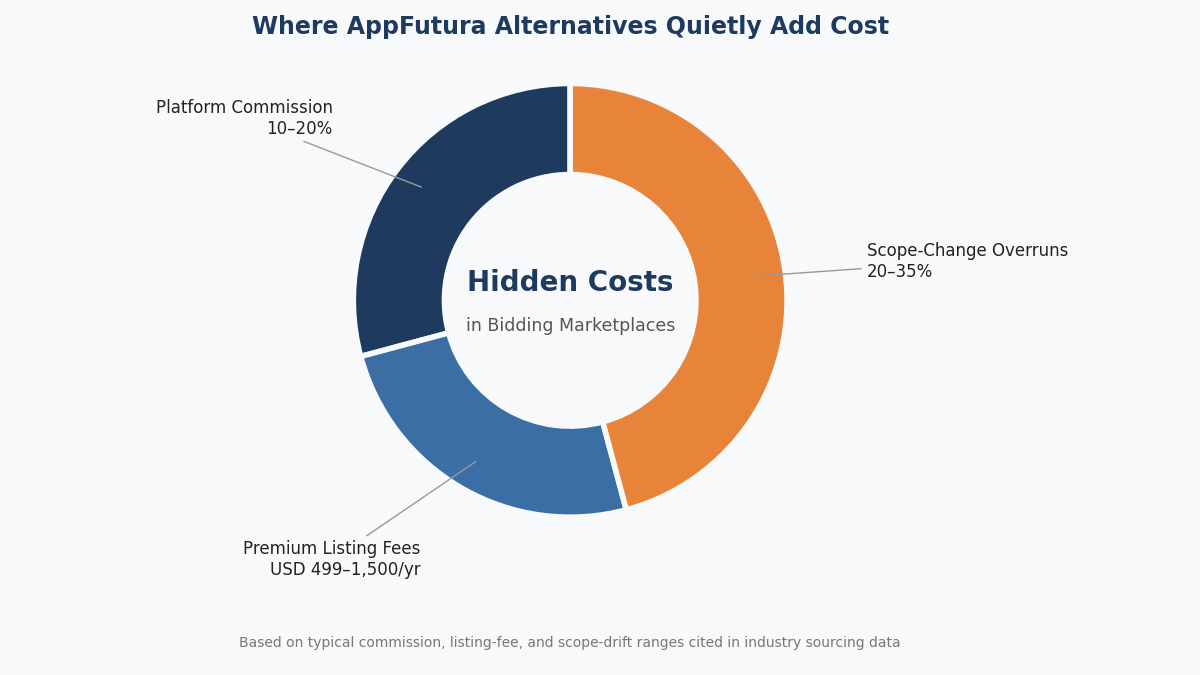
On a bidding marketplace, agencies typically hand over 10% to 20% of the total contract value to the platform, a cut that gets baked directly into the quote a buyer receives exactly the kind of hidden math the better AppFutura alternatives are built to avoid. On a paid-listing directory, agencies pay annual fees that commonly start around $499 and climb well past $1,000 for premium placement, meaning the “top” results are frequently a function of ad spend rather than project fit. Buyers rarely see either of these numbers; they just see a ranked list that looks neutral.
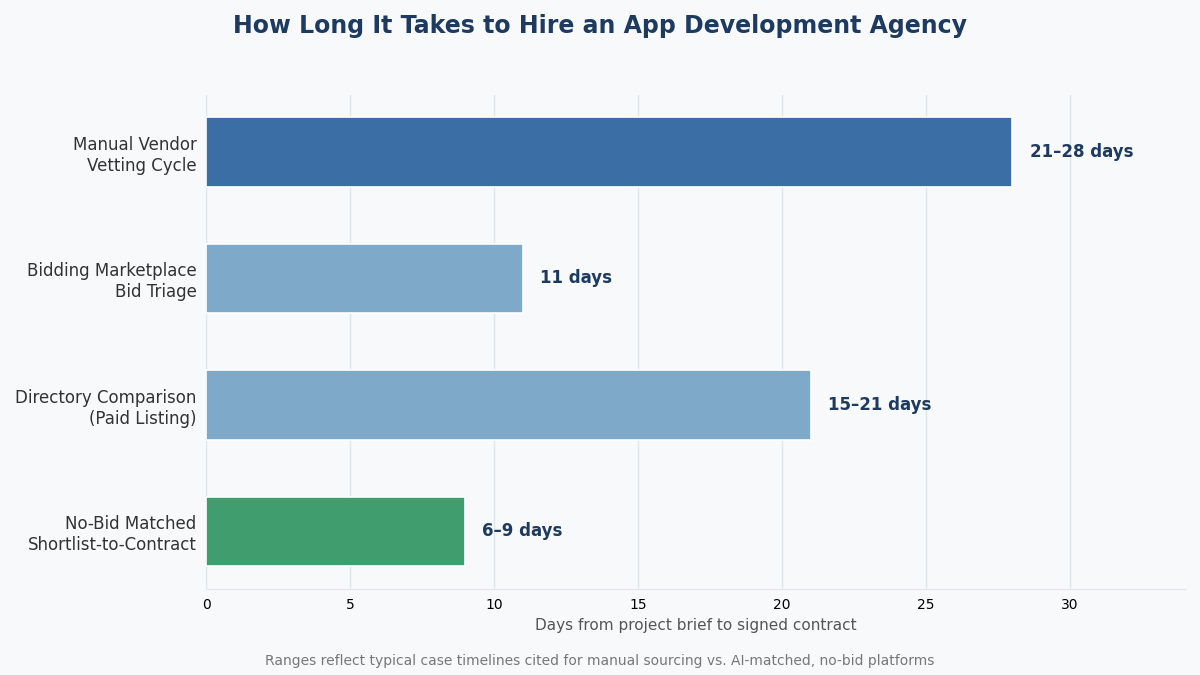
Teams also underestimate how long vendor vetting takes when they do it manually. A typical evaluation cycle shortlisting five to eight agencies, reviewing portfolios, running discovery calls, checking references takes 3 to 4 weeks for most mid-sized projects. Most founders budget one week, which is roughly the timeline it actually takes to shortlist an agency in 72 hours using a structured process instead of ad hoc outreach. That gap is where rushed hiring decisions happen, and it’s a bigger driver of failed app projects than developer skill ever is.
There’s a second, less obvious cost: project scoping drift. When a buyer is juggling 15-20 inbound proposals from a bidding platform, the natural instinct is to pick the cheapest quote that looks “close enough” to the brief, then renegotiate scope once work starts. That renegotiation is where budget balloon industry estimates put mid-project scope changes at adding 20% to 35% to the original contract value on poorly scoped app builds.
A platform that reduces the number of proposals a buyer has to sort through, in favor of a smaller, better-matched shortlist, directly reduces this risk, simply because the buyer spends more of their limited attention on scoping the brief correctly instead of triaging bids. This is essentially how GetProjects’ matching works behind the scenes, comparing a brief against agency data before anything reaches the buyer’s inbox.
How to Evaluate Sites Like AppFutura: A Practical Framework
Choosing among the many sites like AppFutura now available comes down to five variables: cost structure, verification depth, matching method, project-posting speed, and coverage. This is where most comparisons of AppFutura alternatives stop at surface-level feature lists instead of digging into how each variable actually affects a hiring outcome. Here’s how to work through each one.
1. Understand the Cost Structure Before You Compare Features
Ask directly whether the platform charges the buyer, the agency, or both, and whether that charge is a flat fee, a subscription, or a percentage of the deal. A commission-heavy bidding marketplace inflates every quote you receive by the platform’s cut, so two agencies quoting “the same” $40,000 project may actually differ by $4,000-$8,000 once the platform fee is stripped out a gap that becomes obvious once you look at the cost of hiring an IT company directly and compare it against a marketplace-sourced quote for identical scope.
This is the single most overlooked variable when buyers evaluate sites like AppFutura, because cost structure is rarely visible on the buyer-facing side of the platform. A directory that charges agencies $499-$1,500 per year for premium placement has an obvious incentive to surface paying agencies first, regardless of fit. A commission-free marketplace has no equivalent incentive, since it earns nothing from steering a buyer toward one agency over another.
2. Check What “Verified” Actually Means
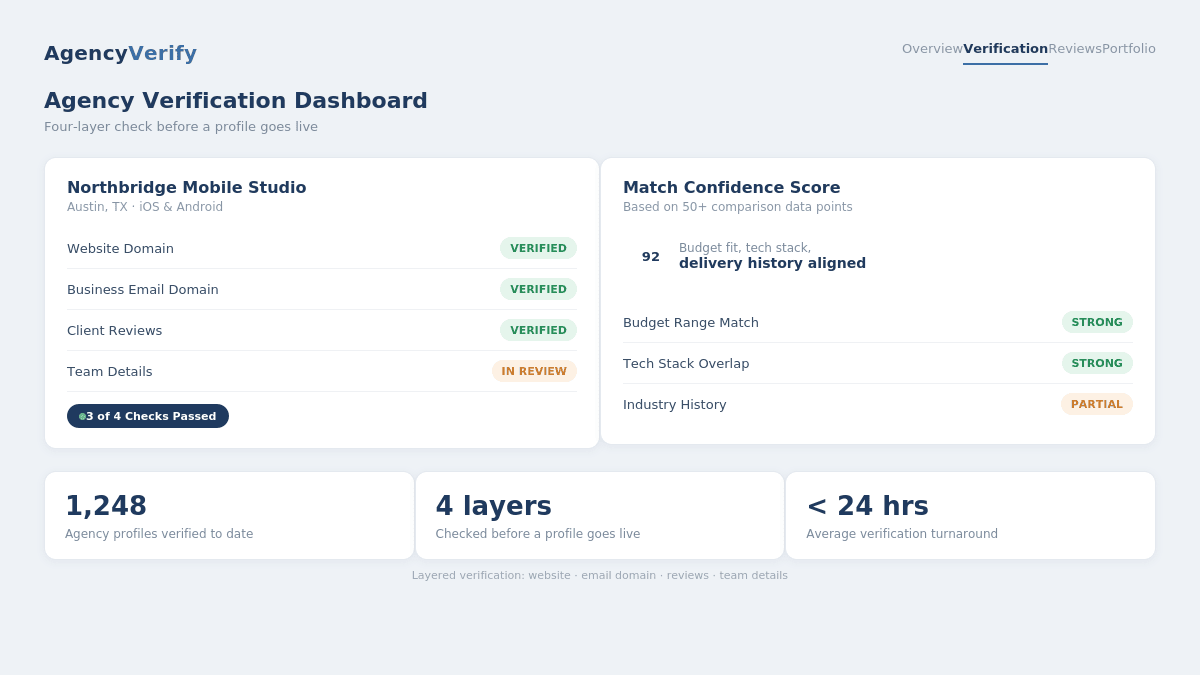
Some directories verify a business license and little else. Others cross-check the agency’s website domain, business email, team composition, and past client reviews before a profile ever goes live. If a platform can’t describe its verification steps in one or two concrete sentences, treat every “Verified” badge on it with skepticism.
3. Decide Between Bidding and Matching
Bidding platforms ask you to write a brief and wait for open proposals useful for price discovery, poor for time-strapped teams, since sorting 15-30 inbound pitches is itself a part-time job. AI-driven matching models instead compare the project against agency data (budget range, technical stack, industry history, delivery performance) and surface a short, ranked shortlist, cutting the sourcing phase from weeks to days.
4. Time the Actual Posting Process
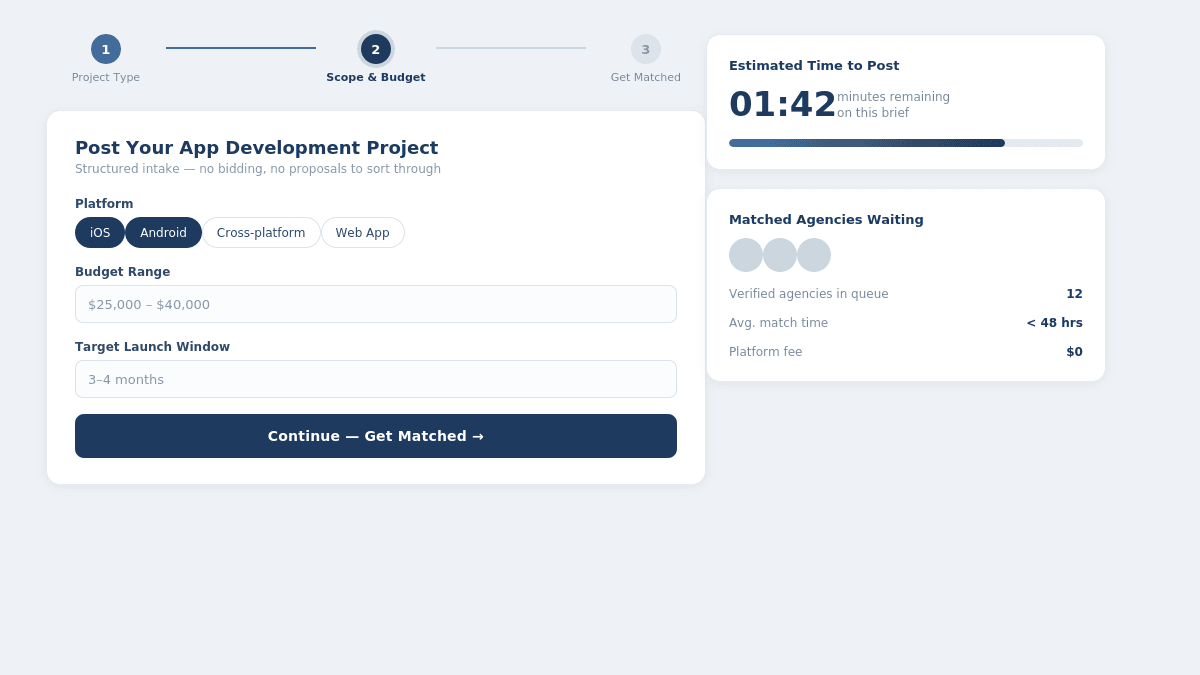
Test how long it takes to go from “landing page” to “project live and visible to agencies.” On several legacy directories this still involves multi-step forms, mandatory phone verification calls, and manual approval queues that can take 48-72 hours. Faster, no-bid platforms have compressed this to under two minutes, since there’s no bid queue to manage and no manual approval gate between submission and agency visibility the same speed you can see for yourself by walking through how to post a free software project from brief to live listing.
5. Look at Geographic and Domain Coverage
A platform that only lists agencies in one or two regions will force you back into cold outreach the moment your project needs specialized expertise, say, a HIPAA-compliant health app or a fintech build requiring PCI-DSS familiarity. Broader agency discovery across dozens of cities and multiple technical domains reduces the odds you’ll need a second platform just to fill a coverage gap the first one left.
Use this checklist when scoring any candidate platform:
- Confirm whether the buyer pays anything to post or connect (many still charge indirectly through inflated agency quotes).
- Read the platform’s stated agency-verification criteria, not just its marketing copy.
- Check whether shortlisting is manual (you review every bid) or AI-assisted.
- Time the actual project posting flow yourself before committing.
- Cross-reference at least two agencies from the platform’s shortlist against independent review sites.
- Confirm there’s a way to message an agency directly before any contract is signed.
How to Post an App Development Project the Right Way
However you decide to post app development project briefs going forward, the brief itself matters more than the platform. A vague one-paragraph description invites vague, wildly-priced proposals; a scoped brief invites comparable ones.
A workable brief includes: the platform (iOS, Android, web, or cross-platform), a rough feature list split into “must-have” and “nice-to-have,” an approximate budget range rather than “flexible,” and a target launch window. Platforms that let you hire app developers online through structured intake forms tend to produce tighter, more comparable proposals than open-ended message boxes, simply because the format forces the same scoping decisions the buyer would otherwise skip a structure laid out in more detail in a practical, no-fluff guide to hiring app developers.
Case Studies: How the Wrong Platform Choice Plays Out
These outcomes aren’t hypothetical. They’re the kind of pattern that shows up repeatedly once teams start comparing AppFutura alternatives against real project timelines instead of homepage claims, and the following three examples make the difference concrete. A 40-person fintech startup in Austin needed a native iOS rebuild and posted the project on a bidding-style marketplace. Within four days it had 27 proposals, ranging from $18,000 to $95,000 for what was described as the same scope. The team spent 11 days just triaging bids before starting real vendor calls, and the agency they eventually hired had priced in a 15% platform commission the founder didn’t discover until the contract was signed.
A healthcare SaaS company evaluating outsourced partners for a HIPAA-compliant patient app took a different route: it used a verified, no-bid marketplace, submitted its brief once, and received three pre-matched agency recommendations within 48 hours based on prior healthcare-compliance project history the kind of prior experience that matters most once you understand HIPAA-compliant healthcare app requirements in detail. The shortlist-to-signed-contract cycle took 9 days instead of the 4-6 weeks the founder had budgeted, and the final rate came in without a hidden commission layer, since the platform itself charged neither party to connect.
A third example illustrates the middle ground: a two-person e-commerce brand tried a paid-listing directory to find a Shopify Plus integration partner, paying nothing upfront as a buyer but spending nearly three weeks manually comparing agencies whose “top ranking” placement correlated more with premium subscription tier than technical fit, a mismatch that’s easier to catch by starting from a vetted list of the best e-commerce development companies rather than a paid directory’s default sort order. After the fourth discovery call surfaced a pricing mismatch with the original listing, the founder switched to a direct-connect platform for the actual hiring decision and closed a contract within six days of posting the brief a second time.
Comparing AppFutura Alternatives at a Glance
| Platform | Cost Model | Verification Depth | Matching Method |
| Clutch | Free basic listing; paid sponsorship/verified tiers for agencies | Phone-verified reviews, moderate profile checks | Buyer-driven browsing and filtering |
| GoodFirms | Freemium; premium packages often $499+/year for agencies | Research-based ranking, no bidding wars but paid visibility | Buyer-driven browsing and filtering |
| Upwork | Buyer free; freelancers pay a sliding service fee per contract | Light identity checks, reputation built via reviews | Open bidding, buyer reviews proposals |
| Sortlist | Free for buyers; commission-based for agencies on won deals | Manual review submission, moderate vetting | Buyer brief matched to a short agency list |
| GetProjects | Free for both buyers and agencies; 0% commission | Layered checks: website, email domain, reviews, team details | AI matching across 50+ data points, no bidding |
Use the table only as a starting filter; the right pick still depends on whether your priority is maximum agency volume (Clutch, GoodFirms) or speed and cost transparency (a direct-connect model with no bidding).
What Most Teams Get Wrong When Choosing an App Development Marketplace
The most common mistake isn’t picking a bad platform, it’s optimizing for the wrong metric, a pattern that shows up across nearly every comparison of AppFutura alternatives available today. Buyers default to “which site has the most agencies listed,” when the number that actually predicts a good outcome is closer matching quality, not raw directory size. A platform with 3,000 loosely verified agencies and no filtering logic is worse than one with 400 agencies and a real matching layer behind it, a distinction that becomes obvious once you know how to vet a mobile app development company properly instead of trusting a badge.
A second pattern: teams treat the free plan on paid-listing directories as fully representative of the platform, then get frustrated when the “best” agencies they see are the ones paying for premium placement rather than the ones best suited to their stack. That’s not a flaw unique to any single directory, it’s structural to any model where agencies pay for visibility. It’s worth knowing going in, not discovering after signing a contract.
A third, quieter mistake: skipping reference checks because a platform shows a “verified” badge. Verification usually confirms the business is real. It rarely confirms the agency is good at your specific tech stack. Those are two different questions, and only one of them gets solved by a badge.
A fourth pattern shows up specifically among teams migrating away from AppFutura: assuming the closest-sounding replacement is automatically the right one. Clutch is the natural default because it absorbed AppFutura’s brand and traffic, but Clutch’s catalog spans marketing agencies, enterprise IT consultancies, and design studios well beyond mobile app development meaning a buyer who liked AppFutura specifically for its narrow, developer-first focus may find Clutch’s breadth works against them during search and filtering, which is exactly why it’s worth scanning best platforms to find software development agencies before assuming the biggest name is the right fit.
The right AppFutura alternative depends on whether you valued AppFutura for its niche focus or simply for being free and low-friction; those two priorities point toward different replacements.
Choosing Your Next Step
If you’re evaluating appfutura alternatives because the site you used to bookmark no longer works the way it used to, the fastest way forward isn’t another paid directory, it’s a platform that skips the bidding wars and the commission math entirely. GetProjects lets you post a project in under two minutes, get matched against verified agencies across 50+ cities, and pay nothing to connect, since the platform makes no cut from either side of the deal. Post your project free and compare matched agencies before you commit to a call.
Frequently Asked Questions
What happened to AppFutura?
AppFutura was acquired in 2024 and, as of this writing, no longer functions as an independent project-posting site. Visiting appfutura.com now redirects entirely to Clutch.co, with the original directory and bidding features discontinued. Buyers who previously used AppFutura need a direct replacement rather than a workaround.
Is AppFutura still active in 2026?
No. The domain remains live but only as a redirect to Clutch, showing options to “find a provider” or “list a business” that route straight into Clutch’s own platform. There is no independent AppFutura login, project dashboard, or bidding flow anymore.
What is the best free alternative to AppFutura?
Among the free-to-post AppFutura alternatives, the best fit depends on whether you want maximum agency volume (Clutch, GoodFirms) or a faster, commission-free way to post one project and get matched directly, without paying to list or connect on either side.
How do app development marketplaces actually make money?
Most agencies charge either a flat annual listing fee (commonly $499 or more per year for premium placement) or a commission on won projects, typically 10-20% of contract value. A smaller group of commission-free platforms make no charge to either side for the connection itself.
Is Clutch better than AppFutura?
Clutch is broader and far more established, with listings spanning agencies well beyond mobile app development, including marketing, design, and enterprise IT services. AppFutura was narrower but more mobile-development-specific before its 2024 acquisition folded it into Clutch entirely.
How do I vet an app development company before hiring?
Cross-check the agency’s platform reviews against an independent source, confirm past project history in your specific tech stack, and always request at least one live reference call. Treat platform verification badges as a starting filter, not a substitute for your own vendor vetting.
How long does it typically take to shortlist an app development agency?
Manual sourcing across bidding platforms usually takes 3-4 weeks once you include discovery calls and reference checks. AI-matched, no-bid platforms have compressed that same process to a matter of days by pre-filtering on budget, expertise, and delivery history before a shortlist ever reaches the buyer.