App Development Cost in South Africa 2026: Rand Prices by App Type
Two quotes for the same food-delivery app can land on a South African founder’s desk in the same week. One is for R380,000 and the other is for R2.1 million. Neither agency is necessarily wrong, and that gap is exactly why app development cost South Africa is one of the most misread line items in a 2026 tech budget.
The spread rarely comes from hourly rates alone. It comes from how the scope was written and how each agency builds its software development estimates: which platforms were assumed, whether backend work was priced in, and whether the quote covers the first year of support or stops at launch.
For buyers, this creates a predictable problem. A vague brief invites vague pricing, and vague pricing makes the cheapest quote look attractive until the change requests start arriving. Founders, CTOs and procurement leads who understand the cost drivers can tighten scope, compare like with like, and negotiate from data instead of guesswork.
This guide breaks down the app development cost South Africa buyers face into rand ranges by app type. It also explains what pushes a project from the lower to the upper end of each range, and how to evaluate agencies in Cape Town, Johannesburg and Durban without overpaying for the wrong partner.
DataReportal’s Digital 2026: South Africa report counts 127 million cellular mobile connections in the country at the end of 2025, and 51.7 million internet users as of October 2025.
With that level of mobile density, a mobile app is often a business’s primary customer channel rather than an add-on. That changes how much investment a build deserves and how carefully it should be scoped.
What Is App Development Cost in South Africa?
App development cost South Africa refers to the total rand investment needed to plan, design, build, test, launch and maintain a mobile application with a South African developer or agency. It typically covers discovery, UI/UX design, frontend and backend engineering, quality assurance, deployment and post-launch support. Agencies price it either hourly or as a fixed project fee.
The Core Problem: Why Quotes for the Same App Vary 3–5x
Ask five agencies to price a booking app from a one-page brief, and the quotes will usually span a 3–5x range. The variance is not dishonesty. Each agency fills the gaps in your brief with its own assumptions.
One agency might assume a single cross-platform build with a lightweight cloud backend. Another might assume separate native apps, a custom admin dashboard and an API layer built for future scale. Both quotes are accurate for the app each team imagined.
The second issue is what gets left out. In a typical South African project, the build itself is only 55–65% of the true first-year spend. The rest is made up of the hidden costs of software development: discovery workshops, third-party services, app store accounts, compliance work and post-launch fixes.
Then there is timeline slippage. Projects scoped without a clear feature list routinely overrun by 30–50%. Under an hourly contract, every extra week is billed, so a R400,000 estimate becomes R560,000 before anyone notices the scope moved.
This is why knowing the app development cost South Africa ranges by app type matters more than knowing an average hourly rate.
How Much Does an App Cost in South Africa? Rand Prices by App Type
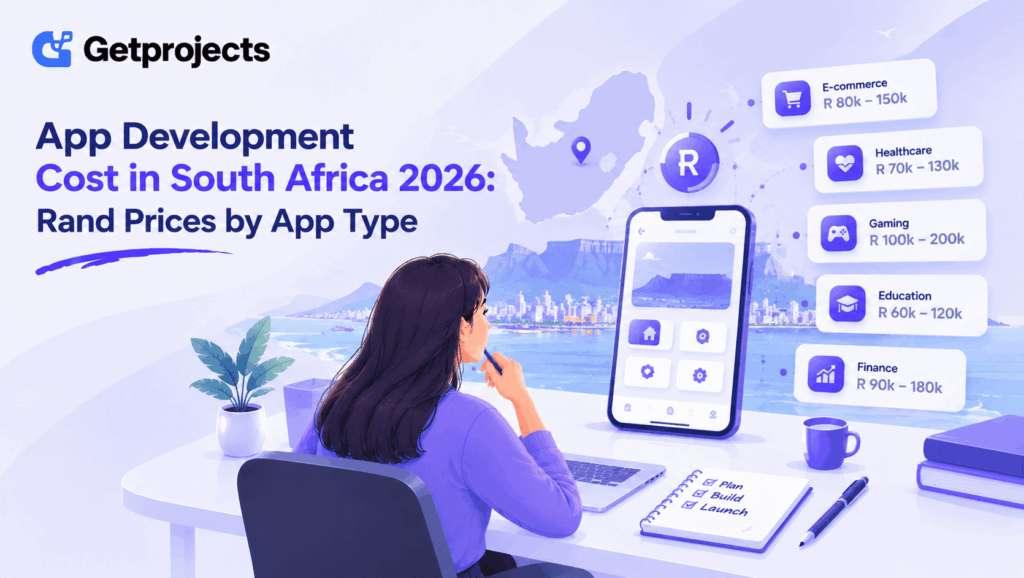
The ranges below reflect the app development cost South Africa agencies typically quote in 2026 for a single cross-platform app with a basic admin panel. Treat them as planning benchmarks alongside global mobile app development cost figures. Your final number will depend on scope depth, integrations and the team you choose.
Simple or MVP App: R80,000–R250,000
This tier covers 5–10 screens, user login, basic content, push notifications and a lightweight backend. Typical timeline: 6–10 weeks. It suits MVP development, where the goal is to validate demand rather than launch a finished product.
At this tier, the app development cost South Africa startups pay depends mostly on design quality and backend choices. Anything quoted under R80,000 is usually a template app or a freelance side project with no ongoing support built in.
Mid-Complexity Business App: R250,000–R650,000
This tier adds user profiles, third-party API integrations, in-app payments, booking or scheduling logic, and a proper admin dashboard. Typical timeline: 3–5 months. Most service businesses, clinics, gyms and B2B portals land here.
This is also the band where app development cost South Africa estimates vary most, because integration depth is hard to judge from a short brief.
E-commerce App: R300,000–R900,000
This tier includes product catalogues, cart, checkout, order tracking and payment gateway integration with local providers such as PayFast, Yoco, Peach Payments or Ozow. Typical timeline: 4–6 months.
Payment and inventory logic make up most of the app development cost South Africa retailers face at this level. Costs rise sharply when the app must sync inventory with an ERP or handle stock across several warehouses.
On-Demand and Marketplace Apps: R600,000–R1.8 million
Delivery, ride-hailing, home-services and two-sided marketplace apps usually need three products: a customer app, a provider app and an admin panel. Real-time GPS, dispatch logic and payouts drive the price, which is why ride-hailing app development cost sits at the top of this band. Typical timeline: 6–9 months.
Because these projects involve three apps instead of one, the app development cost South Africa marketplace founders budget for is often double what a single-app business would spend.
How Much Does a Fintech App Cost in South Africa?
Fintech, lending, insurance and banking apps typically start at R1 million and can exceed R3.5 million. Security architecture, KYC and FICA verification flows, encryption, audit logging and regulatory review add 25–40% compared with a standard app of similar size. Typical timeline: 8–14 months.
For regulated products, the app development cost South Africa financial firms pay depends heavily on the agency’s compliance track record, not just its engineering capacity. That is why shortlisting specialised fintech software development companies matters more here than in any other tier.
Enterprise and Custom Platforms: R1.5 million and Above
Large organisations building internal workforce tools, multi-tenant SaaS products, or apps that integrate with SAP, Oracle or legacy systems should budget R1.5 million–R5 million or more. Delivery is usually phased over 9–18 months.
Custom app development at this scale is usually structured as a retained team rather than a single fixed-price project, the same model that shapes most custom software development cost for large builds. It keeps the app development cost South Africa enterprises carry predictable on a monthly basis.
Across all tiers, compare app development prices rand for rand only after confirming that each quote covers the same platforms, integrations and support period.
How App Development Cost South Africa Breaks Down by Phase
The top-line total of a quote hides where the money actually goes. A typical mid-complexity project splits roughly like this:
- Discovery and project scoping (8–12%): requirements workshops, user flows, technical architecture and a fixed feature list. Skipping this phase is the most expensive saving a buyer can make.
- UI/UX design (10–15%): wireframes, clickable prototypes and the final visual system.
- Frontend development (25–30%): the screens users interact with, built natively or with a cross-platform framework.
- Backend infrastructure and APIs (20–25%): databases, servers, authentication, the admin panel and third-party integrations.
- Quality assurance and testing (10–15%): testing across the many Android devices common in South Africa, performance checks on lower-end handsets, and security checks.
- Deployment and launch (3–5%): app store submissions, production environment setup and monitoring.
This structure explains why two app development cost South Africa quotes can look similar at the top line yet deliver very different products.
App Developer Hourly Rates in South Africa
Hourly pricing is still the clearest way to sanity-check a fixed quote, and South Africa sits competitively among software developer hourly rates by country. Typical 2026 app developer hourly rates south africa fall into three bands:
- Freelance developers: R350–R700 per hour. Suitable for small, well-defined builds.
- Small and mid-sized agencies: R650–R1,100 per hour, for a blended team of developer, designer, QA tester and project manager.
- Premium agencies in major metros: R1,000–R1,800 per hour, often with enterprise, fintech or regulated-industry experience.
To check a fixed quote, divide it by the agency’s blended rate to see how many hours they actually planned. A R500,000 quote at R900 an hour buys about 555 hours. That is roughly 14 weeks if four specialists each give your project 10 hours a week.
Rates only explain part of the app development cost South Africa buyers end up paying. Scope discipline explains the rest.
Mobile App Cost Cape Town vs Johannesburg vs Durban
Location still affects pricing, though less than most buyers expect. Agencies in Cape Town’s tech hub tend to price 10–20% above the national average, driven by demand from fintech, e-commerce and international clients. A typical mobile app cost Cape Town quote for a mid-complexity build sits between R300,000 and R750,000.
Johannesburg and Pretoria agencies price similarly for corporate and financial-services work, and they have more depth in enterprise integration. Durban and smaller-city agencies often come in 15–25% lower. That makes them strong options for MVPs and SME apps that don’t need specialised regulatory experience.
Since most agencies deliver remotely, you don’t have to hire in your own city. The more useful filter is whether an agency’s software company portfolio includes an app like yours, not where its office is.
Native vs Cross-Platform Development
Building separate native apps for iOS and Android development usually costs 1.6–1.9x as much as a single cross-platform build. Cross-platform frameworks such as Flutter and React Native now handle most business, e-commerce and marketplace use cases well, so most South African agencies default to them.
Platform choice is the single biggest lever on app development cost South Africa projects. Native still makes sense for apps that rely heavily on device hardware, complex animations, augmented reality or banking-grade security.
Hidden Costs Most Quotes Leave Out
Several line items rarely appear in the headline figure, yet they shape the app development cost South Africa businesses actually carry over the first year:
- App maintenance costs: 15–20% of the original build cost per year, for OS updates, bug fixes, security patches and minor features.
- Cloud hosting: R1,500–R25,000+ per month, depending on users and data load.
- App store accounts: Apple’s Developer Program costs $99 a year, and Google Play charges a $25 one-time registration fee.
- Third-party services: SMS one-time passwords, maps, email, analytics and payment processing fees.
- POPIA compliance: privacy policies, consent flows, decisions on where data is stored, and a legal review if the app handles sensitive personal data.
- Data-light optimisation: mobile data is still a real cost for many South African users, so keeping the app small and supporting offline use adds engineering time. It also directly improves retention.
Real-World Application: Two Agency-Hiring Scenarios
Case Study 1: Logistics startup, Johannesburg. The company needed a driver app and a dispatch dashboard for its logistics app development project. Its first round of bids on a commission-based platform ranged from R420,000 to R1.6 million, because the brief listed goals rather than features. After rewriting the scope as 22 defined user stories and shortlisting three verified agencies with logistics portfolios, it signed at R610,000 and launched in 16 weeks.
Case Study 2: Retail group, Durban. The group planned separate native iOS and Android loyalty apps, quoted at R720,000. It switched to a single Flutter codebase with an agency that had built two comparable retail apps. That brought the build down to R460,000, a 36% saving. The app launched in under five months, with maintenance budgeted at R7,000 per month.
Neither company cut its app development cost South Africa outlay by squeezing hourly rates. Both saved by fixing the scope and choosing agencies that had already solved the same problem.
Decision Framework: Choosing the Right Development Model
The way you hire affects the final app development cost South Africa projects end up with as much as the app’s feature list does. The choice between agency marketplaces vs direct matching is a large part of that decision.
| Hiring Model | Typical Cost (Mid-Complexity App) | Best For | Main Risk |
| Freelancer | R120,000–R300,000 | Simple MVPs and prototypes | Single point of failure, limited QA |
| Local South African agency | R250,000–R750,000 | Most business and consumer apps, POPIA-sensitive builds | Wide quality gap between agencies |
| Offshore agency | R180,000–R500,000 | Cost-sensitive builds with clear specs | Time-zone gaps, weaker local market knowledge |
| Bidding marketplace hire | Agency quote plus 10–20% commission built into the price | Buyers who need many quotes fast | Race-to-the-bottom bids, unverified vendors |
| Direct-match verified agency | Agency rate, no commission layer | Buyers who want vetted, comparable quotes | Requires a clear brief upfront |
Whichever model fits, run the same four checks before signing:
- A portfolio with at least two apps comparable to yours.
- A written feature list attached to the contract.
- A named team with seniority levels.
- A post-launch support clause with a defined monthly rate.
The contract type matters too. A fixed-price contract protects your budget when scope is stable. Time and materials suit products that will keep changing, where you want to reprioritise every sprint. Many buyers combine the two: a fixed price for the MVP, then a monthly retainer for ongoing work.
What Most Teams Get Wrong About App Budgets
Treating the lowest quote as the baseline. The cheapest bid is usually the one with the most missing assumptions. An unrealistically low price is also one of the classic red flags in a software development company, so read the exclusions before you look at the total.
Budgeting for launch instead of year one. A realistic app development cost South Africa budget is the build cost plus 20–30% for the first 12 months of hosting, maintenance and fixes. Teams that skip this end up pausing development right when user feedback starts arriving.
Overloading version one. In practice, about a third of the features in a typical first-version brief could wait for version two. Every extra feature adds design, development and testing time, along with long-term maintenance.
Ignoring the Android-first reality. Android handsets dominate the South African market, and many of them are mid-range or entry-level devices. An app tested mainly on recent iPhones will feel slow to a large share of real users.
Overlooking the commission layer. When an agency pays a platform 10–20% to win your project, that cost doesn’t disappear. It shows up either in the quote or in fewer hours spent on your build, which quietly inflates the app development cost South Africa clients pay for the same output. Weighing this against the cost of hiring an IT company directly makes the gap obvious.
Compare Verified App Agencies Before You Commit
A well-scoped brief and the right shortlist do more to control your budget than any rate negotiation. If you’re working through app development cost South Africa estimates and want to compare verified agencies without paying commissions or bidding blind, GetProjects matches your project with vetted development partners using 50+ data points, including budget, expertise and track record.
Post your app brief free in under two minutes at getprojects.ai and receive quotes from agencies built for your type of project.
Frequently Asked Questions
How much does it cost to develop an app in South Africa?
Most app development cost South Africa estimates in 2026 fall between R80,000 for a simple MVP and R1.8 million for an on-demand marketplace. Fintech and enterprise platforms often exceed R1 million and can pass R5 million. The final figure depends on features, integrations, platform choice and the agency’s experience with similar apps.
How much does a simple app cost in South Africa?
A simple app with 5–10 screens, user login and push notifications usually costs R80,000–R250,000 and takes 6–10 weeks. The price rises if you add payments, a custom admin panel or third-party integrations. Quotes far below R80,000 rarely include proper testing or post-launch support.
How long does it take to build an app in South Africa?
Simple apps take 6–10 weeks, mid-complexity business apps take 3–5 months, and marketplace or fintech apps take 6–14 months. Timelines slip mostly because of unclear scope, not slow developers. A fixed feature list signed off before development starts is the best protection against delays.
Is it cheaper to hire a freelancer or an agency for app development?
Freelancers charge less per hour (R350–R700), but they suit only small, well-defined builds. Agencies charge more because they supply design, development, QA and project management as one team. For anything beyond an MVP, an agency usually costs less over the full project because it avoids rework and handover gaps.
How much does app maintenance cost per year?
Budget 15–20% of the original build cost per year. A R500,000 app typically needs R75,000–R100,000 a year for OS updates, bug fixes, security patches and small improvements. Hosting and third-party services are billed separately and grow with your user base.
Can I build an app for under R100,000?
Yes, if the scope is tightly limited to a focused MVP with a handful of screens and no complex integrations. Expect to use a cross-platform framework and a lean backend. Plan to reinvest once you’ve validated demand, because a sub-R100,000 build is rarely designed to scale.
How do I find a verified app development agency in South Africa?
Start with a written brief that lists features, platforms and your budget range. Then shortlist agencies that have shipped comparable apps and can provide client references. GetProjects lets you post your project free and get matched with verified agencies across Cape Town, Johannesburg and other cities, with no bidding or commission fees.