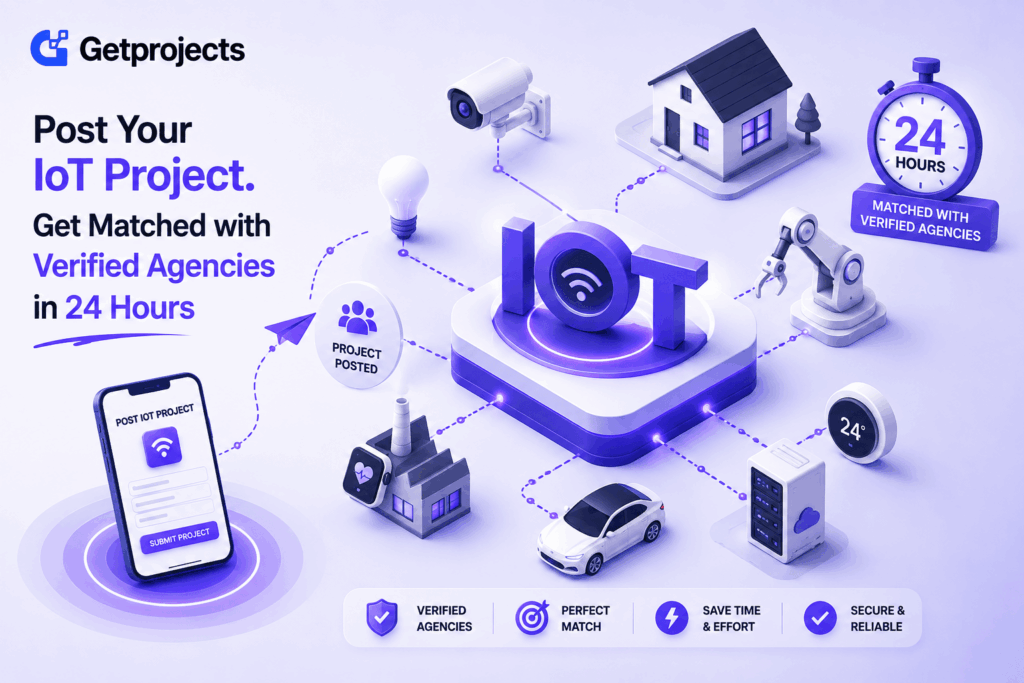
How to Post an IoT Development Project and Get Matched With Verified Agencies in 24 Hours
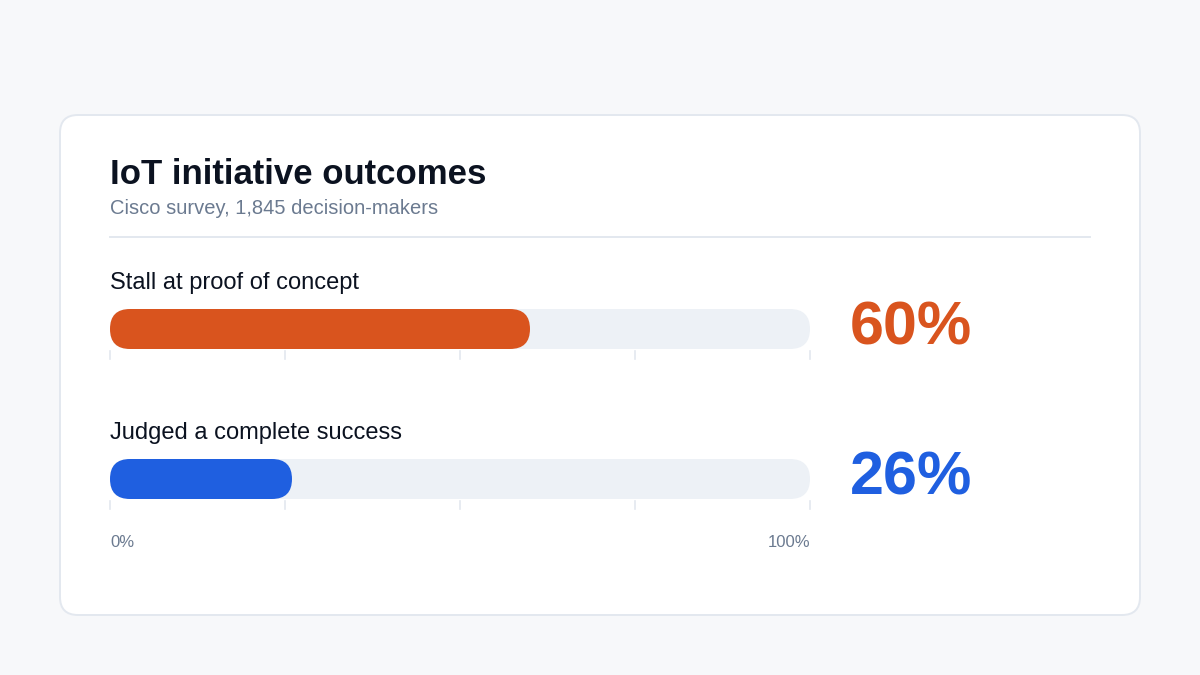
Sixty percent of enterprise IoT initiatives never make it past proof of concept, and only 26% are ever judged a complete success by the companies that funded them. The failure point is rarely the sensor, the gateway, or the cloud stack.
It is the partner decision made in week one. Teams that post a iot development project to a general freelance marketplace get generalists; teams that run a formal ten-week RFP get delays and a shortlist assembled from whoever their procurement lead already knew. Neither route reliably surfaces engineers who have shipped certified, connected hardware at volume.
Cisco surveyed 1,845 IT and business decision-makers and found that 60% of IoT initiatives stall at the proof-of-concept stage, with only 26% of companies reporting a fully successful IoT initiative. The three most cited reasons for stalling were lack of IT–business collaboration (54%), lack of a technology-focused culture (49%), and lack of in-house IoT expertise (48%).
That third statistic is the one that matters for sourcing. Nearly half of stalled projects stall because the expertise was not in the room which makes vendor selection a technical decision, not a procurement formality.
The economics of that decision have quietly changed. Commission-based bidding platforms still take 10–20% of contract value, and paid-listing directories still charge agencies $499+ per year to appear higher in a category. Both models optimize for the agency that pays or bids most aggressively, not the one that has already debugged a LoRaWAN payload at 4,000 nodes. Buyers who post a iot development project on either model pay twice: once in fees, once in filtering time.
A direct-connect model inverts that. You describe the build once, an AI matching layer compares it against verified agency data, and a short list of pre-vetted IoT development firms comes back inside a day. The rest of this guide walks through exactly what happens when you post a iot development project through that model, what to check at each stage, and where most teams still get it wrong.
What It Means to Post an IoT Development Project
To post a iot development project is to publish a structured technical brief scope, budget band, timeline, connectivity and hardware requirements to a marketplace that matches it against verified IoT development agencies. On a direct-connect platform the posting is free, takes under two minutes, and returns three to five vetted matches within 24 hours.
That definition carries three assumptions worth making explicit: the brief is structured rather than a paragraph of prose, the agencies are verified before the profile goes live, and the buyer pays the agency directly rather than paying a platform to make the introduction.
The Real Problem: Vendor Selection Is the Slowest Part of an IoT Build
Most teams budget engineering time and forget to budget sourcing time. A formal RFP cycle for an embedded systems partner runs 6–11 weeks from requirement drafting to signed SOW, and consumes 40–80 hours of internal effort across engineering, legal, and procurement. On a 20-week build, that is a quarter of the calendar spent before a single schematic is reviewed. Teams that post a iot development project through a structured marketplace compress the same shortlisting work into a single day.
The open-bidding alternative is faster to start and slower to finish. Teams that post a iot development project to a commission-based bidding marketplace typically generate 40–80 proposals in 72 hours. Fewer than five come from firms with shipped hardware experience, and the buyer absorbs the entire filtering cost.
There is also a compounding cost most teams price at zero: the wrong partner. Replacing an IoT vendor mid-build after a failed firmware milestone typically costs 3–4x the original discovery spend, because board revisions, certification retests, and cloud re-architecture all reset. Teams consistently underestimate that switching cost by exactly that multiple, which is why the hour spent deciding where to post a iot development project carries more leverage than any later sprint.
Add the commercial layer. A $95,000 IoT build on a 15% commission marketplace transfers roughly $14,000 to the platform. Directory-style competitors charge agencies a listing fee instead, which quietly becomes a pay-to-rank signal rather than a capability signal.
How to Post an IoT Development Project and Get Matched in 24 Hours
The mechanics below describe the actual client flow on a commission-free, no-bid marketplace. Each step exists to remove a specific failure mode from the traditional process, and together they explain why it now takes a day rather than a month to post a iot development project and reach a shortlist worth acting on.
The 5-Step Process
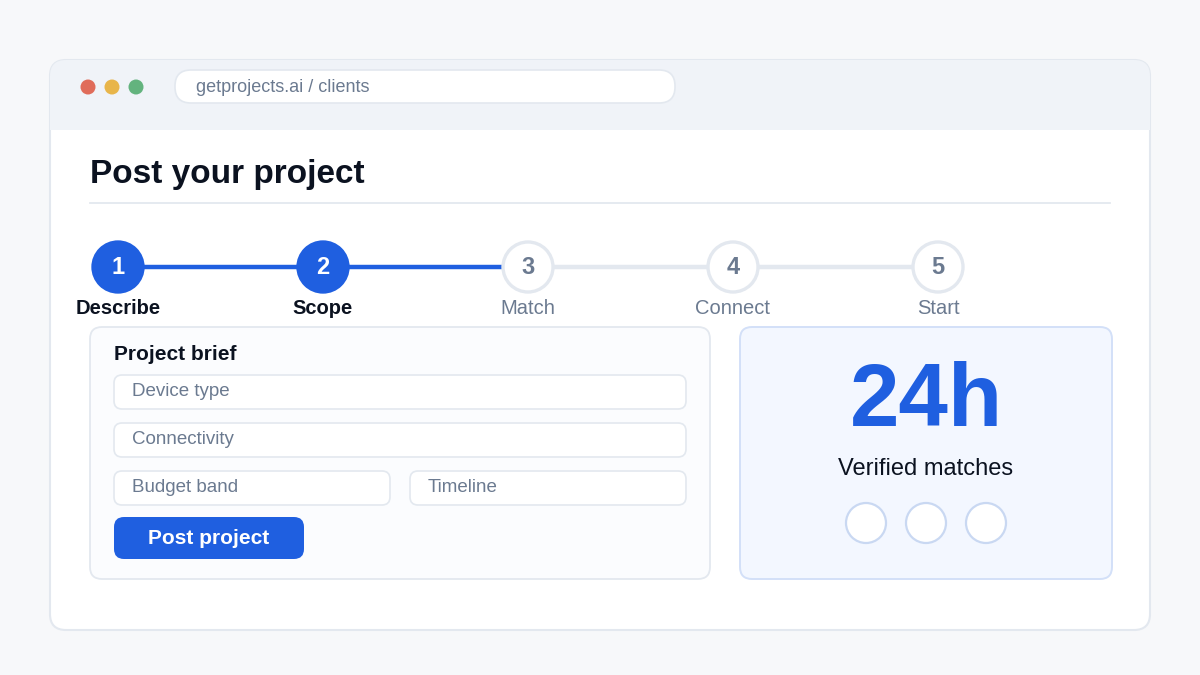
- Describe the build in plain language. There is no 40-field RFP template here you describe what the device does, what you already have, and what you need built. An AI layer converts that into a structured brief covering objectives, deliverables, tech stack, and engagement model in under two minutes.
- Confirm the four scope variables. Budget band, target timeline, engagement model (fixed-scope, dedicated team, or staff augmentation), and location or time-zone preference. These four fields drive most of the matching weight.
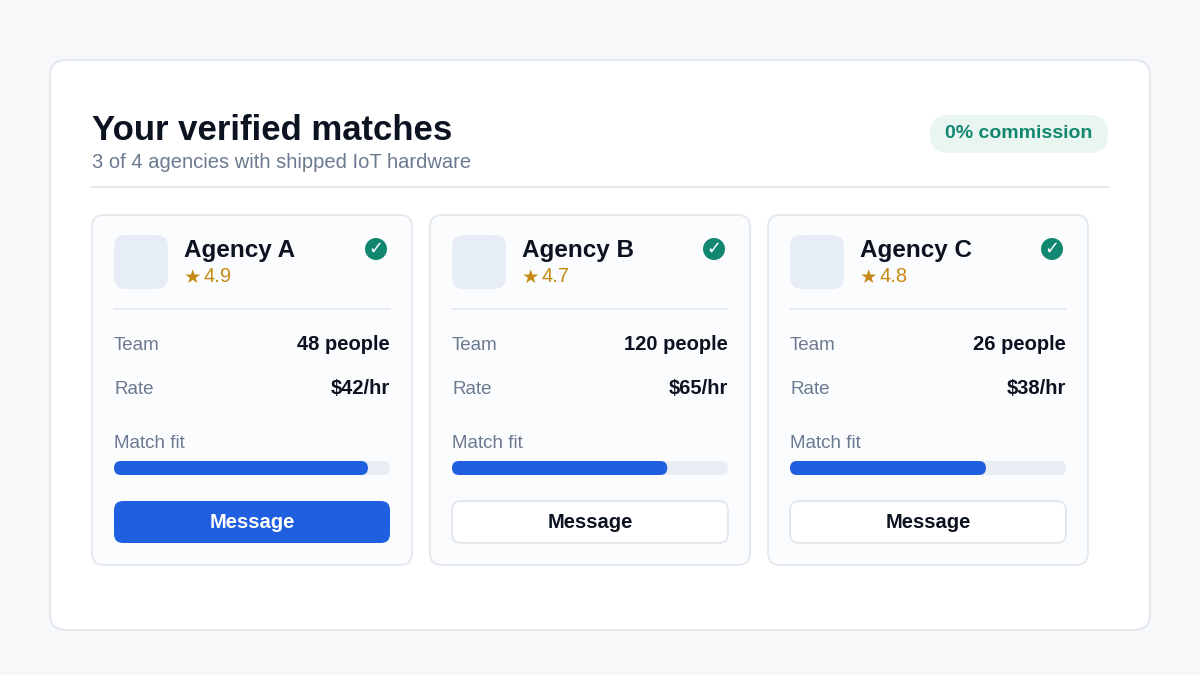
- Receive 3–5 verified agency matches within 24 hours. Each match arrives with a portfolio, team size, verified reviews, hourly rate range, domain expertise, and relevant past work enough to shortlist without a single discovery call.
- Connect directly with the agencies you like. No bidding war, no account manager relaying messages, no waiting for proposals to trickle in. You message the agencies you want and ignore the ones you don’t.
- Start the project with zero commission. The contract, the payment terms, and the relationship sit between you and the agency. The platform takes no cut of the contract value.
The practical effect is that shortlisting compresses from weeks to a day. Buyers who post a iot development project this way end up negotiating on capability rather than on price undercutting.
Post IoT Development Project Online: What Goes in a Brief That Actually Matches Well
Matching quality is bounded by brief quality. When you post a iot development project with a vague scope, the AI matching layer has fewer data points to work with and the shortlist widens instead of sharpening.
Include these six elements:
- Device and physical constraints form factor, power source (battery life target in months matters enormously), enclosure and environmental rating.
- Connectivity BLE, Wi-Fi, LoRaWAN, NB-IoT, or cellular, plus the protocol layer (MQTT, CoAP, HTTPS) if already decided.
- Existing assets whether you have a schematic, a working breadboard prototype, a proof of concept, or nothing but a spec document.
- Cloud and data layer AWS IoT Core, Azure IoT Hub, or a custom backend; expected message volume; whether edge computing is required.
- Compliance targets FCC/CE certification, ISO 27001, HIPAA, or industry-specific standards.
- Scale expectations: 50 units for a pilot behaves very differently from 50,000 units in production, and it changes which agencies should be matched to you at all.
Attach whatever exists a spec sheet, a schematic, even a failed prototype write-up before you post a iot development project. Matched agencies read attachments closely and quote more accurately against them.
Find Verified IoT Development Agencies: The Verification Layers That Matter
“Verified” means very different things across platforms. Self-declared badges based on an uploaded logo are common, so check which of the layers below a platform actually runs before you post a iot development project on it. Real verification for verified IoT development agencies is layered and happens before a profile goes live:
- Domain and website ownership the agency controls the domain it claims to operate.
- Business email verification no free-mail signups masquerading as firms.
- Third-party review validation ratings cross-checked rather than self-reported.
- Team and capability details headcount, roles, and disclosed tech stack reviewed against portfolio evidence.
- Manual review on top of AI screening automated checks catch scale, human review catches nuance.
For vendor vetting on an IoT build specifically, there is one check no platform runs for you: ask for a reference on a scaled deployment, not a pilot. Plenty of firms have shipped 100 devices. Far fewer have handled OTA firmware updates, fleet device provisioning, and field failures across 10,000.
Get IoT Development Quotes Fast Without Triggering a Race to the Bottom
Speed and quality usually trade off in sourcing, and open bidding is why. When 60 firms see the same brief, the winning bid tends to be the one from the firm that understood the scope least. Direct connect removes the auction dynamic: each matched agency quotes against your brief without seeing competitors’ numbers, so teams that post a iot development project on a no-bid platform see a tighter and more honest spread.
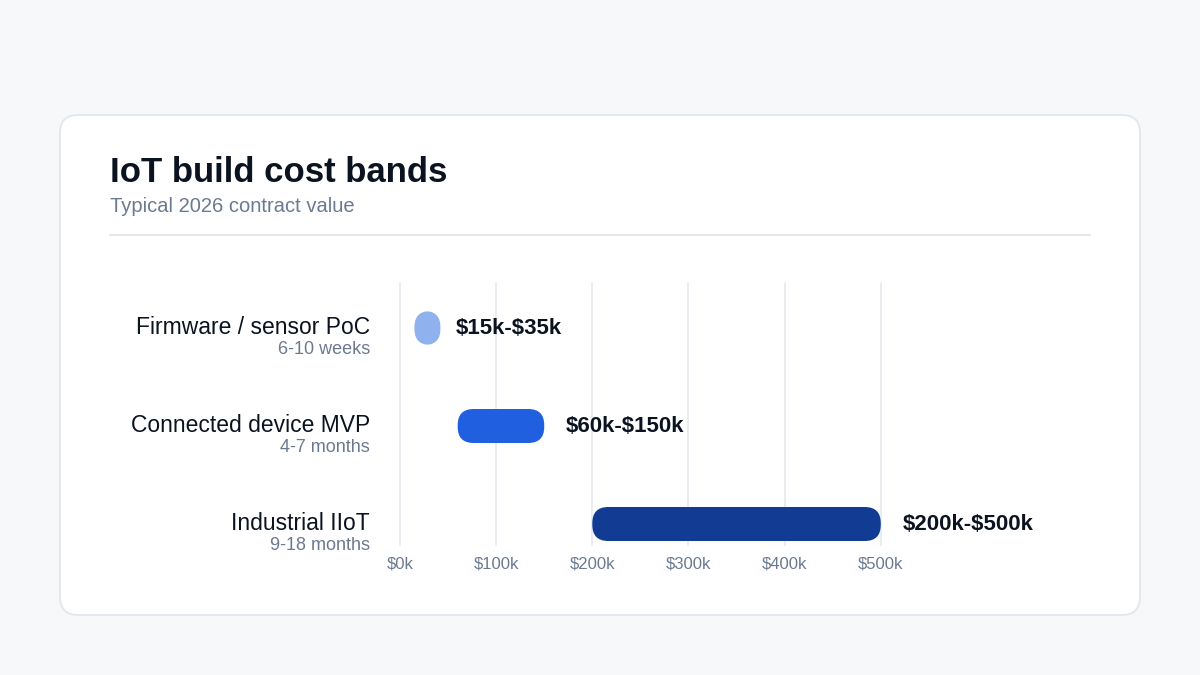
Typical 2026 ranges for scoping reference:
- Sensor or firmware PoC: $15,000–$35,000, 6–10 weeks
- Connected device MVP (hardware + firmware + mobile app + cloud): $60,000–$150,000, 4–7 months
- Industrial IIoT platform with sensor integration across existing machinery: $200,000–$500,000+, 9–18 months
- Blended hourly rates: $25–$45 (India, Eastern Europe), $55–$85 (Latin America, Southeast Asia), $90–$160 (US, Western Europe)
Use those bands as a sanity filter on every number that comes back. A quote 40% below the band is not a discount; it is usually a scope misread most often the certification, firmware engineering, and field-testing lines that get discovered in month three.
Hire IoT Development Company Free: Where the Money Actually Goes
Free posting is not a promotional trial. It costs nothing to post a iot development project, nothing to view or contact the matches that come back, and nothing at the point of contract clients pay only the agency they hire, directly. Agencies list free as well, which matters more than it sounds: when agencies pay nothing to appear, their ranking cannot be bought, so the shortlist reflects fit rather than ad spend.
Against a 15% commission platform, a $150,000 industrial build keeps roughly $22,500 inside the project. That is typically one additional hardware revision cycle, or three months of a dedicated firmware engineer the single largest saving available to anyone deciding where to post a iot development project.
Real-World Application
Cold-chain logistics startup, 11 months to launch. The team first sent its temperature-monitoring brief to a bidding marketplace and received 63 proposals in four days; two mentioned LoRaWAN and neither had shipped a certified device. They then chose to post a iot development project on a direct-connect marketplace, received four verified matches in under 24 hours two with live cold-chain deployments and signed within nine days against a previous seven-week sourcing cycle. On a $95,000 contract, the zero-commission model kept approximately $14,000 in the build budget.
Mid-market manufacturer, predictive maintenance retrofit. The requirement was vibration and current sensing across 140 legacy machines, with Modbus and OPC-UA integration and an on-prem edge tier constraints the team attached in full when it went to post a pilot development project. Three verified agencies were shortlisted, one ran a paid three-week discovery, and production rollout completed in five months. The comparable route quoted earlier a broker introduction at a 20% finder’s fee would have added roughly $48,000 to a $240,000 program.
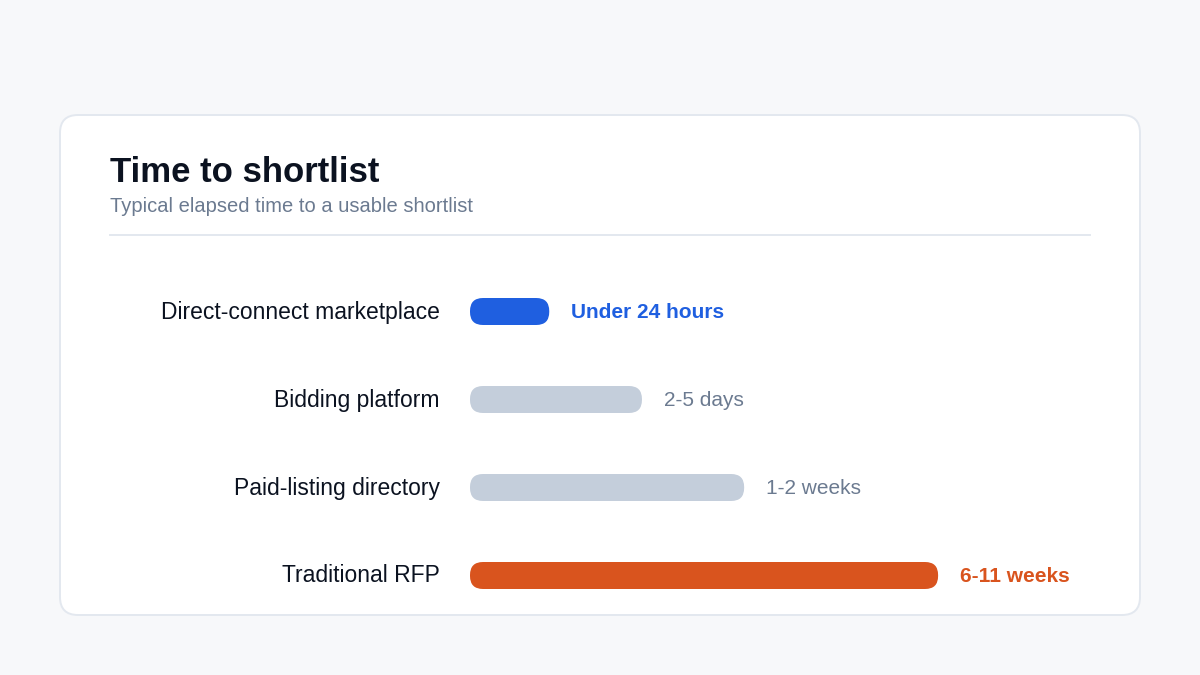
Comparison Framework: Four Ways to Source an IoT Partner
Almost every buyer ends up in one of four models. The differences that matter are time to shortlist, cost to the client, and how much vetting happens before a name reaches you.
| Sourcing model | Time to shortlist | Cost to client | Vetting depth | Best for |
| Direct-connect verified marketplace | Under 24 hours | Free; 0% commission | AI + manual, pre-listing | Founders and CTOs who need speed and cost control |
| Commission-based bidding platform | 2–5 days, 40–80 proposals | 10–20% of contract value | Self-reported, post-signup | Small, low-risk, well-defined tasks |
| Paid-listing directory | 1–2 weeks of manual research | Free to browse; agencies pay $499+/yr | Listing fee, not capability | Early-stage market scanning only |
| Traditional RFP / procurement | 6–11 weeks | 40–80 internal hours | Deep but slow | Regulated enterprise programs |
The table is a filter, not a verdict. A regulated medical-device build should still go through formal procurement; a $60,000 connected-product MVP almost never should. Match the model to the risk profile before you post a iot development project, not after the first quote disappoints.
What Most Teams Get Wrong When They Post an IoT Development Project
They treat “IoT” as a single skill. There are at least five: electronics and PCB design, firmware and RTOS work, connectivity, cloud and data engineering, and certification. Most agencies are strong in two or three. The shortlist should be built around the two you are weakest in internally, not around the ones that demo well. Name those two gaps explicitly when you post a iot development project and match quality changes immediately.
They optimize the hourly rate on a project where the rate is not the variable. On hardware programs, BOM decisions, antenna tuning, and certification retests move the total more than a $20/hour delta ever will. A firm that gets you through FCC on the first submission is cheaper at $120/hour than a firm that fails twice at $45.
They write briefs that describe a solution instead of a constraint set. “Build us an app that shows tank levels” invites 60 identical proposals. “Battery-powered level sensor, 3-year battery life, −20°C to 60°C, 400 sites, no cellular coverage at 30% of them” invites four proposals from firms that have solved that exact problem and the constraint version is what an AI matching layer can act on when you post a iot development project.
They confuse responsiveness with capability. The agency that replies in nine minutes with a full proposal usually has bench capacity, not relevant experience. The one that comes back in a day with three sharp questions about duty cycle and gateway placement is the one to call.
They skip the scaled reference check. Pilot success and fleet success are different engineering problems, and the gap between them is where most of that 60% PoC stall rate actually lives.
Start Your Project
If you are scoping a connected-product build and want to compare vetted engineering partners without paying commission, bidding against 60 unqualified proposals, or spending six weeks on an RFP, the direct-connect route is the faster path.
Submit iot development requirement online in under two minutes, review three to five verified matches inside 24 hours, and talk to as many of them as you want before committing to anything.
GetProjects hosts verified IT and IoT agencies across 50+ cities, with layered verification before listing and 0% commission on every project. Post a iot development project today and see who is genuinely qualified to build it.
Frequently Asked Questions
Is it free to post an IoT development project?
Yes. There is no listing fee to post a iot development project, no charge to receive or contact matches, and no percentage deducted from the contract. Clients pay only the agency they choose to hire. Agencies also list for free, which prevents paid placement from distorting the shortlist you see.
How are IoT development agencies verified?
Verification is layered and happens before a profile goes live: domain and website ownership, business email domain, third-party review validation, and team and capability details. Automated screening runs at scale and manual review handles judgment calls. No profile enters the matching pool on self-declaration alone, so every match returned when you post a iot development project has already cleared each layer.
Can I talk to multiple IoT development agencies before choosing one?
Yes, and you should. Each of the three to five matches is contactable directly with no exclusivity, no intermediary, and no obligation. Most buyers run short scoping calls with all matches, then take two into deeper technical discussion. Talking to fewer than three makes it hard to calibrate whether a quote is reasonable.
How long does it take to get matched with IoT development agencies?
Matches are returned within 24 hours. The brief takes under two minutes to submit, and the matching layer compares it against 50+ data points including budget fit, domain expertise, client history, and performance. Buyers who post a iot development project with existing assets and compliance targets attached generally see a tighter shortlist.
How much does an IoT development project cost?
Firmware or sensor proofs of concept typically run $15,000–$35,000 over 6–10 weeks. A full connected-product MVP spanning hardware, firmware, app, and cloud runs $60,000–$150,000 over 4–7 months. Industrial deployments with legacy machine integration start near $200,000. Certification and field testing are the lines most often under-scoped.
Do I have to pay commission when I hire an IoT development company?
Not on a zero-commission platform. Bidding marketplaces typically take 10–20% of contract value, and directory-style platforms charge agencies annual listing fees that get priced back into quotes. In a direct-connect model, the contract and payment sit entirely between client and agency.
What should an IoT development project brief include?
Device and power constraints, connectivity and protocol choices, existing assets such as schematics or a working prototype, cloud and data expectations, compliance targets, and production scale. You can post a iot development project with an incomplete spec. The AI brief builder fills structural gaps, and matched agencies pressure-test the rest on the first call.