
Software Development Contract Checklist: 14 Clauses You Cannot Skip
Disputes between businesses and development agencies rarely begin in a courtroom. They begin the moment one side says “that was obviously included” and the other side opens the agreement and proves it wasn’t. By then the leverage is gone, the code is half-finished, and the only remaining options are expensive.
A working software development contract checklist exists to prevent that exact conversation. Not to make the relationship adversarial to make it specific.
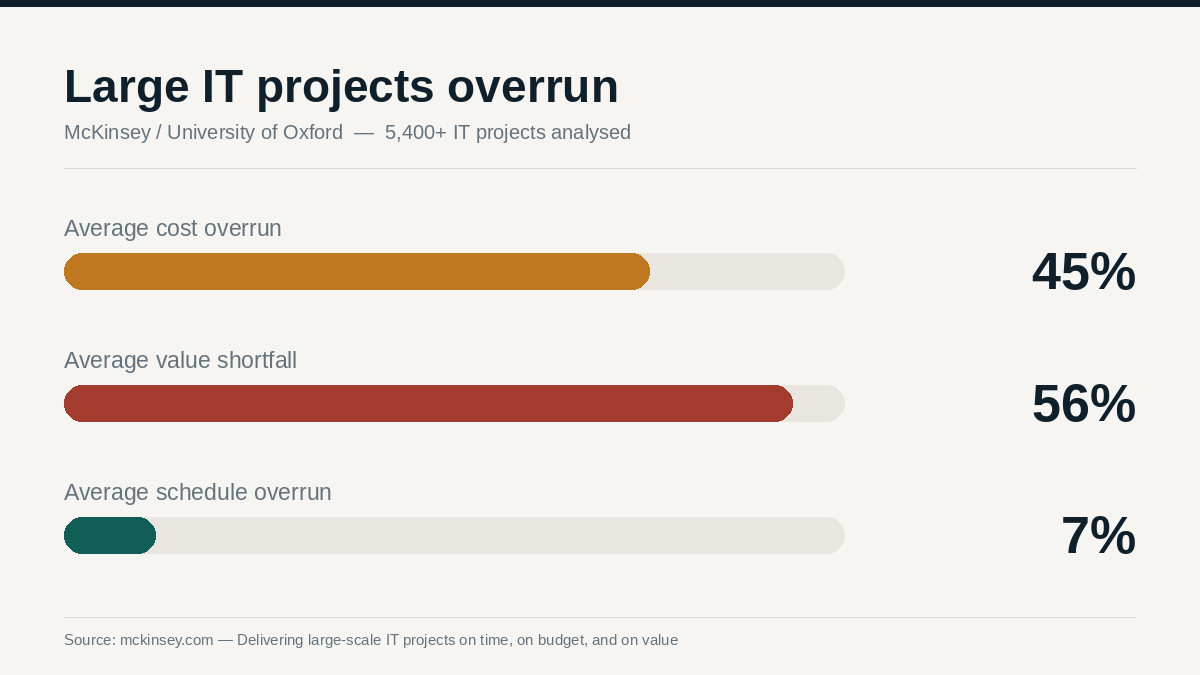
McKinsey, working with the University of Oxford’s BT Centre for Major Programme Management, analyzed more than 5,400 IT projects and found that large IT projects run 45% over budget and 7% over time while delivering 56% less value than predicted with software projects carrying the highest risk of cost and schedule overruns.
Those overruns don’t distribute themselves fairly. They land on whoever the contract says they land on. A vaguely worded agreement pushes every ambiguity toward the party with less legal budget, which in a client-agency relationship is usually the client on the first project and the agency on the tenth.
The pattern is consistent across the outsourcing market: the contract gets signed in week one because everyone is excited, and gets read in month four because someone is angry. Teams spend three weeks vetting an agency’s portfolio and forty minutes reviewing the document that governs a $80,000 engagement. A software development contract checklist is what closes that gap.
This guide is the reverse of that. Fourteen clauses, each with what it actually does, what a weak version looks like, and one line of language that closes the gap. Use it as a working document, not a template to sign blindly.
What Is a Software Development Contract Checklist?
A software development contract checklist is a structured review list of the clauses a development agreement must contain scope, intellectual property, payment milestones, acceptance, warranty, liability, termination, and data handling used to identify missing or one-sided terms before signing. It converts contract review from a legal reading exercise into a repeatable procurement step.
The Core Problem: Ambiguity Is Priced Into Every Estimate
Agencies quote against risk they cannot see. When scope language is soft, a competent agency prices a 20–35% buffer into the proposal or plans to recover margin through change requests later. Either way, the client pays for the vagueness.
The numbers behind failed engagements are boring and repetitive. In mid-market projects between $25,000 and $150,000, the three most common breakdown points are acceptance disputes (the client says it isn’t done, the agency says it is), IP ownership discovered after launch, and milestone payments that stopped being tied to anything measurable around week six all of which are easier to catch when you compare quotes side by side before shortlisting.
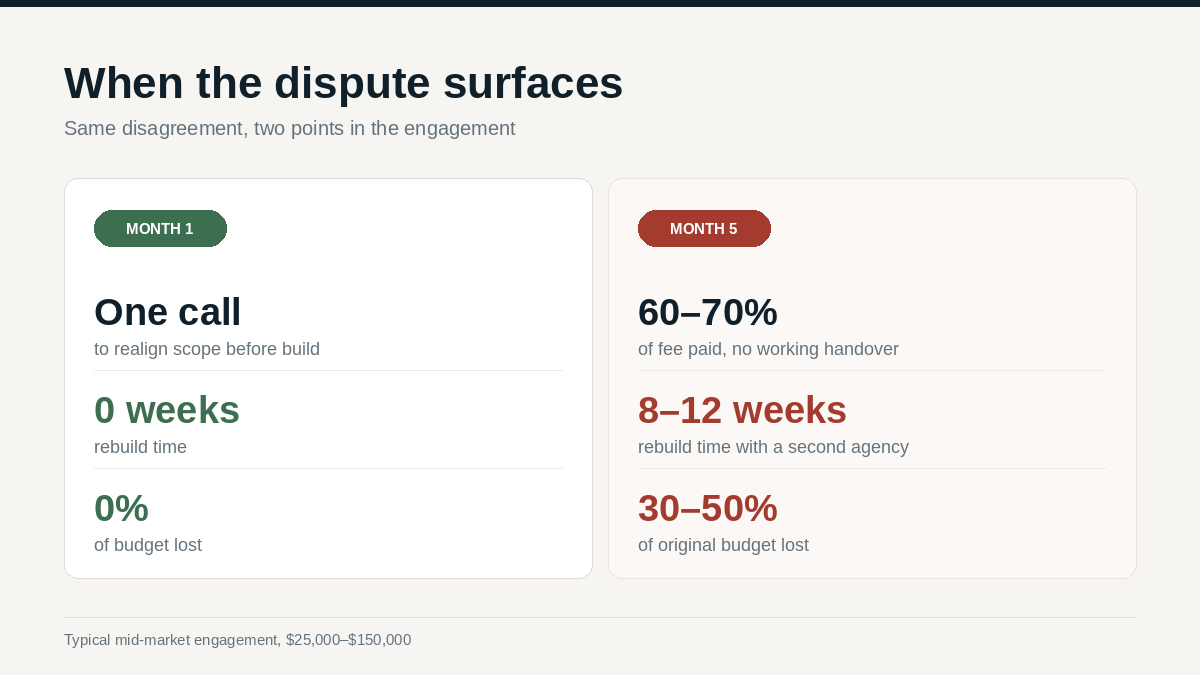
Timelines matter too. A dispute that surfaces in month one costs a difficult call. The same dispute in month five with 60–70% of the fee paid and no working handover costs 8–12 weeks of rebuild time and typically 30–50% of the original budget to bring a second agency up to speed.
The window in which you can protect yourself in a software contract closes at signature, not at kickoff. Cross-border engagements narrow it further. When the agency is in a different jurisdiction, an unenforceable dispute clause is functionally the same as no clause. Knowing what to include in a dev contract for a cross-border relationship is not a legal nicety; it determines whether any of the other 13 clauses can be enforced at all.
None of this requires a large legal spend. Running a software development contract checklist requires knowing which fourteen things to look for, and roughly an hour of attention.
The 14 Software Development Agreement Clauses You Cannot Skip
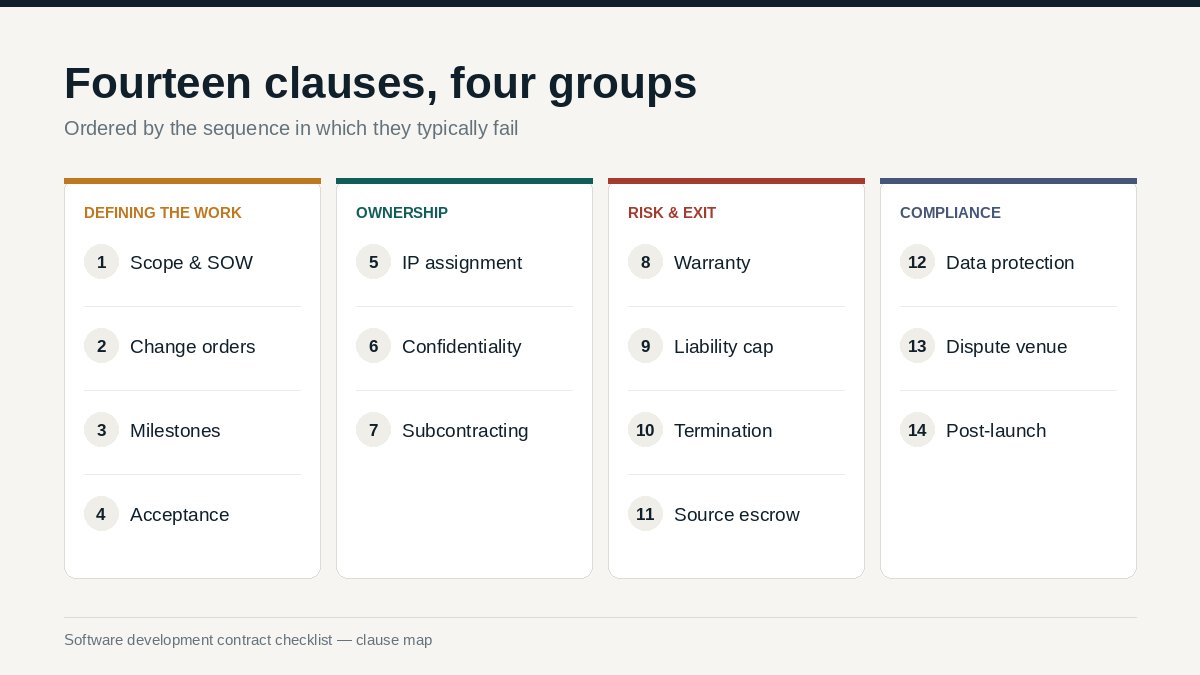
The software development agreement clauses below are ordered by the sequence in which they typically fail, not by legal importance. Each entry gives the function, the weak version, and one sentence of safer language you can adapt with counsel. Treat this as the operative section of your software development contract checklist.
Clauses 1–4: Defining the Work
- Scope and Statement of Work. Defines exactly what is being built, in what environment, to what functional standard. Red flag: Scope described in features (“user dashboard”) with no reference to an attached, versioned statement of work (SOW). Safe language: “The Services are limited to those described in SOW v1.2 dated [date], attached as Exhibit A; anything not expressly listed is out of scope.”
- Change Order Process. Governs how new requests get priced, approved, and scheduled. Red flag: A change order process that lets the agency proceed on verbal or Slack approval, or that is silent on timeline impact. Safe language: “No change is billable unless documented in a written change order stating cost, revised delivery date, and signed by both parties before work begins.”
- Milestones and Payment Schedule. Ties money to verifiable delivery. Red flag: Milestone payments tied to calendar dates or percentages of elapsed time rather than deliverables. Safe language: “Each milestone payment becomes due only upon written acceptance of the corresponding deliverable under Section [Acceptance].”
- Acceptance and Testing. Establishes how “done” is proven. Red flag: Deemed acceptance after 3–5 days of silence, with no defined acceptance criteria. Safe language: “Client has 10 business days to test each deliverable against the acceptance criteria in the SOW and may reject in writing with specific defects; the deliverable is accepted only on written sign-off.”
Clauses 5–7: Ownership and Confidentiality
- Intellectual Property Assignment. Determines who owns the code, designs, and documentation. Red flag: IP transfers “upon completion” or “upon full payment” with no definition of either, or the agency retains a broad license to reuse custom components. Safe language: “All deliverables are works made for hire; to the extent any do not qualify, Agency irrevocably assigns all right, title and interest to Client upon creation, subject only to payment of undisputed invoices.”
- Confidentiality. Protects business logic, customer data, and roadmap detail. Red flag: Mutual NDA language that expires in 12 months and excludes anything “generally known in the industry.” Safe language: “Confidentiality obligations survive termination for five years, and indefinitely for trade secrets and personal data.”
- Subcontracting and Key Personnel. Controls who actually writes the code. Red flag: Unrestricted subcontracting rights the reason a vetted agency can quietly hand a build to a third-party shop you never evaluated. Meaningful subcontractor approval language is the fix. Safe language: “Agency may not subcontract any portion of the Services without Client’s prior written consent, and remains fully liable for subcontractor performance.”
Clauses 8–11: Risk, Remedies, and Exit
- Warranty. Covers defects found after acceptance. Red flag: A 15–30 day warranty period, or warranty voided by any client-side code change. Safe language: “Agency warrants deliverables will conform to the specifications for 90 days after acceptance and will remediate non-conformities at no charge.”
- Limitation of Liability. Caps financial exposure on both sides. Red flag: A limitation of liability capped at one month’s fees, or at $0, with no carve-outs. Safe language: “Liability is capped at total fees paid under this Agreement, except for breaches of confidentiality, data protection obligations, IP indemnity, gross negligence, or willful misconduct.”
- Termination. Defines how either side exists and what happens to work in progress. Red flag: Termination for convenience available only to the agency, or a clause that says nothing about handover. Safe language: “Either party may terminate for convenience on 30 days’ notice; on any termination, Agency delivers all completed and in-progress work product, source code, and credentials within 5 business days.”
- Source Code Escrow. Protects continuity if the agency dissolves or goes dark. Red flag: Escrow mentioned without a release trigger, or a repository “backup” that only the agency can access. Safe language: “Agency shall deposit current source code with [escrow agent] monthly, releasable to Client upon insolvency, breach, or cessation of business.”
Clauses 12–14: Compliance, Venue, and Continuity
- Data Protection. Governments handling of personal and regulated data. Red flag: No data processing agreement (DPA), no named sub-processors, no breach notification window, a serious exposure if the build touches EU, UK, or healthcare data. Safe language: “Agency acts as processor, processes personal data only on documented instructions, and notifies clients of any breach within 24 hours.”
- Governing Law and Dispute Venue. Decides where and how disputes are resolved. Red flag: Venue in the agency’s home jurisdiction with no arbitration alternative often the single most expensive line in a cross-border agreement. Safe language: “Disputes are resolved by binding arbitration under [ICC/SIAC/AAA] rules seated in [neutral city], in English, with each party bearing its own costs.”
- Post-Launch Support and Transition. Covers the 30–90 days after go-live. Red flag: Support quoted verbally, or a handover clause with no documentation standard. Safe language: “Agency provides 60 days of post-launch support at no additional charge and delivers deployment documentation, architecture notes, and a recorded handover session.”
How to Run This Review in 45 Minutes
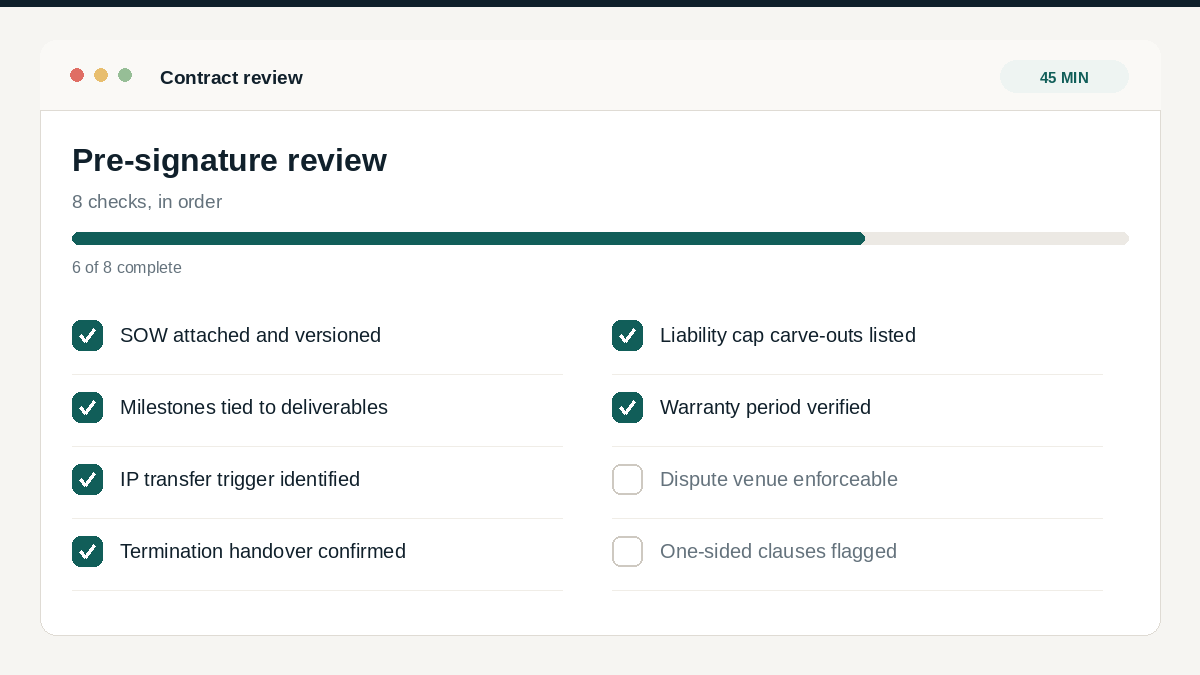
Working through what to include in a dev contract is faster with a fixed sequence. Run the software development contract checklist in this order:
- Confirm the SOW is attached, versioned, and referenced by name in the agreement.
- Trace each payment milestone back to a named deliverable and an acceptance test.
- Locate the IP clause and identify the exact trigger for transfer.
- Read the termination clause and confirm handover obligations exist on both sides.
- Check the liability cap and list which carve-outs are present.
- Verify the warranty period and what voids it.
- Confirm the dispute venue is enforceable where the agency actually operates.
- Flag every clause that appears in the agency’s favour only, and negotiate those as a package rather than one at a time.
A first pass through this software development contract checklist takes under an hour and surfaces the majority of one-sided terms before any legal spend.
Real-World Application: Two Engagements, Two Outcomes
The two engagements below differ in one variable: whether anyone ran a software development contract checklist before signing.
A B2B SaaS company, 40 employees, $95,000 build. The agreement tied IP transfer to “project completion,” which was never defined. When the client paused the project at 70% to reprioritize, the agency retained ownership of the codebase and the migration to a second vendor took 11 weeks and roughly $38,000 in rebuild cost. A single sentence assigning IP on creation would have removed the leverage entirely.
A logistics startup sourcing an offshore agency, $62,000 build. Before signing, the procurement lead ran a clause-by-clause review, replaced deemed acceptance with a 10-day written sign-off, and added a 90-day warranty. Two defects surfaced in week three post-launch and were remediated at no cost. Total contract negotiation time: two days. Estimated avoided cost: 9,000–14,000 in patch work.
Decision Framework: Which Clauses Matter Most for Your Engagement Type
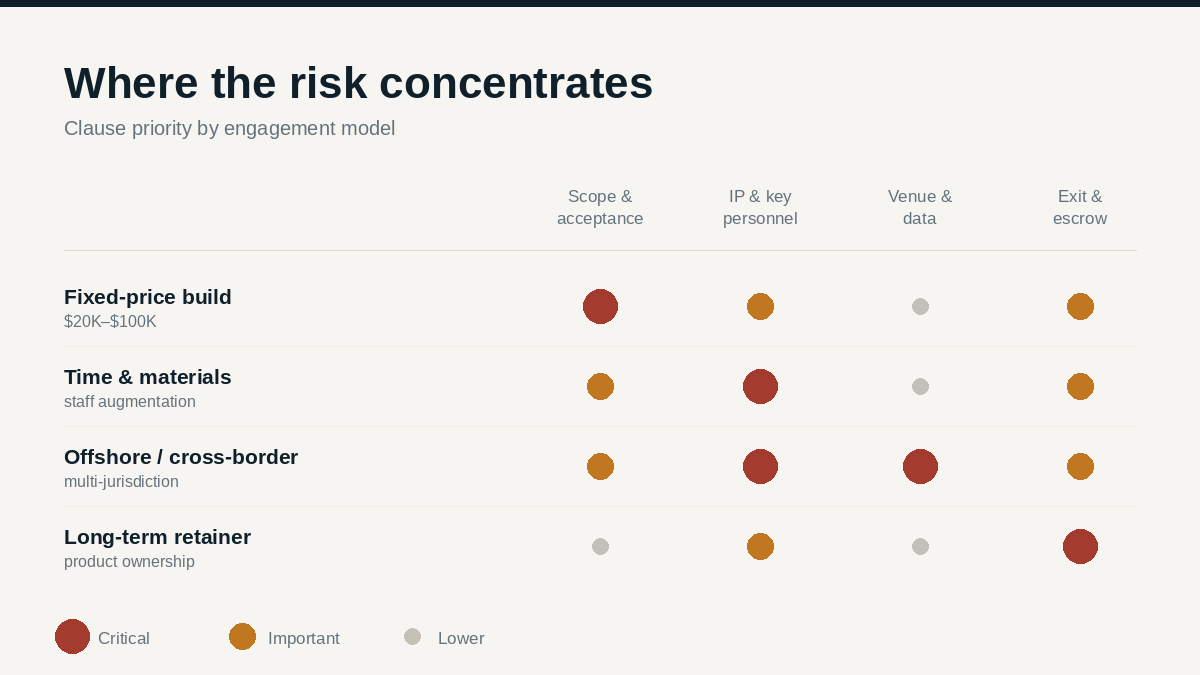
Not every clause carries equal weight. Priorities in a software development contract checklist shift with engagement model and project size.
| Engagement type | Highest-risk clauses | Usually negotiable | Common oversight |
| Fixed-price build (20K–100K) | Scope, acceptance, change orders | Warranty length, support window | Change order pricing left blank |
| Time & materials / staff augmentation | Key personnel, IP, rate escalation | Liability cap, notice period | No cap on total spend |
| Offshore / cross-border | Dispute venue, data protection, IP | Payment currency, milestones | Unenforceable venue clause |
| Long-term retainer or product ownership | Escrow, termination, transition | Support SLA, exclusivity | No handover documentation standard |
Comparing fixed-price vs time and materials on contract terms alone is often more revealing than comparing the quoted rates. Fixed-price agreements shift delivery risk to the agency and make scope language decisive; T&M agreements shift it to the client and make personnel and spend-cap language decisive.
What Most Teams Get Wrong
The second mistake is treating software contract red flags as legal problems. They are usually operational tells. A vague acceptance clause often means the agency does not run structured QA. Missing key-personnel language often means the team you met on the pitch is not the team that will build. Unrestricted subcontracting frequently means the shop is a reseller.
Push back on three clauses and watch closely. An agency that explains its position, offers alternative language, and holds firm on one or two terms is a partner. An agency that accepts every edit without comment is either desperate or not reading it, and both predict problems. An agency that refuses to discuss IP assignment or subcontracting has told you something important.
The second mistake is treating software contract red flags as legal problems. They are usually operational tells. A vague acceptance clause often means the agency does not run structured QA. Missing key-personnel language often means the team you met on the pitch is not the team that will build. Unrestricted subcontracting frequently means the shop is a reseller.
Third: teams over-invest in the negotiation and under-invest in the vetting. On a marketplace where verification is layered website, email domain, reviews, team composition, delivery history a large share of these red flags never appear, because agencies that operate that way don’t survive the screening. Contract rigor and vendor vetting are the same activity performed at two different moments, and a software development contract checklist is simply the later half written down.
Finally, most teams negotiate clauses individually and lose. Bundle them: concede the liability cap in exchange for the IP trigger and the escrow deposit. Agencies price packages, not paragraphs.
Before You Sign, Compare More Than One Agency
Contract terms are negotiable in proportion to your alternatives. A single shortlisted vendor gives you almost no leverage on IP, acceptance, or liability; three comparable, verified agencies give you all of it. That is the quiet advantage a software development contract checklist depends on.
If you’re scoping a build and want to see how different partners respond to the same clause requirements, GetProjects lets you post a project in under two minutes and connect directly with verified IT companies with no bidding wars, no commission cuts, no listing fees. Post the scope, compare the responses, and run the software development contract checklist against each agreement before you commit.
Frequently Asked Questions
What should be included in a software development contract?
At minimum: a versioned statement of work, milestone-linked payment terms, written acceptance criteria, IP assignment, confidentiality, warranty, limitation of liability, termination and handover, subcontracting limits, data protection terms, change order procedure, and governing law. A useful development contract template guide or software development contract checklist treats these as a floor, not a ceiling project-specific risks warrant additional terms.
Who owns the code in a software development contract?
Whoever the assignment clause says owns it. Absent explicit assignment language, default rules in many jurisdictions leave copyright with the developer, even after full payment. Knowing how to protect intellectual property in a software development contract comes down to one mechanism: assignment on creation, with a fallback license, rather than transfer conditioned on undefined milestones.
What is an acceptance clause in a software development agreement?
It defines how a deliverable is formally approved and, critically, what happens if it isn’t. A strong version specifies a testing window (typically 5–15 business days), objective acceptance criteria drawn from the SOW, a written rejection right listing specific defects, and a remediation cycle. Weak versions rely on deemed acceptance after silence.
What happens if a development agency misses a milestone?
That depends entirely on whether the contract attaches a consequence. Well-drafted agreements include a cure period (10–15 days), a right to withhold the associated payment, and escalation to termination for repeated failures. Many agreements include none of these, which is why a software development contract checklist flags milestone remedies specifically; without them, a missed date is a scheduling inconvenience with no consequence attached.
Is source code escrow worth it for a small project?
For builds under roughly $25,000 with the repository already hosted in the client’s own Git organization, escrow is usually unnecessary overhead. It earns its cost when the agency controls the repository, the system is business-critical, or the engagement runs past 6 months. The cheaper substitute is a contractual requirement that all code be committed to a client-owned repository from day one.
What is a reasonable liability cap for a software project?
Total fees paid under the agreement is the common market standard, with carve-outs for confidentiality breach, data protection violations, IP indemnity, and willful misconduct. Caps set at one or three months of fees are aggressive in the agency’s favour. If a prospective partner refuses any carve-outs at all, that is worth raising during evaluation and worth comparing against how other verified agencies respond to the same software development contract checklist.