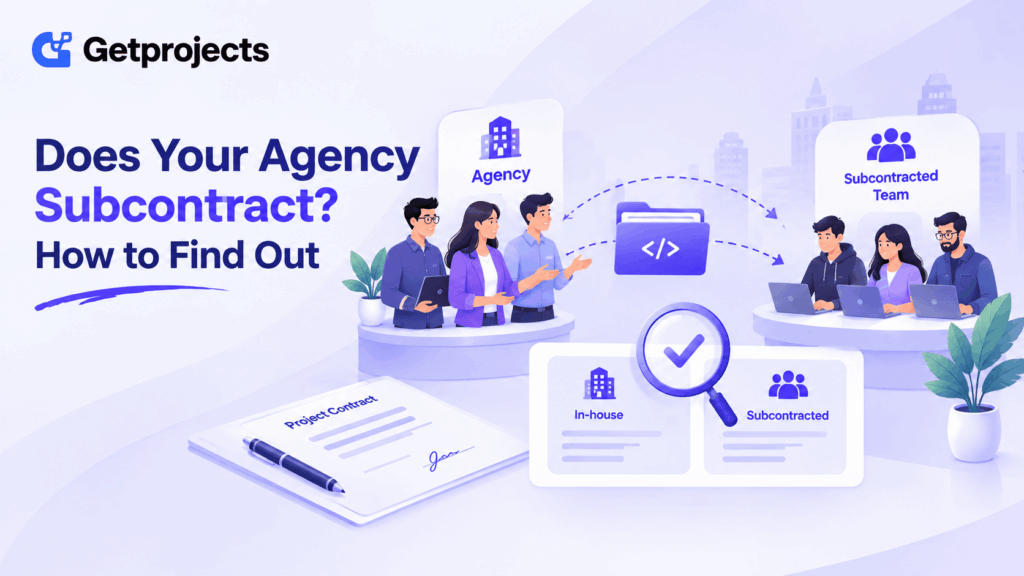
Does Your Agency Subcontract the Work? How to Find Out
The engineers who pitch your project and the engineers who build it are often not the same people. That is why the question does your agency subcontract work belong in your first vendor call, not in month three of missed sprints.
The pattern is predictable. A principal architect and two senior developers lead discovery, answer every technical question well, and help a software development agency close a 40,000–150,000 contract. Within two weeks of kickoff, they move on to the next sales pitch, and delivery shifts to a junior bench, a partner shop, or a freelancer network you never vetted.
None of this is disclosed in the proposal. It surfaces later as code that fails review, a project manager who relays every answer with a 24-hour delay, and velocity that drops by half after the first demo. By the time most buyers ask “does your agency subcontract work,” two to three months of budget are already gone.
Outsourcing chains are also getting longer. Agencies resell capacity from other agencies, rent offshore benches, and white-label entire builds. Subcontracting by itself is not the problem. The risk comes from work that is undisclosed, unapproved, and uncontrolled by contract.
The 2026 Verizon Data Breach Investigations Report found that breaches involving a third party jumped 60% year over year and now account for 48% of all breaches. Every unknown subcontractor with access to your repository or cloud console adds to that exposure.
This guide covers three things. It explains how the handoff pattern works, lists the signals that reveal an agency outsourcing your project without telling you, and gives you contract language that closes the loophole.
What Is Agency Subcontracting in Software Development?
Agency subcontracting is the practice of a software agency passing all or part of a client’s project to a third party, such as another agency, a freelancer network, or an offshore partner, while remaining the client’s contracted vendor. It can be disclosed and approved, or hidden behind the agency’s brand, which is where most of the risk sits.
The hidden version is usually called white labeling. A partner builds the product, the agency rebrands the output, and the white label development risk transfers quietly to you: unknown engineers, unvetted security practices, and intellectual property that passes through a contract you never saw.
The disclosed version is a different situation. A third-party subcontractor that the client knows about can be managed like any other supplier. When a buyer asks “does your agency subcontract work” and gets a clear yes with names attached, the conversation moves to terms, approvals, and accountability.
The Bait and Switch Dev Team Pattern, Explained
The handoff follows a four-stage cycle that repeats across agency engagements of every size.
- The pitch. Senior staff with 8–15 years of experience run discovery calls and write the technical proposal.
- The contract. The SOW lists “resources” or “a dedicated team” instead of named individuals.
- The handoff. Within 1–3 weeks, the seniors step back to an “oversight” role that amounts to 2–4 hours a month.
- The delivery. Junior developers or a partner team do 80–100% of the actual build.
Why the Economics Push Agencies Toward It
Margin explains most of it. An agency billing 55–75 per hour for “senior” work can often source partner capacity at 18–30 per hour. That spread of 50–65% is hard to give up, especially for agencies competing on price in commission-heavy bidding marketplaces, where 10–20% of the contract value already goes to the platform.
For the buyer, the math runs the other way. Rework on poorly structured code commonly consumes 25–40% of the original budget, and handover to a new vendor adds another 4–8 weeks. When buyers ask “does your agency subcontract work” too late, they pay senior rates for junior output and then pay again to fix it.
Why It Stays Hidden for Weeks
Early sprints are mostly scaffolding: authentication, basic CRUD screens, and UI shells. That works well regardless of who wrote it. Architecture problems, missing tests, and security gaps tend to appear between weeks 8 and 12, when integrations begin and the codebase has to hold real load.
The cost of discovering this late is steep. An honest answer to “does your agency subcontract work” at kickoff is worth more than any code review at week ten, because by then the structure of the product is already set.
Who Is Actually Writing My Code? 7 Detection Methods
Sooner or later, every buyer wants to know which engineers are behind the commits. The answer can be verified if you look in the right places, and each method below answers “does your agency subcontract work” with data rather than a sales rep’s reassurance. The goal is not to accuse a vendor. It is to replace “trust us” with evidence you can check in under an hour.
- Require named CVs for every team member in the signed contract.
- Request direct, recurring communication with the developers themselves.
- Check the timezone and author data on repository commits.
- Insist on client-owned repositories and tooling from day one.
- Verify identities through email domains and professional profiles.
- Run a live technical session with the assigned team before signing.
- Match invoice line items against the approved team roster every month.
Demand Named CVs in the SOW
A verbal assurance in a sales meeting is easy to give. Asking “does your agency subcontract work” gets you a spoken answer, while a statement of work with named CVs gets you a contractual one. List each developer with their role, seniority, and expected allocation, such as “Senior backend engineer, 100% allocation, 9 years of Node.js experience.”
Then pair the CVs with a firm replacement rule. A key personnel clause should require 10 business days’ notice and your written approval before anyone named is replaced. Agencies with an honest in-house team rarely object. Agencies that plan to swap the team almost always push back on this single line.
Request Direct Communication With Developers
A shared Slack or Teams channel with the engineers changes the dynamic quickly, especially when paired with at least one weekly standup you can join. Delivery team transparency is hard to fake when the person answering the question also wrote the code.
Watch for the opposite pattern. Every technical answer may route through a project manager, developers may never appear on camera, or the “lead developer” may be unable to explain a pull request they supposedly merged. In any of these cases, the honest reply to “does your agency subcontract work” is probably yes.
How to Check Git Commit Timezones
Commit metadata is one of the fastest signals available. With repository access, a single command shows who committed code and when:
Three details deserve attention. In the git commit history, look first at the timezone offset. An agency based in Chicago whose commits cluster between 10 p.m. and 6 a.m. Central time is likely routing work to an offshore development team. Second, check the author emails, because personal Gmail addresses or unfamiliar company domains suggest outside contributors. Third, look for author names that never appear in any meeting or on the approved roster.
Treat this as evidence, not proof. Timestamps come from the committer’s machine and can be adjusted, and many agencies legitimately run distributed teams. The signal matters when commit data contradicts what you were told, and when the verbal answer to “does your agency subcontract work” no longer matches the repository.
Verify Identities and System Access
Cross-check every name on the roster against a professional profile that lists the agency as the current employer. Then review access logs in GitHub, Jira, and your cloud console for accounts you did not approve. If three names on the roster have no traceable history with the agency, the answer to “does your agency subcontract work” is effectively yes.
There is a legal reason to do this too. It protects code ownership. If an unknown contributor has pushed code, you need to confirm that their work is covered by an IP assignment that flows back to you. Without it, parts of your product may legally belong to someone you have never met.
The Subcontracting Clause Software Buyers Should Demand
Detection tells you what happened. Contract language decides what happens next. A well-drafted clause should cover four elements: prohibition without consent, named key personnel, flow-down of obligations, and a real remedy.
What to Include in a No-Subcontracting Clause
Below is a sample clause you can hand to your legal counsel as a starting point. Adapt it to your jurisdiction and have it reviewed before use. Sending it with the question “does your agency subcontract work” attached also tells you a lot, because the vendor’s redlines reveal how they actually staff projects.
Subcontracting. Vendor shall not subcontract, delegate, or white-label any portion of the Services, including software development, design, testing, or DevOps, to any third party without Client’s prior written consent. Any approved subcontractor shall be bound by written obligations no less protective than those in this Agreement, including confidentiality, intellectual property assignment, and data security, and Vendor shall remain fully liable for the acts and omissions of its subcontractors.
Key Personnel. The individuals named in Schedule B shall perform the Services for the full term. Vendor shall not remove or replace Key Personnel without ten (10) business days’ prior written notice and Client’s written approval of a replacement of equal or greater qualification.
Verification and Remedy. On reasonable notice, Client may request evidence of the identity and employment status of any person with access to Client systems or code. Unauthorized subcontracting constitutes a material breach, entitling Client to terminate for cause and recover all fees paid for Services performed by unauthorized personnel.
The flow-down language matters as much as the prohibition. Your NDA, security requirements, and IP terms are only as strong as the weakest party who touches the code. The clause turns “does your agency subcontract work” from a question into an obligation the vendor must disclose.
Case Studies: When the Sales Team Was Not the Delivery Team
Case study 1: Seed-stage fintech MVP. A founder hired a US-based agency for a $60,000 payment MVP. By week six, the git log showed that 90% of commits landed between 11 p.m. and 7 a.m. Eastern time from personal email accounts, and the agency admitted a partner team was doing the build. The founder had never asked “does your agency subcontract work” during vendor selection. After renegotiating to a named, in-house team under a contract that listed every developer, the MVP shipped in 14 weeks instead of the 22 the original trajectory pointed to.
Case study 2: Mid-market logistics platform. An enterprise procurement lead made named CVs and a shared developer channel mandatory technical vetting requirements in the RFP. Three of seven shortlisted agencies withdrew or could not name a full team. The selected vendor delivered over nine months with zero unplanned team changes and kept rework below 10% of the budget. Asking “does your agency subcontract work” at the RFP stage filtered out the risk before a contract existed.
Does Your Agency Subcontract Work? A Decision Framework
Not all subcontracting deserves the same response. A yes to “does your agency subcontract work” is not automatically a deal-breaker. Use the table below to decide whether an arrangement is manageable or a reason to walk away.
| Scenario | Disclosed? | Verdict | What to require |
| Specialist firm for narrow scope (penetration test, ML model) | Yes | Acceptable | Named firm, flow-down confidentiality and IP terms |
| Partner bench used to add capacity | Yes | Conditional | Named CVs, approval rights, direct access |
| Agency’s own offshore office | Yes | Acceptable | Proof of direct employment |
| Freelancers working under the agency’s brand | No | Red flag | Full roster disclosure or exit |
| Entire build white-labeled to a partner | No | Walk away | Renegotiate with the actual builder or switch vendors |
The pattern is simple. Disclosed staff augmentation from a named partner can work well. Hidden delivery by unknown engineers cannot, because you lose every lever that makes vendor due diligence meaningful.
Checking this before a contract is signed is easier when agency profiles are already verified. GetProjects reviews each agency’s website, email domain, reviews, and team details before a profile goes live. That gives buyers a baseline for asking “does your agency subcontract work” with facts already on the table.
What Most Teams Get Wrong
The most common mistake is treating subcontracting as the enemy. A blanket ban often pushes the practice underground rather than eliminating it, especially when the budget is 30–40% below market rate. An agency that cannot profitably staff your project in-house will find a way to staff it somewhere else. Price pressure and hidden subcontracting are closely linked, so any buyer asking “does your agency subcontract work” should also ask whether the budget makes an in-house team realistic.
The second mistake is asking once. Buyers ask “does your agency subcontract work” during the sales cycle, get a confident no, and never check again. The swap usually happens in months two and three, after trust is established and oversight relaxes. Verification needs to be continuous, with monthly roster checks, quarterly commit reviews, and invoice reconciliation against the approved team.
The third mistake is verifying at the wrong layer. Teams review CVs carefully and then never look at the repository. A résumé shows who could do the work, while the commit history shows who did it. When you want to know whether the answer to “does your agency subcontract work” has changed, the codebase is the most honest witness you have.
Hire the Team You Actually Met
You may be about to sign with a development agency, or you may suspect your current one has quietly handed off the build. Either way, start with the evidence: the roster, the repository, and the contract. Then ask “does your agency subcontract work” in writing, and make the answer part of the agreement.
When you’re ready to compare verified agencies that show you their team up front, without paying commissions or bidding blind, you can post your project on GetProjects for free in under two minutes and connect directly with vetted tech partners.
Frequently Asked Questions
Is it legal for a software agency to subcontract without telling you?
In most jurisdictions, yes, unless your contract prohibits it. Default contract law generally allows vendors to delegate performance while staying liable for the result. That is why the answer to “does your agency subcontract work” should be written into the agreement. A no-subcontracting clause with a named key personnel schedule turns an optional disclosure into a binding obligation.
How can I tell if an agency is subcontracting my project?
Check four signals. Do the developers named in your contract actually attend meetings? Do commit timestamps match the agency’s stated location? Do commit author emails use the agency’s domain? Do technical questions always route through a project manager? Two or more mismatches justify a written request that asks “does your agency subcontract work,” followed by a full roster audit.
What is white labeling in software development?
White labeling is when one company builds software and another company sells or delivers it under its own brand. In agency work, it usually means your contracted vendor has passed the build to a partner who stays invisible to you. It is legitimate when disclosed. Hidden white labeling, however, removes your visibility into security, quality, and IP ownership. Asking “does your agency subcontract work” early is the fastest way to surface it.
What should a no-subcontracting clause include?
It should prohibit subcontracting without prior written consent and name key personnel in a schedule. It should require notice and approval for any replacement, and flow confidentiality, security, and intellectual property terms down to approved subcontractors. It should also define unauthorized subcontracting as a material breach with termination rights and fee recovery. Have legal counsel adapt the language to your jurisdiction.
Should I ban subcontracting entirely?
Usually not. A narrow, disclosed subcontract for specialist work, such as a security audit or a machine learning component, can improve outcomes. The better approach is to require consent, named people, and flow-down obligations. An outright ban can push vendors to hide the practice rather than stop it, particularly on tight budgets. The right answer to “does your agency subcontract work” is a transparent one, not necessarily a no.
What questions should I ask an agency before signing?
Ask exactly who will work on the project, what percentage of their time is allocated, whether they are direct employees, and what happens if one leaves. Then ask “does your agency subcontract work” directly and request the answer in writing. Finally, ask for repository access from day one and a weekly developer standup you can attend.
Where can I find agencies that disclose who will build my project?
Start with platforms that verify agencies before listing them and let you connect with them directly rather than through blind bidding. GetProjects matches clients with verified IT agencies at 0% commission. You can ask “does your agency subcontract work,” request named CVs, and compare answers across several vetted partners before committing any budget.