
How to Post a Web Development Project and Get Matched With Verified Agencies in 24 Hours
Most businesses spend more time evaluating who should build their product than actually building it. A typical agency search research, cold outreach, portfolio review, back-and-forth bidding routinely stretches past 3 to 4 weeks before a contract is signed. The development work itself, quoted at 8 to 12 weeks, often moves faster than the hiring process that preceded it. The bottleneck isn’t engineering capacity. It’s a discovery.
Small businesses are increasing their reliance on outsourced technical talent, not scaling back. A Clutch survey of small business leaders found that 83% plan to maintain or increase their spending on outsourced business services in the year ahead, a trend driven largely by the difficulty of building specialized technical teams in-house. More demand is entering a hiring process that hasn’t gotten meaningfully faster or more transparent.
That’s the gap this guide addresses. Learning to post a web development project correctly and choosing the right channel to do it can compress a multi-week vendor search into a single day. This isn’t about writing a better job ad. It’s about understanding what a modern, verification-first marketplace does differently from a bidding board or a paid directory, and how to use that structure to your advantage.
Below is a full walkthrough of the process, the mistakes that quietly cost teams weeks of delay, and a framework for comparing your options before you commit a budget to any one agency.
What Does It Mean to Post a Web Development Project?
To post a web development project is to submit a structured brief scope, budget range, timeline, and technical requirements to a marketplace or platform so that qualified agencies can review it and respond with proposals or direct contact. Unlike a job listing, it’s typically matched against a database of pre-screened vendors rather than posted publicly for open bidding. The output is a shortlist of relevant, verifiable agencies, not an inbox of unsolicited pitches.
The Real Cost of a Slow Agency Search
Most founders and CTOs underestimate the hiring delay by 3 to 4x. A project budgeted for a 10-week build frequently loses 3 to 5 weeks before development even starts spent researching agencies, sitting through discovery calls, and comparing proposals that arrive in inconsistent formats with no shared baseline for comparison.
The financial exposure compounds. On commission-based bidding platforms, agencies routinely build a 10% to 20% platform fee into their quoted rate before you ever see a number. On paid-listing directories, agencies pay $499 or more per year just to appear in search results, a cost that also gets passed through to the client, regardless of whether the directory ever produces a qualified match.
Meanwhile, the underlying problem of a vendor vetting process with no standardized verification hasn’t changed. Anyone can create a profile on most platforms. Verifying that an agency’s team size, portfolio, and reviews are real is left entirely to the client, one Google search and one reference call at a time.
There’s a second, quieter cost: decision fatigue. When a team decides to post a web development project on an open bidding board, the volume of unsolicited responses often works against them. Ten to twenty proposals arriving over two weeks, each formatted differently, each quoting a different scope interpretation, forces the client to do the standardization work an agency should be doing. That reformatting time rarely gets counted, but it routinely adds another 5 to 8 hours of internal effort before a shortlist even exists.
Post Web Development Project Online: The Step-by-Step Process
Here’s what a functioning, verification-first process looks like when you post a web development project online through a structured intake flow rather than an open job board.
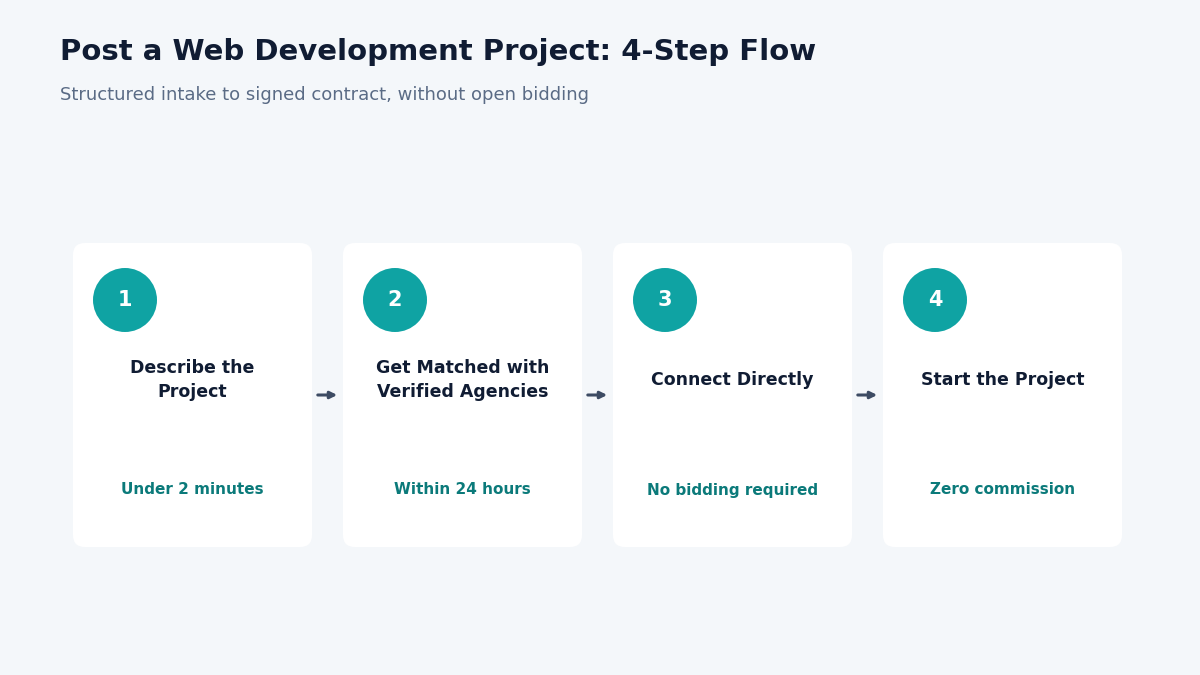
1. Describe the Project (Under 2 Minutes)
Instead of a blank text box, a well-built intake flow uses AI-assisted prompts to convert a rough idea into a structured brief scope, tech stack preferences, budget band, and timeline. This matters more than it sounds: agencies quote faster and more accurately against a standardized brief than a vague paragraph, because there’s no ambiguity to clarify before pricing.
2. Get Matched With 3–5 Verified Agencies Within 24 Hours
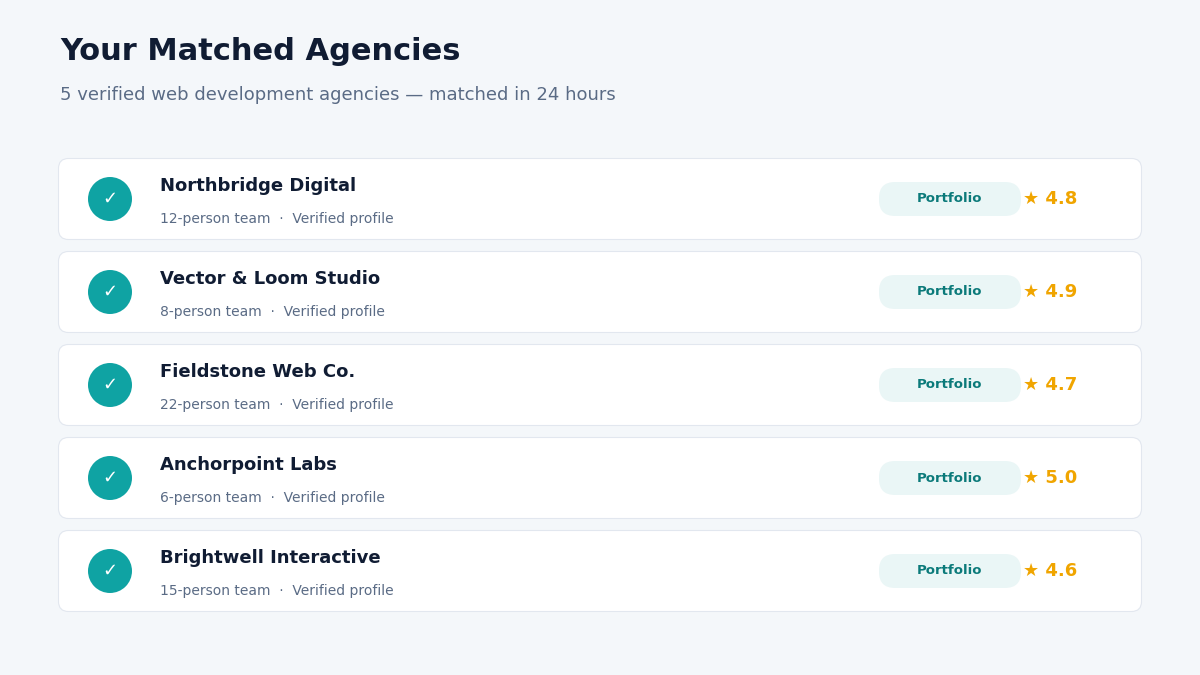
This is where finding verified web development agencies stops being a manual task. Matching engines compare the brief against 50+ data points per agency technical specialization, team size, past project outcomes, budget alignment, and performance history and return a shortlist, typically within a single business day. Each match includes a portfolio, team composition, and rating history, so the comparison starts with real information instead of a sales call.
3. Connect Directly No Bidding Required
Once matched, the client and agency talk directly. There’s no blind bidding war, no anonymous proposal inbox, and no platform intermediary inserting itself into the negotiation. You can message multiple shortlisted agencies in parallel and compare responsiveness, technical depth, and pricing side by side.
4. Start the Project With Zero Commission
The engagement begins on terms negotiated directly between client and agency no platform fee layered on top of the agreed rate. This is the structural difference between a no-bid marketplace and a traditional bidding platform: the marketplace’s revenue model doesn’t depend on inflating your project cost.
Decision Criteria Before You Post
Before you post a web development project anywhere, it helps to have three numbers already decided: a budget range (not a single figure a band gives agencies room to price options), a hard deadline or launch window, and a short list of must-have technical requirements versus nice-to-haves. Agencies consistently report that briefs missing these three elements take 2 to 3 additional rounds of clarification before a usable quote can be produced.
Verification and Compliance Considerations
Not all “verification” means the same thing across platforms, so it’s worth checking what verification actually covers before trusting a badge:
- Website and domain ownership confirms the agency operates a real, active business, not just a landing page built for the listing.
- Business email domain matching reduces the risk of an intermediary or unauthorized reseller posing as the agency itself.
- Review authenticity checks cross-references ratings against verifiable client history rather than accepting self-submitted testimonials.
- Team and portfolio validation confirms claimed headcount and past work actually belong to the agency, not to a subcontractor being represented as in-house.
Agencies that pass all four checks before their profile goes live are meaningfully different from a directory listing that only requires a payment to appear.
Cost Implications by Project Size
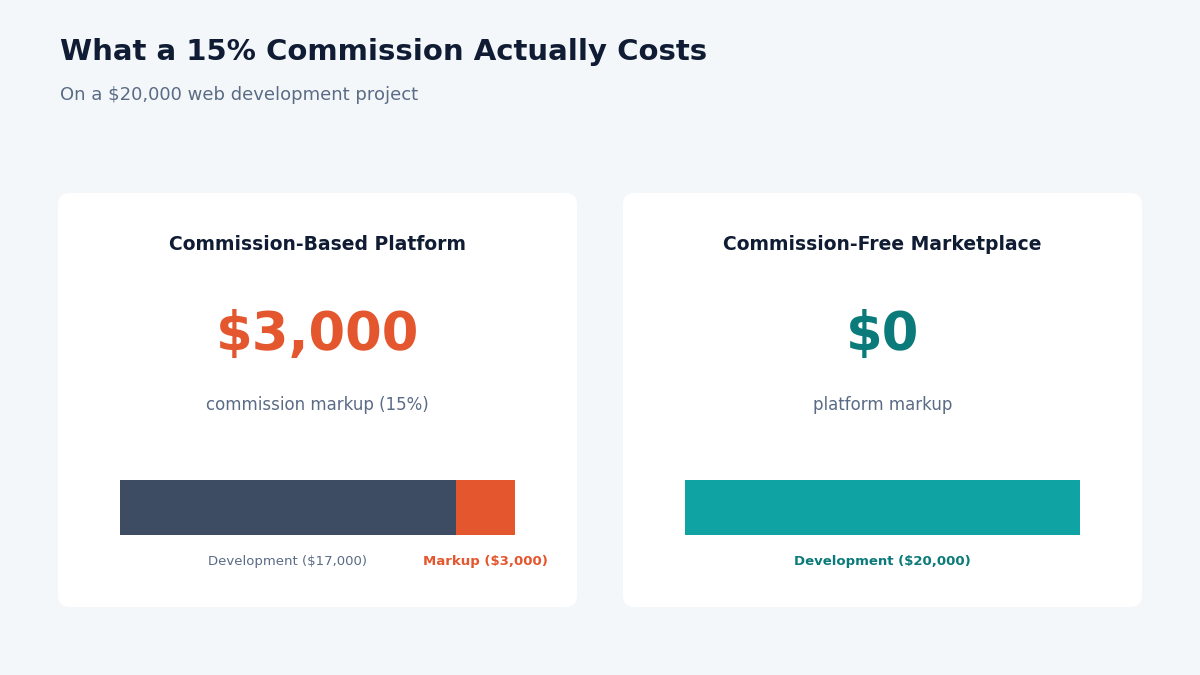
Cost structure changes with project size, and it’s worth modeling before you commit to a channel. A $10,000–$25,000 MVP build absorbs a 15% commission far more painfully, proportionally, than a $150,000 enterprise platform rebuild which is exactly why smaller teams and startups have the most to gain from a commission-free hiring platform. On a $20,000 project, a 15% commission is $3,000 in pure markup; on a no-commission model, that entire amount goes toward development hours instead.
Get Web Development Quotes Fast Without a Bidding War
Speed and quote quality are usually treated as a trade-off: move fast, get shallow quotes; wait longer, get considered ones. A verification-first, matched process removes that trade-off because agencies are pre-qualified against your specific brief before they ever see it. You’re not sorting through 40 generic responses to a public post; you’re comparing 3 to 5 quotes from agencies whose expertise was filtered before the introduction happened.
To get web development quotes fast, the brief itself needs to carry enough detail to eliminate back-and-forth: a defined budget range (not “flexible”), a rough technical scope, and a hard timeline. Agencies price faster and more accurately when the ambiguity is removed upfront.
Why You Can Hire a Web Development Company Free of Platform Commissions
The ability to hire web development companies free of a bolted-on platform fee changes the actual economics of the engagement. On a traditional bidding site charging 10% to 20%, a $30,000 project effectively costs the client an extra $3,000 to $6,000 baked into the agency’s quote money that buys nothing beyond platform access. A commission-free hiring platform removes that markup entirely; the client pays the agency, and only the agency, for the work performed.
This also changes agency behavior. When agencies aren’t absorbing a commission cut, they can quote more competitively and invest more in the actual deliverable rather than pricing in the platform’s cut.
What Happens After You Submit Your Web Development Requirement Online?
Once you submit web development requirement online, the request typically enters a layered verification pipeline before matching even begins. This usually includes website and email domain checks, review authenticity checks, and team-detail verification confirming that an agency profile reflects an actual operating business, not just a listing. Only verified profiles are eligible to be matched against incoming project briefs, which is what separates a curated shortlist from an open directory search.
Case Study or Real-World Application
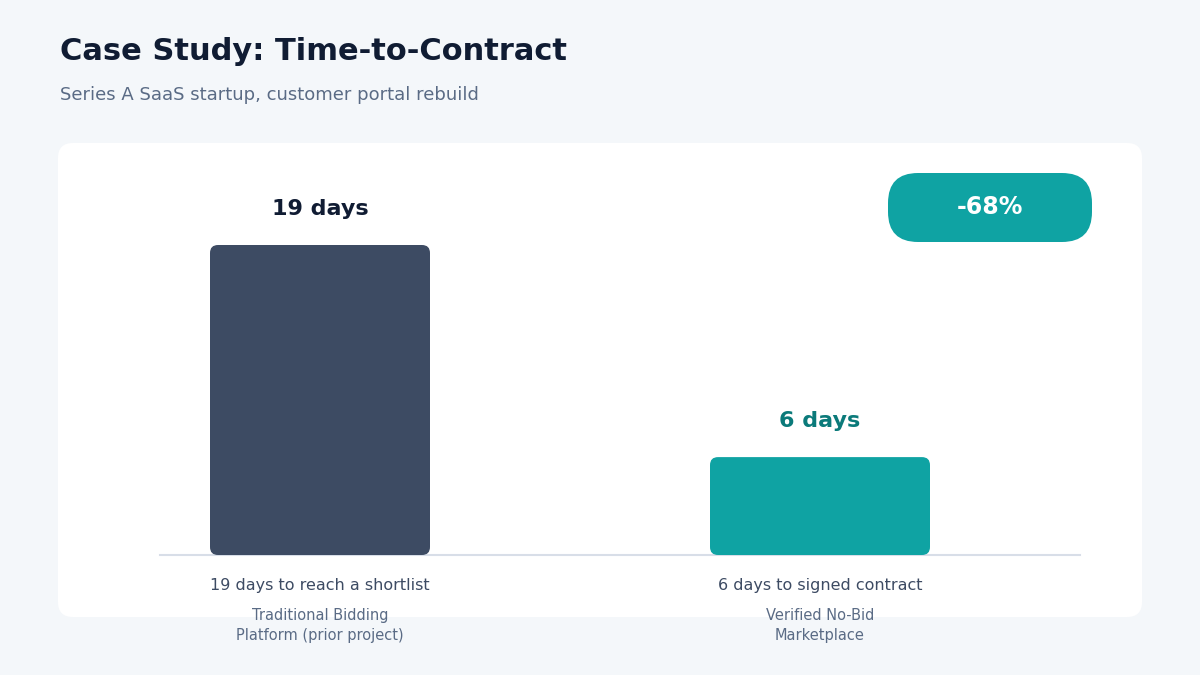
A Series A SaaS startup needed a customer portal rebuilt in 10 weeks ahead of a funding milestone. Using a traditional bidding platform for a prior project had taken 19 days just to reach a shortlist, with three of five “matched” agencies turning out to have inflated team sizes on their profiles. On a verified, no-bid marketplace, the same team received five matched agencies within 24 hours, held two discovery calls, and signed within 6 days a 68% reduction in time-to-contract.
A mid-sized enterprise IT department sourcing a vendor for a multi-region web platform migration had previously defaulted to a paid-listing directory, paying an annual placement fee with no guarantee of match quality. Switching to a commission-free, verification-based model cut vendor discovery from roughly 5 weeks to 3 business days and eliminated an estimated $8,400 in commission costs that would otherwise have been embedded in the winning agency’s quote.
A two-person founder team building an e-commerce MVP had initially planned to hire a freelancer directly to save on agency rates, then discovered that a single freelancer couldn’t realistically cover both backend architecture and frontend design on their 8-week timeline. After they decided to post a web development project through a matched marketplace instead, they were connected with a 6-person agency already specialized in headless commerce builds, and launched two weeks ahead of schedule at a comparable total cost to the freelancer quote.
Comparison or Decision Framework
Not every sourcing model solves the same problem. Here’s how the three common approaches actually compare when you’re trying to hire quickly without overpaying for the introduction itself.
| Factor | Commission-Based Bidding | Paid-Listing Directory | Verified No-Bid Marketplace |
| Cost to client | 10–20% built into quote | Indirect (agency’s $499+/yr fee passed through) | 0% commission |
| Agency verification | Minimal, self-reported | Minimal, pay-to-list | Website, email, review, and team checks |
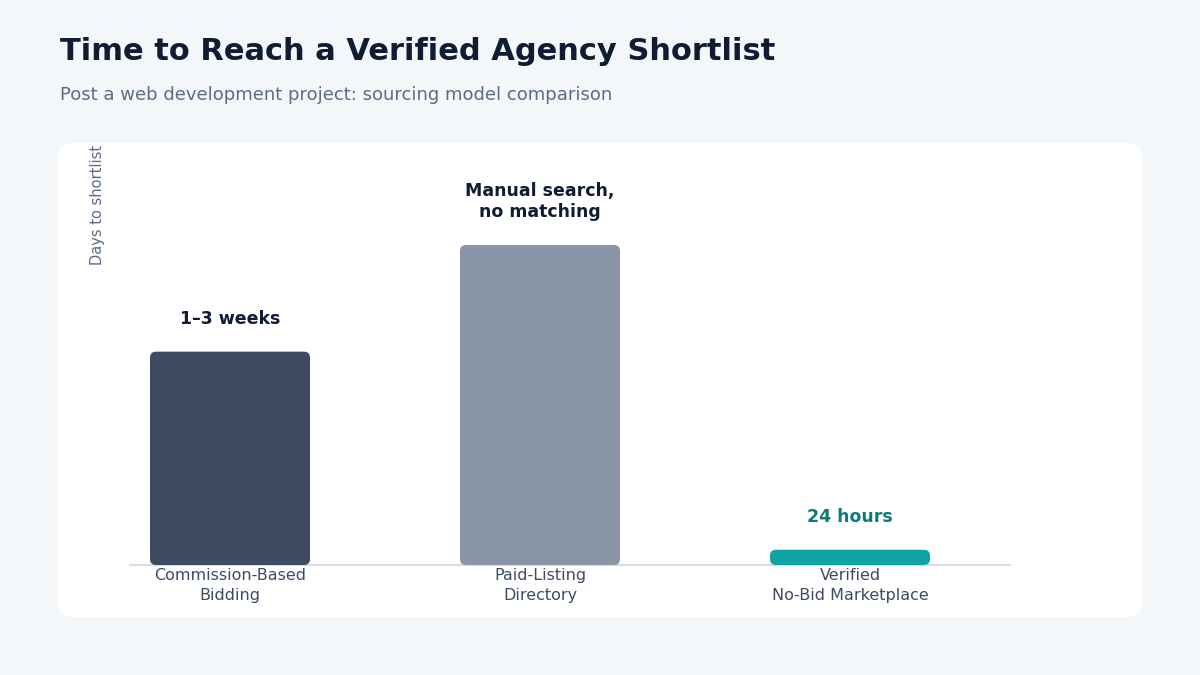
| Time to shortlist | 1–3 weeks (open bidding) | Manual search, no matching | Typically 24 hours |
| Negotiation model | Blind bidding | Direct, unfiltered | Direct, pre-matched |
| Match quality control | None | None | AI-based, 50+ data points |
What Most Teams Get Wrong
The most common mistake isn’t picking the wrong agency, it’s posting a project before the brief is specific enough to be quoted accurately. A brief that says “build us a website” invites five wildly different quotes because five agencies are pricing five different assumptions. A brief with a defined scope, budget band, and timeline gets quotes that are actually comparable.
The second mistake is treating “verified” as a marketing word rather than checking what verification actually covers. A profile badge means nothing if it’s self-attested. Ask specifically what was checked domain ownership, review authenticity, team headcount before assuming a “verified” agency has been through more than a signup form.
The third, and most expensive, mistake is optimizing for the lowest bid on a commission-based platform without accounting for the built-in markup. A quote that looks 15% cheaper on a bidding site may simply reflect a lower commission structure on a different platform, not a genuinely lower-cost agency.
Start Your Project
If you’re ready to post a web development project and want to compare verified agencies without paying commissions or bidding blind, GetProjects has helped businesses across 50+ cities connect with vetted technical partners in a fraction of the usual timeline. Describe your project, get matched with verified agencies within 24 hours, and talk to as many as you need before deciding at no cost to post and zero commission on what you hire.
FAQ
Is it free to post a web development project?
On commission-free marketplaces, yes posting a project, receiving agency matches, and communicating directly all come at no cost to the client. Revenue in these models comes from optional premium features or nothing at all, not from a cut of your project budget. Confirm this before submitting a brief, since some platforms disguise fees inside agency quotes rather than charging clients directly.
How long does it take to get matched with a web development agency?
With an AI-driven matching process, most clients receive 3 to 5 verified agency matches within 24 hours of submitting a brief. This compares to 1 to 3 weeks on open bidding platforms, where matching is manual and dependent on agencies choosing to respond to a public post.
Are the agencies actually verified, or just listed?
On a properly built marketplace, verification includes checks against website ownership, business email domains, review authenticity, and team composition completed before a profile goes live. This is distinct from a directory listing, where any business can create a profile by paying a fee, with no independent check on the claims made.
Can I talk to multiple agencies before choosing one?
Yes, and this should be standard on any no-bid marketplace. You’re not locked into a single introduction; you can hold discovery calls with all matched agencies, compare their technical approach and pricing, and choose based on fit rather than whoever responded first.
What’s the difference between a marketplace and a freelance bidding platform?
A freelance bidding platform is optimized for volume and open competition; anyone can bid on anything, and price often becomes the deciding factor. A verified marketplace narrows the field first, using matching criteria and verification, so the comparison starts among a small number of genuinely qualified agencies rather than a large pool of unfiltered bids.
Do I pay commission when I hire a web development company through a marketplace?
It depends entirely on the platform’s business model. Commission-based marketplaces build a percentage fee into the agency’s quote, which you pay indirectly. Commission-free models remove that layer, meaning your negotiated rate with the agency is the actual cost, not the actual cost plus an undisclosed markup.
What information should I include before I post a web development project?
At minimum, include a defined budget range, a target launch date, the core features or pages required, and any existing technical constraints (current tech stack, integrations, compliance requirements). Briefs missing a budget range are the single biggest cause of mismatched quotes, since agencies price the same request very differently without a stated ceiling.