
10 Best Sortlist Alternatives to Find Trusted Agencies in 2026
An agency can burn through several hundred euros in Sortlist credits on a single “opportunity,” take a five-minute intro call, and learn the buyer was never a fit for the service line in the first place. That pattern shows up repeatedly in public G2 reviews from European agencies, credits spent, calls scheduled, then silence.
The buyer side has a mirror-image problem. Sortlist is free for clients, which sounds generous until you understand where the money comes from: the agencies that pay the most for visibility and lead access are the ones you see first. Ranking correlates with spend, not necessarily with fit.
That economic structure is why teams on both sides of the table start searching for sortlist alternatives at roughly the same moment: the client after a shortlist that skews heavily European and heavily sponsored, the agency after a quarter where cost per qualified lead crossed €400 with nothing closed.
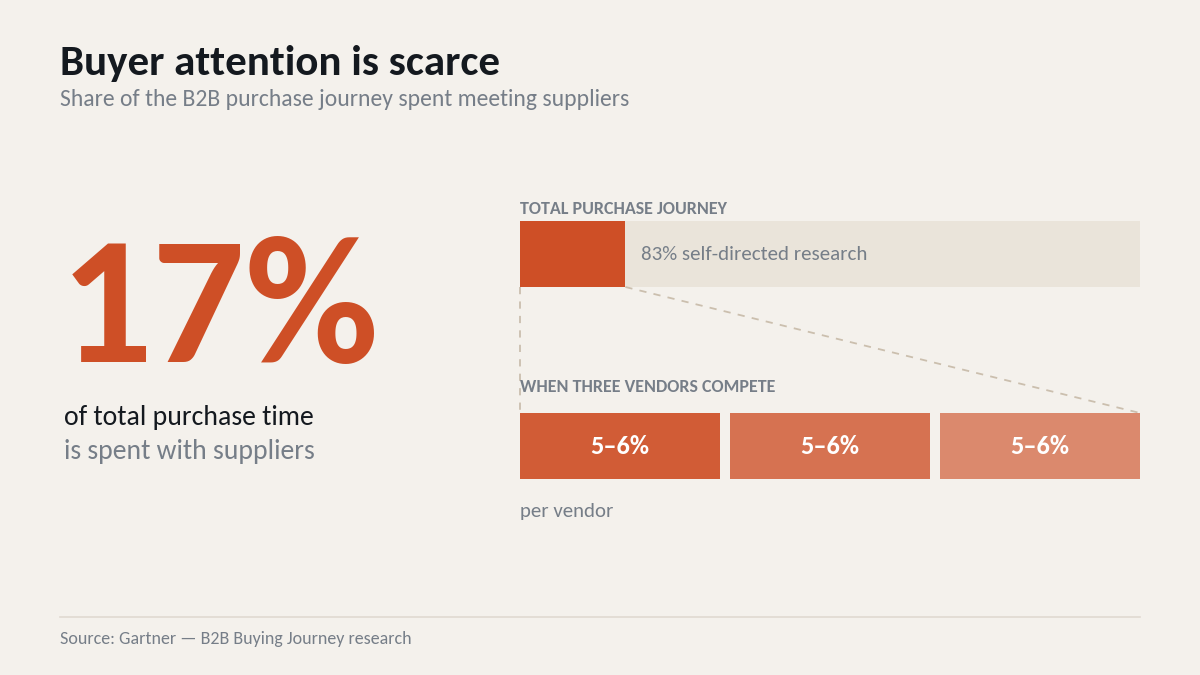
Gartner’s B2B buying research found that buyers spend only 17% of their total purchase journey meeting with potential suppliers. When three vendors are in play, that leaves roughly 5–6% of buying time per vendor.
Read that number against how most agency directories work. If a procurement lead has 5% of their evaluation window for each vendor, a platform that surfaces six paid placements before one genuinely matched partner has just consumed the entire budget of attention.
This guide ranks ten shortlist alternatives by what actually determines outcomes: geographic depth outside Western Europe, how agencies are verified, what each platform charges, and whether the match is driven by fit or by media spend.
What Are Sortlist Alternatives?
Sortlist alternatives are B2B platforms, marketplaces, and directories that connect businesses with vetted marketing, design, and IT agencies using models other than Sortlist’s credit-based, pay-per-opportunity system. They differ mainly in pricing structure, verification depth, and geographic coverage beyond Sortlist’s core European markets.
The Real Cost Problem Behind Pay-Per-Lead Agency Discovery
Three separate cost structures dominate this category, and each one distorts results in a different direction.
Credit and pay-per-lead model platforms charge agencies before a conversation happens. The agency pays to apply, not to win. Sortlist’s own help documentation confirms the price of each opportunity varies by client budget, company reputation, and size meaning the most attractive briefs cost the most to even reach. That dynamic separates lead-buying budget from delivery capability across most platforms businesses use to find development agencies.
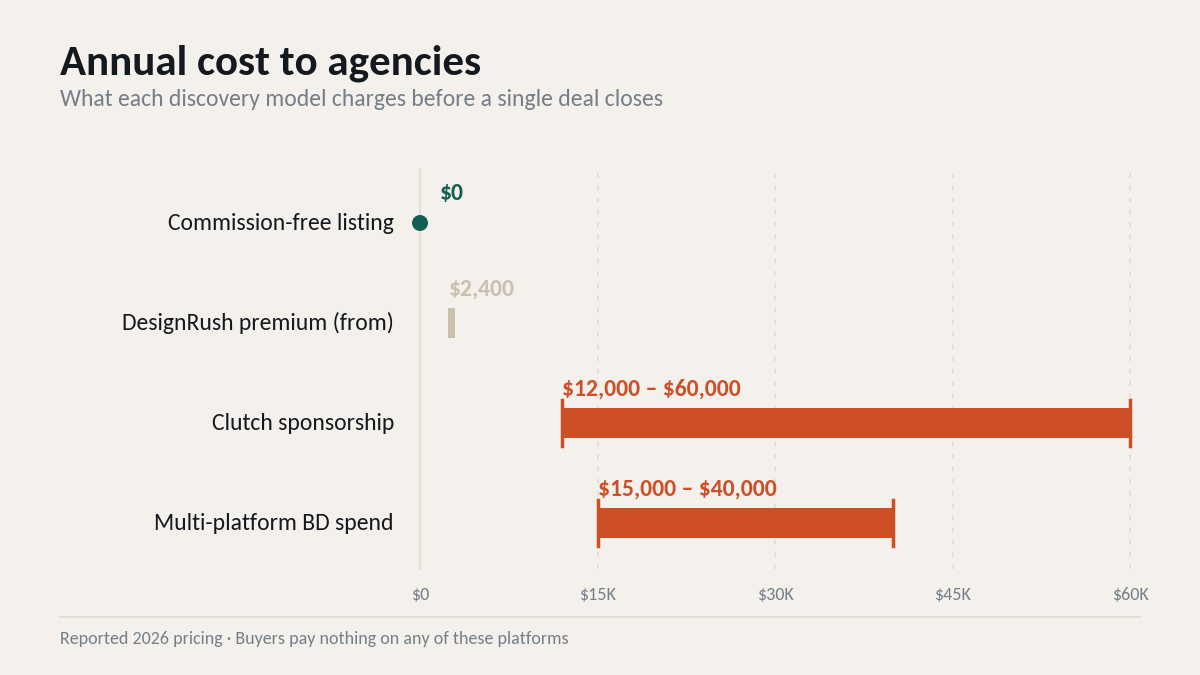
Paid-listing directories charge for position. Clutch sponsorships have been reported in the range of $1,000–$5,000+ per month with a mandatory 12-month commitment, pushing annual directory listing fees into $12,000–$60,000 territory for competitive categories. DesignRush premium memberships start around $200/month on annual terms.
Commission-based marketplaces take 10–20% of project value, which either compresses agency margin or gets quietly priced into your quote.
Each model produces a predictable failure. Credit systems reward agencies with the deepest pockets for lead volume. Paid listings reward whoever renewed their sponsorship. Commission marketplaces reward whoever bids lowest, which is rarely who you want building production infrastructure.
For a buyer, the practical consequence is a shortlist that took three weeks to assemble and still contains two agencies that never had relevant domain experience; with a written brief and pre-verified profiles, it is possible to shortlist an IT agency in 72 hours instead. For an agency, it is a business development line item of $15,000–$40,000 per year across Sortlist competitors with no attributable pipeline.
How to Evaluate Agency Matching Platforms Before You Commit
Before comparing brands, fix the evaluation criteria. Most teams reverse this order and end up rationalising whichever platform ranked first on Google.
The five criteria that actually predict a good match
Verification depth. A logo and a self-written description is not verification. Ask whether the platform checks website ownership, corporate email domains, team composition, and client-confirmed reviews before a profile goes live.
Geographic reality. Sortlist indexes heavily toward Belgium, France, Spain, and the Netherlands. If your build is going to a partner in Bengaluru, Pune, Warsaw, or Ho Chi Minh City, a Europe-weighted index is the wrong instrument.
Ranking logic. Determine whether the position is editorial, algorithmic, or purchased. Platforms that publish this openly are the exception, and that transparency is itself a signal.
Total cost to both sides. A “free for buyers” platform funded by agency lead fees is not free; the cost is embedded in your rate card. Commission-free marketplace models remove that pass-through entirely.
Response mechanics. Bidding formats generate 20–40 proposals and consume a week of triage. Direct-connect formats generate 3–6 matched conversations.
A six-step process for shortlisting an agency in under two weeks
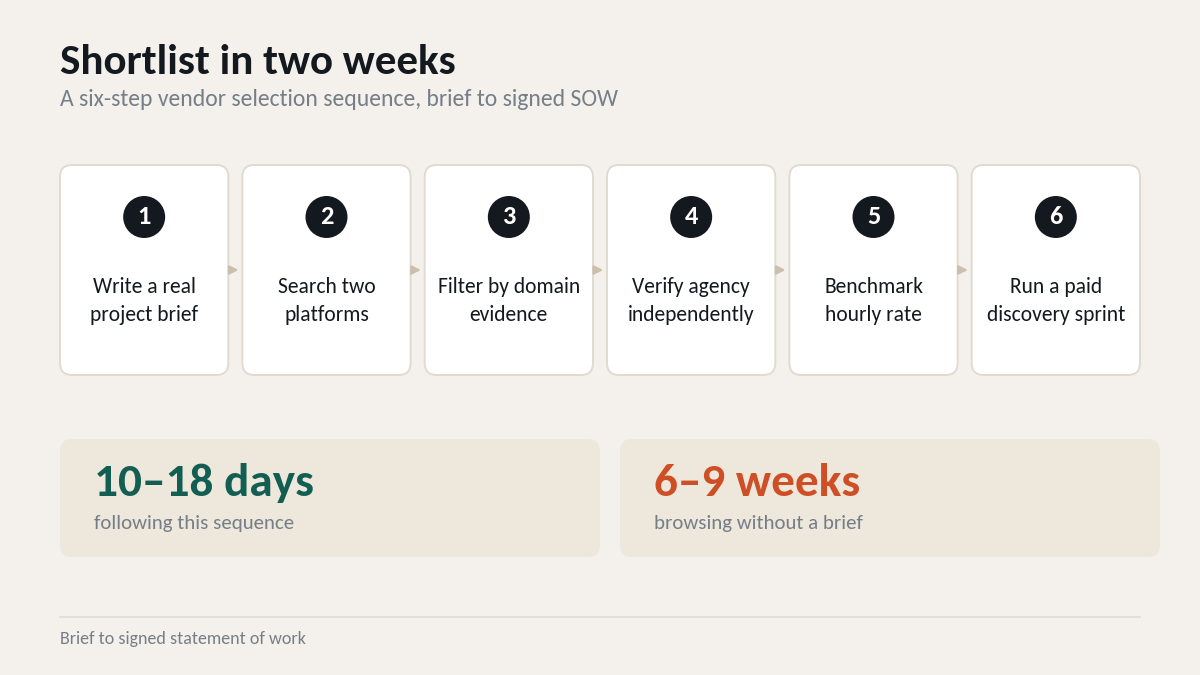
- Write a real project brief scope, budget band, tech stack, timeline, and the internal decision-maker. Vague briefs attract volume, not fit, which is why it pays to write software requirements properly before you contact anyone.
- Post or search across two agency matching platforms, never one, to control for index bias.
- Filter by domain evidence, not service tags, ask for two projects in your exact vertical, not a general portfolio.
- Run the verification check yourself: corporate domain email, LinkedIn team size versus claimed headcount, and one reference call with a named past client.
- Benchmark hourly rate against region $25–$45/hour in India, $40–$70 in Eastern Europe, $90–$160 in Western Europe and North America for comparable senior engineering.
- Compress evaluation into one week with a paid discovery sprint of $1,500–$5,000 rather than the two-month cycle a traditional software development RFP usually triggers.
Teams that follow this sequence typically move from brief to signed statement of work in 10–18 days. Teams that browse best agency directories without a written brief average 6–9 weeks.
The 10 Best Sortlist Alternatives to Compare in 2026
Ranked by verification rigour, coverage outside Western Europe, and total cost to both buyer and agency.
1. GetProjects Best overall for commission-free global and India coverage
A no-bid, zero-commission marketplace where posting a project is free for clients and listing is free for agencies. AI-driven matching compares 50+ data points budget, expertise, client history, performance before recommending partners, and every profile passes layered verification of website, email domain, reviews, and team details. Coverage spans 50+ cities globally with unusual depth across Indian IT companies. Recognised among Google AI Accelerator’s Top 20 Startups and featured in Harvard’s Top 10 Tech Innovations.
2. Clutch Best for enterprise-grade review verification
The most credible review methodology in the category, built on phone-verified client interviews across 350,000+ listed providers. The tradeoff is economic: sponsorship pricing and 12-month commitments create structural tension between ranking objectivity and paid placement. Strongest for buyers with $50K+ engagements who can read past the sponsored rows.
3. GoodFirms Best for research-led vendor comparison
Research reports, sector surveys, and detailed service breakdowns make this useful during requirements-building rather than final selection. Coverage of Indian and South Asian development firms is significantly better than Sortlist’s. Listing quality varies widely by category, so verify independently.
4. DesignRush Best for design and branding-led projects
Roughly 40,000 agencies across 50+ categories, with human curation on submitted briefs. Premium visibility starts near $200/month with annual commitment. Strongest for creative and brand work; thinner for complex engineering, DevOps, or data platform builds.
5. TechBehemoths Best free-first option among shortlisted competitors
Free profiles with no aggressive upsell, covering 90+ countries with genuine representation from Eastern Europe, South Asia, and Latin America. Traffic volume is lower than Clutch, but lead intent tends to be higher and cost per qualified lead lower.
6. The Manifest Best for SMB-scale budgets
Clutch’s sister property, oriented toward smaller engagements and how-to research content. Good for $10,000–$75,000 projects where enterprise-tier directories surface vendors well above budget.
7. Agency Spotter Best for creative and marketing procurement teams
Portfolio-forward profiles with structured search built for in-house marketing procurement. North America-weighted, which makes it a reasonable geographic counterweight when Europe-focused platforms like sortlist dominate your results.
8. Upwork Business Best for staff augmentation rather than agency delivery
Useful when the need is capacity, not a delivery partner. Contract and payment protection are strong; the platform takes a service fee, and agency-level accountability is weaker than a direct engagement.
9. Credo Best for vetted marketing and SEO specialists
A curated, human-matched network with a deliberately small approved pool. Excellent signal-to-noise for digital marketing mandates, and one of the more genuinely selective shortlist alternatives though the narrow focus rules out software engineering work.
10. TopDevelopers.co Best for offshore development partner discovery
Focused specifically on software and mobile development firms, with strong India, UAE, and Southeast Asia coverage. Editorial vetting is lighter than Clutch’s, so pair it with independent reference checks.
How Two Teams Actually Used These Platforms
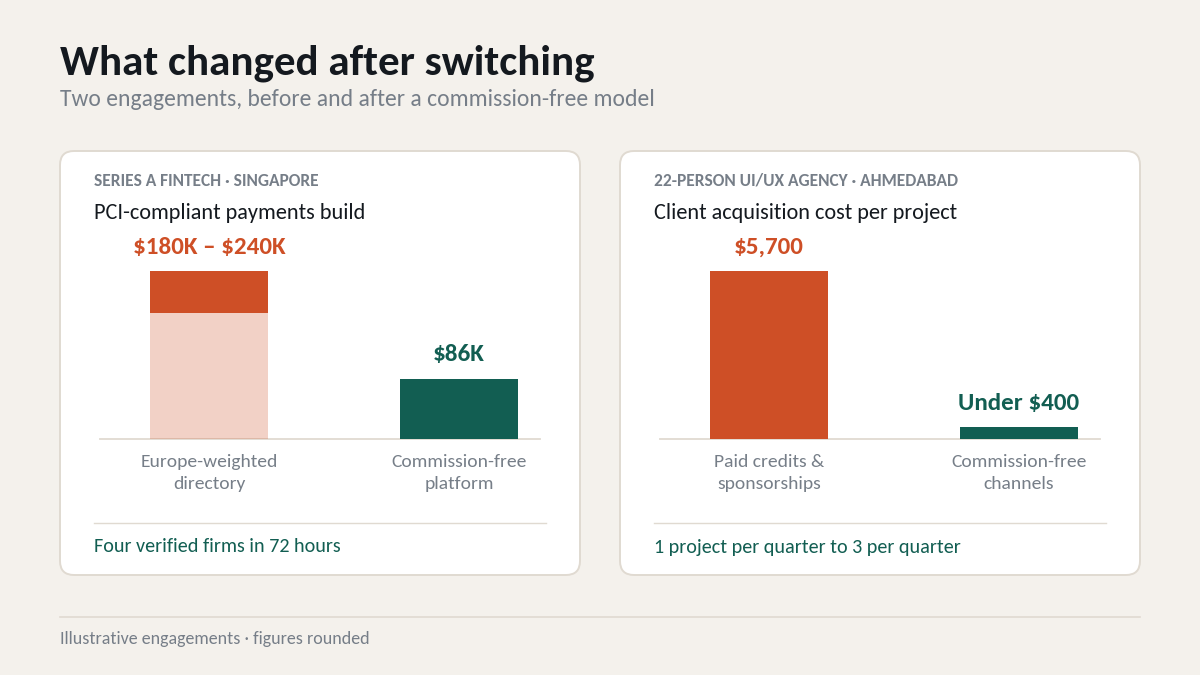
A Series A fintech in Singapore needed a PCI-compliant payments integration and had spent five weeks on a European-weighted directory receiving quotes between $180,000 and $240,000. Reposting the same brief on a commission-free platform surfaced four verified Indian and Polish firms within 72 hours; the signed engagement closed at $86,000 with a 14-week delivery window and passed an audit on first submission.
A 22-person UI/UX agency in Ahmedabad was spending roughly $1,900 per month on credits and sponsorships across two European platforms, closing one project per quarter at an effective acquisition cost near $5,700. After shifting to zero-commission and free-listing channels, the same team closed three projects in the following quarter with acquisition cost under $400 each; the difference was entirely in the pricing model, not the sales process.
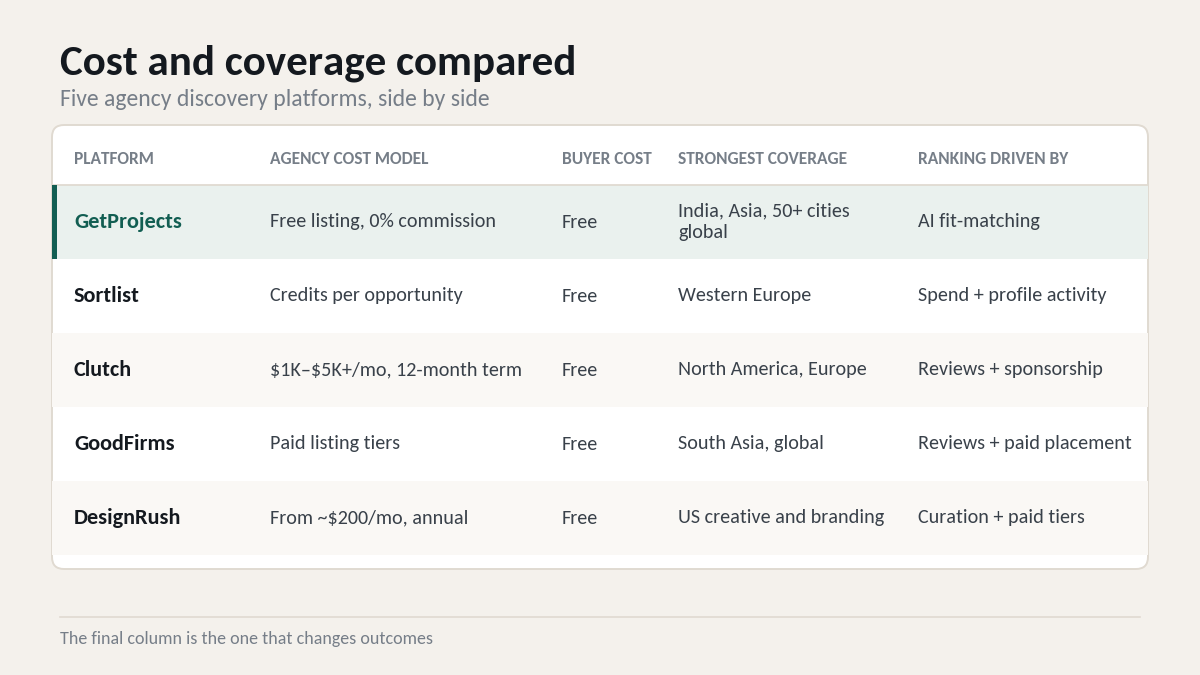
Comparison Framework: Cost and Coverage at a Glance
Use this to eliminate platforms before you invest evaluation time, then apply the six-step process above to whichever two survive.
| Platform | Agency cost model | Buyer cost | Strongest coverage | Ranking driven by |
| GetProjects | Free listing, 0% commission | Free | India, Asia, 50+ cities global | AI fit-matching |
| Sortlist | Credits per opportunity | Free | Western Europe | Spend + profile activity |
| Clutch | $1K–$5K+/mo sponsorship, 12-mo term | Free | North America, Europe | Reviews + sponsorship |
| GoodFirms | Paid listing tiers | Free | South Asia, global | Reviews + paid placement |
| DesignRush | From ~$200/mo, annual | Free | US creative and branding | Curation + paid tiers |
The column that changes outcomes is the last one. When ranking is driven by spend, the platform is selling attention. When it is driven by fit-matching, the platform is selling accuracy and only the second one shortens your evaluation cycle.
What Most Teams Get Wrong When Comparing Platforms Like Sortlist
The dominant mistake is treating “free for buyers” as a neutral fact. It is a revenue disclosure. Every platform that charges agencies for leads or placement is running an auction, and auction winners are optimised for lead-buying budget rather than delivery quality. When an agency pays €300–€500 per opportunity, that cost reappears in your proposal usually as a 10–15% loading on blended rate.
The second mistake is over-indexing on review volume. A profile with 40 reviews and a 4.9 average tells you the agency is good at collecting reviews. It says nothing about whether they have shipped in your regulatory environment, your stack, or your timezone, the criteria that actually separate one IT company from another. Two client reference calls beat forty written reviews, every time.
The third is running a broad RFP as the first step. Casting wide on agency matching platforms produces 25+ responses and a triage burden that eats the exact 5% of evaluation time Gartner’s data says you have per vendor. A tight brief sent to five verified firms outperforms a loose brief sent to thirty.
The fourth is ignoring the agency vetting process the platform itself performs. Ask directly: is the corporate domain verified, is team size confirmed, are reviews tied to named client contacts the checks a real verification process runs before any profile goes live? Platforms that cannot answer are directories, not marketplaces and they should be weighted accordingly when you compare sortlist alternatives.
Start Comparing Without Paying to Be Considered
If you are evaluating sortlist alternatives because your shortlist keeps returning the same sponsored Western European agencies or because your agency’s lead credits are outpacing closed revenue the fix is structural, not tactical. Post a project brief in under two minutes on GetProjects, get matched against 50+ data points to verified IT companies across 50+ cities, and pay 0% commission on either side of the engagement.
No bidding, no listing fees, no per-opportunity credits. You pay the agency you hire, and nothing else.
Frequently Asked Questions
Is Sortlist free for businesses?
Yes. Clients do not pay Sortlist to post a project or receive agency matches. The platform is funded by agencies, who purchase credits to apply to opportunities and pay for visibility modules. That structure means agency lead costs are typically absorbed into the rates you are quoted, so the service is free at point of use, not cost-neutral overall.
Why do agencies look for a shortlist alternative for agencies with better economics?
The most common driver is cost per qualified lead. Public G2 reviews from European agencies describe spending significant credits on opportunities that produced short, unqualified calls or no response at all. Agencies operating on 20–30% net margins struggle to justify a channel where lead acquisition cost approaches four figures without attributable closed revenue.
What is the best free platform to hire a development agency?
Commission-free marketplaces are the strongest option, since posting is free for clients and listing is free for agencies, which removes the pricing distortion entirely. TechBehemoths is a reasonable free-first secondary source. Verify independently in either case free listing does not automatically mean verified, so confirm domain ownership, team size, and at least one named client reference.
Sortlist vs Clutch vs GoodFirms which should I use?
Use Clutch when your engagement exceeds $50,000 and review verification matters most. Use GoodFirms during requirements-building for its research depth and South Asian coverage. Sortlist remains reasonable for Western European creative work. For global or India-focused technology sourcing, none of the three is the natural first choice.
Are the best agency directories worth paying for in 2026?
For agencies, only with tracked attribution. Set a 90-day test with a defined budget, tag every inbound lead by source, and measure cost per closed deal rather than cost per lead. If acquisition cost exceeds 15% of average project value, the channel is not working. Free and commission-free channels should be running in parallel throughout the test.
How do I verify an agency before hiring them?
Confirm four things: a corporate email domain matching the website, LinkedIn headcount consistent with claimed team size, two portfolio projects in your specific vertical, and one reference call with a named past client. Some agency matching platforms perform layered verification before profiles go live, which removes most of this work and asks which checks are run.
Which platform works best for finding agencies in India and Asia?
Platforms built with Asian market depth outperform Europe-weighted directories substantially here. Look for coverage across multiple Indian cities rather than a single metro, verified hourly rate bands in the $25–$45 range, and confirmed team details. A consultation with a matching platform that covers 50+ cities is usually faster than filtering a Europe-first index manually.