
Change Orders in Software Projects: How to Handle Scope Changes
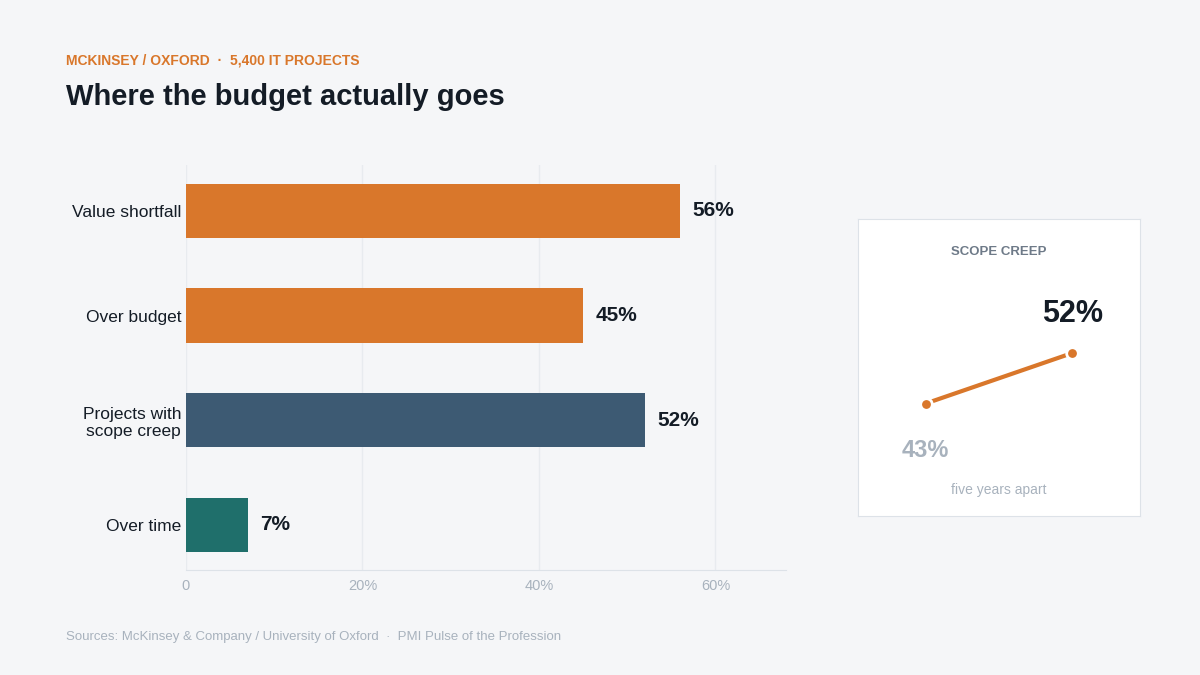
Forty-five percent. That is the average budget overrun on large IT projects, based on a McKinsey and University of Oxford analysis of more than 5,400 projects and software carried the highest cost and schedule risk of any project category in that dataset.
Almost none of that overrun arrives as one catastrophic decision. It accumulates in fifteen-minute calls, Slack threads, and hallway requests that never become documents. A defined software development change order process is the only control that reliably converts those conversations into billable, scheduled, agreed work before the work begins.
PMI’s Pulse of the Profession research found that 52% of projects completed in the prior 12 months experienced scope creep or uncontrolled changes to scope up from 43% five years earlier.
Here is the part most buyers and most agencies get backwards. Change orders are not a sign that a project is failing. Projects that produce zero change orders across a six-month engagement are usually the ones in trouble, because the changes still happened; they simply went undocumented, unpriced, and unpaid. One side absorbed them silently until the relationship broke, which is why change control belongs in the conversation about how you hire a software development company rather than in a clause nobody reads.
The fights are never about whether the requirement changed. Both parties know it did. The fights are about when it changed, who asked, what it cost, and whether anyone with signing authority agreed. Those four questions have documented answers or they have opinions, and opinions get litigated.
What Is a Software Development Change Order Process?
A software development change order process is the documented workflow a client and vendor use to evaluate, price, approve, and schedule any work that falls outside the agreed statement of work. It converts an informal request into a signed amendment that specifies deliverables, cost, timeline impact, and authorization before development starts.
That definition contains the entire mechanism. A change order is not a status update or a note in a ticket. It is a contract amendment, a document that modifies the commercial agreement between two parties and requires the same authority to execute as the original statement of work (SOW).
Three things distinguish it from a change request. A request is an input; anyone can submit one. A change order is an output, produced only after assessment, and only signed by someone with budget authority. And a request costs nothing to raise, while a change order carries an explicit price and a scheduled consequence.
Why Verbal Change Requests Are the Number One Source of Budget Disputes
Ask any agency that has been through a payment dispute what triggered it, and the answer is almost always the same category of event: a verbal request that both sides remembered differently four months later.
The mechanism is predictable. A stakeholder describes a change in a sprint review “can we also let admins bulk-export this?” The developer hears a two-day task and starts building. The client hears a minor tweak that was obviously implied by the original requirements documentation. Neither party is lying. They are working from different mental models of what “in scope” meant, and no artifact exists to arbitrate between them.
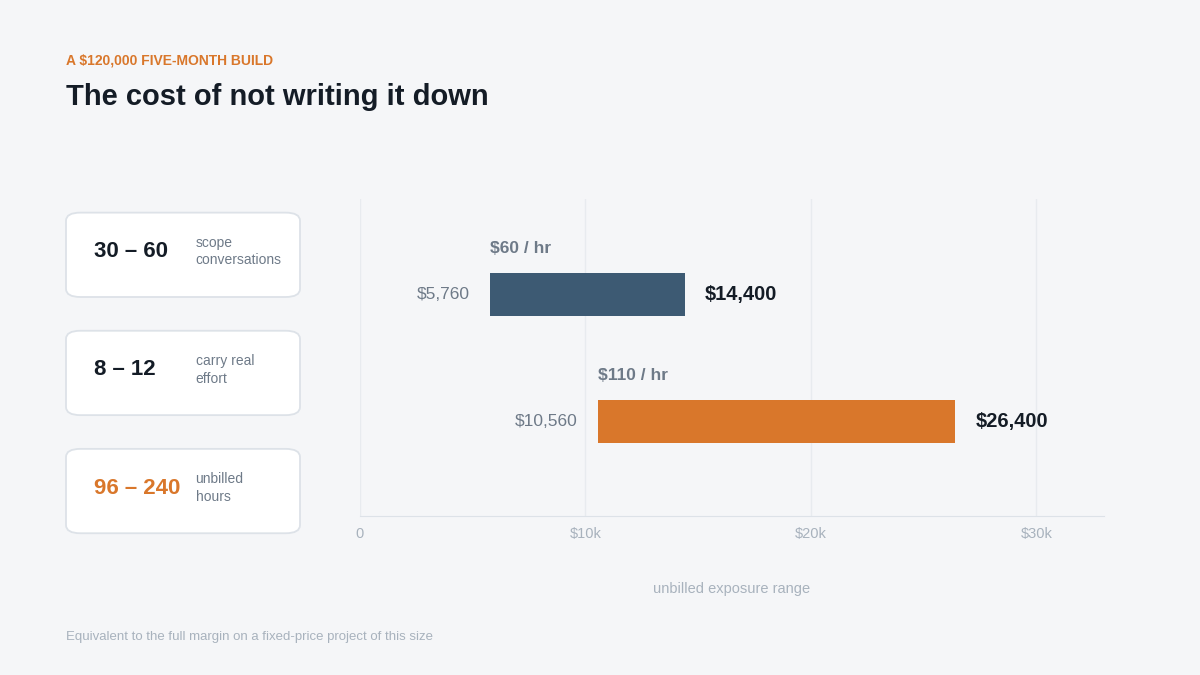
Scale that across a typical mid-size engagement. A $120,000, five-month build generates somewhere between 30 and 60 discrete scope conversations. If even 20% of them carry real effort, call it 8 to 12 changes at an average of 12 to 20 hours each, that is 96 to 240 unbilled hours. At a $60 blended hourly rate card, the exposure sits between $5,760 and $14,400; at $110 an hour it exceeds $26,000, and rate benchmarks across service categories vary widely enough that the same change order can differ by 2x between two shortlisted vendors. That is the entire margin on a fixed-price project of that size.
The damage is not only financial. Undocumented changes corrupt the project baseline, which means every subsequent estimate is measured against a schedule that no longer reflects reality. Teams then miss deadlines they were never actually resourced to hit, and the client concludes the vendor is slow rather than overloaded.
Verbal requests also destroy the audit trail that protects the client. Without written records, a client cannot demonstrate that a missed milestone was caused by vendor underperformance rather than by their own additions.
And agencies that repeatedly absorb unbilled work do not absorb it forever. They recover it by quietly reducing quality: less testing, thinner documentation, junior staff rotated onto the account. The client pays either way just in defects instead of dollars.
Building a Scope Change Approval Workflow That Holds Up
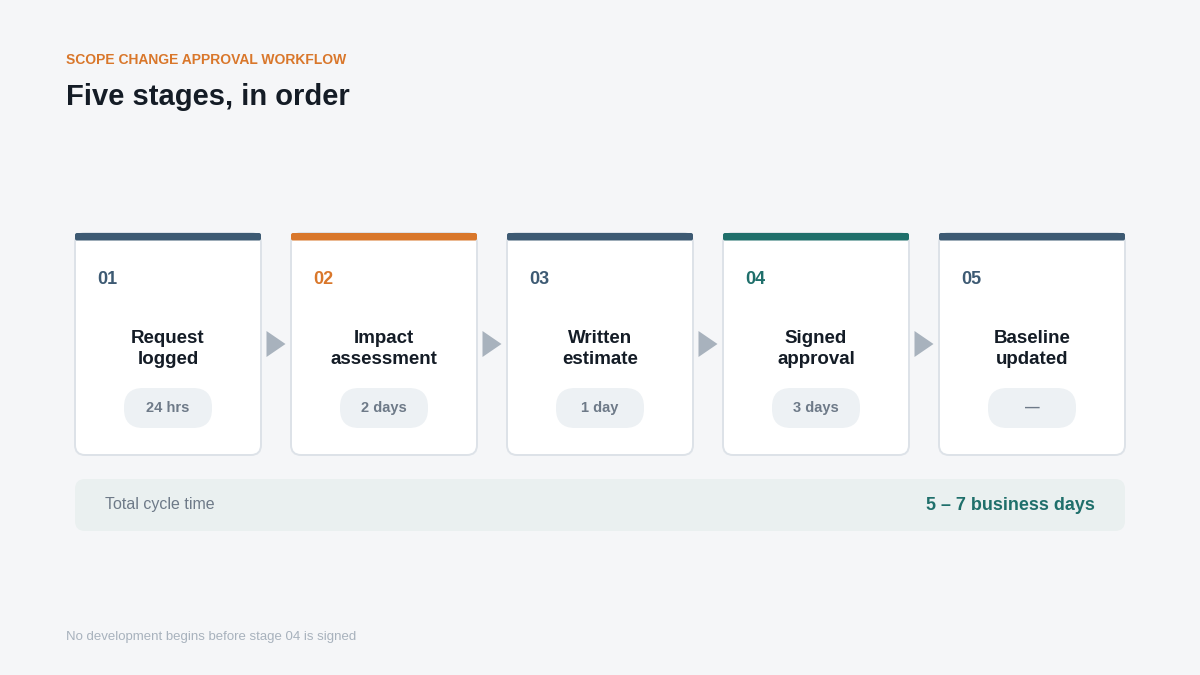
A functioning scope change approval workflow has five stages, and the sequence is not negotiable. Skipping stage two to move faster is the single most common cause of change orders that get signed and then disputed at invoicing. It is also one of the few operational signals worth judging an agency on delivery process rather than price alone.
The full software development change order process looks like this:
- Request logged any stakeholder submits a written change request into a single tracked system within 24 hours of raising it verbally.
- Impact assessment of the technical lead scopes effort, dependencies, and risk within 2 business days.
- Written estimate issued the vendor returns cost, hours, and schedule impact in a formal change order document within 1 business day of the assessment.
- Signed approval a named budget authority on the client side approves or rejects in writing within 3 business days.
- Baseline and schedule updated the project plan, sprint commitments, and invoicing schedule are formally revised before any development begins.
Total cycle time: 5 to 7 business days. Anything faster usually means the impact assessment was skipped. Anything slower blocks the team and creates pressure to start work “at risk,” which is how unapproved changes get built anyway.
Stage 1: Standardize the Change Request Process for the Software Project
Every mature change request process software project teams run shares one property: there is exactly one intake channel. Not email plus Slack plus verbal plus Jira. One.
The intake form should capture the requester’s name, the business justification, the affected feature or module, the desired outcome, and a priority flag. It should not capture an estimate that comes later, from the people who will do the work.
Set an explicit rule in the SOW: verbal requests are acknowledged but not actioned until logged in writing, and either party may log the other’s request. That last clause matters more than it appears. It lets a developer who hears a scope change in a call create the record themselves rather than waiting for a client who has already moved on a discipline that shows up consistently among verified agency profiles with repeat enterprise clients.
Stage 2: Run a Real Impact Assessment, Not a Gut Estimate
The impact assessment is where change orders earn their credibility. A one-line “about three days” is not an assessment; it is a guess that will be wrong roughly half the time and will be quoted back during the dispute.
A defensible assessment covers six dimensions:
- Direct development effort hours by role, at the rates in the SOW.
- Dependency affects what already-completed work must be modified or retested.
- QA and regression cost typically 20–30% of development effort, and routinely omitted.
- Critical path impact whether this change delays a milestone or consumes slack.
- Sprint velocity displacement, what committed work gets pushed, and to when.
- Technical debt or risk introduced architectural shortcuts required to hit the date.
Assessment itself takes time. Two to four hours of senior engineering effort for a mid-size change is normal, and the QA line is where most estimates quietly break teams that route regression work through independent QA and testing partners tend to price it accurately because someone is invoicing for it. Best practice is to make small assessments free and to charge for assessments above a defined threshold, for example any request estimated to exceed 40 hours. This discourages speculative requests without penalizing legitimate ones.
Stage 3: How to Price a Change Order Without Guessing
There are three defensible pricing methods, and the right one depends on how well-defined the change is. Teams learning how to price a change order consistently should pick a method per change rather than applying one model to everything.
Rate-card multiplication works for well-specified changes. Hours by role multiplied by the SOW rate, plus QA overhead. Transparent and easy to audit. Use it when the requirement is unambiguous and the codebase is well understood.
Banded estimation works for changes with genuine uncertainty. Quote a range for example, $8,000–$12,000 with the upper bound as the contractual cap and an agreement to bill actuals. This is honest about risk and prevents the padding that makes fixed quotes on vague requirements 40–60% more expensive than they need to be.
Time and materials carve-out works for exploratory or research-heavy changes. The change order authorizes a fixed budget of hours for investigation, after which a firm estimate is produced for the build. Use this when nobody can scope the work without writing code first, the default condition for most AI and ML development work, where model behaviour cannot be estimated from a requirements document.
Two rules apply across all three. Price at the rates in the original SOW unless the change extends the engagement beyond its term; new rates mid-project read as opportunism. And price the whole change regression testing, documentation, deployment. A change order covering development only, followed by a surprise QA invoice, is worse than none at all.
Stage 4: Who Signs, and What Signed Approval Actually Requires
Name the approvers in the SOW, by role and by dollar threshold. A common structure: the product owner approves anything under $2,500, the project sponsor approves $2,500–$15,000, and anything above requires the original contract signatory. This is a five-minute decision at kickoff and an eight-week argument if skipped, which is why procurement leads scoping the engagement should set the bands before the SOW is countersigned.
Approval must be affirmative and written. Silence is not approval, and a thumbs-up reaction is not a signature. Use e-signature or a formal email reply quoting the change order reference number and total.
The unbreakable rule: no development starts before signature. Agencies break this constantly out of goodwill, and it causes most unpaid change orders. If something is genuinely urgent, issue an interim authorization capped at a specific number of hours, in writing, and reconcile it within a week.
Stage 5: Update the Schedule, the Baseline, and the Invoice
An approved change order that does not move the delivery date is a lie both parties agreed to tell. If 60 hours of work enter a fully committed schedule, something moves a milestone, a feature, or the team’s evenings.
Update three artifacts on approval: the project plan and critical path, the sprint backlog with displaced items named explicitly, and the milestone billing schedule. Then re-issue the delivery date. On longer web development engagements running six months or more, skipping this step compounds by change order eight, the baseline bears no relationship to the plan anyone is being measured against.
What Should a Change Order Include in Software Development
Effective change order template development produces a document short enough that people actually complete it in one page, eleven fields. Anything longer gets skipped under deadline pressure.
| Field | What Goes In It | Why It Matters |
| Change Order ID | Sequential reference, e.g. CO-014 | Creates an auditable trail and prevents duplicate work |
| Date Raised / Date Required | Both dates, explicitly | Establishes the timeline if the sequence is later disputed |
| Requested By | Named individual and role | Prevents “nobody asked for that” months later |
| Original SOW Reference | Section and clause being amended | Proves the work sits outside the baseline scope |
| Change Description | 2–4 sentences, plain language | Ensures both parties describe the same thing |
| Business Justification | Why this is needed now | Supports the client’s own internal budget approval |
| Effort Estimate | Hours by role, plus QA allocation | Makes the price auditable rather than arbitrary |
| Cost | Fixed, banded, or capped T&M | The commercial term being agreed |
| Schedule Impact | Specific dates, not “minor delay” | Sets expectations before the milestone is missed |
| Affected Deliverables | Modules requiring rework or retest | Surfaces hidden regression cost |
| Approval Block | Name, role, signature, date, both parties | Converts the document into an enforceable amendment |
Number change orders sequentially from CO-001 and keep them in one shared location both parties can access. Fragmented records are functionally the same as no records. The same eleven fields work whether the engagement is a data migration or one of the multi-platform app development projects where a single change touches iOS, Android, and the API at once.
How This Plays Out on Real Engagements
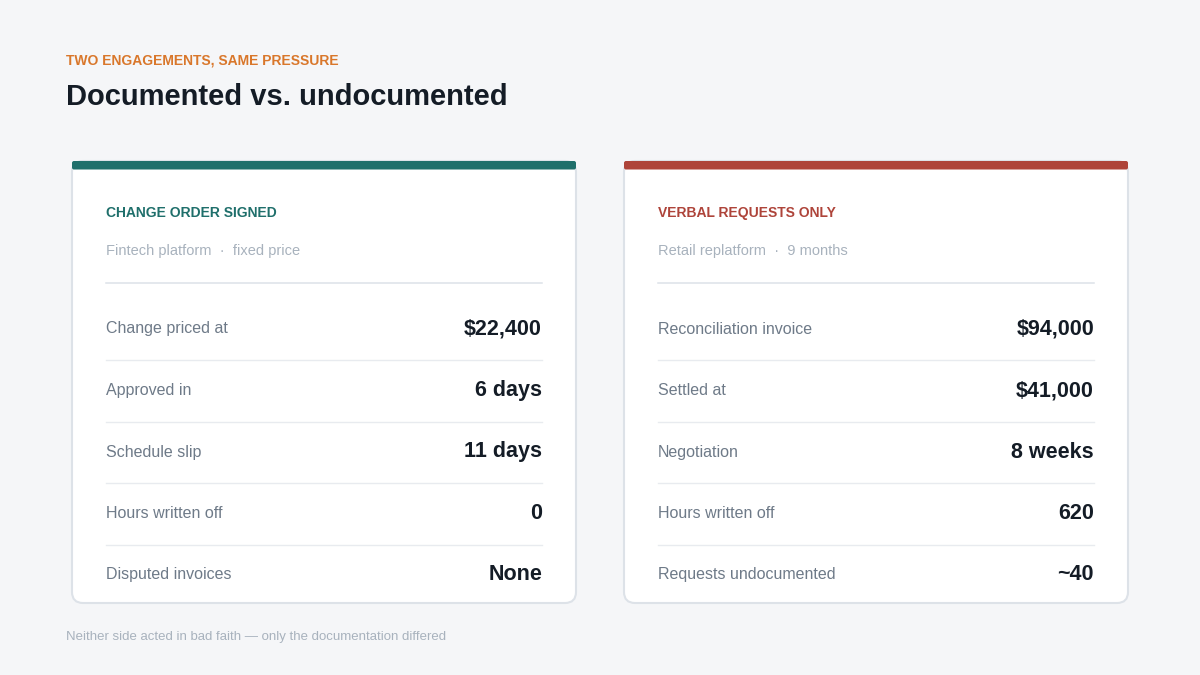
A Series A fintech startup engaged a 14-person development agency for a $180,000 platform built on a fixed-price contract. Regulatory guidance shifted in month three, requiring an audit-logging layer nobody had scoped. Because the SOW already defined a five-day approval cycle and a named sponsor, the change was assessed, priced at $22,400, and signed in six days. Delivery slipped 11 days against an original 22-week timeline, and the engagement finished without a single disputed invoice.
Contrast that with an enterprise retail client running a 9-month commerce replatform. Roughly 40 verbal change requests accumulated across the first two quarters with no formal documentation. At month seven the agency presented a $94,000 reconciliation invoice. The client disputed the majority of it; the parties settled at $41,000 after eight weeks of negotiation, and the agency wrote off approximately 620 hours. Neither side had acted in bad faith; they simply had no shared record of what had been agreed.
The variable in both cases was not team quality, technology stack, or contract value. It was whether a documented software development change order process existed before the first change arrived. Worth noting that neither engagement originated on commission-based bidding platforms, where the pressure to win on headline price often produces exactly the thin SOW that makes change control unenforceable later.
Absorb, Change-Order, or Defer: A Decision Framework
Not every scope change warrants a formal change order. Processing one costs 3 to 6 hours of combined client and vendor time, which makes a formal amendment for a 90-minute task economically irrational. Use a threshold, and put it in the SOW.
| Scenario | Recommended Response | Typical Threshold | Commercial Risk |
| Clarification of existing requirement | Absorb document in the ticket only | Under 4 hours effort | Low; billing here damages trust |
| Genuinely new functionality | Full change order with signature | Above 8 hours or $1,000 | Low if documented, high if verbal |
| Change altering architecture or data model | Change order plus technical review | Any size | High; downstream rework compounds |
| Cluster of small related requests | Batch into a single monthly change order | 4–8 hours each, 3+ items | Medium; batching reduces admin drag |
| Change exceeding 25% of original contract value | Renegotiate as a new phase | Above 25% of SOW total | High; original assumptions no longer hold |
That final row matters more than it looks. Once cumulative changes approach a quarter of the contract value, the original assumptions about team composition, architecture, and timeline are no longer valid, and bolting further change orders onto a stale baseline produces a project nobody planned. The right move is a re-scoped phase two with a fresh estimated standard practice on phased platform builds, where discovery, MVP, and rollout are priced as separate engagements from the start. It is a change order vs new project phase judgment experienced delivery leads make on instinct.
What Most Teams Get Wrong
The dominant failure mode is not the absence of a process. Most agencies have a change order template somewhere in a shared drive. The failure is treating the process as a contractual artifact rather than an operational one, something you invoke when a relationship is already going badly.
By then it was a theater. Introducing formal change control at month five, after four months of informal accommodation, reads as retaliation. The client hears “we are now going to start charging you for things we used to do for free,” and they are not wrong. Process introduced under duress destroys goodwill; process established in week one reads as professionalism.
The second mistake is asymmetry. Change orders are framed almost universally as a mechanism for vendors to bill more. In healthy engagements they run both directions scope reductions also need change orders, with a corresponding credit and a pulled-forward date. Vendors who proactively issue reduction change orders when a feature gets descoped build more trust in one document than in six months of status reports. It is also the fastest way to avoid change order disputes entirely, because it demonstrates the process is a measurement instrument rather than a revenue tactic.
Third: teams optimize the template and ignore the cycle time. A perfect eleven-field document that takes three weeks to approve is worse than a rough one signed in four days, because delay is what pushes teams into building unapproved work.
Fourth, and most consequential during vendor selection buyers evaluate agencies on portfolio, rate, and stack, and almost never ask how change control works. Neither review-driven marketplaces nor paid-listing agency directories surface it, because it is not a field anyone collects. So request a redacted change order from a past engagement. An agency with a real software development change order process produces one in under an hour; an agency that improvises a template overnight does not. That single question separates disciplined delivery organizations from the rest more reliably than any case study.
Before You Sign the Next SOW
Change control is the cheapest insurance in software delivery and the one buyers investigate least. A one-page template and a five-day approval window prevent the overwhelming majority of the disputes that end otherwise-good client-agency relationships.
If you are scoping a build and want to compare verified IT agencies on how they actually manage scope, not just what they charge, GetProjects connects businesses directly with vetted development partners across 50+ cities, with no bidding wars and zero commission on either side. Post a project in under two minutes at getprojects.ai, then ask every shortlisted agency the same question: show me a redacted change order from your last engagement.
The ones who can will save you more than their rate difference.
Frequently Asked Questions
What is a change order in software development?
A change order is a signed contract amendment authorizing work outside the original statement of work. It documents the requested change, the effort and cost to deliver it, the schedule impact, and approval from a named budget authority. Unlike a ticket or a task, it modifies the commercial agreement and is enforceable by both parties.
What is the difference between a change request and a change order?
A change request is an informal input any stakeholder can raise, costing nothing to submit and carrying no commitment. A change order is the priced, assessed, signed output that follows and only some requests become one. Clarifications of existing scope, or requests below the agreed effort threshold, should be absorbed and documented rather than converted.
Who approves change orders on a software project?
Approval authority belongs in the original SOW, defined by role and dollar band typically a product owner for small changes, a project sponsor for mid-range amounts, and the original contract signatory above a set ceiling. The approver must hold actual budget authority. Sign-off from someone who cannot commit funds is a leading cause of later payment disputes.
How long should a change order approval take?
A well-run cycle takes 5 to 7 business days end to end: 1 day to log, 2 days for impact assessment, 1 day to issue the estimate, and 3 days for client approval. Build these windows into the contract with an escalation path. Anything beyond 10 days pushes teams into starting unapproved work, which reintroduces the exact risk the process exists to eliminate.
How much should a change order cost?
Price at the rates already in the SOW, using hours by role plus a 20–30% QA and regression allowance. For typical mid-size changes this lands between $1,500 and $25,000. Uncertain requirements should be quoted as a capped band rather than a fixed figure. Fixed quotes on vague scope run 40–60% higher because vendors price in risk they cannot measure.
Can a client refuse to pay for a change order?
Yes, if the work was performed without signed approval. This is precisely why the sequence matters: assessment, estimate, signature, then development. Work delivered on a verbal go-ahead is legally ambiguous and commercially weak, and most such disputes settle well below the invoiced amount. The written approval is the vendor’s protection, not bureaucracy.
How do you handle scope changes in fixed-price contracts on agile projects?
Fix the budget and the timebox, not the feature list. Define a sprint capacity and treat swaps within it as free one item out, one comparable item in, documented but not billed. Additions that increase total capacity trigger a change order. If you are evaluating agencies and want to compare how each one handles this in practice, request their change control policy alongside the proposal; the difference in maturity is immediately visible.