How to Post an AI/ML Development Project and Get Matched With Verified Agencies in 24 Hours
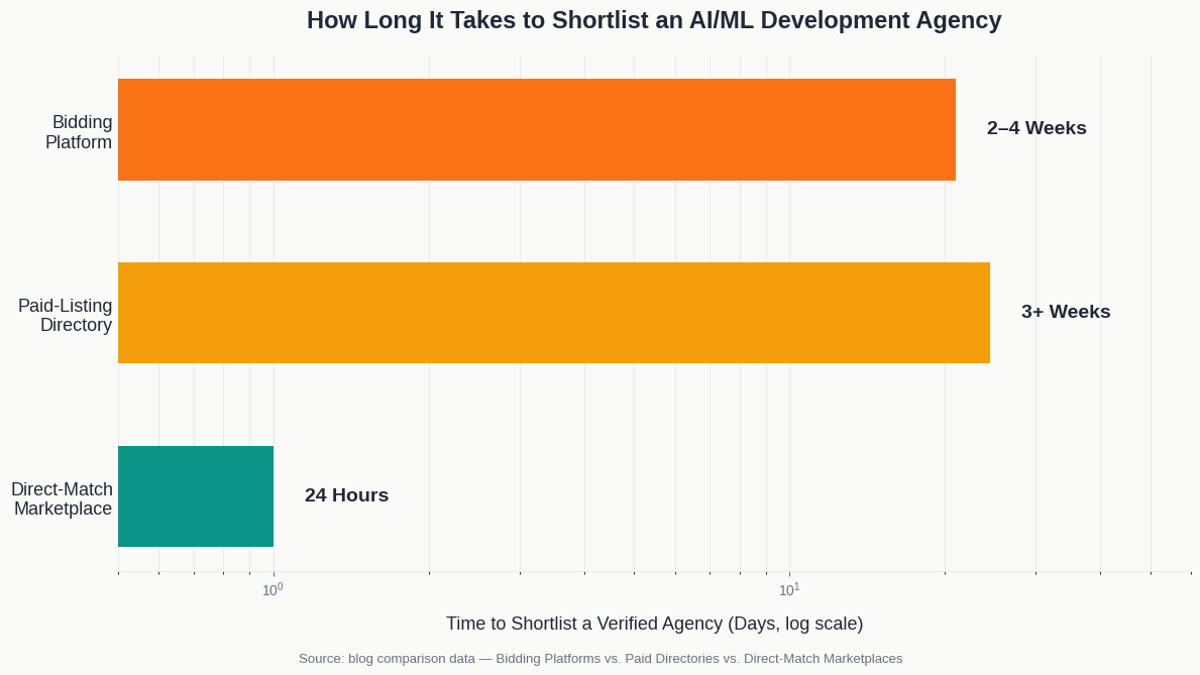
Companies posting technical projects on traditional bidding platforms wait an average of two to four weeks just to shortlist a vendor and that’s before reference checks even start. The gap between “we need an AI/ML partner” and “we have a signed agency” is where most AI initiatives quietly stall.
That delay isn’t a talent problem. It’s a discovery problem. Most businesses don’t lack access to AI/ML expertise; they lack a fast, verified way to find it. The organizations moving quickest this year are the ones that skip the RFP cycle entirely and post an AI/ML development project through a direct-match marketplace instead of a bidding board.
The U.S. entered 2025 with 1.4 million unfilled technology roles against only 400,000 annual computer-science graduates, a gap translating into roughly $162 billion in foregone output, according to Mordor Intelligence’s Software Development Outsourcing Market report. For AI/ML specifically, the scarcity is worse: applied ML engineers and AI architects rank among the hardest technical roles to fill in-house anywhere in North America or Western Europe.
That scarcity is the real reason procurement leads and CTOs are changing how they source AI/ML partners. Internal hiring can’t close the gap fast enough, and the old way to compensate for posting a listing on a bidding platform and wait has its own built-in delay. When speed and verification both matter, the fastest reliable path left is to post an ai ml development project online through a marketplace built specifically to match, not just list.
What Does It Mean to Post an AI/ML Development Project Online?
To post an ai ml development project online means submitting a structured project brief scope, budget range, timeline, and technical requirements to a marketplace that matches it against a pool of vetted AI/ML agencies. The output is a shortlist of qualified vendors, not an open call for anonymous bids.
The Core Problem: Sourcing Is Slower Than Building
Most teams underestimate vendor sourcing by 3 to 4x. A founder budgets one week to “find an agency” and ends up spending five to six weeks on it reviewing directory profiles, fielding cold outreach, and running discovery calls with agencies that turn out to lack real ML delivery experience.
The timeline breaks down like this on a typical bidding-platform search:
- Week 1–2: Post a listing, wait for proposals, filter out irrelevant ones.
- Week 3: Screen 15–20 inbound bids, most from generalist dev shops padding an “AI” line onto a broader software listing.
- Week 4: Run 4–6 discovery calls to find 2 agencies worth a technical interview.
- Week 5–6: Reference checks, contract negotiation, commission terms.
By the time a contract is signed, 5 to 6 weeks have passed and on a bidding marketplace, the platform has typically taken a 10–20% commission on top of the agency’s rate. Paid-listing directories charge the client side too, often $499 or more per year just to appear in search results, regardless of whether a project ever closes.
For AI/ML work specifically, this delay is more expensive than for a generic software build. Model development timelines are compressed by data availability windows, competitive launch dates, and in regulated industries compliance deadlines that don’t move. A 5-week sourcing delay on a 4-month build is a 25% timeline hit before a single line of code gets written. Teams that submit an ai ml development requirement online through a matching platform instead of an open bidding board typically absorb none of that delay, because the shortlist step compresses from weeks to hours.
There’s a second, quieter cost: opportunity cost on the agency side. Strong AI/ML shops don’t chase bidding boards, because racing other agencies to the lowest price on a public thread devalues specialized work. The best teams increasingly only respond to direct, matched introductions which means a slow, public bidding process doesn’t just cost the client time, it filters out the vendors most capable of doing the work well.
There’s a third cost that rarely shows up in a post-mortem: internal opportunity cost. Every week a procurement lead spends screening directory profiles is a week not spent on the parts of vendor selection that actually require judgment technical interviews, architecture review, reference calls. Compressing the shortlist step from weeks to a single day gives that time back to the part of the process where it matters most.
How to Submit an AI/ML Development Requirement and Get Matched Fast
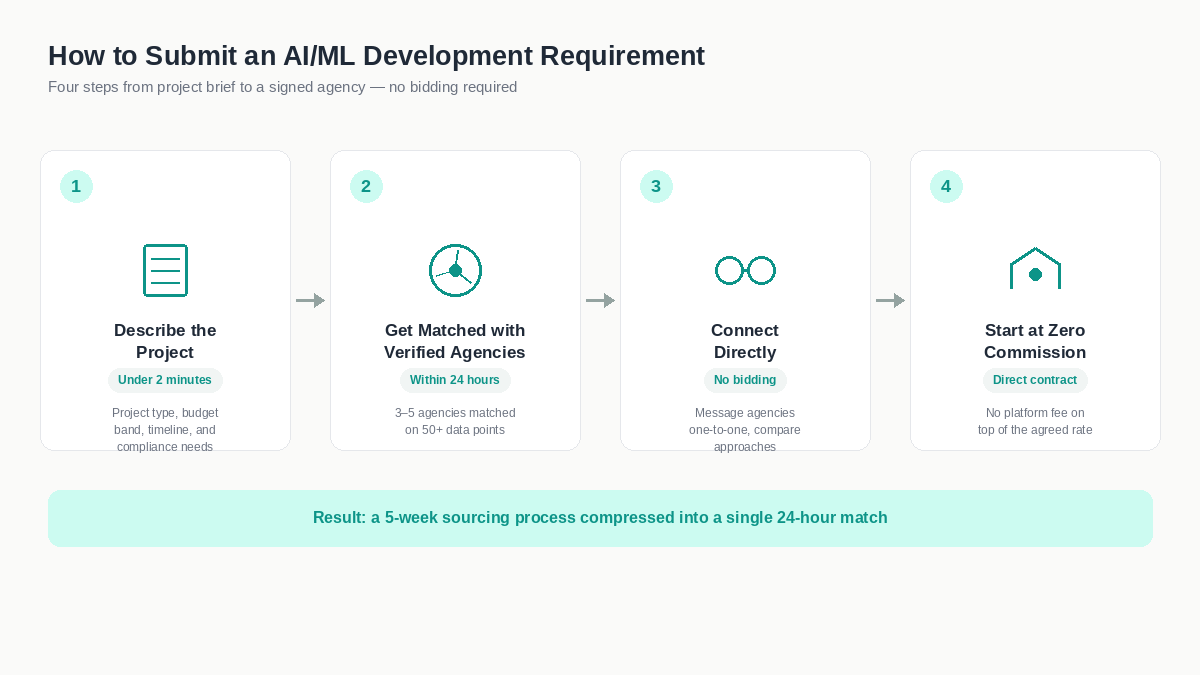
Getting from “we need an AI/ML partner” to “we have three qualified quotes” comes down to four steps. This is the process that compresses a 5-week search into a 24-hour match.
Step 1: Describe the Project (Under 2 Minutes)
Rather than drafting a formal RFP, you answer structured prompts: project type (computer vision, NLP, predictive modeling, MLOps, LLM integration), budget band, timeline, and any compliance requirements (HIPAA, SOC 2, GDPR). AI-assisted brief-building turns loose notes into a clear scope of work in under two minutes no procurement template required.
This matters more than it sounds. A vague brief (“we need help with AI”) returns vague matches. A structured brief that specifies data volume, model type, and integration points returns agencies that have actually shipped that exact kind of project before which is the entire point of choosing to post an AI/ML development project through a matching system instead of a generic job board.
Step 2: Get Matched With Verified Agencies
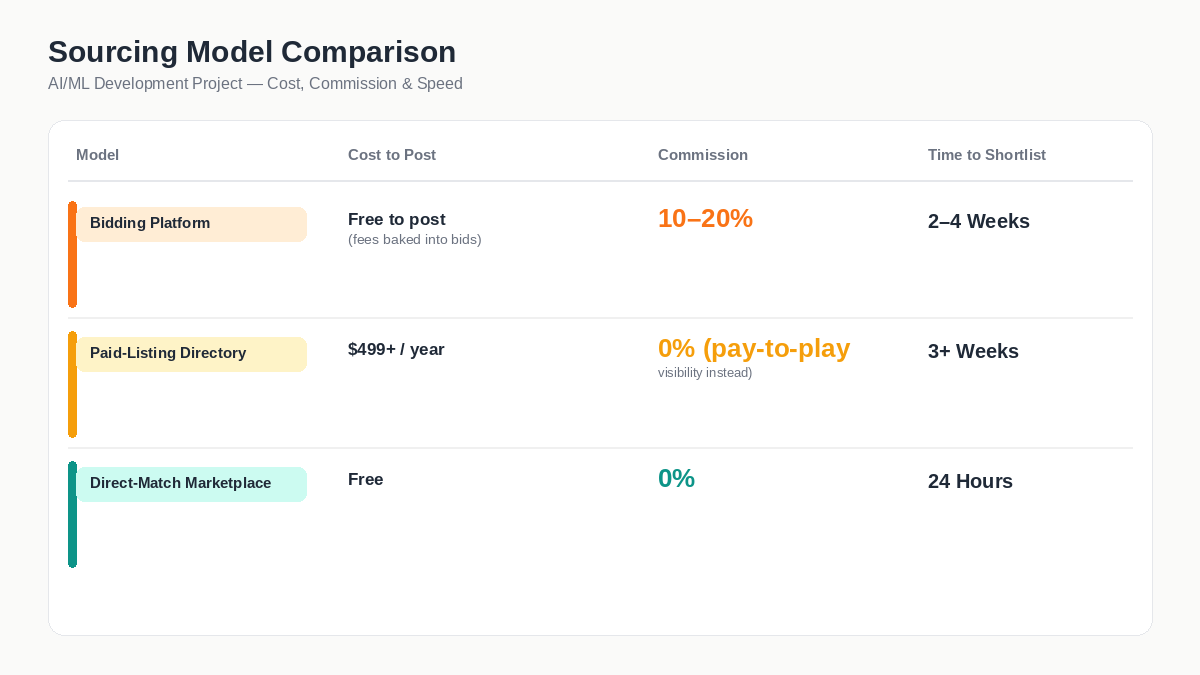
This is where finding verified ai ml development agencies replaces the old bidding model. Instead of broadcasting the project to anyone who wants to bid, an AI matching layer compares the brief against 50+ data points per agency technical specialization, team size, budget alignment, past project outcomes, and client history and returns 3 to 5 relevant matches, typically within 24 hours.
Each match includes a portfolio, verified team size, client ratings, and examples of comparable past work. The information that used to take 4 to 6 discovery calls to extract now sits in the first screen. Agencies are also searchable by service category, location across 50+ cities, hourly rate band, and specific domain expertise, so a healthcare-focused NLP shop doesn’t get lost in a generic “software development” filter.
Step 3: Connect Directly No Bidding
There’s no proposal auction. You message shortlisted agencies directly, ask clarifying questions, compare technical approaches, and negotiate terms one-to-one. This is the structural difference between a hire ai ml development company free marketplace model and a commission-bidding board: agencies aren’t racing each other’s price down in a public thread, which means the conversation stays about fit and capability, not just cost.
Step 4: Start the Project at Zero Commission
Once you pick a partner, you contract with them directly. There’s no platform fee layered on top of the agreed rate; the marketplace’s revenue model doesn’t depend on taking a cut of your project, so pricing stays between you and the agency you hired. This is also why agencies participate: a free listing with no recruiter-style commission cut means their quoted rate is the rate you actually pay.
What Verification Should Actually Cover
Not every “verified” badge means the same thing. A real agency verification process should confirm, at minimum:
- Website ownership and business registration
- Corporate email domain (not a generic Gmail contact)
- Independent client reviews and reference checks
- Team composition and named technical leads
- Portfolio evidence tied to the specific service category claimed (AI/ML, not just “software development”)
Layered, manual-plus-automated verification is what separates a curated marketplace from a directory that lets anyone create a listing. It’s also the reason a business can reasonably choose to post an ai ml development project online and trust the resulting shortlist without running a full independent background check on every name that shows up.
Cost Implications: What Commission Actually Costs Over a Project Lifecycle
A 15% commission sounds small on a single invoice. It compounds badly over a multi-phase AI/ML engagement. A $60,000 initial model build followed by $8,000–$12,000 in monthly MLOps retainer work over 12 months puts total spend well past $180,000 and a 15% commission on that lifetime value is $27,000 that never touches the agency’s actual delivery cost.
Paid-listing directories shift the cost differently: the client absorbs a flat annual fee regardless of outcome, and the agency absorbs a separate annual fee just to remain visible in search results. Both models add cost that has nothing to do with the quality of the match. A commission-free structure removes that layer entirely, which is one reason budget-conscious teams increasingly choose to post an ai ml development project on a marketplace built around direct connections rather than either fee structure.
Compliance and Data Handling Considerations
AI/ML projects carry data-handling stakes that generic software builds don’t always share. Before finalizing an agency, confirm in writing: where training data will be stored, whether the agency has handled comparable regulatory frameworks (HIPAA for healthcare data, PCI-DSS for payment data, GDPR for EU user data), and who retains rights to the trained model versus the underlying dataset. A verified agency profile should make this information easy to request during the direct-connect stage before a contract, not after.
Real-World Application: Two Sourcing Scenarios
Scenario one enterprise compliance timeline. A mid-sized fintech company needed a fraud-detection model built and deployed within a regulatory reporting deadline. Rather than run another RFP cycle, the team decided to post an ai ml development project through a direct-match marketplace instead. It received five verified agency matches within 24 hours, ran technical interviews with three, and signed a contract in 6 business days compared to the 5–6 week timeline their prior bidding-platform process had taken for a similar build.
Scenario two early-stage startup, tight budget. A seed-stage SaaS company needed a recommendation engine but couldn’t absorb a 15% marketplace commission on top of agency rates. By choosing to post a ML development project online on a commission-free platform, the founder connected with two mid-size ML shops directly, compared fixed-bid proposals without a bidding war, and closed a $22,000 project at the agency’s stated rate with no platform markup added on either side.
Comparison: Bidding Platforms vs. Paid Directories vs. Direct-Match Marketplaces
A short comparison makes the trade-offs clearer than another paragraph of prose would.
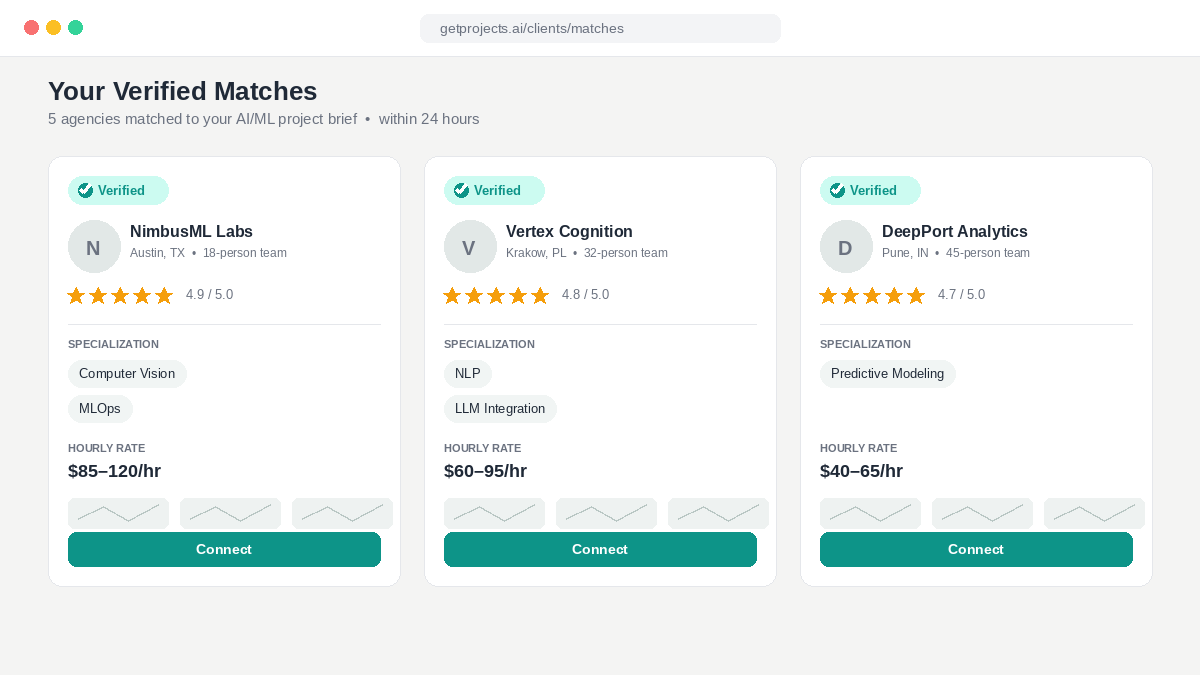
| Model | Client Cost to Post | Commission/Fees | Agency Selection Method | Typical Time to Shortlist |
| Bidding platform | Free to post, fees baked into bids | 10–20% commission on project value | Open bidding, race-to-lowest-price | 2–4 weeks |
| Paid-listing directory | $499+/year to list or search | None on project, but pay-to-play visibility | Manual browsing, no matching | Variable, often 3+ weeks |
| Direct-match marketplace | Free | 0% commission | AI-matched, verified shortlist | 24 hours |
The structural difference is the incentive. Bidding platforms make money when a deal closes at a higher agency rate padded to cover the cut. Directories make money whether or not a client ever hires anyone. A commission-free, direct-match model only works if the match is actually good; there’s no markup to hide a bad fit behind, which is a meaningful reason procurement teams increasingly prefer it when they decide to post an ai ml development project.
What Most Teams Get Wrong When Sourcing AI/ML Talent
The most common mistake isn’t picking the wrong agency, it’s writing a brief that’s too generic to match against in the first place. Teams that describe the project as “build us an AI feature” get matched (or bid on) by agencies that will say yes to anything, because the brief doesn’t disqualify anyone. A brief written specifically enough to rule out 80% of respondents is doing its job.
The second mistake is treating price as the primary filter. On a bidding platform, the lowest bid often comes from a team padding an unrelated skill set with an “AI/ML” tag, because the entire system rewards winning the bid, not proving the specialization. Verified, portfolio-backed matching flips that: the agencies you see already cleared a specialization filter before price ever entered the conversation.
The third mistake and the hardest one to fix after the fact is skipping direct technical conversation before signing. A verified profile and a strong portfolio narrow the field; they don’t replace a real conversation about how the agency would approach your specific data constraints, model architecture, or deployment environment. Deciding to submit an ai ml development requirement online gets a business to a qualified shortlist fast, but the shortlist is a starting point, not a decision.
A fourth, less obvious mistake: assuming the fastest match is the cheapest match. Speed and price are separate variables. A 24-hour shortlist means less time wasted narrowing candidates, not a discount on the agency’s actual rate; the savings come from removing commission and listing fees, not from pressuring agencies to undercut each other.
Start Your Project
If you’re evaluating how to post an ai ml development project without absorbing a 10–20% commission or waiting three weeks for a usable shortlist, GetProjects has helped businesses connect with AI-and-manually-verified agencies at zero platform cost. Describe the project, review matched agencies within 24 hours, and talk to the ones that fit before committing to anyone.
Frequently Asked Questions
Is it free to post an AI/ML development project?
Yes. On a direct-match, commission-free marketplace, posting a project carries no listing fee and no cost to connect with matched agencies. Clients only pay the agency they eventually hire, at the rate they negotiate directly there’s no platform markup added on top of that rate.
How are agencies verified before they can respond to a project?
A layered verification process checks website ownership, corporate email domain, independent client reviews, and named team details before an agency profile goes live. Combined AI and manual review filters out generalist shops that list AI/ML as one of a dozen unrelated services rather than a genuine specialization.
Can I talk to multiple agencies before choosing one?
Yes. A direct-connect model is built around comparing several verified matches typically 3 to 5 before making a decision. There’s no obligation to commit to the first agency you speak with, and there’s no bidding auction pressuring a fast, price-driven choice.
How long does it take to get ai ml development quotes fast through a marketplace like this?
Most matching systems return 3 to 5 relevant agency profiles within 24 hours of a completed project brief. Getting an actual quote takes a bit longer typically 1 to 3 business days after the first conversation but that’s still a fraction of the 2-to-4-week window a bidding platform usually takes just to produce a shortlist.
What’s the real difference between a bidding platform and a direct-match marketplace?
Bidding platforms let any agency submit a proposal and typically take a 10–20% commission on the winning bid. A direct-match marketplace pre-filters agencies through AI-driven matching and verification, skips the public bidding process entirely, and doesn’t charge a commission on the project at all.
Do I need a detailed technical specification before I submit a requirement?
No. A structured brief project type, budget range, timeline, and any compliance needs is enough to generate a relevant shortlist. Full technical specifications typically get finalized during discovery calls with the shortlisted agencies, once the field has narrowed to serious candidates.
What happens after I connect with an agency I like?
Contracting and kickoff happen directly with that agency, outside the marketplace’s involvement in pricing. Because there’s no commission structure to account for, project terms are negotiated the same way they would be with a vendor found through a direct referral just without the weeks spent finding that referral in the first place.