
Dedicated Team vs Time and Material vs Fixed Price Which Engagement Model Is Right for Your Project?
The engagement model you choose with a software development agency affects cost, control, risk, and outcomes in ways that most buyers do not fully understand until they are in the middle of a project that is going wrong. Choosing a fixed price for a project with evolving requirements produces a renegotiation every week. Choosing time and material for a project with limited budget produces scope creep that runs past your number without warning. Choosing a dedicated team for a 2-month project is like hiring a full-time employee for a sprint.
Choosing the wrong engagement model can quietly derail a software project leading to budget overruns, scope confusion, or delivery delays. What looks like a simple pricing decision often turns into a structural problem once development begins.
That’s why understanding dedicated team vs time material vs fixed price software development is essential before signing any contract, especially when your project scope, timeline, and budget vary.
According to Statista, global software market revenue is projected to exceed $858 billion in 2026, with a significant rise in outsourced and flexible engagement models. As demand grows, choosing the right model has become a key factor in project success.
The right model is not a matter of opinion, it is a function of your specific project’s characteristics. This guide covers all three models honestly, with the trade-offs stated clearly.
Dedicated Team vs Time Material vs Fixed Price: The Three Models Explained
Fixed Price:
The agency quotes a single price for a defined scope. You pay in milestones as the work is delivered. The scope is locked at the start. Change requests outside the defined scope are quoted separately. The risk of scope misestimation sits with the agency if they underestimated the work, they absorb the cost. If you’re gathering multiple proposals before committing, it helps to know how to compare software development quotes so you’re judging agencies on the same basis rather than on price alone.
Time and Material (T&M):
The agency charges by the hour or day at an agreed rate. You pay for the actual time spent on your project, plus any materials (third-party services, software licenses). The scope can evolve. You have maximum flexibility to change direction. The risk of scope expansion sits with you if requirements grow, the cost grows.
Dedicated Development Team:
You effectively hire a team from the agency on a monthly retainer, a defined set of developers working exclusively (or primarily) on your project for a defined period. You pay the monthly cost regardless of what you deliver in that period. The team is yours to direct. The agency handles HR, infrastructure, and management overhead. Since the monthly retainer cost varies significantly by where the team is based, see this breakdown of offshore development costs across India, Eastern Europe, and LatAm before setting your budget.
Fixed Price When It Works and When It Does Not
When fixed price is the right model:
Your requirements are specific enough to write a 2 to 4 page functional specification. You can describe every screen, every user action, and every expected system response. You have gone through a discovery process and the scope is stable. You have a defined budget and the project fits within it. You want cost certainty above all other variables.
Fixed price is best for: well-defined MVPs with clear acceptance criteria, adding a specific feature to an existing product, rebuilding a defined component of an existing system, and small discrete projects where the scope fits on two pages.
When fixed price goes wrong:
You are building something where you expect the requirements to evolve as you learn. The specification has ambiguity that seemed fine at signing but will produce disputes during development. You underspecified the design with no wireframes, no visual reference and the agency’s interpretation differs from yours. You assumed integrations were simple and they are not. Any of these scenarios produces change requests that either cost you more money or reduce your scope below what you needed.
The change request trap:
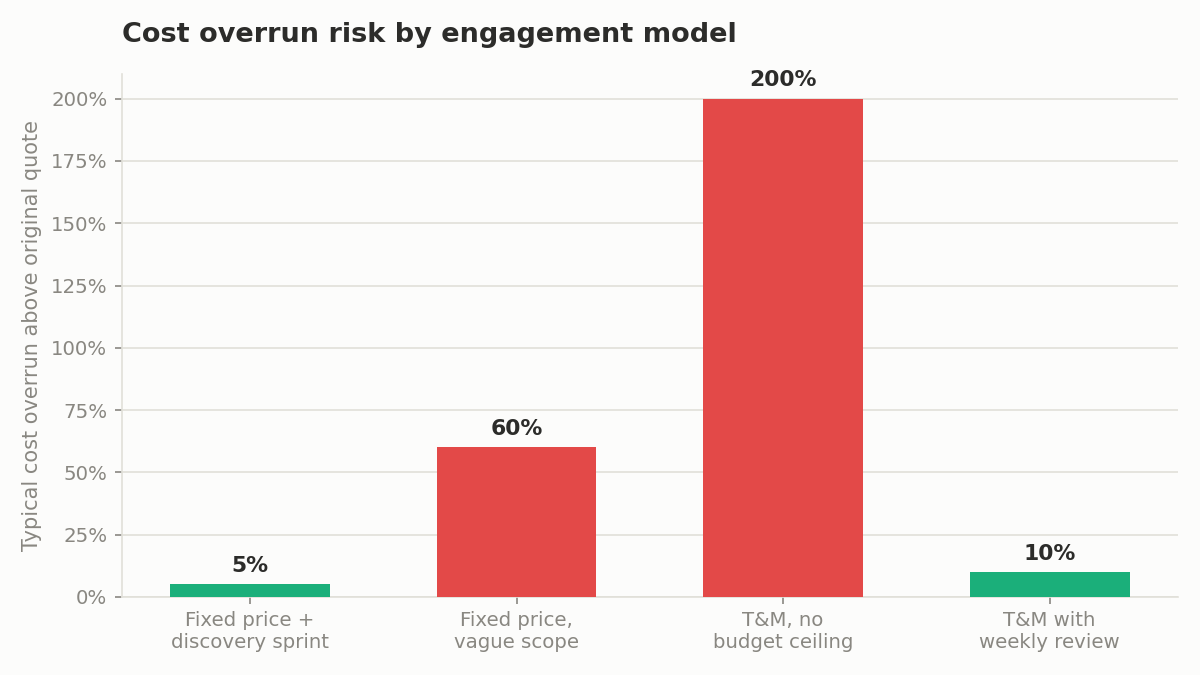
Fixed price contracts include change request mechanisms. Every requirement that was not explicitly specified in the SOW is potentially a change request. In a project with a vague initial specification, every ambiguous assumption becomes a change request when reality diverges from expectation. Buyers who choose a fixed price to get cost certainty then face an unpredictable stream of change requests often end up spending 30 to 60% more than the original fixed price. A tighter SOW starts upstream of the contract see how to write a software development RFP that closes off these gaps before an agency ever quotes you.
The practical protection:
Before signing a fixed price contract, document every assumption you are making. “I am assuming the design will be custom, not template-based.” “I am assuming the backend API will be included in this price.” “I am assuming iOS and Android are both included.” Share this list with the agency and ask them to confirm each assumption. The ones they push back on are the gaps that will become change requests. It’s also worth screening the agency itself at this stage; these are the same red flags in a software development company that predict a bad change-request experience later.
Time and Material When It Works and When It Does Not
When T&M is the right model:
You are building something exploratory where requirements will change as you learn. You are iterating on a product and new features depend on what you learn from previous features. You have ongoing development needs and want a consistent team that accumulates product knowledge over time. You trust the agency and can verify progress by reviewing code and testing features continuously.
T&M is best for: product development with evolving requirements, long-term partnerships where the scope evolves monthly, complex systems where architectural decisions affect what is possible, and projects where user research will shape features during development. If you’re weighing T&M against other long-term setups, it’s worth reading how to choose between freelancers, agencies, and product studios for this kind of ongoing partnership before committing.
When T&M goes wrong:
You lose track of how many hours are being spent on what. The agency is billing 40 hours per week and you cannot tell whether the output justifies the hours. The project runs 3× over your expected budget because nobody defined a scope constraint. Requirements changed so many times that the original estimate is meaningless but the budget was never revised upward.
The budget protection mechanism for T&M:
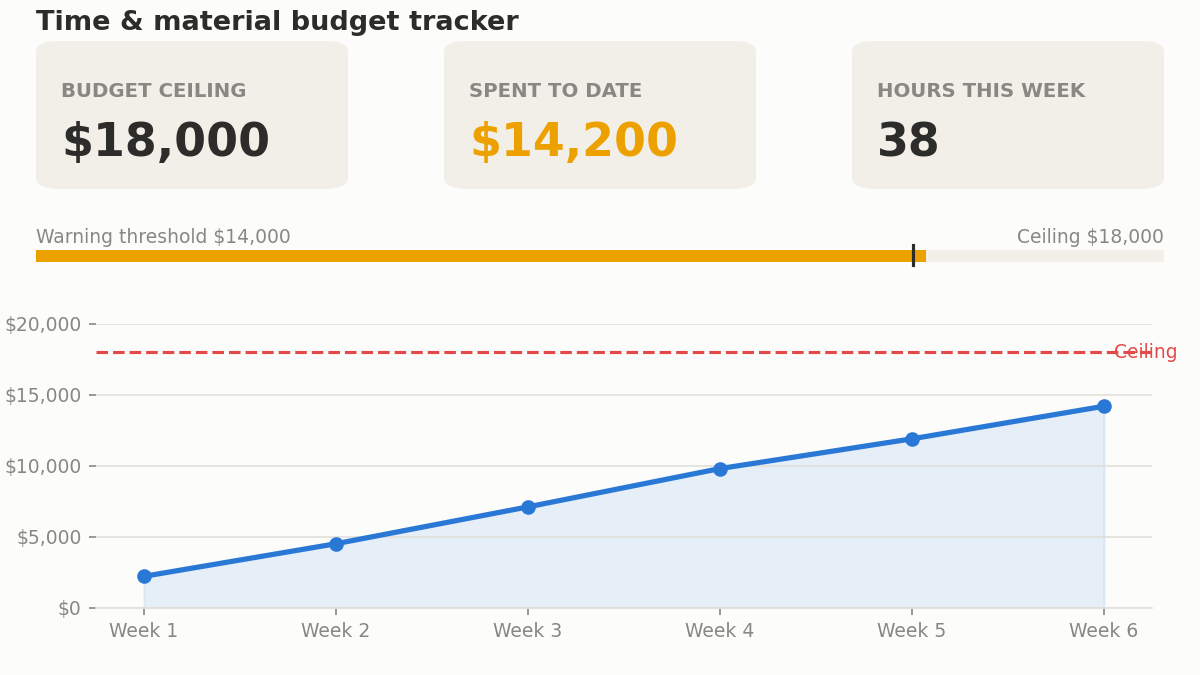
Agree to a budget ceiling and a warning threshold. “Total T&M spend should not exceed $18,000 without my explicit approval. Notify me when you reach $14,000 so we can evaluate the remaining scope.” This turns T&M into a flexible but bounded engagement rather than an open-ended commitment. Review actual vs estimated hours weekly not monthly. Monthly reviews on T&M projects consistently produce budget surprises. Weekly reviews catch overspend while there is still time to adjust.
Dedicated Development Team When It Works and When It Does Not
When dedicated team is the right model:
You have a continuous, predictable development workload for 3 months or longer. You want to build an internal-equivalent engineering capability without the HR overhead of direct employment. You need the team to accumulate deep product knowledge over time. You are scaling a product and need development capacity that can grow as your needs grow.
Dedicated team is best for: scale-up companies with continuous development needs, companies wanting to build an offshore development capability, long-term product evolution with consistent team composition, and situations where team continuity and product knowledge are the highest-priority variables. If you’re still deciding whether a dedicated external team beats hiring internally, this comparison of in-house vs. outsourced software development lays out the trade-off in more depth.
The cost reality of a dedicated team:
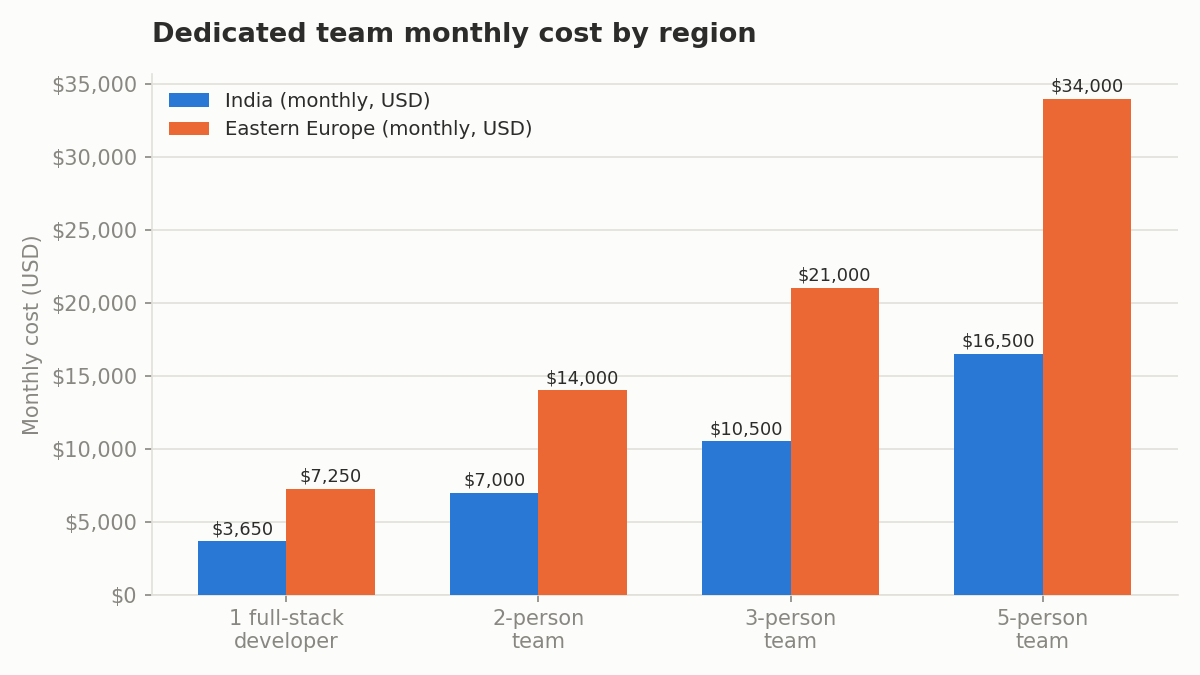
| Team Composition | India Monthly Cost | Eastern Europe Monthly Cost | What You Get |
| 1 full-stack developer | $2,800–$4,500 | $5,500–$9,000 | 160 hours/month, one developer’s capacity |
| 2-person team (frontend + backend) | $5,500–$8,500 | $11,000–$17,000 | 320 hours/month, specialised roles |
| 3-person team (full-stack + QA + PM) | $8,000–$13,000 | $16,000–$26,000 | Complete delivery team |
| 5-person team (2 dev + QA + design + PM) | $13,000–$20,000 | $26,000–$42,000 | Startup engineering team equivalent |
When dedicated team goes wrong:
You hire a dedicated team for a finite 6-week project. The economics do not work minimum monthly commitment with 2 to 4 weeks of ramp-up means you are paying full-team costs for a project that would have been more efficient as fixed-price. The team is technically dedicated to you but the quality of direction from your side is insufficient. Without clear sprint planning, prioritised backlogs, and product management on your side, a dedicated team will fill hours but not make meaningful progress.
The agency designates your dedicated team members but reassigns them to other projects during slow weeks without telling you. Catching this kind of agency before you sign is easier than fixing it mid-contract. This guide on how to shortlist an IT agency in 72 hours covers what to verify about team allocation and accountability upfront.
The Model Selection Framework
The honest decision framework:
| Your Situation | Best Model | Why |
| Requirements are fully defined, budget is fixed | Fixed price | Cost certainty, locked scope, milestone accountability |
| Requirements will evolve, you have time to manage | T&M with budget ceiling | Flexibility, weekly hour reviews keep cost in check |
| You need 6+ months of continuous development | Dedicated team | Team continuity, accumulated product knowledge, cost efficiency at scale |
| First project with a new agency | Fixed price (after paid discovery sprint) | Limit commitment until trust is established |
| MVP with well-defined core feature set | Fixed price | Budget predictability matters most for first build |
| Post-MVP product iteration | T&M | Requirements evolve based on user feedback |
| Building an in-house-equivalent team | Dedicated team | Long-term, process-oriented, team identity |
The hybrid model that works for most startups:
Phase 1 Discovery (T&M, $500–$1,500): The agency reviews your requirements, asks questions, builds a specification, and provides a fixed price quote for Phase 2. You pay for their time, they invest in understanding your product. This is also the window to evaluate whether the agency itself is the right long-term fit. This practical buyer framework for comparing software development companies is worth running through before Phase 2 begins.
Phase 2 MVP build (Fixed price): Well-defined scope, milestone-based payments, clear acceptance criteria. Budget certainty for the initial build. If you’re still narrowing down who to build with at this stage, this list of the best MVP development companies is a useful starting point for comparison.
Phase 3 Product evolution (T&M or dedicated team): After launch, requirements evolve based on user feedback. T&M with monthly budget reviews, or a dedicated team if the pace of development justifies it. This is usually the point where founders start thinking about a permanent team rather than a per-phase vendor, see how startups should build their first tech team for how that transition typically plays out.
This sequence discovery T&M into fixed-price MVP into T&M evolution captures the best of each model at the right phase of the product lifecycle.
Frequently Asked Questions
Which engagement model is cheapest?
Fixed price tends to produce the lowest total cost when scope is well-defined; the competitive quoting process drives prices down and the agency absorbs underestimation risk. Time and material is cheapest when scope is genuinely minimal and you have strong internal project management to prevent scope creep. Dedicated team is cheapest when you need continuous development for 6 months or longer. The monthly rate is lower than equivalent T&M hours because the agency has predictable revenue and reduced sales overhead. The most expensive outcome in any model is a poorly scoped fixed price project with extensive change requests; you pay the fixed price plus 40 to 80% in changes, with all the friction of renegotiation.
Can I switch engagement models mid-project?
Yes and sometimes this is the right decision. Starting at a fixed price and switching to a T & M mid-project makes sense when you discover that requirements are significantly more complex or uncertain than initially assumed, and the change request process is creating more friction than the cost certainty is worth. Starting T&M and switching to fixed price makes sense when you have used the T&M phase to fully understand the scope and want cost certainty for the remaining deliverables. The switch should be formalised in a contract amendment and not continue on an informal basis where the model is ambiguous.
What is a discovery sprint and why should it precede a fixed price contract?
A discovery sprint is a paid, time-boxed (typically 3 to 5 days) engagement where the agency digs into your requirements in detail reviewing your existing materials, asking clarifying questions, identifying technical risks, and producing a functional specification and architecture overview. It typically costs $500 to $1,500 and produces two outputs: a much more accurate fixed price quote, and early evidence of the agency’s communication quality and technical thinking. It is the most cost-effective risk mitigation available before a software development contract. The alternative of signing a fixed price contract based on a high-level brief consistently produces misaligned scopes, change request disputes, and final costs 40 to 80% above the original quote.
What is a typical milestone structure for a fixed price project?
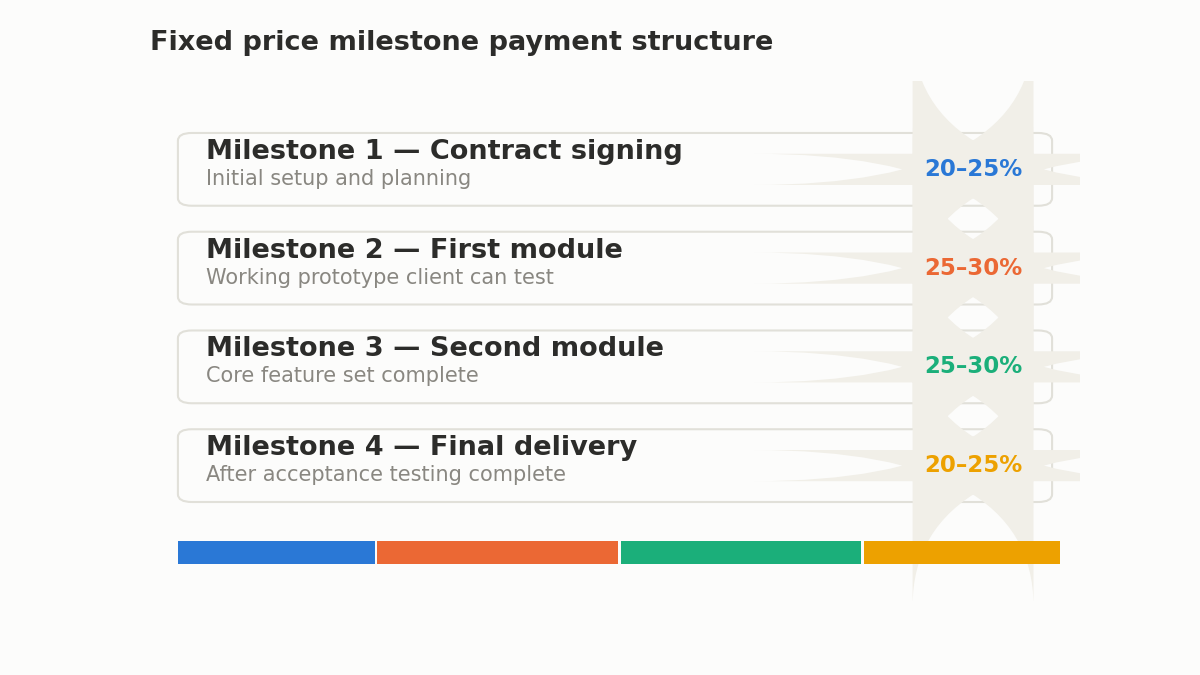
A well-structured fixed price project has 4 to 5 milestones with payments tied to specific, verifiable deliverables not to time elapsed or percentage of work claimed complete. A typical structure: 20 to 25% at contract signing to fund initial setup and planning, 25 to 30% after delivery of working first module or prototype that the client can test, 25 to 30% after delivery of second major module (typically core feature complete), 20 to 25% at final delivery after acceptance testing is complete. Every milestone should have specific acceptance criteria that exactly must be demonstrably working for the milestone payment to be due. “Design complete” is not a good acceptance criterion. “All 14 screens are pixel-accurate to the approved mockups and functional on iOS 17 and Android 14” is a good acceptance criterion.