How to Choose an AI Development Company The Complete Evaluation Guide 2026
Choosing an AI development company is the hardest vendor selection decision in software outsourcing. The knowledge gap between buyer and seller is wider in AI than in any other category. Most buyers cannot assess whether a proposed AI architecture is appropriate for their use case, whether the quoted accuracy is achievable, or whether the evaluation methodology is rigorous. This information asymmetry creates significant risk and a structured evaluation process is the only protection against it.
That’s why how to choose AI development company options requires a structured evaluation of technical expertise, AI architecture, model selection, security, testing, and proven project experience.
The good news: the evaluation process is learnable. You do not need to be a machine learning engineer to assess whether an AI development company genuinely knows what it is doing. You need to know the right questions to ask and the right signals to look for in the answers.
The need for careful evaluation is growing rapidly. Stanford HAI’s 2026 AI Index reports that 88% of surveyed organizations used AI in at least one business function in 2025, highlighting how quickly AI is moving into real business operations.
This guide explains the key questions to ask, signals to evaluate, and practical steps to identify an AI development company that can deliver beyond the sales pitch.
Step 1 Define Your AI Project Category Before Evaluating Anyone
The most common mistake buyers make when evaluating AI development companies is starting with “who is good at AI?” before answering “what specifically am I building?” The AI category is too broad for this approach to work.
Define your project category first:
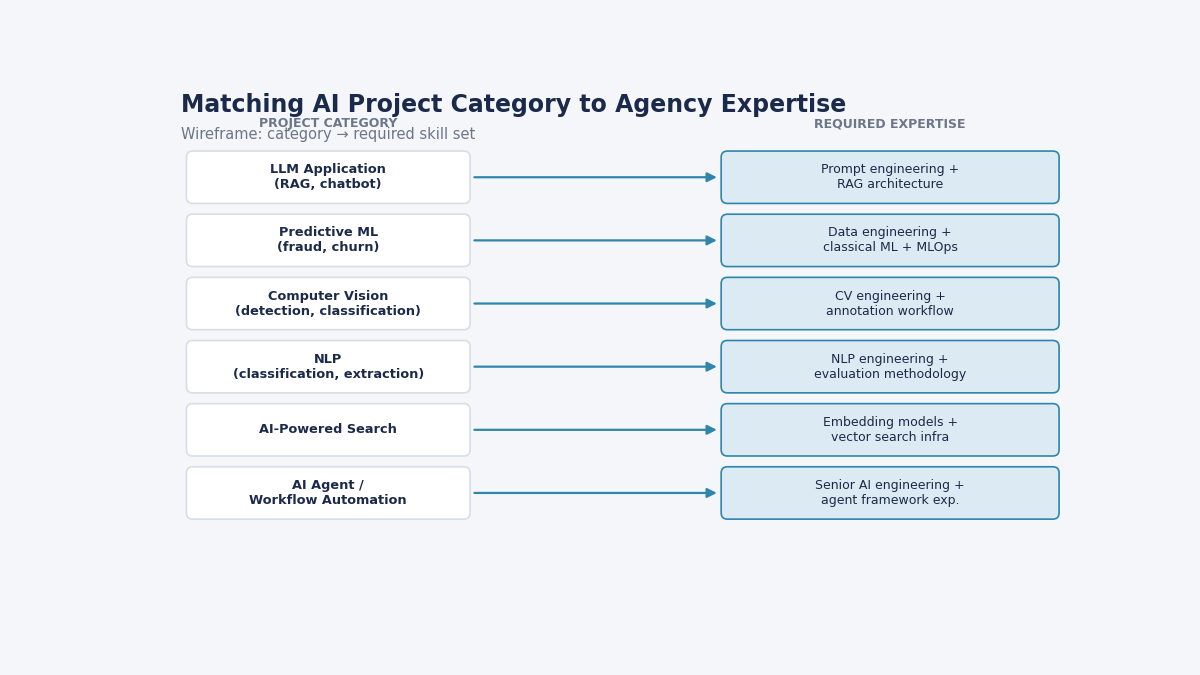
| AI Project Category | What It Involves | What You Need From the Agency |
| LLM application (RAG, chatbot, writing tool) | LLM API integration + retrieval architecture | Prompt engineering expertise + RAG architecture experience |
| Predictive ML (fraud, churn, demand forecasting) | Custom model training on tabular data | Data engineering + classical ML + MLOps |
| Computer vision (image classification, object detection) | Training or fine-tuning vision models | Computer vision engineering + annotation workflow |
| NLP (classification, extraction, sentiment) | Text classification, entity extraction, sentiment models | NLP engineering + evaluation methodology |
| AI-powered search | Semantic search, recommendation systems | Embedding models + vector search infrastructure |
| AI agent / workflow automation | LLM + tool use + planning + error recovery | Senior AI engineering + agent framework experience |
Each category requires different skills. An agency with strong RAG architecture experience may have no custom ML model training experience. An agency that has built excellent computer vision systems may have no LLM application experience. Match the agency’s expertise to your project category before evaluating anything else.
Step 2 Evaluate Technical Depth Through Specific Questions
The technical evaluation is the core of choosing an AI development company. Every question below has a right answer, not a single correct response, but a set of characteristics that reveal genuine expertise versus surface familiarity.
For LLM application projects:
Describe your approach to RAG architecture for a document Q&A application. A deep answer discusses chunking strategy (recursive character text splitting vs semantic chunking vs document-level), embedding model selection trade-offs, vector database choice and why, retrieval method (dense vs hybrid), re-ranking, and how you handle the context window budget when retrieved documents are long the kind of depth you’d expect from a team that specializes in AI/ML development rather than one bolting an API call onto an existing product. A shallow answer says “we embed your documents and search for relevant ones.”
How do you prevent hallucination in a production LLM application? A specific answer discusses retrieval grounding (LLM instructed to answer only from retrieved context), structured output validation, confidence thresholds, and monitoring for answer drift after model updates, the same evaluation framework rigor that separates agencies who ship AI features from agencies who ship AI demos. A shallow answer says “we test it thoroughly.”
For predictive ML projects:
Describe your model development workflow from data exploration to production deployment. A specific answer covers: exploratory data analysis, feature engineering decisions, train/validation/test split methodology, model selection and comparison, hyperparameter tuning, and monitoring in production (data drift detection, performance degradation alerting). A shallow answer says “we train a model on your data and deploy it.”
How do you handle class imbalance in a fraud detection model where fraud is 0.1% of transactions? A specific answer discusses: SMOTE or other oversampling techniques, cost-sensitive learning, threshold calibration for the precision-recall trade-off, and evaluation metrics appropriate for imbalanced datasets (AUC-PR over AUC-ROC). A shallow answer reveals no specific fraud ML experience.
For computer vision projects:
What is your approach to building a training dataset for a custom object detection model when labelled data does not exist? A specific answer covers: data collection strategy, annotation tooling (Label Studio, Scale AI, Roboflow), annotation guidelines and quality control, active learning to prioritise which images to label next, and synthetic data augmentation to expand the training set since data labelling can be a significant share of AI project costs, a serious agency will walk you through this before quoting a number. A shallow answer says “we’ll label the images.”
Step 3 Evaluate the Portfolio Against Your Specific Category
AI portfolio evaluation criteria:
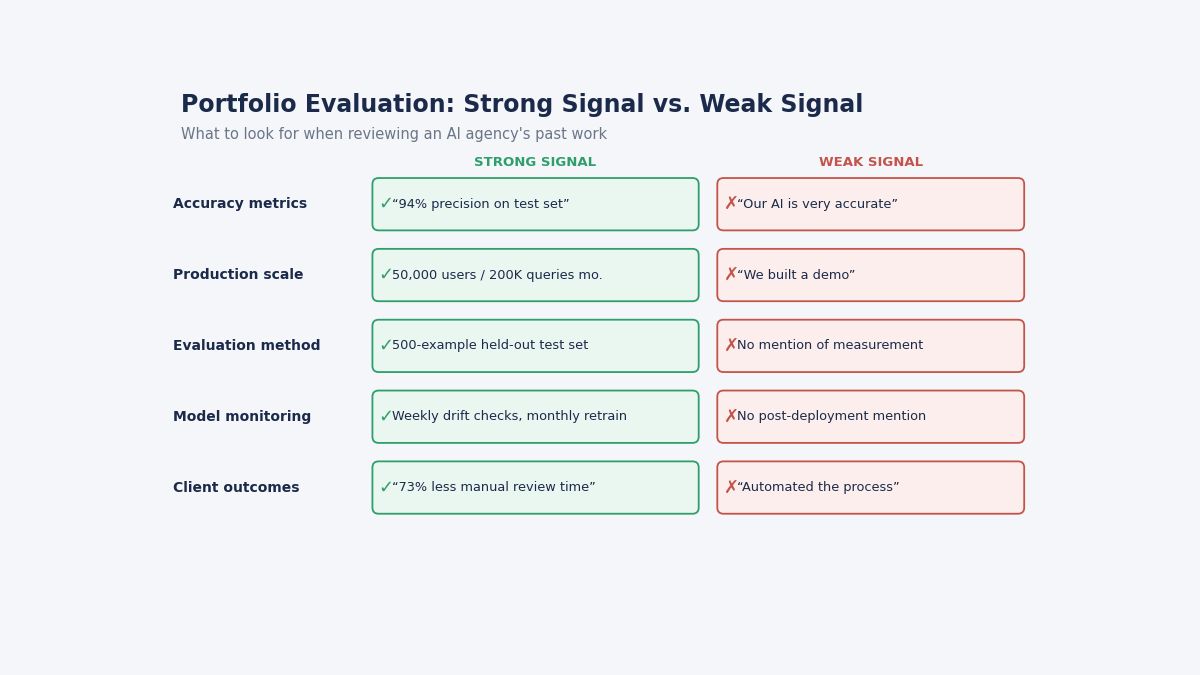
The portfolio question in AI is different from other software categories because the most important evidence is not visual, it is technical outcome data.
| Portfolio Element | What to Look For | What to Ignore |
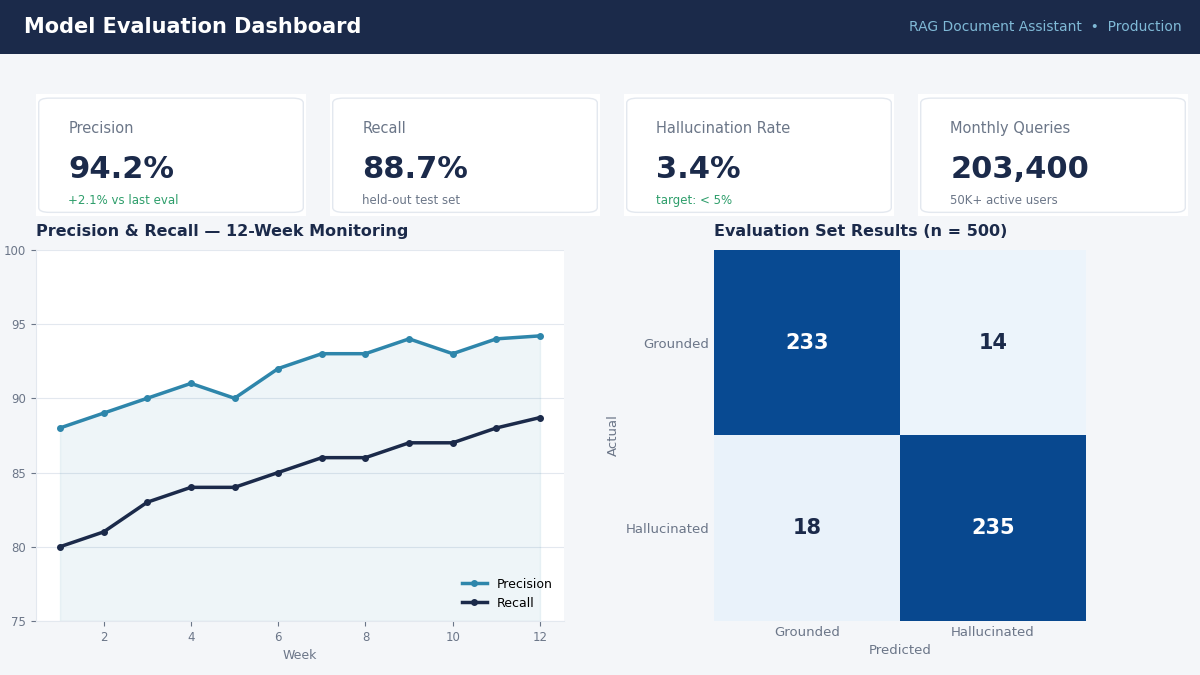
| Accuracy metrics | “Our model achieves 94% precision on the test set” specific, verifiable | “Our AI is very accurate” meaningless |
| Production scale | “Deployed to 50,000 users, processing 200,000 queries per month” real usage | “We built a demo” no production validation |
| Evaluation methodology | “We used a held-out test set of 500 labelled examples” rigorous | No mention of how performance was measured |
| Model update management | “We monitor for data drift weekly and retrain monthly” production thinking | No post-deployment mention |
| Client outcomes | “Reduced manual document review time by 73%” business impact | “Automated the process” no measurable outcome |
The portfolio request that reveals everything:
Ask the agency to walk you through a recent AI project not via case study PDF, via a live conversation with the engineer who built it. In 20 minutes of technical conversation, you will learn more than any written case study can convey: their actual depth of understanding, how they approached problems, what they learned, and whether they can communicate clearly about technical concepts.
Step 4 Evaluate the Engagement Approach for AI Projects
AI development requires a different engagement model than standard software development because the outcomes are probabilistic rather than deterministic. A web form either works or it does not. An AI model achieves 87% accuracy rather than 94% and the path to 94% may require more data, a different architecture, or a different framing of the problem.
What to look for in how an AI agency structures their engagements:
Discovery and data assessment phase before quoting a fixed price for an AI project, a good agency assesses your data (volume, quality, labelling status), defines the success criteria (what accuracy level constitutes “good enough for production?”), and scopes the project based on what the data can support. Agencies that quote a fixed price for AI development without seeing your data have not understood AI development the same discipline that should inform how you weigh fixed price against time-and-material or dedicated team models more broadly.
Iterative milestone structure The first milestone should be a proof of concept that achieves a defined accuracy threshold with your actual data. If the POC does not hit the threshold, the project either needs more data or a revised approach and this is discovered cheaply before full development investment, not expensively at the end.
Evaluation infrastructure a production AI application needs ongoing monitoring: data drift detection, performance degradation alerts, A/B testing for model updates. An agency that does not include evaluation infrastructure in their scope is delivering a product that will degrade silently without your awareness, which is exactly the kind of gap worth checking against common red flags in a software development company before you sign.
Step 5 Evaluate Cost Against Realistic Expectations
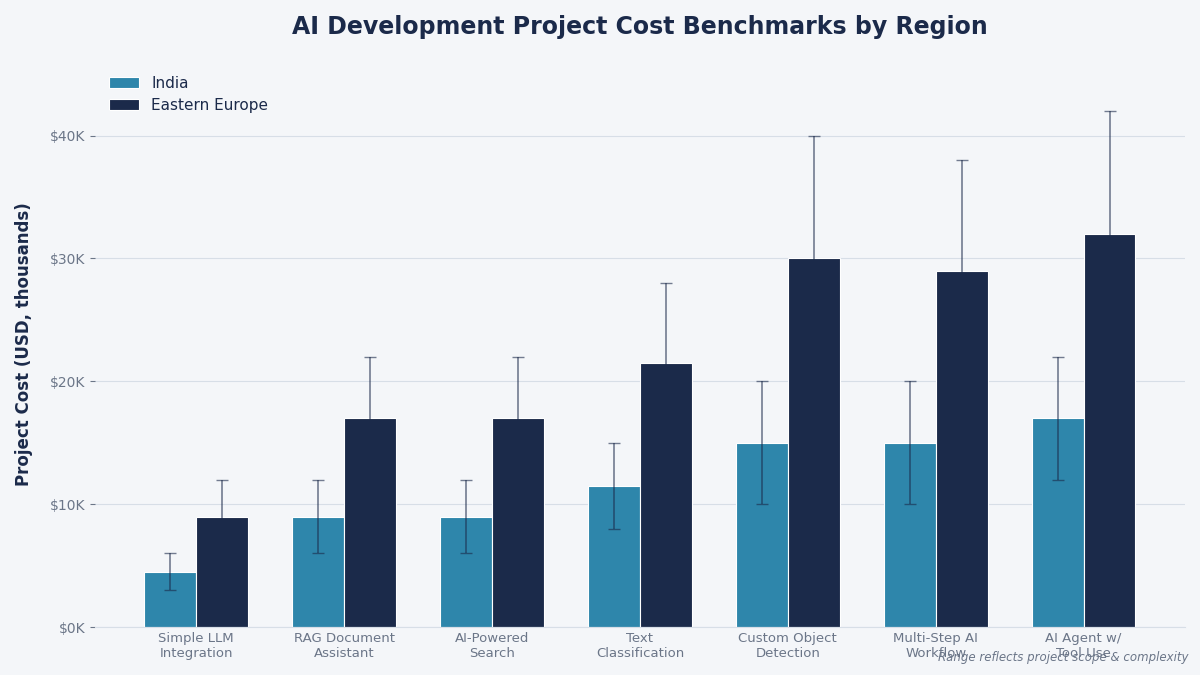
AI development cost benchmarks at the $5K–$30K level:
| Project Type | India Cost | Eastern Europe Cost | What Determines the Range |
| Simple LLM integration (API + basic prompt) | $3K–$6K | $6K–$12K | Number of endpoints, prompt complexity |
| RAG document assistant | $6K–$12K | $12K–$22K | Number of document sources, evaluation rigour |
| AI-powered search | $6K–$12K | $12K–$22K | Corpus size, reranking complexity |
| Text classification model | $8K–$15K | $15K–$28K | Data labelling requirements, accuracy target |
| Custom object detection | $10K–$20K | $20K–$40K | Training data requirements, accuracy target |
| Multi-step AI workflow | $10K–$20K | $20K–$38K | Number of steps, tool integrations |
| AI agent with tool use | $12K–$22K | $22K–$42K | Tool complexity, error recovery requirements |
The data cost that most AI budgets miss:
If your project requires labelled training data that does not currently exist, data labelling is a significant cost. At $0.05 to $0.50 per labelled example (depending on complexity), a dataset of 10,000 examples costs $500 to $5,000 to label. A dataset of 100,000 examples costs $5,000 to $50,000. Data labelling cost should be planned separately from development cost and the expected dataset size should be discussed with the agency during scoping, not discovered mid-project.
The AI-Specific Red Flags Summary
An agency that guarantees accuracy targets before seeing your data has not understood how ML works. Accuracy depends on data quality, data volume, and the inherent difficulty of the classification task none of which can be known without data assessment.
An agency that does not ask about your data during the sales process is not serious about your project. The data is the most important input to any AI development project an agency that does not inquire about it has not thought about what they are building.
An agency that proposes training a custom model when a RAG or fine-tuning approach would solve your problem more cheaply and quickly is either padding scope or demonstrating a lack of LLM application experience. Custom model training is significantly more expensive and time-consuming than LLM-based approaches for most business applications, which is exactly why comparing AI/ML development costs upfront helps you spot inflated scope before you sign anything.
An agency that has no evaluation methodology for AI deliverables is delivering code, not AI. Every AI feature needs a test set and a performance measurement. Without this, you have no way of knowing whether the AI is working correctly or getting worse over time. The same accountability gap in this guide’s companion piece on vetting a mobile app development company flags as a signal of an unserious vendor.
Frequently Asked Questions
What data do I need before starting an AI development project?
The data requirements depend on the type of AI project. For LLM applications using RAG, the most common category at $5K to $30K budgets, you need your documents in a processable format (PDF, Word, HTML, text) and a test set of 50 to 200 representative questions with expected correct answers. For custom ML model training, you need labelled training data; the minimum viable dataset is typically 1,000 to 5,000 labelled examples for text classification, and 1,000 to 10,000 labelled images for computer vision, with more being better in both cases. For fine-tuning an LLM on your specific use case, you need 100 to 1,000 high-quality input-output example pairs. The agency you choose should assess your data before providing a final quote. If they quote without asking about your data, treat it as a rough estimate, not a commitment.
How do I set success criteria for an AI development project?
Define success criteria before development begins, in writing, as part of the project agreement. For classification tasks: “The model must achieve at least 90% precision and 85% recall on the held-out test set.” For RAG applications: “At least 85% of test queries must return a correct answer grounded in the source documents, with less than 5% of answers containing hallucinated information.” For semantic search: “At least 80% of test queries must return a relevant document in the top-3 results.” These criteria are both the acceptance threshold for the project and the ongoing monitoring benchmark. An agency that resists specific success criteria is signalling uncertainty about whether they can meet them.
Should I use an AI-specialist agency or a general software agency with AI capabilities?
For projects where AI is the core value proposition a product that would not exist without the AI feature being good use an AI specialist. The difference in outcome quality justifies the potentially higher cost. For projects where AI is a feature enhancement to an existing product adding an AI writing assistant to an otherwise non-AI product a strong general development agency with demonstrated LLM application experience is often more appropriate. They understand your full product context, manage the integration with existing systems more smoothly, and often produce better overall products because they treat the AI feature as one component of the user experience rather than the product itself. The test: is the AI the product, or is the AI a feature of the product?