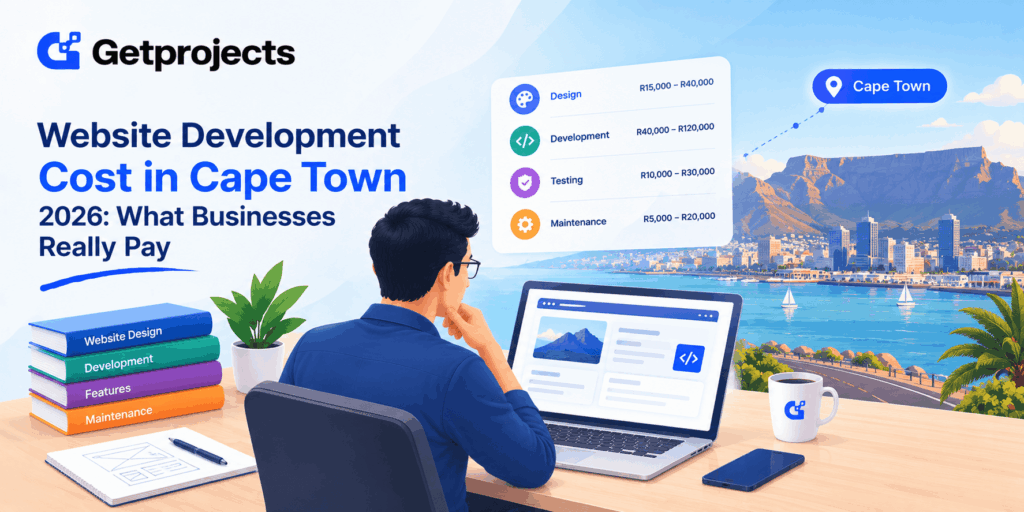
Website Development Cost in Cape Town 2026: What Businesses Really Pay
The same five-page brief can draw a R6,000 quote and a R95,000 quote from two studios in the same week. Neither number is necessarily wrong. The difference sits in what each quote quietly includes or leaves out, and that gap is where most budgets get burned.
This guide breaks down the website development cost Cape Town businesses face in 2026, tier by tier, so you can read a proposal for what it actually covers. The figures below are rand ranges for real project types, not “starting from” prices pulled from a homepage banner.
Pricing in the Western Cape sits in an unusual spot. Local studios compete with Johannesburg firms, offshore teams and template builders, while serving one of the fastest-growing ecommerce markets on the continent. As a result, the website development cost Cape Town businesses budget for has become harder to predict from one quote to the next. The software development rates in Africa also vary sharply between cities, so entry-level work has become cheaper while builds with integrations, compliance and performance work have become more expensive.
Three markers frame the rest of this article. A basic brochure site typically lands between R5,000 and R15,000. A properly scoped SME site runs R15,000 to R45,000, and online stores or custom platforms start near R25,000 and can pass R500,000 once bespoke logic enters the picture.
Everything between those markers depends on scope, team structure and recurring costs. Once you understand those three levers, the website development cost Cape Town agencies quote stops looking random and starts looking negotiable.
South African online retail is forecast to reach roughly R159 billion in 2026, close to 10% of total retail turnover, according to the Online Retail in South Africa 2026 report produced by World Wide Worx with Mastercard, Peach Payments and Ask Africa. World Wide Worx also reports that about 56% of online shopping now happens on mobile phones, which makes mobile-first builds a baseline requirement rather than an add-on.
What Is Website Development Cost?
Website development cost is the total amount a business pays to plan, design, build, test and launch a website, plus the recurring spend to host, secure and maintain it. In Cape Town, it covers agency or freelancer fees, platform licences, integrations such as payment gateways, and post-launch support, usually quoted in rand per project or per month.
Why Quotes for the Same Website Vary by 5–10x
Few website proposals are built to be compared. Ask five studios for website design prices Cape Town buyers can line up side by side, and you will rarely get them. One quote includes copywriting, imagery, SEO setup and three revision rounds; another covers development only and assumes you supply everything else. Knowing how software development estimates work makes these gaps far easier to spot.
The scope gap
Most briefs describe pages, not functionality. “A contact page” can mean a simple form or a lead-routing workflow that pushes enquiries into a CRM, and those two versions differ by R8,000–R20,000 in build time. Until the brief defines each feature, every website development cost Cape Town vendors return is an educated guess.
The content gap
Content is the most underestimated line item. In many briefs it is left out of the website development cost Cape Town providers quote altogether. Projects routinely stall for 2–4 weeks waiting on copy and images, and many studios bill content creation at R800–R1,500 per page when the client cannot deliver. Teams that budget only for design and code are usually short by 15–25% before launch.
The ongoing-cost gap
The build fee is only the first invoice. Hosting typically adds R150–R600 per month, plugin and theme licences R2,000–R8,000 per year, and a maintenance retainer R1,500–R6,000 per month. Over 12 months, the real website development cost Cape Town companies carry often runs 30–50% above the original build quote.
Website Development Cost Cape Town: 2026 Price Breakdown
The tiers below reflect typical 2026 quotes from Cape Town freelancers, boutique studios and full-service agencies. Each range shows the website development cost Cape Town providers commonly quote for that scope, excluding VAT. For context on the national picture, Procompare’s 2026 website development cost guide places the average South African business website at about R14,000, within a typical R7,500–R20,000 band.
If the broader question is how much does a website cost in South Africa, the national answer tracks closely with Cape Town. The main difference is that Cape Town agency rates sit 10–20% above smaller metros, reflecting higher operating costs and strong demand from tourism, property and ecommerce brands.
Starter and brochure websites: R5,000–R15,000
This tier covers 1–5 pages built on a premium template, usually in WordPress or a hosted builder. Expect basic contact forms, Google Maps, social links and mobile responsiveness. Delivery takes 1–3 weeks, and the website development cost Cape Town freelancers charge at this level rarely includes copywriting or technical SEO. Before choosing this tier, weigh the custom vs template website cost over a three-year horizon rather than at launch.
How much does a small business website cost in Cape Town?
A 6–15 page business site with a semi-custom design, a blog, lead forms and basic analytics typically costs R15,000–R45,000. Studios at the upper end add proper UX/UI design, on-page SEO structure and two or three revision rounds. Timelines run 4–8 weeks, depending on how quickly content arrives. At this tier, the website development cost Cape Town studios quote usually reflects design depth more than page count.
Online stores and ecommerce builds
Ecommerce is where the price spread is widest. Entry-level stores built on Shopify or WooCommerce with fewer than 100 products run R15,000–R30,000, while SME stores with custom design, courier integration and payment gateway integration for PayFast, Peach Payments or Yoco typically cost R30,000–R85,000. The best Shopify development companies usually quote toward the upper half of that band because theme customisation and app configuration are included.
Fully custom platforms with ERP sync, B2B pricing or subscription logic start near R85,000 and can exceed R500,000. At that level, the website development cost Cape Town retailers approve is usually split across discovery, build and optimisation phases. Anyone researching ecommerce website cost South Africa benchmarks should treat product count as secondary; integrations, checkout rules and stock logic drive the number far more. For online stores, the website development cost Cape Town merchants face rises sharply with each third-party system the store must talk to.
Custom web applications and portals: R150,000–R750,000+
Client portals, booking engines, marketplaces and SaaS dashboards sit in their own category. These projects need discovery workshops, a dedicated CMS or custom admin, role-based access, API work and structured QA. Expect 3–9 months of delivery and a team of 3–6 people, which is why the website development cost Cape Town buyers see here behaves more like custom software development cost and is quoted in phases rather than as one fixed number.
Website redesign vs new build
Not every project starts from zero. Redesigning an existing site on the same platform typically costs 40–60% of a new build, because hosting, content and structure can be reused. Once the existing site needs a platform migration, URL restructuring and redirect mapping, a redesign often matches or exceeds the website development cost Cape Town companies would pay for a fresh build, so ask for both options to be priced.
Hidden costs most quotes leave out
Several line items rarely appear on the first proposal. A .co.za domain is inexpensive, but business email, premium plugins, stock photography and accessibility fixes can add R5,000–R20,000 in year one. Like most hidden costs of software development, technical SEO setup, including schema, redirects and speed optimisation, is often quoted separately at R4,000–R15,000.
Add these items to your comparison sheet before choosing a provider. A quote that looks R10,000 cheaper frequently becomes the more expensive option once these extras are priced, which is why the true website development cost Cape Town buyers should compare is the 12-month total.
What affects website development pricing?
Six factors move a quote more than anything else:
- Page templates, not page count: 30 pages built from 4 templates cost less than 12 pages with 12 unique layouts.
- Integrations: each CRM, ERP, payment or booking connection typically adds R5,000–R30,000.
- Design approach: a customised theme costs a fraction of research-led custom design.
- Content responsibility: who writes, sources and uploads copy and images.
- Compliance: POPIA compliance work such as consent banners, privacy notices and secure form handling.
- Team structure: freelancers typically bill R350–R700 per hour and Cape Town agencies R750–R1,500 per hour, while software developer hourly rates by country vary widely for offshore teams.
Red flags in a website quote
A low number is not the only warning sign. Watch for quotes with no page or feature list, unlimited revisions promised at a fixed price, hosting locked to the developer’s own account, and no mention of testing on mobile devices.
Equally risky are proposals that skip a fixed-price quote structure entirely and bill open-ended hours for a simple site. Any of these patterns usually means the website development cost Cape Town clients end up paying will drift well beyond the signed figure.
How to budget and hire in 7 steps
Use this sequence to turn a vague idea into comparable quotes. It keeps the website development cost Cape Town vendors return anchored to one shared brief:
- Define the business goal: leads, online sales, bookings or credibility.
- Write a project scope document listing pages, templates, features and integrations.
- Decide who owns content, and budget for it if the answer is “the agency.”
- Set a build budget plus a 12-month running budget for hosting, licences and support.
- Shortlist 3–5 verified providers with relevant portfolios, not just the lowest rates.
- Request itemised quotes against the same scope, with timelines and revision limits.
- Confirm ownership of the domain, hosting account, code and admin access before signing, using a software development contract checklist.
Real-World Scenarios From Cape Town Projects
A Cape Town logistics startup posted a 12-page brief that included a client login area. Its first round of quotes ranged from R38,000 to R210,000 because each vendor imagined a different portal. After the brief was rewritten with a feature list and content ownership, three shortlisted agencies quoted R72,000–R96,000, and the site launched in 10 weeks at R84,000.
A Stellenbosch direct-to-consumer wine brand needed a WooCommerce store with age verification, courier tracking and PayFast checkout. After weighing the cost of hiring an IT company directly against a bidding marketplace taking a 15% service fee, it hired a verified agency directly and kept roughly R18,000 of a R120,000 budget inside the project. That saving funded a six-month maintenance retainer after launch.
Both scenarios point to the same lesson. The final website development cost Cape Town businesses pay is shaped less by the vendor’s rate card and more by how clearly the work is defined before quotes are requested.
How to Compare a Web Development Agency in Cape Town Against Other Options
Choosing between a builder, a freelancer and a web development agency Cape Town firms recommend is mostly a question of risk tolerance. The table below summarises typical 2026 trade-offs and shows how the website development cost Cape Town buyers pay shifts with each delivery model.
| Option | Typical 2026 cost | Timeline | Best for | Main risk |
| DIY website builder | Monthly plan fees plus your time | 1–2 weeks | Sole traders testing an idea | Limited SEO and integration flexibility |
| Freelancer | R5,000–R30,000 | 2–6 weeks | Brochure and simple business sites | Single point of failure for support |
| Boutique studio | R25,000–R90,000 | 4–10 weeks | SMEs needing custom design and SEO | Capacity limits during busy seasons |
| Full-service agency | R80,000–R500,000+ | 2–9 months | Ecommerce, portals and integrations | Higher overheads built into rates |
How you find the provider also changes the number. Bidding marketplaces typically take 10–20% in commission, which is either added to your bill or squeezed out of the agency’s margin, and directory-style platforms often charge agencies $499 or more per year for visibility. Those costs eventually show up in the website development cost Cape Town clients are quoted, which is the real trade-off in agency marketplaces vs direct matching.
What Most Teams Get Wrong About Website Budgets
The most common mistake is treating the cheapest quote as the cheapest website. A R6,000 template site that cannot rank, load fast on mobile or connect to a CRM is often rebuilt within 18–24 months. Paying twice is the most expensive pricing model in web development.
The second mistake is approving design before content exists. Designers then build around placeholder text, real copy breaks the layouts, and revision rounds burn budget that should have gone into features. The website development cost Cape Town teams pay for redesign loops is usually invisible in the original quote.
The third mistake is losing control of ownership. Many businesses discover, when switching providers, that the hosting and domain accounts or admin logins are registered to the old developer. Settling who owns the code when you outsource before work starts avoids this, so insist on owning every credential from day one.
and domain accounts or admin logins are registered to the old developer. Insist on owning every credential from day one.
A related error is skipping mobile-first design reviews. Teams sign off desktop mockups, then discover in testing that checkout, menus and forms need rework on smaller screens. Since most South African traffic now arrives on phones, fixing this late adds avoidable cost to the website development cost Cape Town projects already carry.
The final mistake is judging the project by build cost alone. A R60,000 site that generates 40 qualified leads a month is cheaper than a R15,000 site that generates 3. Cost per lead, not cost per page, is the number that matters. Measured that way, the website development cost Cape Town businesses should accept depends on revenue impact rather than page count.
Get Comparable Quotes From Verified Cape Town Agencies
If you are budgeting a new website or rebuilding and want quotes that can actually be compared, the fastest route is a clear scope and a shortlist of verified providers. GetProjects is a commission-free, no-bid marketplace where businesses post a project in under two minutes, get AI-matched with verified agencies by budget, expertise and location, and pay only the agency they hire.
There are no listing fees and no bidding wars, so the quotes you receive reflect the work itself rather than platform margins. That keeps the website development cost Cape Town agencies quote tied to scope, not commission. Post your website project on GetProjects and compare Cape Town agencies on scope, portfolio and price before you commit.
FAQs on Website Development Cost Cape Town
How much does a basic website cost in Cape Town?
A basic 1–5 page website built on a template typically costs R5,000–R15,000 in Cape Town in 2026. This usually covers design customisation, mobile responsiveness and a contact form. Copywriting, professional photography, technical SEO and ongoing maintenance are normally billed separately, so confirm exactly what is included before comparing quotes.
How much does it cost to maintain a website per month in South Africa?
Most South African businesses spend R300–R6,500 per month keeping a site running. Hosting accounts for R150–R600, while maintenance plans covering updates, backups, security monitoring and small content changes cost R1,500–R6,000. Ecommerce stores and custom platforms sit at the higher end because plugin conflicts and payment issues carry direct revenue risk.
How long does it take to build a website in South Africa?
A brochure site takes 1–3 weeks, a small business site 4–8 weeks, an online store 8–16 weeks and a custom web application 3–9 months. Content delays are the most common reason projects overrun. Having approved copy and images ready before design starts can cut 2–4 weeks from a typical timeline.
Is it cheaper to hire a freelancer or an agency in Cape Town?
Freelancers are cheaper upfront, typically R350–R700 per hour against R750–R1,500 for agencies. For simple sites, a skilled freelancer is often the better value. For ecommerce, integrations or anything needing ongoing support, agencies reduce delivery risk because work does not depend on one person’s availability.
Is Wix or Shopify cheaper than a custom-built website?
Hosted platforms are cheaper to launch but carry ongoing subscription and app fees that compound over time. Shopify suits most product-led stores; custom builds make sense when checkout rules, integrations or B2B pricing exceed what apps can handle. Compare three-year total cost, not launch cost, before deciding.
Do I own my website after the developer builds it?
You should, but only if the contract says so. Confirm that the domain, hosting account, source code, design files and admin logins transfer to your business on final payment. Some low-cost packages lease the site on a monthly basis, which means leaving the provider can mean losing the website entirely.
How do I get accurate website quotes without overpaying a platform?
Start with a written scope, then request quotes from 3–5 verified agencies against that same document. This is the most reliable way to keep the website development cost Cape Town providers quote comparable. Avoid platforms that add bidding commissions, since those fees end up in your price. Posting a scoped project on a commission-free marketplace lets you compare matched Cape Town agencies directly and speak to them before committing.