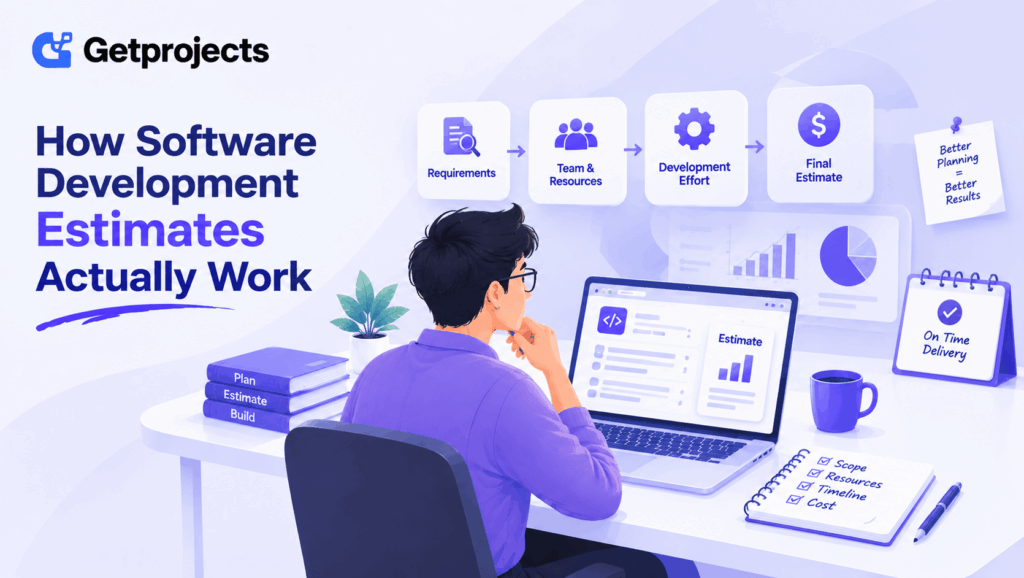
How Software Development Estimates Actually Work
Two agencies can read the same 12-page project brief and return quotes of $38,000 and $140,000. Neither of them is necessarily wrong, padding, or lowballing. They are answering different questions, built on different assumptions, and very few buyers ever see those assumptions written down.
That gap is where budgets start slipping. Once you understand how software development estimates work, a quote stops looking like a price tag and starts looking like what it actually is: a forecast with a confidence level attached.
Most founders and procurement leads treat the first number they receive as a commitment. Agencies know that a number produced from a two-page brief can be off by a factor of three or four in either direction. The distance between those two mindsets is where scope disputes and change-order fatigue come from.
This guide breaks down what sits inside an estimate, the techniques agencies use to build one, and how to compare quotes without getting burned. It is written for both sides of the table: the CTO evaluating vendors and the agency lead trying to win work without underpricing it.
The stakes are rising. More of the work being quoted today involves AI features, third-party model APIs, and integration layers with no reliable historical benchmarks. Knowing how software development estimates work is now a buyer skill, not just an engineering one.
Gartner forecasts worldwide AI spending will reach $2.7 trillion in 2026, up 49.5% year over year, and in its September 2026 update it raised expected 2026 growth for AI application development platforms from 28% to 39%, as enterprises, software providers and services firms push to build custom AI applications. More custom builds mean more estimates, and a growing share of them cover work with no historical baseline.
What Is a Software Development Estimate?
A software development estimate is a forecast of the effort, time, and cost required to deliver a defined scope of software, expressed as a range with an attached confidence level. It is built from a breakdown of features and tasks, historical team performance, and documented assumptions, and it becomes more accurate as requirements, design, and technical risks are clarified.
The key word is range. A single-number quote is not more precise than a range; it simply hides the uncertainty. Anyone explaining how software development estimates work to a board or finance team should start there.
The Core Problem: Software Estimation Accuracy Is Structurally Limited
Estimates fail for predictable reasons, and almost none of them involve slow developers. The biggest is timing. A quote produced before discovery is built on a fraction of the information the team will eventually have, which is why the cone of uncertainty model places early-stage estimates anywhere between 0.25x and 4x of the final actual.
The second is hidden scope. Briefs describe features users see, not the non-functional requirements that consume real hours: role-based permissions, audit logs, performance targets, accessibility, data migration, and security reviews. On a typical business application, this invisible layer accounts for 25–40% of build effort, and it is the first thing a low bid quietly leaves out.
The third is integration. Connecting to a payment gateway, an ERP, or a legacy CRM sounds like a single line item. It is also the least intuitive part of how software development estimates work, because integrations with poorly documented systems regularly take 2–3x their first estimate once someone reads real API responses.
Then there is scope creep. A project that adds two “small” features per sprint across a 16-week build has absorbed 16 unplanned features by launch. Each looked trivial alone; together they explain most surprise overruns.
Commercial pressure distorts the number before it is written. On bidding-style marketplaces, agencies compete on the lowest visible price, so the incentive is to quote the optimistic case and recover margin through change orders later. Buyers who understand how software development estimates work learn to read a very low bid as a risk signal, not a bargain.
How Software Development Estimates Work, Step by Step
Every credible agency follows a version of the same process, whether it calls it pre-sales, scoping, or solution design. The steps below separate a defensible estimate from a guess. Once you see the sequence, it becomes clear how software development estimates work and where each number comes from.
- Clarify the business goal. The team confirms what the software must achieve, who uses it, and what “done” means, because scope without a goal cannot be sized.
- Decompose the scope. Features are broken into a work breakdown structure of epics, user stories, and tasks small enough to estimate, usually 4–16 hours each.
- Flag technical risks. Integrations, unfamiliar technologies, data migration, and compliance needs are isolated so they can carry their own buffer.
- Estimate effort per item. Most agencies combine a bottom-up task estimate with a comparison to past projects.
- Add non-development effort. QA, project management, DevOps, design, and code review typically add 30–50% on top of pure coding hours.
- Apply a contingency buffer. A contingency buffer of 10–25% covers known risks, scaled to how much remains undefined.
- Convert effort to cost and timeline. Hours are multiplied by a blended hourly rate and mapped to team capacity, producing a range, a schedule, and an assumptions list.
Every agency’s version differs in detail, but if a quote cannot be traced back through these seven steps, you are looking at a guess. That traceability is the core of how software development estimates work when they are done properly.
The Estimation Methods Behind the Number
No single method is accurate on its own, so experienced teams layer them. Most software project estimation techniques fall into five families, each suited to a different stage:
- Analogous estimation compares the new project to similar past builds. It is fast and useful for ballparks, but only as good as the agency’s portfolio.
- Bottom-up estimation sums the hours for every task in the breakdown. It is slower, but the most defensible basis for a fixed quote.
- Three-point estimation (PERT) weights optimistic, most likely, and pessimistic figures as (O + 4M + P) / 6. A task estimated at 8, 12, and 28 hours comes out at 14 hours, not 12.
- Parametric estimation multiplies measurable drivers such as screens, API endpoints, or integrations by historical rates.
- Story points and velocity let agile teams size work relative to reference stories and forecast delivery from points completed per sprint.
Ask every agency which method produced its number. Seeing the method behind a quote is a big part of understanding how software development estimates work in practice, and an agency that cannot answer probably has not done the breakdown.
How Do Agencies Calculate Software Development Cost?
The arithmetic is simpler than most buyers assume. Under the hood, software cost estimation comes down to estimated hours across all roles, multiplied by the blended rate, plus contingency and third-party costs such as licences, cloud hosting, or model API usage.
A worked example makes it concrete. Take an MVP with 900 development hours, add 40% for QA, PM, DevOps, and design (360 hours), then 15% contingency on the total (189 hours). The build lands at 1,449 hours: roughly $65,000 at a $45 blended rate, or roughly $174,000 at $120.
The scope did not change between those two numbers; only the rate did. Comparing quotes on total price alone tells you very little about how software development estimates work or which vendor is actually cheaper.
Effort vs. Duration: Turning Hours Into a Timeline
Effort and duration are different numbers, and confusing them causes most timeline disputes. When estimating development time, agencies convert effort hours into calendar weeks based on team size, parallel work, and dependencies. For a team of three full-time engineers, 1,449 hours is about 12 weeks of pure capacity, but reviews, feedback cycles, and holidays usually stretch that to 14–16 weeks.
Adding people does not compress this linearly. Doubling a team from three to six engineers typically shortens delivery by 25–35%, not 50%, because coordination and onboarding costs rise with headcount. This distinction is central to how software development estimates work: effort is what you pay for, duration is when you get it.
How AI Is Changing Estimates in 2026
AI coding assistants have changed the productivity side of the equation, but unevenly. Boilerplate, test generation, and documentation move noticeably faster; complex business logic, integration debugging, and architecture decisions largely do not. Agencies applying a flat 30–40% “AI discount” across an entire estimate are usually overcorrecting.
AI features inside the product are the opposite problem. Prompt design, evaluation, guardrails, and model cost management have little historical data behind them, so they deserve wider ranges and a dedicated line item. Any serious discussion of how software development estimates work this year has to separate AI-assisted delivery from AI-powered scope.
What Should a Software Estimate Include?
A usable estimate is a document, not a number. At minimum, it should contain:
- A scope summary tied to features or user stories, with explicit exclusions.
- Effort broken down by role and phase, not just a grand total.
- A low–high range with a stated confidence level.
- Assumptions, dependencies, and client responsibilities such as content, API access, and feedback turnaround.
- The commercial model, payment milestones, and how a change request is priced and approved.
The statement of work should then reference this estimate directly, so disputes are settled against written assumptions rather than memory. Clients who know how software development estimates work ask for any missing items before comparing prices.
Real-World Application: What Better Estimation Changes
Case study 1: Fintech MVP. A Series A lending startup in the US collected three quotes from a two-page brief: $48,000, $95,000, and $160,000. Instead of picking the middle, it paid its shortlisted agency $7,500 for a three-week discovery phase, which produced a revised range of 78,000–92,000 with a documented assumption log. The build shipped at $86,000, two weeks past a 20-week plan, with zero disputed invoices.
Case study 2: Agency win rate. A 40-person development agency in Pune was winning roughly 1 in 9 bids on commission-based platforms, mostly by quoting low and absorbing overruns. After switching to range-based estimates with separate risk buffers and a paid discovery option, it raised its close rate on qualified leads to about 1 in 4 and cut post-launch write-offs by nearly half within two quarters.
In both cases, once both sides agreed on how software development estimates work, the conversation moved from price to assumptions.
Fixed Price vs Time and Materials: A Decision Framework
The estimate and the commercial model are inseparable. The same 1,449-hour projection means something very different depending on who carries the risk if it proves wrong. Use this framework to match the pricing model to how well-defined your scope actually is.
| Model | How the estimate is used | Who carries overrun risk | Best fit | Watch out for |
| Fixed price | Becomes a contractual ceiling | Agency, priced in via a 20–30% risk premium | Fully defined scope, 8–16 week builds | Rigid change control; low bids that cut testing |
| Time and materials | A forecast; billing follows actual hours | Client | Evolving products, R&D, AI features | Weak burn-rate tracking |
| Capped T&M | Forecast with a not-to-exceed limit | Shared | Moderately defined scope, first engagements | A cap with no buffer leads to rushed final sprints |
| Phased (paid discovery + fixed milestones) | Re-estimated at each phase | Shared, reset per phase | Projects above $50,000 or with integration risk | Slower start; needs decisive client input |
Before comparing totals, normalise each agency project quote to hours, rate, and buffer. Also check whether a platform fee is baked into the rate: on bidding marketplaces that take a 10–20% commission, that cost usually flows back to the client. Choosing well depends less on the model itself and more on knowing how software development estimates work underneath each one.
What Most Teams Get Wrong About Software Estimates
The most common mistake is treating the estimate as the plan. It is the opening hypothesis. Teams that re-estimate after discovery, after design sign-off, and at the build’s midpoint catch drift while it is still cheap to fix; teams that defend the original number until month four do not.
The second is rewarding the lowest number. A quote 40% below the median of four others is rarely more efficient; it usually excludes testing, DevOps, or non-functional work. Anyone familiar with how software development estimates work reads it as a missing-scope warning.
The third is contrarian but consistent: precision is not accuracy. An estimate of 1,312 hours looks rigorous, yet a range of 1,200–1,600 hours with named risks is more honest and more useful. Agencies that give ranges are not hedging; they are showing their work.
Buyers also underinvest in discovery. Spending 5–10% of the expected budget on a structured discovery sprint routinely saves far more than it costs, because it converts guesses into scoped work. Experienced practitioners know how software development estimates work: the quality of the number depends almost entirely on the quality of the input.
For agencies, the lesson is to stop giving free fixed quotes from two-page briefs. It trains clients to expect certainty nobody can provide, and it turns every change into a negotiation.
Get Estimates You Can Actually Compare
If you are scoping a build and want estimates grounded in real assumptions rather than race-to-the-bottom bids, start with the right shortlist. GetProjects connects businesses directly with verified IT agencies, with no bidding wars and 0% commission, so the rate you see is the rate the agency charges.
Post your project in under two minutes, compare matched agencies side by side, and ask each one to show you how software development estimates work on your scope before you sign anything.
Frequently Asked Questions
How accurate are software development estimates?
Accuracy depends on project stage. A ballpark from a short brief can land anywhere from 0.25x to 4x of the final cost, while an estimate built after discovery and design typically lands within 10–25%. Knowing how software development estimates work means asking what stage a quote was produced at before trusting its precision. Always ask for a range and a confidence level.
Why do software estimates go over budget?
Most overruns come from unclear requirements, hidden non-functional work, underestimated integrations, and unmanaged scope additions. Low bids add another cause by leaving out testing or DevOps. This is the practical side of how software development estimates work: overruns are usually visible in the assumptions before the project starts, and a formal change process prevents most of them.
How long does it take to estimate a software project?
A rough order-of-magnitude figure takes one or two days. A defensible bottom-up estimate for a mid-size build usually needs one to two weeks of analyst and architect time, and a paid discovery sprint runs two to four weeks. Depth takes time; that trade-off sits at the heart of how software development estimates work. A detailed fixed quote returned within 24 hours is still a ballpark.
What are the main software estimation methods?
The five most common are analogous, bottom-up, PERT-style weighted estimation, parametric, and agile point-based forecasting from sprint throughput. Mature agencies combine at least two, such as a bottom-up total cross-checked against similar past projects. Understanding how software development estimates work starts with knowing which method produced the number in front of you.
How much buffer should you add to a software estimate?
For well-defined scope after discovery, 10–15% contingency is typical. Projects with new integrations, AI features, or evolving requirements usually warrant 20–30%. The buffer should sit on identified risks rather than be spread evenly. Keeping it visible is part of how software development estimates work in a healthy agency relationship, because both sides can see when it is consumed and why.
Is a fixed-price quote safer than time and materials?
Only when scope is genuinely stable. Fixed price shifts overrun risk to the agency, which prices it in through a premium and treats every change as a contract amendment. The right choice follows from how software development estimates work for your scope: the less certain the estimate, the less a fixed price protects you. Capped or phased models often cost less overall.
How do I compare estimates from different development agencies?
Normalise every quote to effort by role, blended rate, contingency, and exclusions before comparing totals, and ask each agency which estimation method it used. Starting from a shortlist of verified vendors also helps. GetProjects lets you post a project free, get matched with verified agencies on budget and domain expertise, and compare them directly without bidding or commission markups.