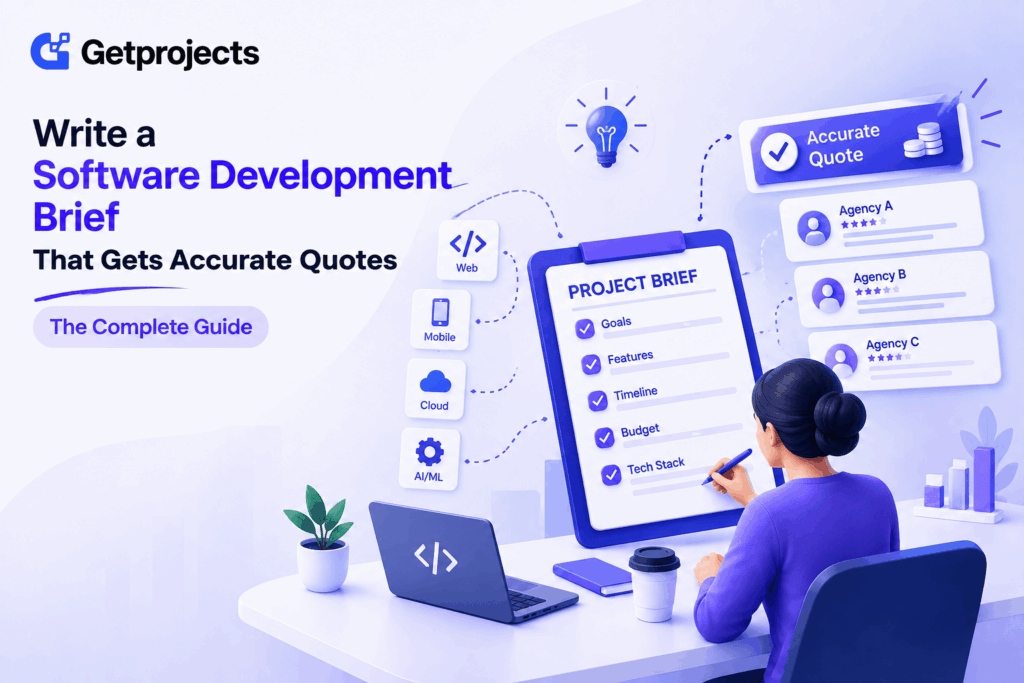
How to Write a Software Development Brief That Gets Accurate Quotes The Complete Guide
The quality of your development brief determines the quality of every proposal you receive. A vague brief produces vague proposals with wide price ranges, unclear scope assumptions, and no basis for comparing one agency against another. A specific brief produces specific proposals with comparable prices, clear scope, and a real basis for evaluation.
Most buyers spend 30 minutes writing a brief and 3 weeks evaluating proposals that are incomparable because each agency quoted a different product. Investing 2 to 3 hours in a well-structured brief collapses that evaluation process to 3 to 5 days and produces quotes that are within 20% of the final project cost rather than 200% off.
How to write a software development brief effectively starts with defining your project goals, users, core features, integrations, constraints, timeline, and budget expectations before you begin looking for the right software development company.
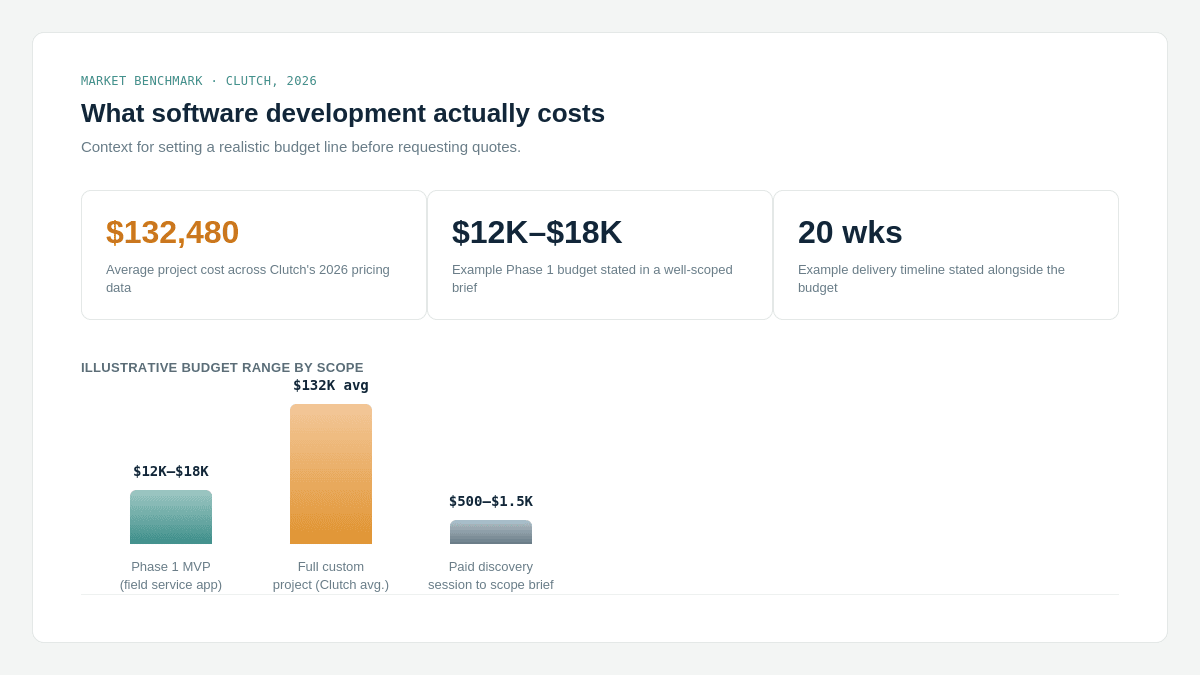
According to Clutch’s 2026 software development pricing data, the average software development project reviewed on its platform costs $132,480.29, showing why clear project requirements are essential when requesting and comparing development quotes.
This guide explains what to include in your brief, how to structure it, and the common mistakes that can make software development quotes inaccurate or difficult to compare.
What a Software Development Brief Is
A brief is not a specification document. It is not a requirements document. It is a structured description of a problem you want to solve, a product you want to build, and the constraints you are working within written clearly enough that a development agency can assess whether they can help you, propose an approach, and estimate a realistic cost.
A brief should answer five questions:
What are you building and why? Who will use it? What are the most important things it must do? What constraints exist technical, budget, timeline, and regulatory? What does success look like?
Nothing more is required in the brief. The technical specification of how it will be built comes after you select an agency and enter a discovery phase together.
The Brief Structure That Works
Section 1 Company and context (3–5 sentences):
What your company does, how big it is, what industry you are in, and what stage you are at (pre-revenue startup, growing SME, established mid-market company). This context helps agencies assess whether they have relevant experience and whether your project is the right size for their team, a distinction that matters most when your existing product is a live platform maintained by web development agencies rather than a greenfield build.
Example of a weak context section: “We are a startup.”
Example of a strong context section: “We are a 3-year-old B2B SaaS company with 150 customers and $1.2M ARR in the field service management space. Our current product is a web application built on React and Node.js. We have 2 internal developers and use AWS for hosting.”
The strong version tells an agency: your company has traction (so this is not a hopeful pre-revenue build), you have existing technical infrastructure they need to integrate with, and you have internal developers who will maintain what they build.
Section 2 Problem statement (1–2 paragraphs):
What specific problem are you solving with this software? Why does it need to be solved now? What is the consequence of not solving it?
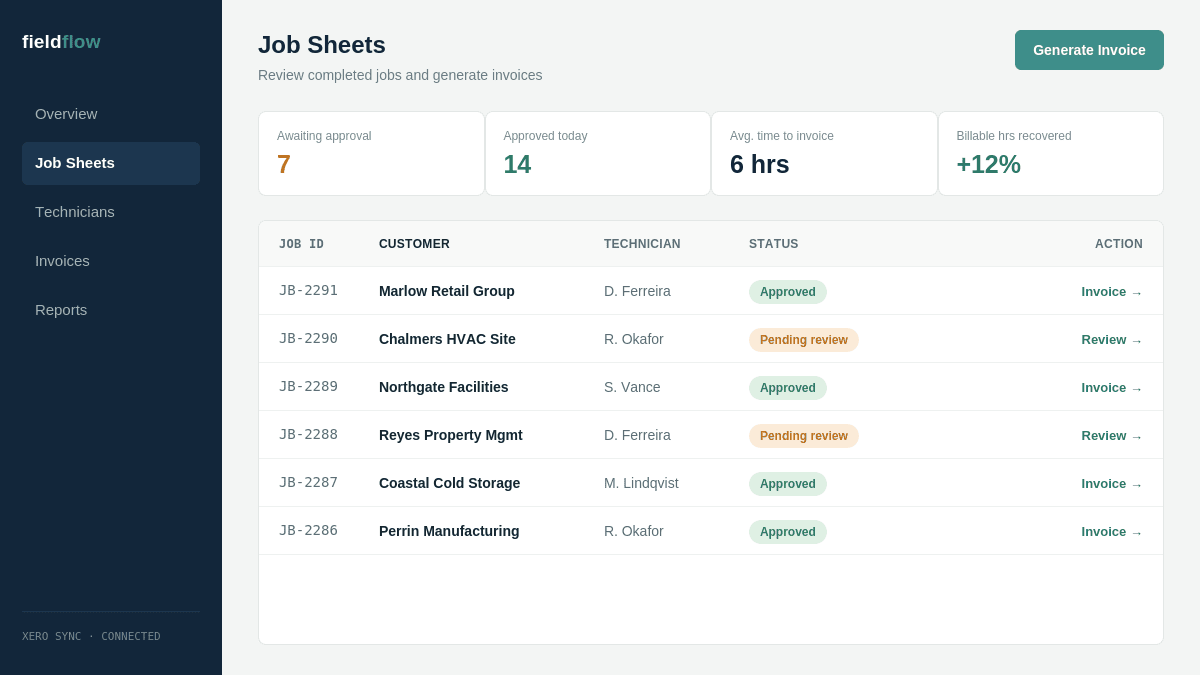
A good problem statement is specific about pain: “Our field technicians currently receive job assignments via phone call, fill out paper job sheets, and return them to the office at the end of the week. This produces a 5 to 7 day delay between job completion and invoice generation, and we lose approximately 12% of billable hours because paper sheets are incomplete or illegible. We want to build a mobile app that captures job data in the field and generates invoices automatically.”
This problem statement contains: the current process (phone + paper), the specific pain (5–7 day delay, 12% billable hour loss), and the desired outcome (mobile capture + automatic invoicing). Every sentence informs scope, and every sentence gives mobile app development agencies something concrete to estimate against.
Section 3 Product description (2–3 paragraphs):
What the product does, who uses it, and how the main workflow operates. Write it as a narrative taking the reader through the product’s core journey from the user’s perspective. This is the section UI/UX design teams read most closely, because it tells them how many screens and states the product actually needs.
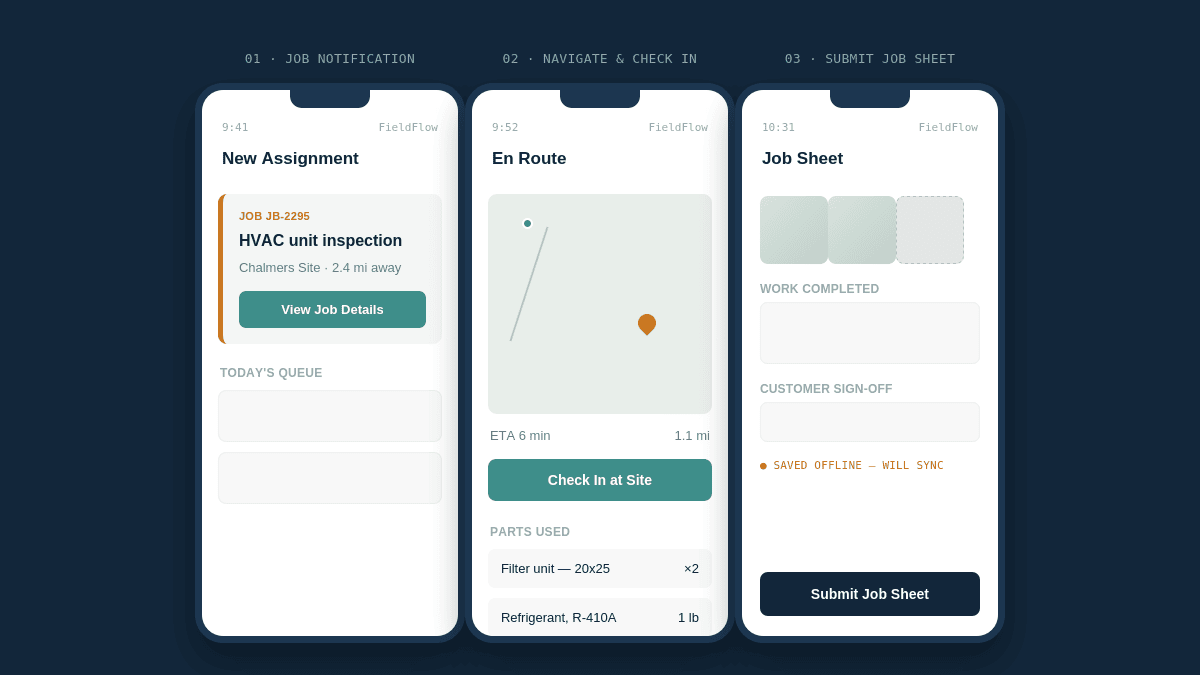
“The app has two user types: field technicians and office managers. A technician receives a job notification on their phone, navigates to the job location using the in-app map, checks in when they arrive, records what work was done and what parts were used, takes photos of the completed work, and submits the job sheet. The office manager sees all submitted job sheets in a web dashboard, can review and approve them, and with one click generates an invoice from the job data that is sent to the customer.”
This narrative makes the scope tangible in a way that a feature list does not. Agencies who read it can visualise the application and estimate it with much less ambiguity.
Section 4 Core feature list (10–20 user stories):
User stories in the format: “As a [user type], I want to [action] so that [benefit].”
Write one user story per meaningful feature. This is the most important section for generating comparable quotes every agency interprets the same user stories as the same features. If you are unsure how many stories belong in a first release, the scoping patterns used by MVP development companies are a useful benchmark for a first version.
Example user stories for the field service app:
- As a field technician, I want to receive job notifications on my phone so I know about new assignments immediately.
- As a field technician, I want to navigate to the job location from the app so I do not need a separate navigation app.
- As a field technician, I want to record which parts I used on a job so the office can track inventory.
- As an office manager, I want to see all submitted job sheets in one dashboard so I can review and approve them.
- As an office manager, I want to generate an invoice with one click from an approved job sheet so I can bill the customer faster.
Section 5 Technical requirements (5–10 bullet points, genuine constraints only):
List only the technical requirements that are genuinely fixed, not preferences. Fixed requirements are constraints that cannot be changed. Preferences are things you would like but can discuss with the agency.
Fixed requirements: “Must integrate with our existing Xero accounting system for invoice generation.” “Must work offline field technicians are frequently in locations with poor connectivity.” “Must be available on iOS and Android.” Offline sync and third-party integrations are where estimates diverge most, so it is worth stating them precisely enough that cloud and server development teams can size the backend work.
Preferences (do not include as requirements): “We prefer React Native.” “We think PostgreSQL would be a good database.” These constrain agency creativity without being genuine constraints. If you have preferences, describe them as such in a separate section and invite the agency to agree or propose alternatives.
Section 6 Out of scope (3–5 bullet points):
Explicitly list what you are not asking for in this phase. This prevents agencies from scoping Phase 2 features into your Phase 1 quote and padding your budget. Phased delivery is standard practice on larger platform builds; the same logic that governs how a construction management platform is built in stages applies to a two-user field service app.
Examples: “Customer-facing portal Phase 2 only.” “Analytics and reporting beyond basic job summary Phase 2.” “iOS only for this phase Android in Phase 2.”
Section 7 Timeline and budget (2–3 sentences):
State your ideal launch date or timeline and your budget range. Both pieces of information improve proposal quality significantly.
“We want to launch by Q4 2026 this gives us approximately 20 weeks from contract. Our budget for this phase is $12,000 to $18,000.”
Section 8 What you want in the proposal (1 paragraph):
Tell agencies what you expect to receive. This produces structured, comparable proposals rather than whatever each agency chooses to include, and it is the same standardisation that makes proposals easy to review inside the GetProjects B2B marketplace.
“Please provide: a proposed technical approach and architecture overview, a feature scope based on our budget range, a project timeline with major milestones, team composition and the experience level of the lead developer, and at least one previous project similar to what we are building.”
The Brief Length and Format
Ideal length: 2 to 4 pages.
Shorter than 2 pages is not specific enough for accurate quotes. Longer than 4 pages is excessive for a brief detailed specification belonging in a discovery sprint, not in the brief that initiates vendor selection.
Format: structured prose, not bullet lists.
Prose communicates context that bullet lists cannot. “We lose approximately 12% of billable hours because paper sheets are incomplete” is more useful to an agency than “• Reduce billable hour loss.” The context in the prose is what allows accurate scoping.
Tables are appropriate for the feature list and integration list; they impose structure on enumerable items that prose would make harder to scan. An integration table matters most on hardware-connected products, where IoT development teams need to see every device, protocol, and third-party system in one place before they can quote.
The Six Mistakes That Make Briefs Produce Bad Proposals
Mistake 1 Features without context:
A feature list without the problem statement or product narrative is a shopping list. “User authentication, job management, invoice generation, reporting.” What kind of job management? How does invoice generation work? What reporting is needed? Without context, every agency invents different answers and quotes different products and the same ambiguity applies to a one-word line item like “testing”, which can mean anything from a smoke test to the full automation suites offered by QA and testing companies.
Mistake 2 Describing the solution instead of the problem:
“We need a microservices architecture with event sourcing and CQRS.” Most first-time buyers who write this do not fully understand what they are asking for. Describing the technical solution constrains agency creativity and often produces an over-engineered proposal. Describe the problem and the outcome let the agency propose the technical approach.
Mistake 3 No budget statement:
Already covered in the RFP guide worth repeating here. Stating your budget does not get you overcharged. It produces proposals scoped to your budget. Without it, every agency guesses, and the guesses diverge by 10×.
Mistake 4 Too many features for the stated budget:
A brief that lists 40 features for a $12,000 budget will receive either honest proposals that scope 30% of your features, or optimistic proposals that scope all 40 features at $12,000 and plan to deliver half. Neither is useful. Apply the MVP filter before writing the brief. What are the 10 to 15 features that genuinely must be in the first version to test your hypothesis? Checking what app development companies actually quote for a build of that size is a fast reality check before you send the brief out.
Mistake 5 No acceptance criteria:
A brief that says “build a mobile app” with no definition of what done looks like produces a contract with no enforceable completion standard. Include at least a definition of the key workflows that must function: “a technician must be able to complete a job sheet and submit it from their phone with no connectivity, and the submission must sync when connectivity is restored.”
Mistake 6 Confidentiality without NDA:
If your project involves genuinely sensitive business information, say so in the brief and request that agencies sign an NDA before receiving the full brief. Most agencies will sign a standard NDA without friction. Sharing sensitive strategic information in a public brief without this step is unnecessary risk.
Posting Your Brief on GetProjects.ai
Once your brief is written, GetProjects.ai matches it against agencies in the vetted network whose portfolios include relevant experience, not just any agency who claims the capability. You post once and receive proposals from 3 to 5 agencies who have built similar products.
The matching process considers: technology stack mentioned in your brief, industry or domain, project complexity and budget range, and geographic preference for the development team. You are not starting from a directory of 10,000 agencies, you are receiving targeted proposals from pre-qualified agencies that match what you actually described.
Post your brief at getprojects.ai it takes 10 minutes and is free for buyers.
Frequently Asked Questions
How specific does a software development brief need to be?
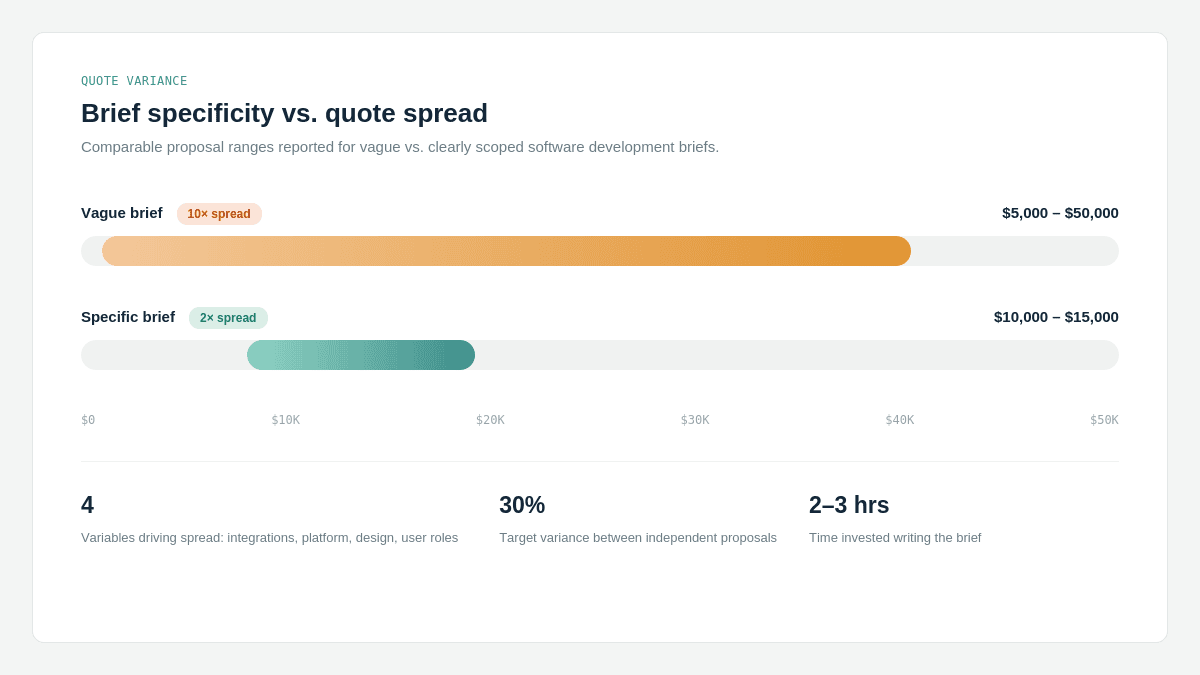
Specific enough that two agencies reading it independently would quote within 30% of each other that is the practical test. A brief that produces quotes ranging from $5,000 to $50,000 is too vague. A brief that produces quotes ranging from $10,000 to $15,000 is appropriately specific. The variables that most drive quote variance are: integration list (complete or incomplete), platform specification (iOS only vs both), design requirements (template vs custom), and user role complexity (one user type vs many with different permissions). Getting these four variables clearly specified in the brief typically reduces quote variance from 10× to 2× or less.
Should I write a brief before or after speaking to agencies?
Write the brief before speaking to agencies. Speaking to agencies before you have a written brief produces conversations that help the agencies sell you rather than help you evaluate them. With a written brief, the first agency conversation becomes an evaluation of how well they understood and responded to your brief, a structured assessment rather than an open-ended sales conversation. The exception: if you genuinely do not know what you want to build yet, a paid discovery session with one agency ($500 to $1,500) to develop the brief is more effective than a free discovery call that serves the agency’s sales process.
What is the difference between a brief and a specification?
A brief description describes what you want to achieve, the product, the key user workflows, and the constraints. A specification describes exactly how it will be built: the data model, API endpoints, wireframes, acceptance criteria for every feature. A brief is appropriate for the vendor selection phase; it gives agencies enough context to assess fit and provide accurate estimates. A specification is appropriate for the development phase it gives the selected agency a detailed blueprint to build from. Most buyers start with a brief, select an agency through a discovery sprint, and produce the specification as the first deliverable of the engagement. Trying to write a complete specification before selecting an agency is premature; the right specification is produced collaboratively with the agency you choose, incorporating their technical judgment.
How do I describe a software project if I am not technical?
Non-technical buyers consistently produce better briefs when they write from the user’s perspective rather than the system’s perspective. Instead of trying to describe databases, APIs, and architectures, describe: who uses the product, what they do before using it (the current process), what they want to do with the product (the new process), and what the benefit is (why the new process is better). The field service example in this guide “technicians get job assignments by phone, fill out paper sheets, return them at week’s end” is a completely non-technical description that communicates all the context a development agency needs. The technical decisions (what database, what framework, what architecture) are the agency’s job. Your job is to describe the problem and the workflow clearly enough that the agency can make good technical decisions.