Agency vs Freelancer for Software Development Which Is Right for Your Project?
The agency vs freelancer decision is the first decision most first-time software buyers get wrong either overpaying for agency overhead on a project that a freelancer would handle better, or underestimating the risk of a single freelancer for a project that requires a team. Both mistakes are expensive. The right choice depends entirely on your project’s characteristics, not on a general preference.
Agency vs freelancer software development comes down to your project’s complexity, budget, timeline, technical requirements, and need for ongoing support, not simply which option costs less.
The demand for independent technical talent continues to grow. In 2026, 44% of small and medium-sized businesses surveyed by Upwork identified software developers among their top freelance roles for the next three months, highlighting the growing role of freelancers in technology projects.
Upwork hosts 18 million freelancers. GetProjects.ai and Clutch list tens of thousands of agencies. The supply side of both markets is enormous. The signal-to-noise ratio is low in both. Knowing which model to use before starting the search reduces the time and cost of finding the right match by 60 to 70%.
The Honest Comparison Agency vs Freelancer
| Dimension | Freelancer | Agency |
| Cost | 20–40% lower for equivalent skill level | Higher overhead, project management, margin |
| Continuity risk | High illness, life events, other clients can interrupt your project | Lower team can absorb individual absences |
| Skill breadth | Limited to individual’s skills rare to find one person exceptional at everything | Team covers multiple disciplines simultaneously |
| Project management | Usually your responsibility | Usually included |
| Accountability | Individual no institutional backup | Institutional agency reputation is at stake |
| Speed to start | Often faster no procurement process | Slower proposals, contracts, onboarding |
| Quality ceiling | Can be very high for a senior specialist | Consistent floor quality rare catastrophic failures |
| After-hours support | Depends on the individual | Defined SLA typically covered |
| IP and legal protection | Contract-dependent less standardised | More standardised contracts, clearer IP terms |
| Scale | Cannot scale beyond one person’s hours | Can add team members as project grows |
When a Freelancer Is the Right Choice
Specific, well-defined tasks with a clear endpoint:
A freelancer is optimal when you can describe exactly what you need, the task has a clear completion criterion, and the work primarily requires one discipline: frontend development, API integration, UI design, data engineering. The more specific the task, the more a specialist freelancer outperforms an agency. Getting that specificity down on paper first makes the engagement far smoother. Our guide on how to write a software development RFP walks through exactly how to scope a task tightly enough that a freelancer can quote and deliver against it with no ambiguity.
“Build an admin dashboard for our existing Node.js backend. Here are the API endpoints, here are the mockups, here are the acceptance criteria.” This is a perfect freelancer engagement. A $4,000 to $7,000 contract with a senior frontend developer produces a better outcome than a $7,000 to $12,000 agency quote for the same work the freelancer does the work themselves rather than delegating to a junior developer managed by a project manager.
Augmenting an existing team with a specific skill:
If you have an internal engineering team and need a specific skill temporarily, a senior React Native developer for a 2-month mobile sprint, a data engineer to build a data pipeline, a Solidity developer for a specific smart contract a freelancer integrates into your team more efficiently than an agency. You provide the project management and direction; the freelancer provides the technical execution. This is essentially a lightweight version of staff augmentation, and our roundup of the best staff augmentation companies is a useful comparison point if your temporary need turns out to be bigger than one person.
Budget under $5,000:
At budgets below $5,000, agency overhead makes the economics difficult. A $4,000 project with an agency typically means junior developers, minimal project management attention, and compressed timelines. A $4,000 project with a skilled freelancer typically means the senior person doing the work themselves. Below $5,000, the freelancer wins on value almost every time.
When an Agency Is the Right Choice
Multi-discipline projects where different skills are needed simultaneously:
Building an MVP requires frontend development, backend development, database design, and sometimes UI/UX design happening in parallel. A single freelancer cannot do all of these simultaneously. A two-person or three-person agency team can and the cost of coordination between agency team members is lower than the cost of you coordinating between three separate freelancers. If you’re weighing exactly how to structure that engagement once you’ve decided on a team, see dedicated team vs time & material vs fixed price for how the commercial model changes your risk exposure.
Projects where continuity is critical:
If a freelancer working on your project becomes unavailable due to illness, another project taking priority, life events your project stops. For a 3-month engagement with a hard launch deadline, a single-point-of-failure freelancer introduces meaningful schedule risk. An agency provides a backup if the primary developer becomes unavailable, the agency can reassign another developer who has context from code reviews and documentation.
Projects requiring institutional accountability:
An agency’s reputation is a collective asset. Poor delivery on your project damages their ability to win future work. This creates accountability that does not exist with individual freelancers whose worst-case scenario is leaving a negative review on Upwork. For projects above $15,000, the institutional accountability of an agency matters.
First-time buyers without technical evaluation ability:
A non-technical buyer evaluating a freelancer has almost no way to assess the quality of the code being produced until problems surface. Agencies typically have internal code review processes that catch quality issues before delivery. A non-technical buyer’s first development engagement is generally safer with a structured agency than with an individual whose work is unsupervised. If this describes you, our practical framework for comparing software development companies gives you an evaluation structure that doesn’t require a technical background.
The Cost Comparison What You Actually Pay
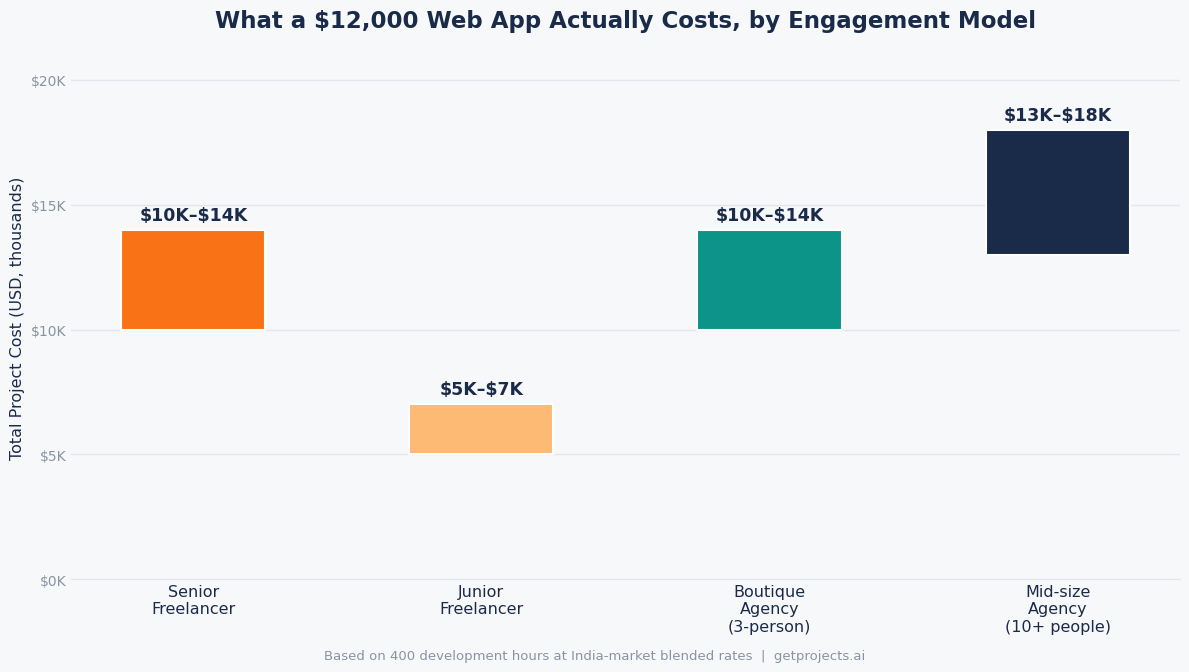
Equivalent output cost comparison for a $12,000 web application:
| Model | Cost Structure | What You Get |
| Senior freelancer (India) | $25–$35/hour × 400 hours = $10K–$14K | Senior developer doing all work high quality code, your project management |
| Junior freelancer (India) | $12–$18/hour × 400 hours = $5K–$7K | Cheaper, but you bear quality management overhead |
| Boutique agency (India, 3-person team) | $22/hour blended × 400 hours = $8,800 + PM overhead = $10K–$14K | Senior lead + junior dev + PM structured delivery, professional process |
| Mid-size agency (India, 10+ people) | $28/hour blended × 400 hours + overhead = $13K–$18K | More process, more overhead, less personal attention per project |
The cost comparison shows that a senior freelancer and a boutique agency are often priced similarly for equivalent output; the difference is not primarily cost, it is risk profile and project management responsibility.
The Hybrid Approach Lead Freelancer + Support Freelancers
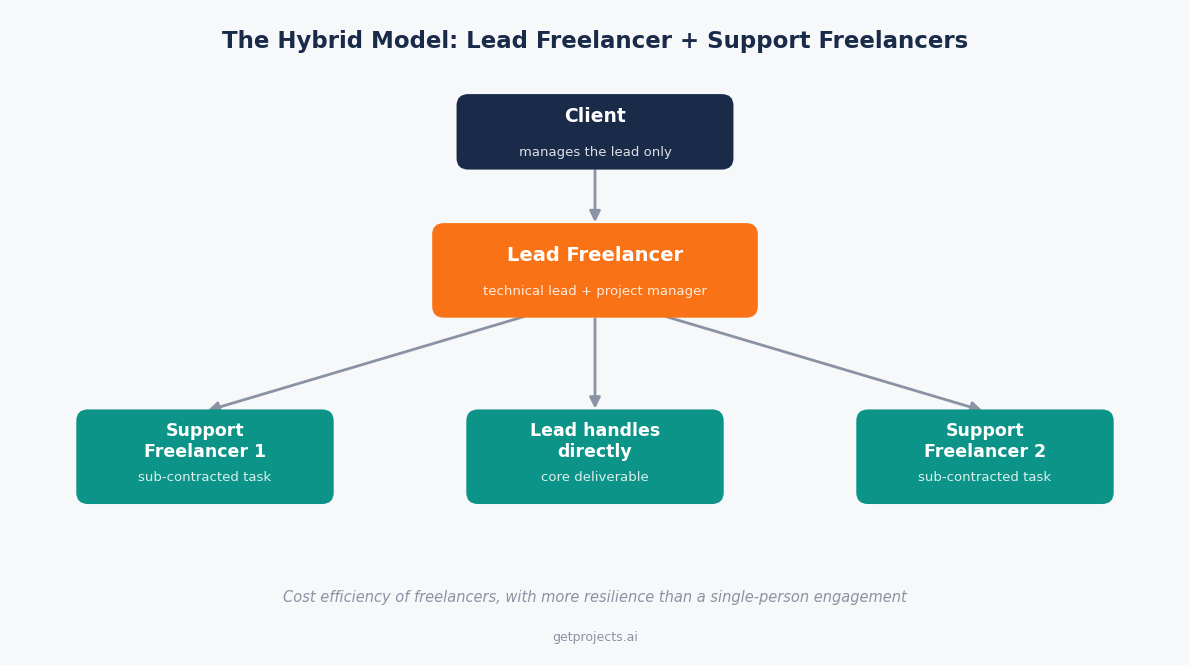
A model that works well for $8,000 to $20,000 projects: hire a senior freelancer as your technical lead and project manager, who then sub-contracts specific work to other freelancers or handles it themselves. The lead freelancer manages quality and coordination; you manage the lead freelancer. This provides the cost efficiency of freelancers with more resilience than a single-person engagement. Whichever structure you land on, tying payments to actual progress rather than time elapsed reduces your exposure see our guide to milestone payments in software development for how to structure this correctly.
Requirements for this model to work: the lead freelancer must have proven project management experience in addition to technical skills, and you must verify that they have a trusted network of specialist collaborators rather than hiring unknowns for sub-contracted work.
The Due Diligence Difference
Vetting a freelancer:
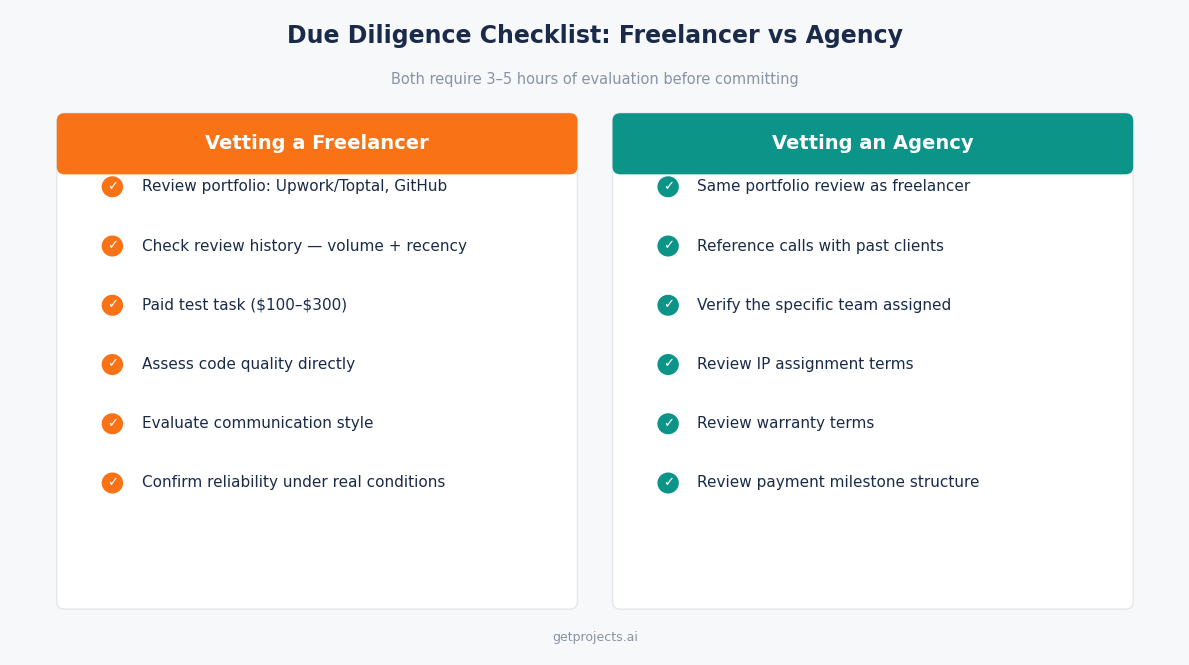
Review their portfolio check Upwork/Toptal profile, GitHub, live projects. Review their review history volume and recency matter. Do a paid test task ($100 to $300 for a specific small task) before committing to a larger engagement. This reveals code quality, communication style, and reliability under real conditions.
Vetting an agency:
Same portfolio review. Add: reference calls with previous clients (not just written testimonials), verification of the specific team who will work on your project, and review of the contract terms IP assignment, warranty, payment milestone structure. If you’re working against a tight timeline, our process for shortlisting an IT agency in 72 hours compresses this without skipping the checks that matter.
The due diligence effort is similar and both require 3 to 5 hours of evaluation before committing. The vetting criteria differ in emphasis: for freelancers, individual reliability and code quality are paramount. For agencies, process quality and team stability matter more.
Frequently Asked Questions
Is a freelancer less reliable than an agency for software development?
Individual reliability: the risk that work stops because a single person becomes unavailable is higher with a freelancer than with an agency. This is structural, not a reflection of individual quality. An agency can reassign work; a freelancer cannot. For projects with hard deadlines, this continuity risk is meaningful. The practical mitigation: choose a freelancer with a long track record of completed projects (not new to the platform), build milestone-based checkpoints so you can assess progress regularly, and maintain access to the code repository throughout so another developer could pick up if needed. The reliability risk is manageable; it requires more active management than an agency engagement, not avoidance.
For a $10,000 project, which produces better results from a freelancer or an agency?
At $10,000, a senior freelancer or a small boutique agency produces similar quality outcomes when both are selected carefully. The meaningful differences: a senior freelancer who does the work themselves often produces better technical quality than an agency that assigns a junior developer managed by a project manager because the senior person’s judgment is applied to every decision rather than just code review. An agency provides more structured project management daily updates, milestone documentation, formal testing which matters more to buyers without technical evaluation ability. The practical recommendation: if you can evaluate technical quality (or have someone who can), a senior freelancer at $10,000 is often the better value. If you need the project management scaffolding and cannot evaluate technical quality independently, a structured boutique agency at the same price is the safer choice.
What should I include in a contract with a freelancer to protect my interests?
Four clauses that matter most in freelancer contracts: IP assignment all code and deliverables are owned by you upon payment, explicitly stated. Repository access you have read access to the development repository throughout the project. Non-compete for your specific domain the freelancer will not build the same product for a direct competitor during the engagement period. Payment milestone structure 20 to 25% upfront, 30 to 35% after first working deliverable, 25 to 30% after second milestone, 20% at final acceptance. Freelancers often work on simplified contracts to verify each of these provisions is explicitly covered rather than assumed.