Enterprise Software Development Cost in 2026 What Enterprises Actually Pay and Why
Enterprise software development is the category where cost ranges are widest, scope ambiguity is highest, and the gap between a good vendor and a poor one is most financially significant. A mid-market company that hires the wrong agency for a $25,000 enterprise software project does not just lose $25,000 it loses 6 to 12 months of operational time and typically needs to spend $40,000 to $60,000 to fix or replace what was built.
The global enterprise software market is valued at $270 billion in 2026. At the $5K to $30K budget level the range where most SMEs and mid-market buyers operate enterprise software typically means one of four things: a specific module or feature extension to an existing enterprise system, a standalone internal tool that connects enterprise data, a vertical application for a specific department or workflow, or a proof-of-concept that will be evaluated for larger investment.
That’s why understanding enterprise software development costs is essential before setting a budget or approaching a development company.
According to Grand View Research – Enterprise Software Market Report, the global enterprise software market is estimated to reach $322.8 billion in 2026, growing at a 12.8% CAGR through 2033. The continued investment in enterprise technology makes realistic cost planning increasingly important.
This guide breaks down what enterprise software development can cost in 2026, the factors that influence pricing, and the hidden expenses businesses should consider before development begins.
What Enterprise Software Development Is at the $5K–$30K Level
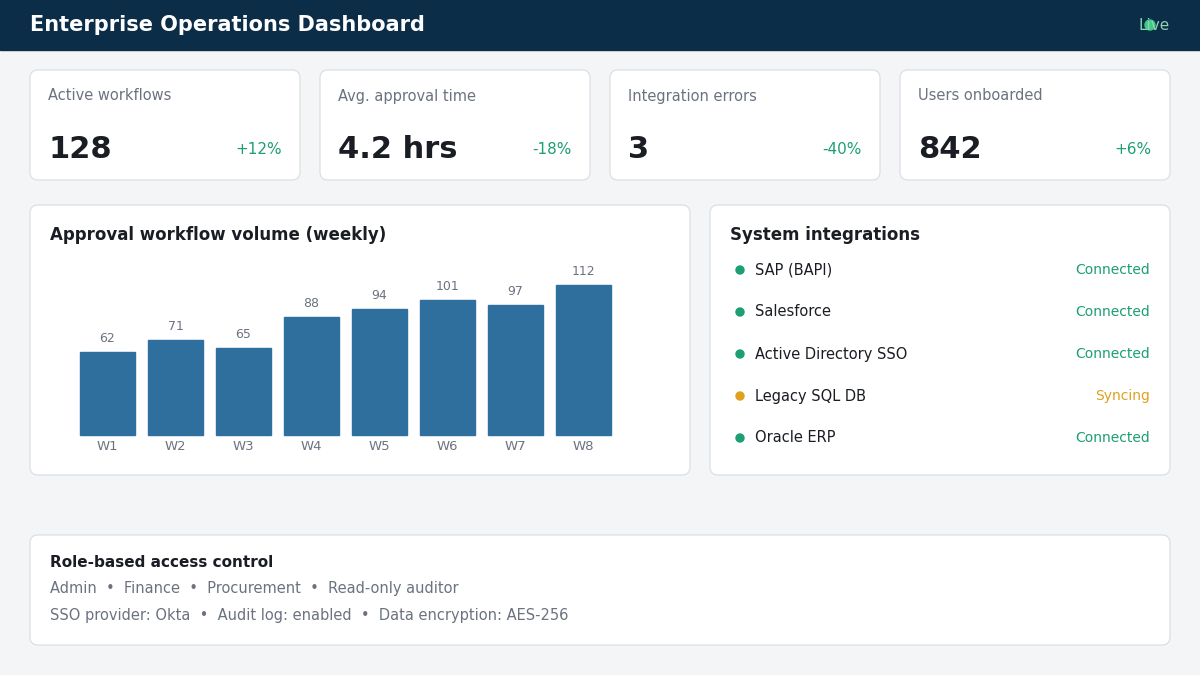
Enterprise software buyers at $5K to $30K are not building SAP. They are building the specific application that fills the gap that SAP does not fill the custom workflow, the industry-specific tool, the internal dashboard that brings together data from multiple enterprise systems. Teams extending an existing SAP, Oracle, or NetSuite footprint should also read our dedicated breakdown of ERP software development for a deeper look at module-level scoping.
The four most common enterprise builds at this budget:
| Type | What It Is | Examples | India Cost |
| Internal workflow tool | Application that automates a manual internal process | Approval workflows, document management, employee onboarding portals | $6K–$15K |
| Enterprise data dashboard | Analytics or reporting layer on top of existing enterprise data | Operations dashboard, executive KPI views, sales performance analytics | $7K–$15K |
| ERP module extension | Custom functionality that extends SAP, Oracle, or NetSuite | Custom reports, industry-specific forms, integration with legacy systems | $8K–$18K |
| Vertical enterprise application | Application serving a specific enterprise use case in a defined industry | Fleet management, vendor portal, compliance tracking, procurement tool | $10K–$25K |
Understanding which type you are building prevents the most common enterprise software scoping failure treating a workflow tool as a full ERP replacement or treating a dashboard as a data engineering project.
Enterprise Development Cost The Variables That Drive Pricing
The five factors that determine enterprise software development cost more than any other:
Integration complexity is the single largest cost driver in enterprise development. Connecting to SAP through BAPI or RFC interfaces typically adds $5,000 to $12,000 to a project versus connecting to a modern REST API. Connecting to a legacy Oracle database with a proprietary schema adds $4,000 to $8,000. Every enterprise integration requires understanding the source system’s data model, authentication method, rate limits, and error handling none of which is documented in a standard way. Where this work is delivered also shifts the number meaningfully see our developer hourly rates by country breakdown for how integration-heavy hours price out across regions.
Security and compliance requirements add 20 to 35% to development cost. An enterprise internal tool needs role-based access control, single sign-on (SSO) integration with Active Directory or Okta, audit logging, and data encryption that a consumer application does not require. Each of these adds development time and testing overhead.
Data volume and performance requirements affect architecture decisions significantly. An enterprise analytics dashboard that processes 10,000 rows per query has different architecture requirements than one that processes 100 million rows. The difference in development cost: $3,000 to $10,000 for query optimisation, proper indexing, and potentially a separate analytics store.
User count and access model affect infrastructure and authentication design. A tool used by 20 internal users has different infrastructure requirements than one used by 5,000 employees globally; the latter requires load balancing, SSO at scale, and CDN configuration that adds $2,000 to $5,000 to infrastructure setup costs.
The regulatory environment GDPR, HIPAA, SOC 2, ISO 27001 adds compliance requirements to the architecture that increase both development cost (implementing the required controls) and testing cost (verifying the controls work correctly). These obligations should be written explicitly into the vendor agreement our software development contract checklist covers the specific clauses that protect you when compliance scope shifts mid-project.
Enterprise Software Cost by Application Type
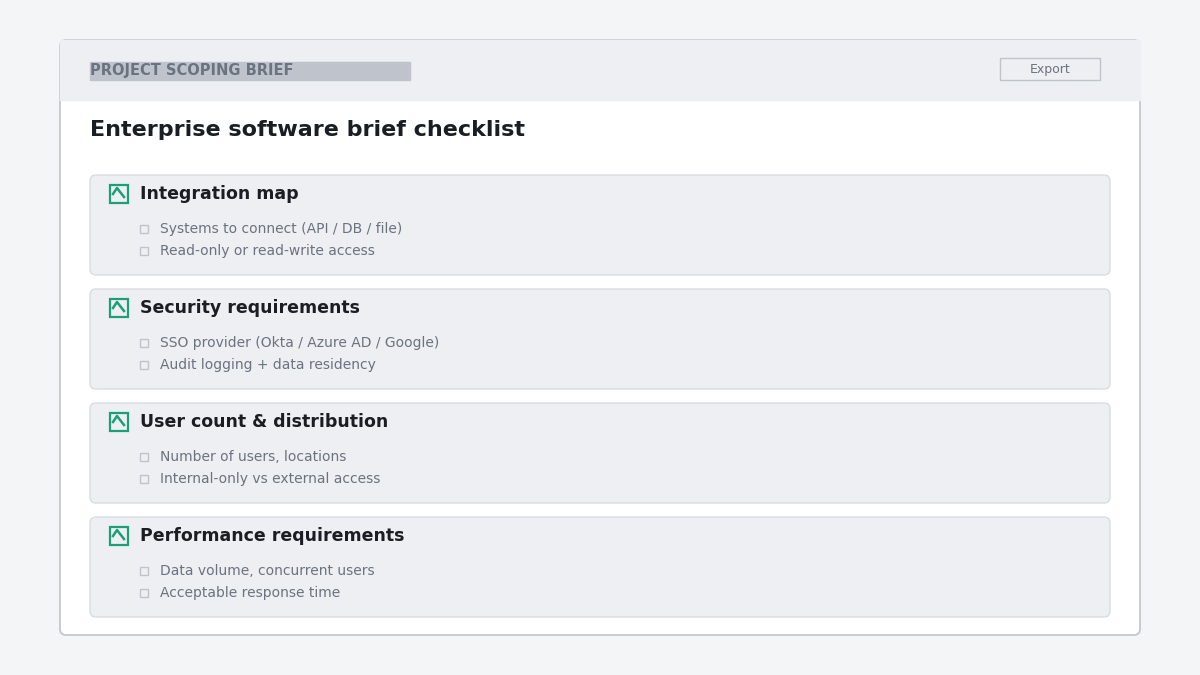
Cost ranges for common enterprise applications built with strong Indian development teams:
| Application Type | Complexity | India Cost | Eastern Europe Cost | Timeline |
| Internal approval workflow | Simple 3 user roles, standard approval chain, email notifications | $6K–$10K | $12K–$20K | 8–14 weeks |
| Internal approval workflow | Complex multiple paths, SLA tracking, escalations, SAP integration | $12K–$22K | $22K–$42K | 14–22 weeks |
| Operations dashboard | Standard 5–8 KPI cards, bar/line charts, date filtering | $7K–$12K | $14K–$22K | 8–14 weeks |
| Operations dashboard | Advanced real-time data, drill-down, custom date comparison, 3+ data sources | $12K–$20K | $22K–$38K | 12–20 weeks |
| Vendor/supplier portal | Standard vendor profiles, document upload, basic communication | $8K–$15K | $16K–$28K | 10–16 weeks |
| Compliance tracking tool | Standard requirement tracking, evidence upload, status reporting | $8K–$15K | $16K–$28K | 10–16 weeks |
| Custom ERP module | Simple 1–2 new workflows, SAP BAPI integration | $10K–$18K | $20K–$35K | 12–18 weeks |
| Fleet/asset management tool | Standard asset registry, maintenance scheduling, cost tracking | $10K–$18K | $20K–$35K | 12–20 weeks |
| HR self-service portal | Standard leave management, payslips, basic profile management | $8K–$14K | $16K–$26K | 10–16 weeks |
| Procurement tool | Standard purchase requisitions, approvals, vendor management | $10K–$18K | $20K–$35K | 12–20 weeks |
The Hidden Costs Specific to Enterprise Software
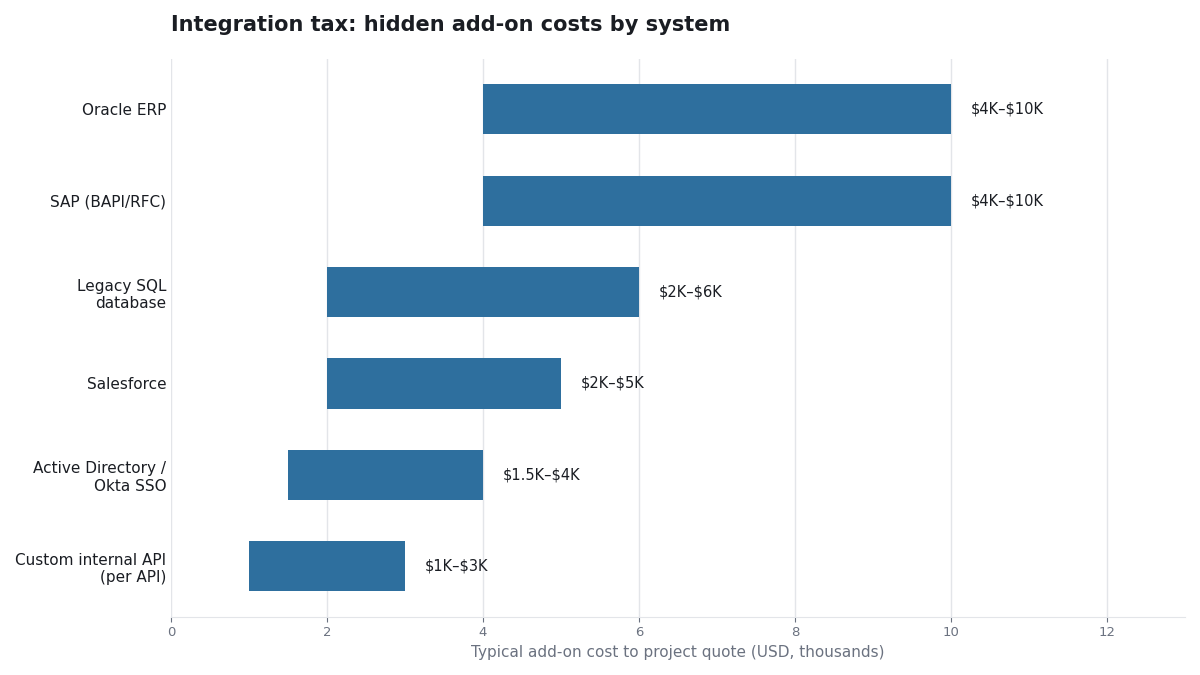
Integration tax the most underestimated cost:
Every enterprise integration adds to the development cost in ways that are difficult to estimate without seeing the source system. Common integration costs that are missed in initial quotes:
| Integration | Typical Add-On Cost | Why |
| SAP (BAPI/RFC) | $4K–$10K | Complex authentication, non-REST interface, testing environment setup |
| Salesforce | $2K–$5K | OAuth setup, API limits, complex object model |
| Active Directory / Okta SSO | $1.5K–$4K | SAML or OIDC implementation, testing with enterprise AD |
| Legacy SQL database | $2K–$6K | Schema reverse-engineering, no API layer, direct database access |
| Oracle ERP | $4K–$10K | Similar to SAP non-standard interface, complex data model |
| Custom internal API | $1K–$3K per API | Variable depends on documentation quality |
The Testing Cost Premium:
Enterprise software requires more thorough testing than consumer software because failures affect business operations, not just user experience. Enterprise QA typically costs 20 to 30% of development cost (versus 15 to 20% for consumer applications) due to: integration testing across multiple enterprise systems, performance testing at enterprise data volumes, security testing including penetration testing, and user acceptance testing with business stakeholders who have detailed process knowledge. Vendors with dedicated QA benches, like those in our roundup of testing and QA companies in India, typically absorb this overhead more predictably than generalist teams.
The Deployment and Change Management Cost:
Consumer applications are deployed on the internet. Enterprise applications are often deployed within corporate network environments behind firewalls, requiring IT department involvement, with change management processes that add time and coordination overhead. Budget $1,500 to $4,000 for deployment support and change management documentation that a consumer project does not require.
What Enterprise Buyers Should Prepare Before Requesting Quotes
Enterprise software quotes are more sensitive to brief quality than almost any other category. The integration complexity, security requirements, user count, and data volume are all variables that change the quote significantly and none of them have default assumptions that agencies can safely make. Our step-by-step guide on writing a software development RFP walks through how to structure this brief so vendors quote against the same scope.
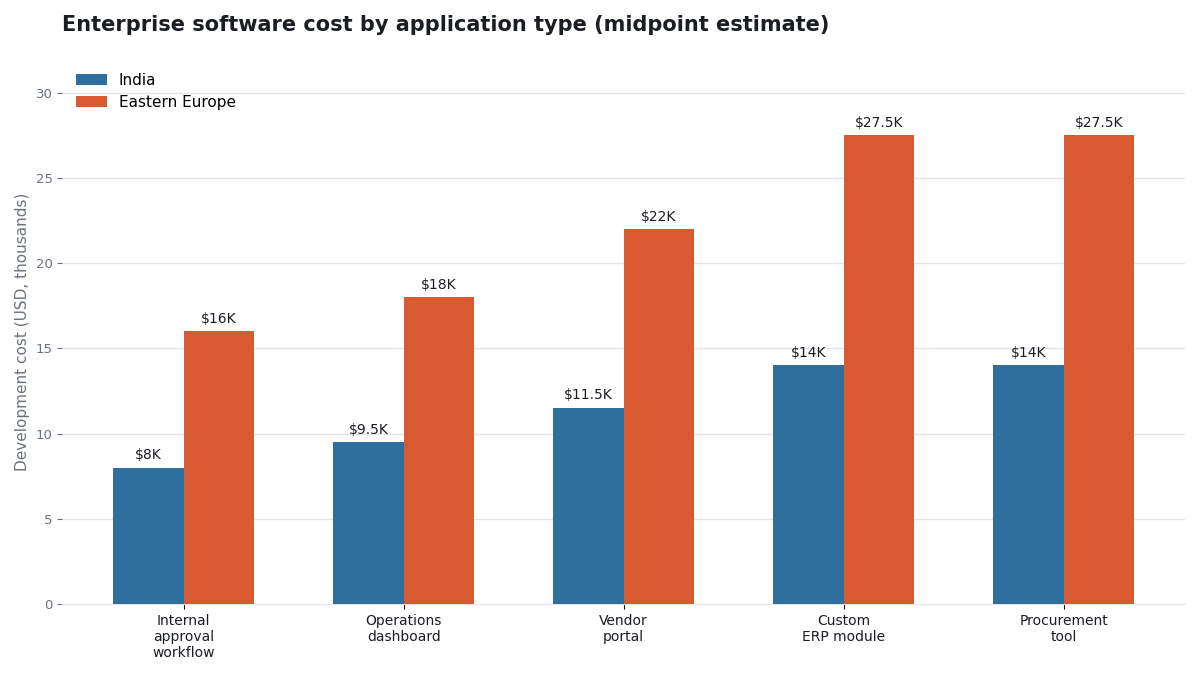
The brief checklist for enterprise software:
Integration map lists every system the application must connect to, the method of integration (API, database, file), and whether the integration is read-only or read-write. This single element reduces quote variance by 30 to 40%, and it’s the same variable we flag in our guide to comparing software development quotes side by side.
Security requirements SSO required? If yes, which provider (Okta, Azure AD, Google Workspace)? Audit logging required? Data residency requirements? Role-based access control complexity?
User count and distribution: how many users, across how many locations, with what network access pattern (internal only, or accessible from outside the corporate network)?
Performance requirements: what are the data volumes? How many concurrent users? What response time is acceptable for the primary workflows?
Regulatory context GDPR, HIPAA, SOC 2, or other compliance requirements that affect the architecture?
Frequently Asked Questions
What is the difference between enterprise software development and SME software development?
The primary differences are scale, integration complexity, and security requirements rather than feature complexity. Enterprise software typically involves: integration with existing enterprise systems (ERP, CRM, HRMS) that require specific integration knowledge; SSO integration with corporate identity providers; role-based access control for large user populations with diverse permission requirements; higher performance requirements from larger data volumes and more concurrent users; and compliance and audit requirements that consumer software does not face. At the $5K to $30K budget level, the enterprise characteristics that add most to cost are integration complexity and SSO each adding $2,000 to $12,000 depending on the specific systems and complexity. Feature complexity at this budget level is similar to non-enterprise software.
How do I evaluate whether an agency has genuine enterprise development experience?
Three questions that reveal enterprise experience specifically: ask them to describe their experience with enterprise SSO integration, specifically SAML 2.0 or OIDC with Active Directory or Okta. Ask them to describe their approach to integration testing when the source system is an enterprise ERP with limited test environment access. Ask them what security controls they implement as standard for an internal enterprise tool. An agency with genuine enterprise experience has specific, opinionated answers to all three. A consumer-focused agency will give generic answers about authentication and APIs that reveal no enterprise integration experience.
Is it worth building a custom enterprise tool or should we buy an existing SaaS solution?
This is the most important question to answer before starting any enterprise software development project. Build custom when: no existing SaaS solution meets your core workflow requirements, the proprietary integrations with your specific enterprise systems make generic SaaS impractical, competitive differentiation depends on the specific capabilities of the tool, or the long-term cost of SaaS licensing exceeds the cost of custom development and maintenance. Buy SaaS when: a solution exists that meets 80%+ of requirements, the SaaS vendor has solved the integration problems you would face building custom, and your organisation has the change management capacity to adopt a new tool. At the $5K to $30K budget level, the honest assessment is that many enterprise workflow problems are best solved by a combination of a SaaS backbone and custom integrations rather than building from scratch.