
How to Structure Milestone Payments on a Software Project
A vendor holding 50% of your budget before a single line of production code ships has already been paid for the hard part. Everything invoiced after that point is cost to them, not revenue which is precisely why milestone payments software development agreements behave so differently depending on how the first number is set. The contract language rarely changes vendor behaviour. The cash position does.
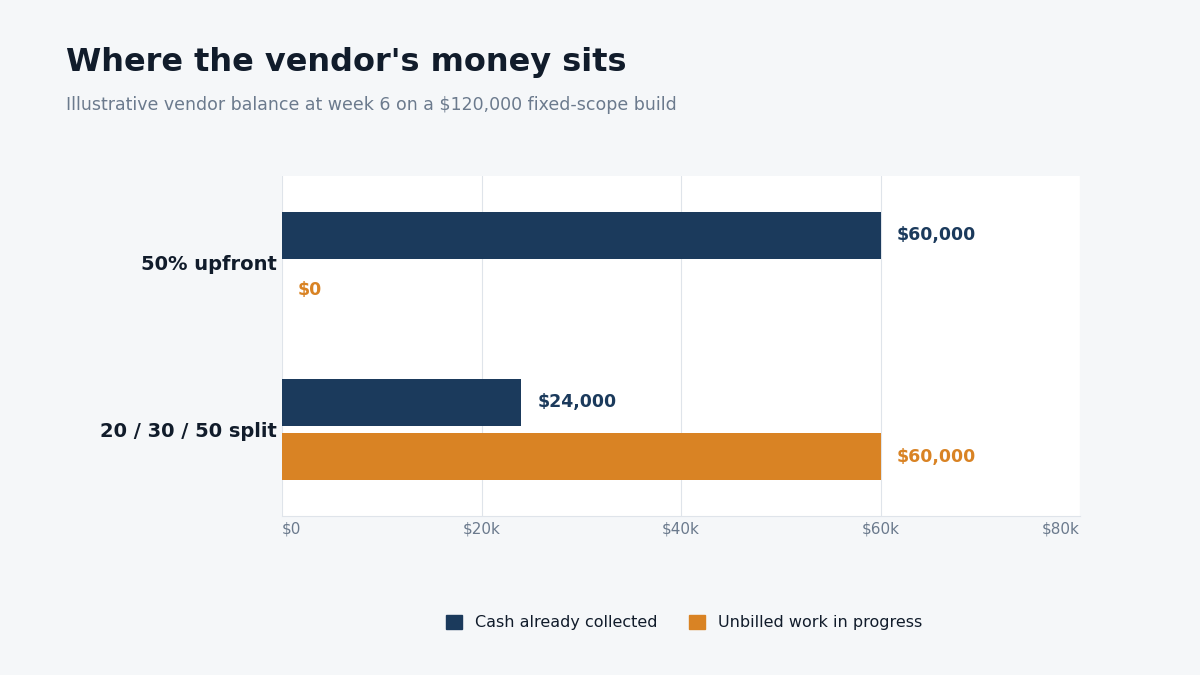
This is not a trust problem. It is an incentive problem, and it is predictable enough to design around. An agency sitting on 50% of a $120,000 build has $60,000 of collected cash and an open delivery obligation. When a higher-margin client appears in week six, the rational commercial decision is to move the strongest engineers onto the new account and staff yours with whoever is available. Nobody breaches anything. Your velocity just quietly halves.
Flip the structure so that 50% of contract value sits behind user acceptance testing, and the same agency now has $60,000 of unbilled work-in-progress on its balance sheet. Suddenly your project is the one that gets the senior React developer.
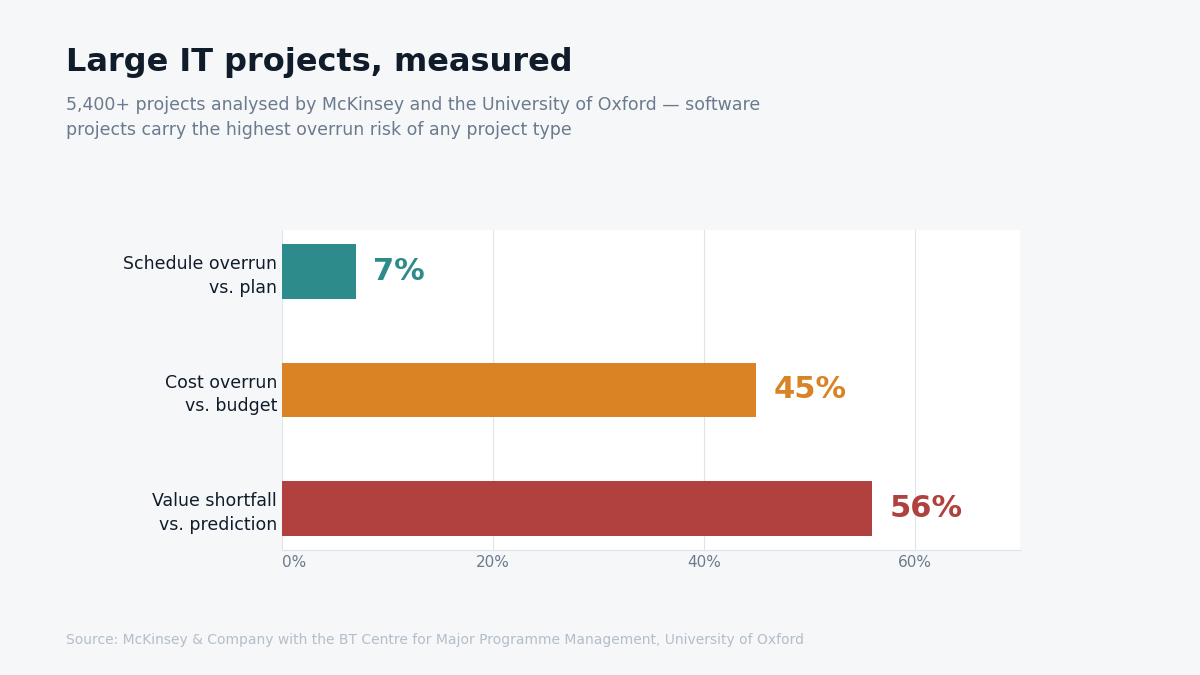
McKinsey, working with the BT Centre for Major Programme Management at the University of Oxford, analysed more than 5,400 IT projects and found that large IT projects run 45% over budget and 7% over time while delivering 56% less value than predicted with software projects carrying the highest risk of cost and schedule overruns of any project type.
What follows is the practical version: three payment split models with the project profiles each one fits, a defensible ceiling for upfront deposits, the clauses that make a milestone enforceable rather than decorative, and five questions to send to whoever drafted your contract before you sign it.
What Are Milestone Payments in Software Development?
Milestone payments in software development are contract terms that release portions of a project fee only when defined deliverables pass agreed acceptance criteria such as a working prototype, integration completion, or UAT sign-off rather than on fixed calendar dates. They replace a single upfront fee with staged transfers tied to verifiable output.
The distinction that matters: a milestone is an artifact, not a date. “Design phase complete, week 4” is a calendar entry. “Clickable Figma prototype covering all 14 authenticated screens, approved in writing by the product owner” is a milestone. Only the second one is contractually enforceable.
The Core Problem: Deposit Structures Are Inherited, Not Designed
Roughly nine out of ten first-time buyers accept the vendor’s template without editing a single percentage. That template exists to solve the agency’s cash-flow problem, not the client’s delivery risk and the payment terms software project buyers inherit by default reflect exactly that asymmetry.
The financial exposure is concrete. Because milestone payments software development budgets are usually agreed before technical discovery is finished, the first percentage is set at the moment of least information. On a $150,000 six-month build with a 50% deposit, you have transferred $75,000 against zero shipped functionality.
If the engagement fails at month three a normal outcome, not an edge case, your recovery options are a legal claim against an agency whose entire asset base may be laptops and a lease.
Three failure patterns show up repeatedly in vendor disputes:
- Front-loaded discovery. 40–50% is consumed by a discovery phase producing a slide deck and a Jira backlog. Real code starts at month two with 45% of the budget already spent.
- Date-anchored milestones. Payment triggers on the calendar rather than on acceptance, so a milestone gets marked complete with three open P1 defects.
- The final-payment hostage. A single 50% terminal payment turns handover into a negotiation, where scope creep disputes, repository access, and outstanding invoices all collide at once.
There is a mirror-image failure that buyers cause. Milestones set too far apart force agencies to carry 8–10 weeks of payroll on a fixed-price contract, which is exactly when subcontracting and junior substitution start. A schedule that starves your vendor produces bad software just as reliably as one that overpays them.
Building a Milestone Payment Schedule Software Vendors Will Actually Sign
The workable range is narrower than most negotiations assume. Any structure that leaves a delivery team cash-negative for more than one sprint will either be rejected outright or silently absorbed through reduced staffing quality.
How Much Deposit for Developer Work Is Actually Defensible?
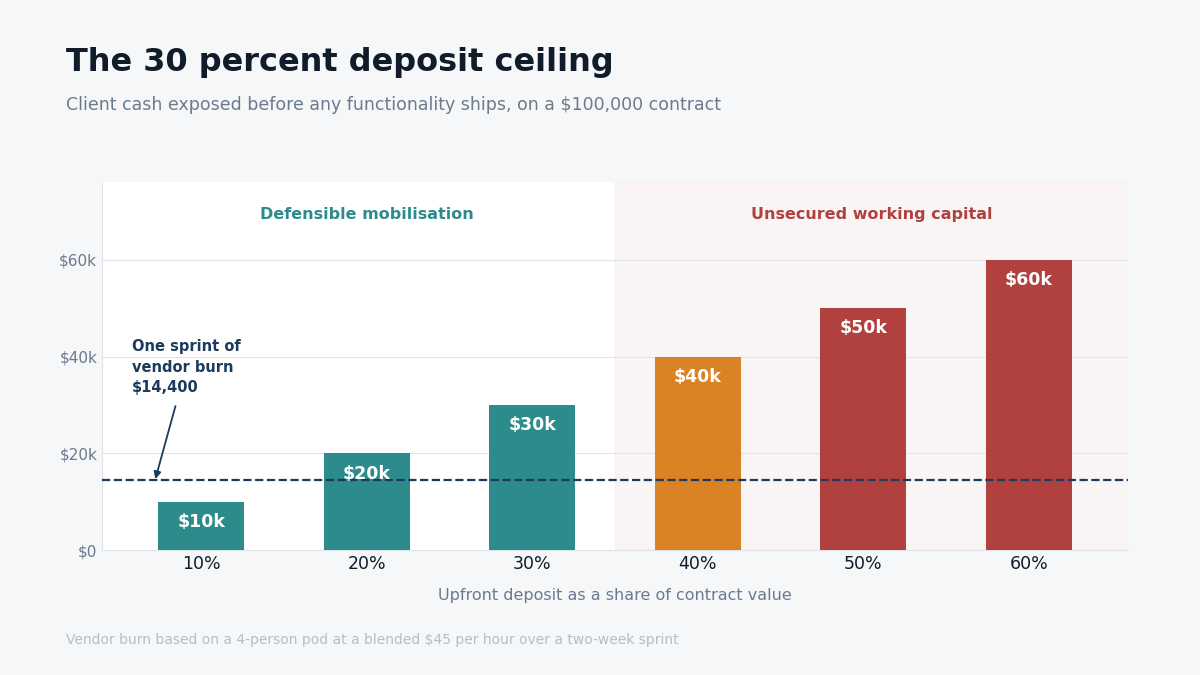
There is a defensible answer to this, and it is narrower than most proposals suggest: cap the upfront payment at 30% of contract value, or one sprint of the vendor’s burn rate, whichever is lower.
A 20–30% deposit covers legitimate mobilisation costs, contract execution, environment provisioning, team allocation, and the first two weeks of payroll. A 4-person pod at blended $45/hour costs roughly $14,400 per two-week sprint; on a $100,000 contract, a 20% deposit ($20,000) covers that comfortably.
Above 30%, the deposit stops funding mobilisation and starts funding the agency’s other obligations. Above 50%, you are extending an unsecured working-capital loan to a company you have known for three weeks. Treat any request above 30% as a signal to run deeper vendor vetting check registration, audited accounts if available, client references from projects that finished in the last 12 months, and whether the team members named in the proposal are the ones on the contract.
Model 1 The 20/30/50 Split
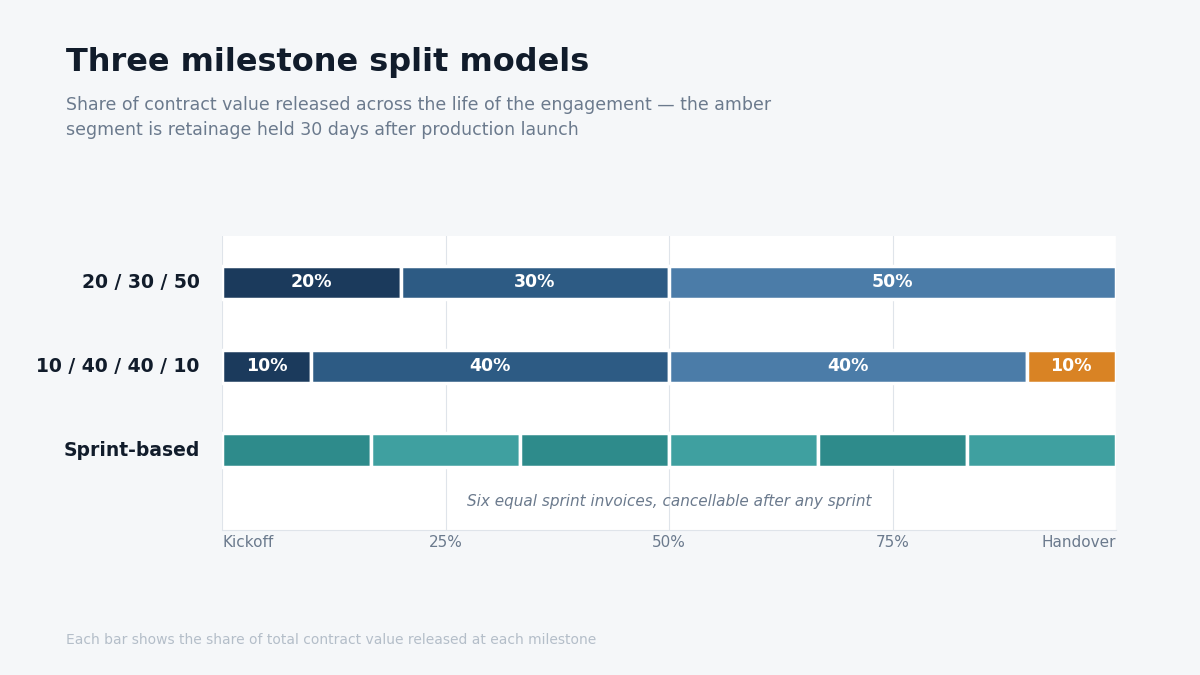
- 20% on contract signature and team allocation
- 30% on a working demo of core functionality in a staging environment
- 50% on UAT sign-off, production deployment, and full code repository handover
Best fit: single-scope builds of 8–16 weeks in the $15,000–$60,000 range, and any first engagement with an unproven vendor. The weight sits behind delivery, which is uncomfortable for agencies but appropriate when there is no relationship history. Expect to concede a 3–7% price premium for this structure that premium is cheaper than the risk it removes.
Model 2 The 10/40/40/10 Split
- 10% on kickoff
- 40% on alpha: core modules functional, third-party integrations connected
- 40% on beta and successful UAT
- 10% retainage, released 30 days after production launch
Best fit: 4–9 month builds in the $60,000–$250,000 range, integration-heavy work, and regulated environments. The terminal 10% is a warranty holdback covering post-launch defects, and it changes handover behaviour more than any other single clause. Agencies that would otherwise disengage on go-live day stay responsive through the stabilisation window because $12,000–$25,000 is still outstanding.
Model 3 The Sprint-Based Split
- Fixed price per two-week sprint, invoiced on sprint demo acceptance
- Net-15 payment terms
- Rolling two-sprint cancellation notice on either side
Best fit: evolving scope, product teams with an internal PM, and engagements where a full SOW cannot honestly be written yet typically $8,000–$25,000 per sprint. This sits between a fixed-price contract and pure time and materials: the vendor carries no long unbilled exposure, and you can exit after any sprint with a maximum loss of four weeks’ spend. The trade-off is that you own scope discipline. Without an internal product owner running the backlog, sprint-based billing becomes an open-ended retainer.
What a Staged Payments Development Contract Must Define
Percentages are the easy part. The agreement is only enforceable if each milestone specifies four things: the deliverable artifact, the acceptance test, the reviewer with signing authority, and the remediation window on rejection.
Add these clauses regardless of model:
- Acceptance window. The client has 5–10 business days to accept or reject in writing; silence after that is deemed acceptance. This protects the vendor and forces your team to actually review.
- Remediation at vendor cost. On rejection, the vendor has 10 business days to remediate at its own expense before the milestone is re-submitted.
- Progressive repository access. Code is pushed to a client-owned Git organisation at every milestone, not at final payment. This is the single most valuable clause in the document.
- IP assignment on payment. Ownership of each milestone’s deliverables transfers on payment of that milestone not on completion of the whole contract.
- Change order threshold. Any request adding more than 8 hours of work requires a written change order with a price and a schedule impact before work begins.
- Escrow for cross-border work. For international engagements above $50,000 with a first-time vendor, a conditional escrow arrangement typically costs well under 1% of transaction value and removes the enforcement problem entirely.
How to Structure Payments for a Fixed Price Software Project
- Define the deliverable, not the date every milestone names a testable artifact.
- Write acceptance criteria before you write percentages criteria drafted after the numbers are agreed always favour the party that drafted them.
- Cap the upfront payment at 30% of contract value, or one sprint of vendor burn, whichever is lower.
- Place at least 40% of contract value behind post-integration milestones, where the genuinely hard work sits.
- Hold 10–15% as retainage for 30 days after production launch.
- Attach repository access to every milestone, so leverage never concentrates in the final invoice.
- Document the miss procedure before the first miss notice period, cure window, and termination-for-convenience terms.
- Keep milestones 3–4 weeks apart so neither side carries more than one sprint of unbilled or unearned exposure.
Case Studies: What Changes When the Split Changes
A Series A fintech restructuring mid-engagement. A payments startup signed a $180,000 mobile build on 50/50 terms and hit month four with a slipping schedule and two senior engineers rotated off the account. Renegotiating the outstanding 50% into a 15/20/15 structure tied to integration, UAT, and a 30-day holdback restored the original team within two sprints; the project shipped 5 weeks late instead of the 14 weeks the trajectory implied.
An enterprise retailer running two vendors in parallel. A mid-market retailer scoping a headless commerce replatform ran a 12-week pilot with two shortlisted agencies on identical sprint-based terms $18,000 per sprint, net-15, cancellation after any sprint. The losing vendor was released after sprint three at a total exposure of $54,000, against the roughly $95,000 deposit a conventional milestone payments software development contract would have demanded upfront across both awards.
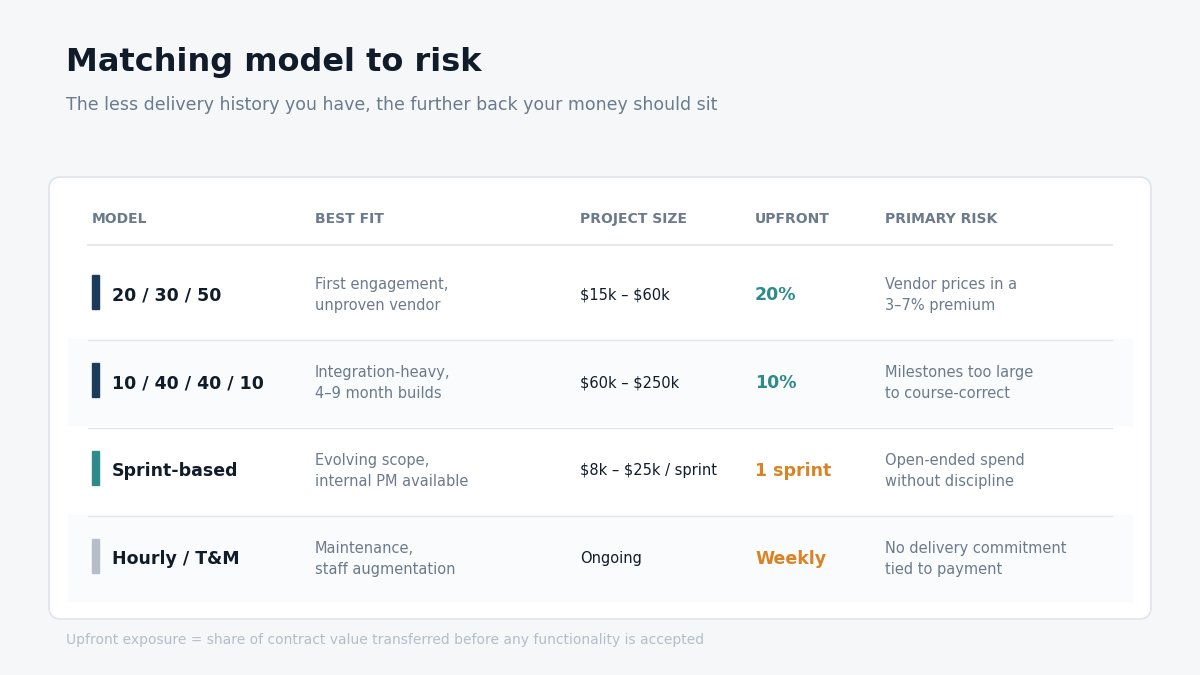
Decision Framework: Matching Model to Risk
| Model | Best fit | Typical project size | Upfront exposure | Primary risk |
| 20/30/50 | First engagement, unproven vendor, fixed scope | $15,000–$60,000 | 20% | Vendor prices in a 3–7% premium |
| 10/40/40/10 | Integration-heavy, regulated, 4–9 month builds | $60,000–$250,000 | 10% | Milestones too large to course-correct |
| Sprint-based | Evolving scope, internal PM available | $8,000–$25,000 per sprint | One sprint | Open-ended spend without scope discipline |
| Hourly / T&M | Maintenance, staff augmentation, R&D spikes | Ongoing | Weekly or monthly | No delivery commitment attached to payment |
The selection logic is straightforward: the less delivery history you have with a vendor, the further back in the schedule your money should sit. Marketplaces built on verified agency profiles GetProjects among them compress that history problem by making prior client outcomes, team composition, and domain track record visible before terms are negotiated. But no amount of due diligence replaces a payment structure that keeps incentives aligned through month five.
What Most Teams Get Wrong About Milestone Payments Software Development
Negotiating hard on percentages while accepting the vendor’s acceptance criteria is the most common and most expensive mistake in this entire process. A 20/30/50 split with vague criteria is weaker than a 30/30/40 split with a defined test plan, because in the first case the vendor decides when a milestone is met.
The Milestone Based Billing Agency Trap
This model can fail in the client’s direction too. When buyers push milestones to 8–10 weeks apart to minimise their own exposure, they force the vendor to finance two months of payroll and the vendor responds by substituting juniors, or by pausing your work whenever a faster-paying client appears. The correct interval is 3–4 weeks in both directions.
Three more patterns worth naming:
- Treating the deposit as a trust signal. Willingness to accept 20% is not evidence of quality, it is often evidence of poor cash management. Read it as one input among many, not a verdict.
- Skipping the SOW appendix. The statement of work (SOW) exhibit, not the master agreement, is where milestone definitions live. Legal reviews the MSA; nobody reviews the appendix that actually governs payment.
- Confusing a demo with acceptance. A screen-shared walkthrough on the vendor’s laptop is not accepted. Acceptance is your team running the test plan in your environment.
One contrarian note: fixed-price milestone structures are frequently the wrong instrument. If the requirements genuinely are not settled, a fixed-price contract forces the vendor to price uncertainty as margin 25–40% above true cost and every subsequent conversation becomes a change order dispute. Sprint-based terms are cheaper and more honest for genuinely exploratory work.
The 5 Questions to Send Whoever Wrote the Contract
Send these verbatim to the drafting party agency principal, procurement lead, or outside counsel before signature. The answers, or the evasions, tell you more than the document does.
- Which specific artifact proves milestone 2 is complete, and who has signing authority to accept it?
- If we reject a milestone, how many business days does the vendor have to remediate, and is that remediation at the vendor’s cost?
- Does source code repository access transfer at each milestone, or only on final payment?
- What percentage of total contract value remains unpaid after production go-live, and for how long?
- If we terminate for convenience after milestone 2, what do we owe, and what deliverables and IP do we retain?
Before You Sign
If you are structuring milestone payments software development vendors will honour under pressure, the schedule matters more than the rate card and both are easier to evaluate when you can compare several verified agencies against the same brief. GetProjects connects businesses directly with verified IT companies with no bidding wars and no platform commission: posting a project is free, and you pay only the agency you hire.
Post your scope, compare payment structures side by side, and send the five questions above before anyone countersigns.
Frequently Asked Questions
Should you pay a software agency 50 percent upfront?
Rarely. A 50% deposit transfers most of the project’s financial risk to you before any functionality exists, and it removes the vendor’s cash incentive to prioritise your delivery. Cap deposits at 30% for a first engagement. Larger deposits are defensible only where the vendor is pre-purchasing licences, hardware, or third-party services on your behalf, with invoices attached.
What are typical payment terms for a software development project?
Common structures are 20/30/50 for short fixed-scope builds, 10/40/40/10 for four-to-nine-month programmes, and fixed-price-per-sprint for evolving scope. Net-15 to net-30 is standard on milestone invoices. Retainage of 10–15% held for 30 days post-launch is increasingly common on contracts above $75,000 and materially improves post-handover support responsiveness.
How do you structure milestone payments in a contract?
Each milestone needs four elements: a named deliverable artifact, a written acceptance test, a reviewer with signing authority, and a remediation window on rejection. Percentages sit in the payment schedule; definitions sit in the SOW appendix. Structuring milestone payments software development contracts without those four elements produces a schedule that cannot be enforced when it matters.
What to do when a developer misses a milestone deadline?
Issue written notice within 48 hours citing the specific unmet acceptance criterion, not the date. Invoke the contractual cure window typically 10 business days at vendor cost. Do not release partial payment for partial completion; it resets the vendor’s urgency. If a second consecutive milestone slips, escalate to the termination-for-convenience clause and confirm your repository access is current before you do.
Should final payment be tied to source code handover?
Handover should be continuous, not terminal. Code belongs in a client-owned Git organisation from sprint one, with IP assignment transferring on payment of each milestone. Tying all code delivery to the final invoice creates a single point of maximum leverage for both parties and is the most common trigger for handover disputes on milestone payments software development engagements.
Are milestone payments better than hourly billing?
They serve different risk profiles. Milestone billing suits defined scope and transfers delivery risk to the vendor at a 15–30% price premium. Hourly and time-and-materials billing suits maintenance, staff augmentation, and R&D work where scope genuinely cannot be fixed. Many mature engagements run both: milestones for the initial build, hourly for the support phase.
How should a milestone payment schedule for a 6 month development project be spaced?
Use five to seven milestones spaced 3–4 weeks apart, weighted so that at least 40% of contract value sits behind integration and UAT. If you are unsure how your draft schedule compares to what verified agencies in your budget band are currently accepting, it is worth reviewing terms across several shortlisted vendors before signing the first one.