Best Generative AI Development Companies in 2026 What Real GenAI Expertise Looks Like
Generative AI has produced the most crowded agency market in the history of software development. Every development company added “generative AI” to their service page in 2023. Most of them mean they know how to call the OpenAI API. A small number of them can actually build production-grade LLM applications RAG systems with production accuracy, multi-agent workflows that complete complex tasks reliably, fine-tuned models that outperform general-purpose models in specific domains, and AI products with the evaluation infrastructure to measure whether the AI is actually working.
That’s why choosing the best generative AI development companies requires looking beyond service pages and checking real technical expertise, production experience, and measurable AI outcomes.
According to Grand View Research – Generative AI Market Report, the global generative AI market is estimated to reach $29.6 billion in 2026 and is projected to grow at a 40.8% CAGR through 2033. This rapid growth is increasing demand for development partners capable of moving GenAI projects from experimentation to production.
The global generative AI market is growing at 37% annually and is projected to reach $1.3 trillion by 2032. At the $5K to $30K budget level, the most common GenAI builds are: RAG-powered document assistants, AI writing and content generation tools, LLM-powered workflow automation, AI-assisted analysis tools, and conversational AI applications. This guide covers how to find an agency genuinely capable of building these.
What Generative AI Development Actually Requires in 2026
Generative AI development in 2026 is not a single discipline. It spans a spectrum from simple API integration to sophisticated machine learning engineering, and most buyers underestimate how wide that spectrum actually is. Understanding which level your project requires determines what kind of agency you need a mismatch here is the single biggest reason GenAI projects run over budget or under-deliver; for a broader look at where different AI capabilities sit on this spectrum, see our guide to choosing the right AI development company.
The GenAI development stack:
| Layer | What It Involves | Skill Required |
| API integration | Calling OpenAI/Anthropic/Gemini API from an application | Standard web development + basic prompt engineering |
| Prompt engineering | Designing system prompts, few-shot examples, chain-of-thought instructions that produce reliable output | Understanding of LLM behaviour, testing methodology |
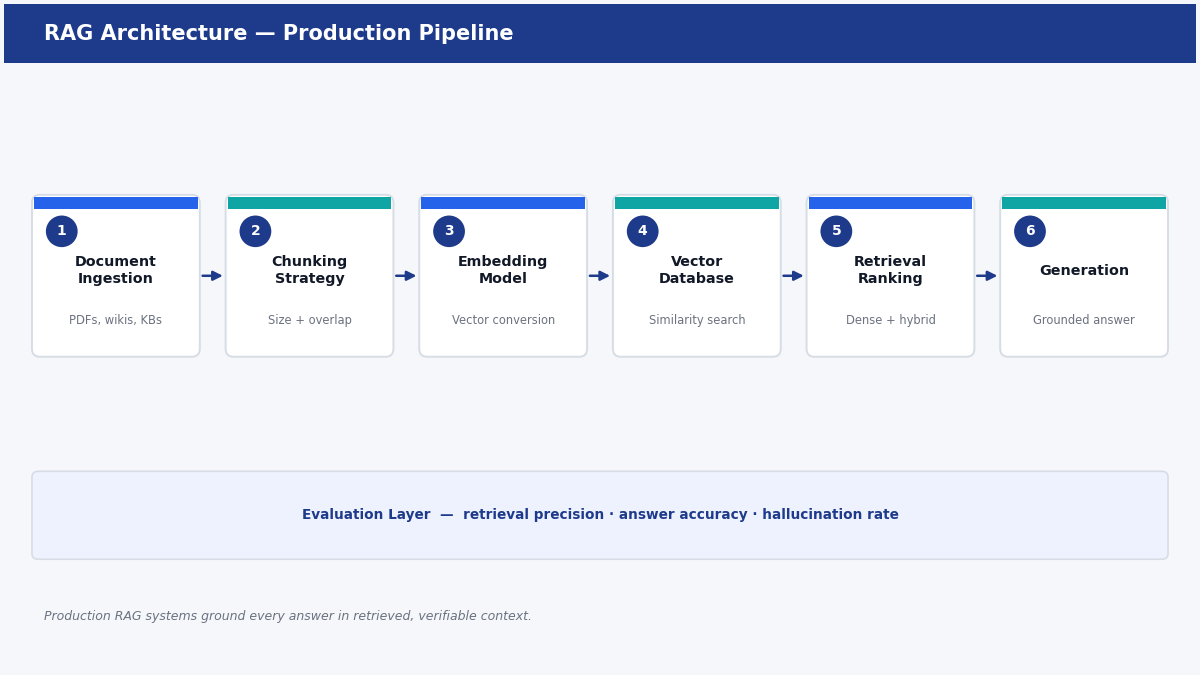
| RAG architecture | Vector databases, document chunking, embedding models, retrieval ranking, generation with grounding | ML engineering + backend architecture |
| LLM orchestration | Multi-step reasoning chains, tool use, memory management, output parsing | Frameworks: LangChain, LlamaIndex, DSPy |
| Agent development | Autonomous task execution, planning, tool use, error recovery | Senior AI engineering + evaluation infrastructure |
| Fine-tuning | Customising base models on domain-specific data | ML engineering + compute infrastructure |
| Evaluation infrastructure | Building test sets, measuring hallucination rates, A/B testing prompts, monitoring drift | ML engineering + production operations |
Most GenAI projects at $5K to $30K sit in the API integration to RAG architecture layers. Fine-tuning and agent development at meaningful complexity require either larger budgets or well-scoped, focused use cases and since ongoing model and infrastructure spend can shift significantly depending on which layer your project touches, it’s worth reviewing typical AI and ML development cost benchmarks before locking in scope.
The RAG Architecture Why It Defines Most GenAI Projects at This Budget
Retrieval-Augmented Generation (RAG) is the architecture that enables LLM applications to answer questions about your specific data, your documents, your product catalogue, your knowledge base, your customer records reliably and without hallucination.
Without RAG, an LLM answers from its training data. It will not know about your company’s specific policies, your product specifications, or your customer’s history. For most business GenAI applications, this is useless.
With RAG, the application retrieves relevant documents from your corpus, passes them to the LLM as context, and instructs the LLM to answer only from that retrieved context. The LLM’s answer is grounded in your actual data; if the answer exists in the retrieved documents, the LLM can produce it accurately; if it does not, the LLM says it does not know rather than guessing. This retrieval-and-grounding pattern is also the backbone of most production AI SaaS products, so if you’re scoping a broader platform rather than a single feature, it’s worth seeing how RAG fits into the full architecture of an AI SaaS product before committing to a build.
The components of a production RAG system:
| Component | What It Does | Key Decisions |
| Document ingestion pipeline | Processes your documents and stores them for retrieval | File format handling, update frequency |
| Chunking strategy | Splits documents into segments appropriate for retrieval | Chunk size, overlap, semantic vs fixed chunking |
| Embedding model | Converts text chunks to vector representations | OpenAI text-embedding-3-large vs open-source alternatives |
| Vector database | Stores embeddings for fast similarity search | Pinecone, Qdrant, pgvector, Chroma |
| Retrieval ranking | Selects most relevant chunks for a query | Dense retrieval vs hybrid (dense + BM25) |
| Generation | LLM produces answer from retrieved context | Model selection, system prompt, output format |
| Evaluation | Tests whether retrieved chunks are correct and answers are accurate | Test set, precision/recall metrics |
A development agency that can articulate each of these decisions for your specific use case has built production RAG systems. An agency that describes RAG as “connecting ChatGPT to your documents” has not.
Common GenAI Project Types at $5K–$30K
What your budget realistically builds:
| GenAI Project Type | What It Is | India Cost | Eastern Europe Cost | Timeline |
| Document Q&A chatbot | RAG system over your documents PDFs, wikis, knowledge bases | $6K–$12K | $12K–$22K | 6–12 weeks |
| AI writing assistant | LLM-powered content generation tool with templates, tone control, brand voice | $5K–$10K | $10K–$18K | 5–10 weeks |
| AI-powered search | Semantic search over product catalogue, knowledge base, or content library | $6K–$12K | $12K–$22K | 6–12 weeks |
| Customer support AI | LLM agent with RAG knowledge base, escalation logic, CRM integration | $10K–$18K | $20K–$35K | 10–16 weeks |
| Data extraction tool | LLM-powered extraction of structured data from unstructured documents | $7K–$13K | $14K–$24K | 7–12 weeks |
| AI workflow automation | Multi-step LLM pipeline automating a defined business process | $10K–$20K | $20K–$38K | 10–18 weeks |
| AI-powered analytics | LLM-based summarisation and insight generation from business data | $8K–$15K | $16K–$28K | 8–14 weeks |
| Code assistant | LLM-powered code review, documentation generation, or debugging assistant | $7K–$13K | $14K–$24K | 7–12 weeks |
How to Evaluate a Generative AI Development Company
The five questions that reveal genuine GenAI expertise:
Describe the RAG architecture of a production system you have built, not a demo, not a prototype. A development team with production RAG experience can walk you through chunking strategy decisions, why they chose a specific vector database, how they handled document updates in the index, and what retrieval method they used (dense only vs hybrid). Vague answers reveal prototype experience. Specific, opinionated answers reveal production experience.
How do you measure whether the AI feature is working well enough for production? A genuine answer involves an evaluation dataset, a set of representative queries with expected correct answers, and specific metrics: retrieval precision (are the right documents being retrieved?), answer accuracy (is the LLM generating correct answers from the retrieved context?), and hallucination rate (how often is the LLM generating claims not supported by the retrieved documents?). An answer that focuses on “testing a few queries and seeing if they look right” is a prototype-level answer this is exactly the kind of specificity worth probing for during vendor calls, and our guide on vetting a development company before you sign covers how to tell a rehearsed answer from real production experience.
What LLM would you use for this project and why? The answer should weigh: task requirements (GPT-4o for complex reasoning, Claude 3 Haiku for high-volume low-latency tasks, Mistral or Llama for data-private deployments), cost at expected query volume, context window requirements, and whether fine-tuning is relevant. An agency that says “ChatGPT” without considering alternatives has not thought carefully about model selection.
How do you handle hallucination in this type of application? For RAG applications, the answer should include retrieval grounding (the LLM is instructed to answer only from retrieved context), confidence thresholds (queries where no relevant context is retrieved produce “I don’t know” rather than a fabricated answer), and output validation (structured outputs verified against expected schema). An agency with no specific hallucination mitigation strategy is building an AI product that will embarrass its users, and vague answers like this tend to cluster with other warning signs. Our list of red flags to watch for in a software development company is a useful checklist to run alongside these questions.
What is your experience with prompt versioning and prompt drift? Production LLM applications require managing prompt versions, tracking which prompt produced which results, testing prompt changes before deployment, and monitoring for prompt drift as model updates change LLM behaviour. An agency that treats the system prompt as a static configuration has not managed a production LLM application through a model update cycle.
The Model Selection Landscape in 2026
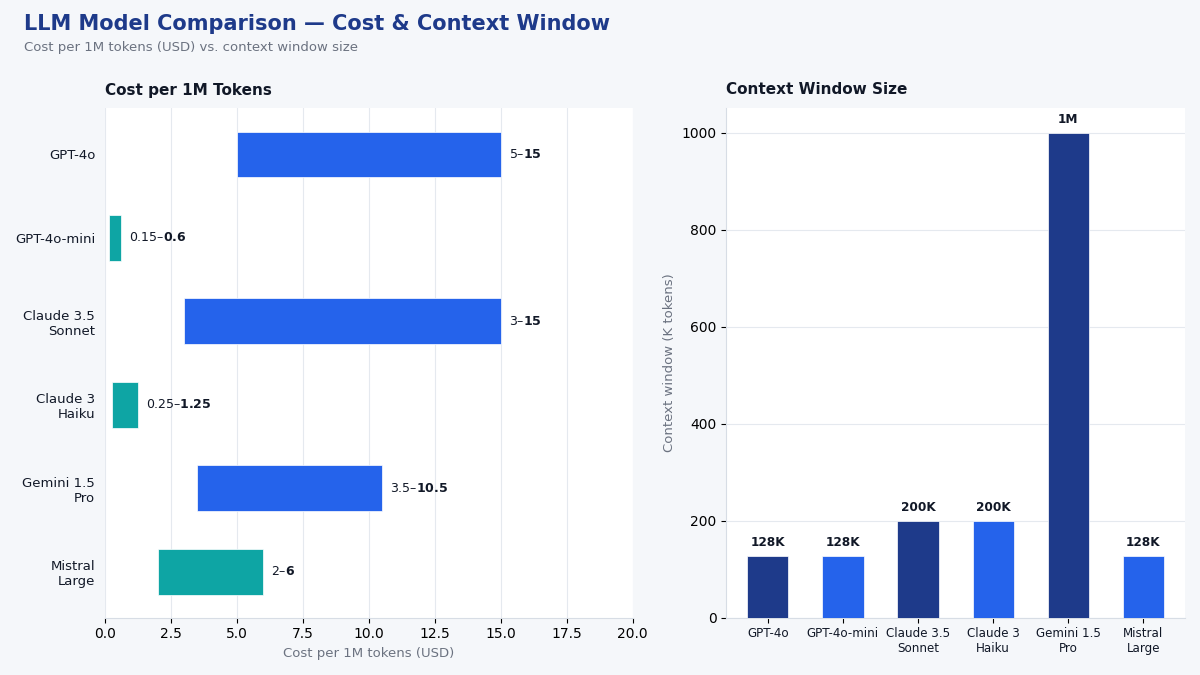
The major LLM options and when to use each:
| Model | Provider | Best For | Cost | Context Window |
| GPT-4o | OpenAI | Complex reasoning, multimodal, broad capability | $5–$15 per 1M tokens | 128K tokens |
| GPT-4o-mini | OpenAI | High-volume, cost-sensitive tasks with moderate complexity | $0.15–$0.60 per 1M tokens | 128K tokens |
| Claude 3.5 Sonnet | Anthropic | Long document analysis, coding, nuanced reasoning | $3–$15 per 1M tokens | 200K tokens |
| Claude 3 Haiku | Anthropic | High-volume, low-latency tasks | $0.25–$1.25 per 1M tokens | 200K tokens |
| Gemini 1.5 Pro | Very long context (1M tokens), multimodal | $3.50–$10.50 per 1M tokens | 1M tokens | |
| Llama 3.1 (open source) | Meta | Self-hosted, data-private deployments | Compute cost only | 128K tokens |
| Mistral Large | Mistral | European data residency, competitive quality | $2–$6 per 1M tokens | 128K tokens |
For most $5K to $30K GenAI projects, GPT-4o or GPT-4o-mini for complex reasoning tasks and Claude 3 Haiku for high-volume tasks represent the practical choice. Open-source models (Llama, Mistral) are the right choice when data privacy requirements prevent sending data to third-party APIs.
The Ongoing Costs of GenAI Applications
Unlike traditional software, GenAI applications have significant variable operating costs every LLM API call costs money.
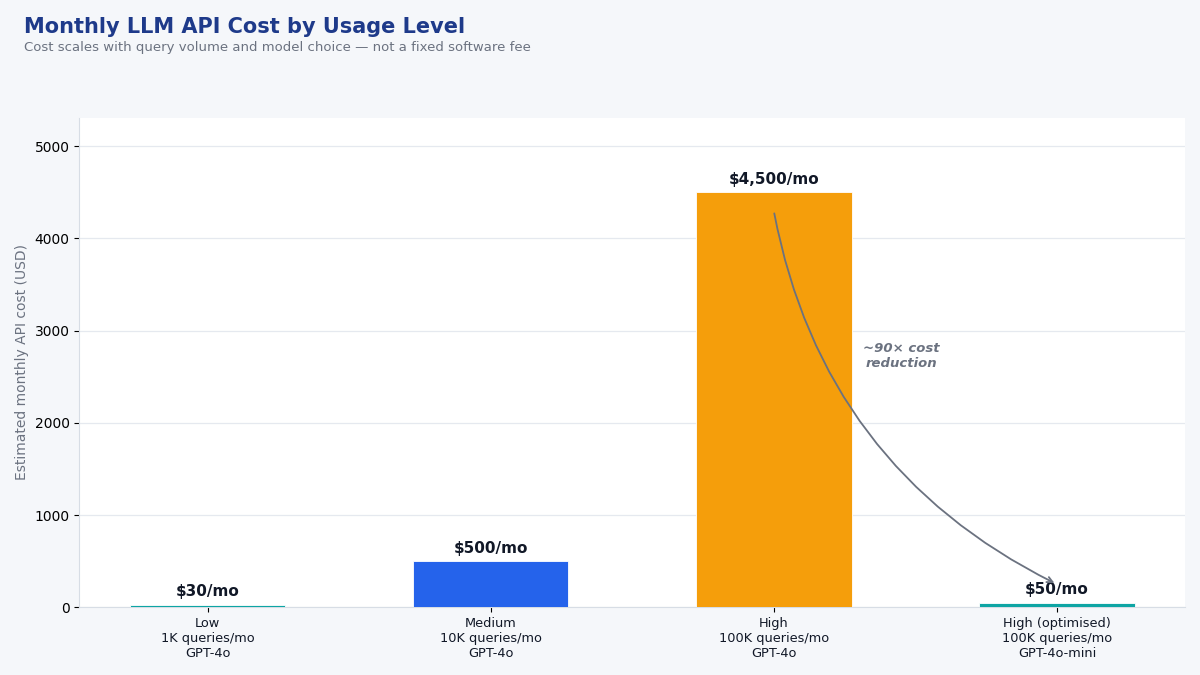
Estimating your monthly LLM API costs:
| Usage Level | Queries per Month | Avg Tokens per Query | Model | Monthly API Cost |
| Low | 1,000 | 2,000 input + 500 output | GPT-4o | ~$30 |
| Medium | 10,000 | 3,000 input + 800 output | GPT-4o | ~$500 |
| High | 100,000 | 3,000 input + 800 output | GPT-4o | ~$4,500 |
| High (optimised) | 100,000 | 3,000 input + 800 output | GPT-4o-mini | ~$50 |
The table above illustrates why model selection is an economic decision as much as a quality decision. Using GPT-4o-mini instead of GPT-4o for high-volume, simpler tasks reduces API cost by 90× at minimal quality cost for appropriate use cases. This is worth factoring in early, since ongoing LLM API spend behaves like a recurring operating cost rather than a one-time build fee closer in nature to the recurring infrastructure and hosting costs covered in our breakdown of SaaS development costs than to a fixed line item in your initial quote.
Frequently Asked Questions
What is the difference between a chatbot and a RAG application?
A chatbot is a conversational interface that can be powered by anything from simple rule-based logic to an LLM. Most LLM chatbots without RAG answer from the model’s training data; they can discuss general topics but have no knowledge of your specific company, products, or documents. A RAG application adds a retrieval layer when you ask a question, the system first retrieves relevant documents from your specific corpus and passes them to the LLM as context. The LLM then answers based on your actual data, not training data. For business applications where the answers must come from your specific content, your documentation, your policies, your product database, RAG is not optional. Without it, the LLM will either hallucinate plausible-sounding answers or acknowledge that it does not have the information, neither of which is useful.
How much does it cost to run a GenAI application with 10,000 users per month?
Monthly operating costs for a GenAI application with 10,000 active users depend on how many queries each user makes and which model you use. Assuming each user makes 5 queries per month (50,000 total queries) with an average context window of 3,000 input tokens and 500 output tokens: using GPT-4o, monthly API cost is approximately $750 to $1,200. Using GPT-4o-mini for appropriate tasks, the cost drops to $25 to $60. Infrastructure (vector database, compute for embeddings, hosting) adds $100 to $300 per month. Total monthly operating cost: $150 to $1,500 depending on model selection. The practical approach is to use GPT-4o for complex reasoning tasks that require it and GPT-4o-mini or Claude Haiku for high-volume, simpler tasks blending models based on task complexity significantly reduces operating costs.
What should I look for in a GenAI development agency’s portfolio?
Four portfolio signals specific to GenAI: first, live products with AI features you can actually use, not demos, not screenshots, actual working applications where you can interact with the AI. Second, specific accuracy or performance claims in case studies “our RAG system achieves 92% answer accuracy on our evaluation set” is a specific, verifiable claim that a demo cannot fake. Third, production scale experience: have they deployed a GenAI application to real users at meaningful scale (1,000+ monthly active users) and maintained it through model updates? Fourth, evaluation infrastructure evidence: do they describe how they measure AI performance in their case studies, or do they only describe features? A GenAI agency that has never built an evaluation framework has never shipped a production AI application with confidence.