Best Healthcare Software Development Companies in 2026 What to Look for Before You Hire
Healthcare software development is the category where the wrong agency choice has the most serious consequences. A consumer app built incorrectly ships a bad update. A healthcare application built incorrectly can expose protected health information, fail a HIPAA audit, violate FDA regulations for software as a medical device, or in the worst cases contribute to a clinical error. The phrase “we have built healthcare applications before” means nothing without specifics. Which regulations? Which integrations? Which clinical workflows?
That’s why choosing the best healthcare software development companies requires evaluating healthcare-specific expertise, regulatory knowledge, security practices, and experience with real clinical systems.
The global digital health market is projected to reach $420.2 billion in 2026, growing at a 23.4% CAGR through 2033, according to Grand View Research. Grand View Research – Digital Health Market
The global digital health market is valued at $660 billion in 2026 and growing at 18% annually. At the $5K to $30K budget level, the most common healthcare builds are: telehealth MVP applications, patient management tools, health tracking apps, healthcare CRM systems, appointment scheduling platforms, and wellness applications. Each has different compliance requirements and different technical challenges.
This guide covers what genuinely separates healthcare-capable agencies from agencies that have treated a healthcare project like any other software build.
Why Healthcare Development Is Categorically Different
The technical differences between healthcare software and general software are specific and non-negotiable. Understanding them helps you evaluate agencies accurately.
The specific requirements that separate healthcare development:
| Requirement | What It Means | What Happens Without It |
| HIPAA compliance (US) | PHI must be encrypted at rest and in transit, access controls documented, BAAs signed with every vendor who touches PHI | HIPAA violation civil penalties from $100 to $50,000 per violation, up to $1.9M per year |
| HL7 FHIR integration | Clinical data exchanged with hospitals, EHRs, and health systems in structured interoperable format | Cannot exchange data with healthcare institutions isolated product |
| Audit logging of PHI access | Every access to patient data logged with who, when, and why | Cannot demonstrate HIPAA compliance cannot pass an audit |
| Role-based access to clinical data | Clinicians see patient data relevant to their role; billing sees billing data; neither sees the other’s data | Privacy breach clinical data accessible to non-clinical staff |
| Emergency access provisions | Clinical systems must have break-glass emergency access with accountability logging | Clinical risk emergency situations may require access that normal controls prevent |
| Data retention and deletion | Healthcare records have minimum retention requirements you cannot delete patient data because a user requests it | Regulatory violation healthcare records must be retained per state/federal requirements |
| Business Associate Agreement | Any vendor who handles PHI on your behalf must sign a BAA | HIPAA violation using AWS without a BAA is a HIPAA violation |
Most of these requirements are not technically complex to implement correctly. They are complex to know about if you have never built a HIPAA-compliant application before.
Healthcare Application Types at the $5K–$30K Budget Level
The $5K to $30K budget does not build an EHR or a hospital management system. It builds specific, valuable healthcare applications that serve real clinical and patient needs.
The most common healthcare builds at this budget:
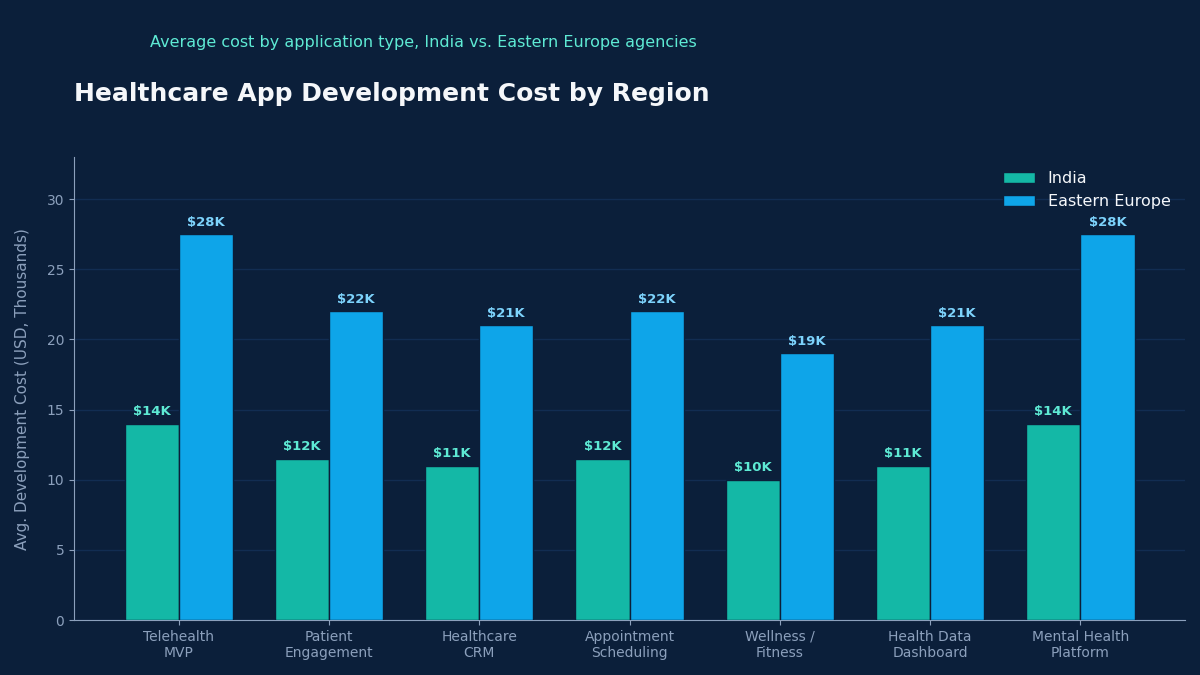
| Application Type | What It Is | Core Features | India Cost | Eastern Europe Cost |
| Telehealth MVP | Video consultation platform for patients and providers | Video (Twilio/Daily.co), scheduling, basic provider profiles, payment | $10K–$18K | $20K–$35K |
| Patient engagement app | App for a specific patient population condition tracking, medication reminders, provider communication | Health data logging, push notifications, secure messaging, appointment view | $8K–$15K | $16K–$28K |
| Healthcare CRM | Lead and patient acquisition management for clinics or health systems | Lead capture, appointment scheduling, follow-up workflows, basic analytics | $8K–$14K | $16K–$26K |
| Appointment scheduling platform | Online booking for multi-provider healthcare practices | Provider availability, patient booking, reminders, EMR-lite notes | $8K–$15K | $16K–$28K |
| Wellness / fitness app | Consumer wellness habit tracking, fitness logging, nutrition | Health data capture, visualisation, social features, wearable integration | $7K–$13K | $14K–$24K |
| Health data dashboard | Internal analytics tool for clinical or administrative data | Data visualisation, reporting, role-based access, FHIR data display | $8K–$14K | $16K–$26K |
| Mental health platform | Self-guided mental health support with professional access | Mood tracking, CBT exercises, therapist messaging, crisis resources | $10K–$18K | $20K–$35K |
The compliance tier matters:
Not all healthcare applications carry the same regulatory burden. A consumer wellness app that tracks hydration and exercise is not subject to HIPAA; it does not handle PHI (Protected Health Information).
A telehealth platform that enables a licensed physician to consult with a patient is subject to HIPAA, requires a BAA with every vendor, and must have appropriate clinical safeguards if you’re scoping this exact build, our telemedicine app development guide breaks down the features, cost, and compliance requirements specific to telehealth platforms.
Understanding which tier your application falls into determines your compliance requirements and therefore your agency requirements.
HIPAA Compliance What Buyers Must Understand Before Hiring
HIPAA (Health Insurance Portability and Accountability Act) applies to covered entities, healthcare providers, health plans, and healthcare clearinghouses and their business associates, anyone who handles PHI on their behalf.
If you are building a platform that will be used by covered entities to handle patient data, your platform is likely subject to HIPAA requirements; for a full breakdown of every safeguard, BAA obligation, and audit requirement this involves, see our dedicated guide on HIPAA-compliant healthcare app requirements.
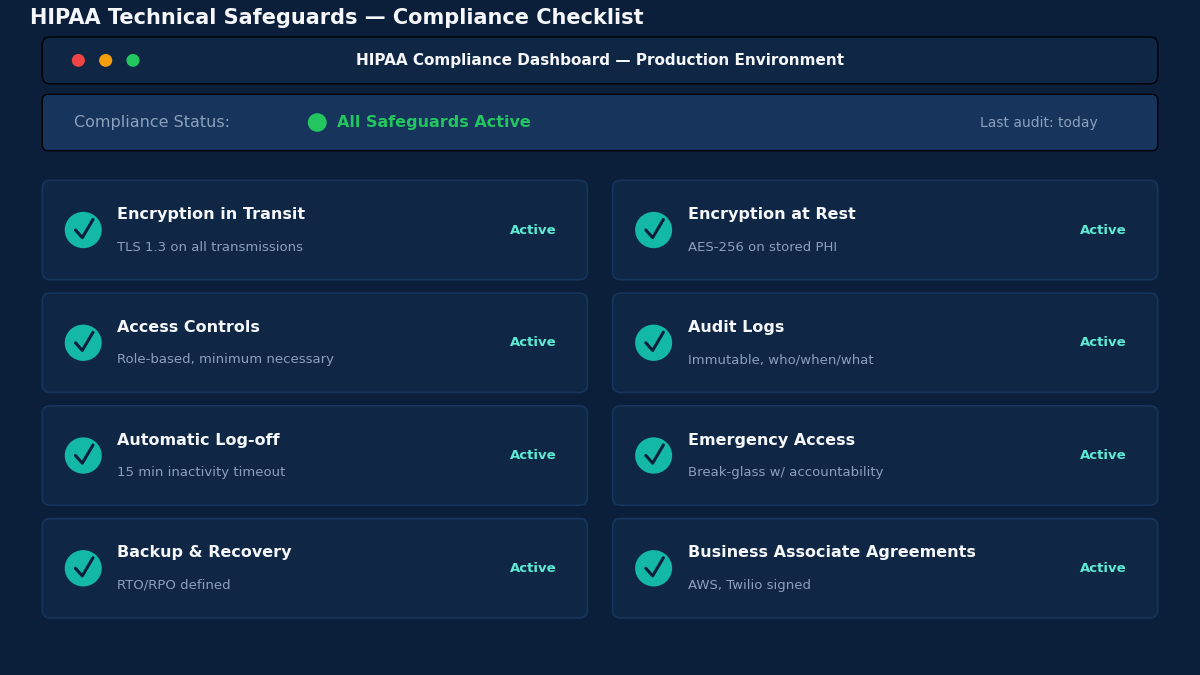
The key HIPAA technical safeguards that your development agency must implement:
| Safeguard | Technical Implementation |
| Encryption in transit | TLS 1.3 on all data transmissions no exceptions |
| Encryption at rest | AES-256 encryption on all stored PHI |
| Access controls | Role-based access with minimum necessary access principle |
| Audit logs | Immutable logs of all PHI access who, when, what, from where |
| Automatic log-off | Sessions terminate after inactivity typically 15 minutes for clinical systems |
| Emergency access | Break-glass protocol with accountability logging |
| Backup and recovery | PHI backed up and recoverable with RTO and RPO defined |
| Business Associate Agreements | BAAs signed with AWS, Twilio, any vendor touching PHI |
The most common HIPAA compliance mistake in development:
Using standard cloud services AWS, Google Cloud, Twilio, SendGrid without signing the Healthcare Business Associate Agreement (BAA) that each of these vendors offers. AWS has a HIPAA BAA available at no additional cost. Twilio offers a BAA. Every vendor who might touch PHI must have a signed BAA before your application goes to production.
An agency that deploys a healthcare application on AWS without signing the BAA has created a HIPAA violation regardless of how well the application itself is built. This is exactly the kind of infrastructure decision our healthcare management system development guide walks through in more detail.
How to Evaluate a Healthcare Software Development Agency
The evaluation criteria for healthcare agencies require additional specificity beyond the standard portfolio and reference check.
The healthcare-specific questions that reveal genuine expertise:
Ask them to describe their HIPAA compliance architecture for a recent project. The answer should include specific mention of: encryption approach, BAA list (which vendors), audit log implementation, and access control design. Vague answers about “following HIPAA guidelines” indicate no production HIPAA implementation experience; the same instinct that should raise your guard here is covered more broadly in our guide to red flags in a software development company.
Ask how they handle PHI in the development and testing environments. The correct answer: test environments use de-identified or synthetic data never real patient data. Development on real PHI without appropriate controls is a HIPAA violation. An agency that says “we used a copy of the production database for testing” has violated HIPAA in a previous project; proper environment discipline is one of the things separating specialist testing and QA companies in India from generalist dev shops.
Ask whether they have experience with HL7 FHIR integration and which EHR systems they have integrated with. For applications that need to exchange data with clinical systems Epic, Cerner, Meditech FHIR R4 API experience is required. This is a specialised integration skill that most general development agencies do not have; our EMR/EHR healthcare app guide goes deeper into what this integration work actually involves.
Ask what their approach is to building software that might qualify as a Software as a Medical Device (SaMD) under FDA guidance. The answer reveals whether they have any regulatory awareness beyond HIPAA relevant for applications that claim to diagnose, treat, or monitor clinical conditions, such as the connected devices covered in our remote patient monitoring app guide.
Cost Benchmarks Healthcare Development at $5K–$30K
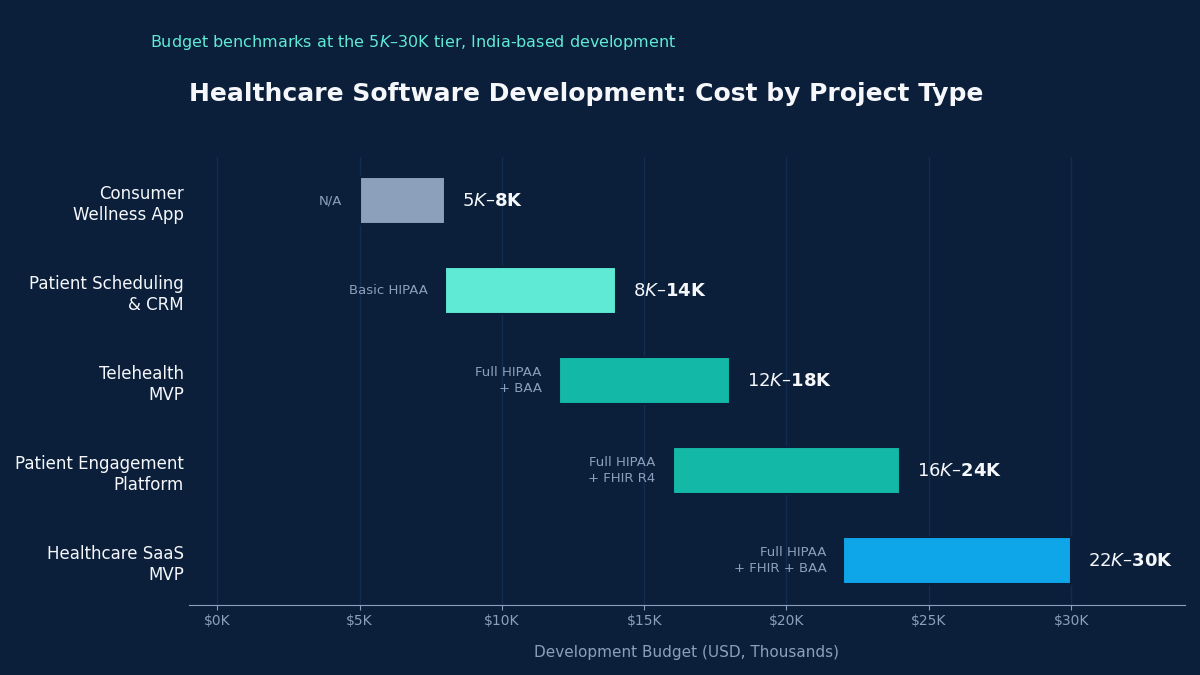
What your budget builds with a strong Indian healthcare development agency:
| Budget | Deliverable | HIPAA Included? | Timeline |
| $5K–$8K | Consumer wellness app no PHI, no HIPAA | N/A | 8–12 weeks |
| $8K–$14K | Patient scheduling and CRM basic HIPAA architecture | Basic HIPAA | 12–18 weeks |
| $12K–$18K | Telehealth MVP video, scheduling, basic EHR-lite | Full HIPAA, BAA setup | 14–20 weeks |
| $16K–$24K | Patient engagement platform HIPAA + FHIR data display | Full HIPAA + FHIR R4 | 18–26 weeks |
| $22K–$30K | Healthcare SaaS MVP multi-provider, full HIPAA, FHIR integration, admin panel | Full HIPAA + FHIR + BAA documentation | 22–30 weeks |
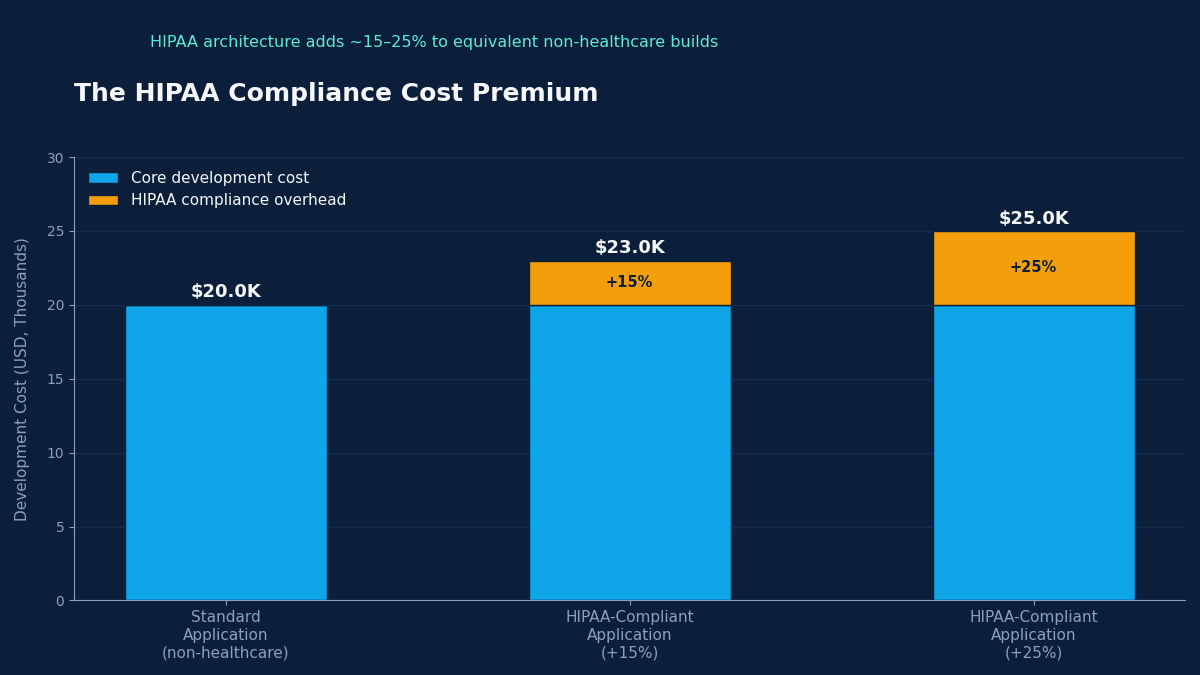
The HIPAA compliance overhead:
HIPAA-compliant architecture adds approximately 15 to 25% to the development cost of a healthcare application compared to an equivalent non-healthcare application. This overhead covers: audit log implementation, additional access control complexity, encryption configuration, BAA setup and documentation, security review, and HIPAA-specific QA testing. Budget this premium explicitly does not expect a healthcare application with full HIPAA compliance to cost the same as a general-purpose application of equivalent feature complexity; for a broader sense of how complexity tiers affect pricing outside healthcare too, see our custom software development cost guide.
Red Flags Specific to Healthcare Development
An agency that proposes building a telemedicine platform using standard Zoom integration without a Zoom for Healthcare (HIPAA-compliant) account has not thought about compliance. Standard Zoom does not sign BAAs. Zoom Healthcare does. This single oversight creates a HIPAA violation on every video consultation.
An agency that proposes storing patient health information in a Firebase Realtime Database without verifying Firebase’s BAA status has not verified their vendor compliance. Firebase offers a BAA through Google Cloud’s healthcare compliance programme, but it must be explicitly activated; it is not the default; this kind of backend-and-database decision is worth understanding at the architecture level, which our SaaS product development guide breaks down.
An agency that has built “healthcare applications” consisting entirely of appointment booking for medical spas and fitness studios has not built HIPAA-regulated applications. These applications are not subject to HIPAA because they do not handle clinical PHI in a covered entity context.
Verify specifically whether previous healthcare clients were covered entities operating under HIPAA if what you actually need is patient-facing engagement and CRM functionality rather than a spa-style booking tool, our healthcare CRM and patient engagement app guide covers that distinction in detail.
Frequently Asked Questions
Does my healthcare app need to comply with HIPAA?
HIPAA applies when your application handles Protected Health Information (PHI) on behalf of a covered entity, a healthcare provider, health plan, or healthcare clearinghouse. If you are building a consumer wellness app that does not interact with clinical health systems and is not used by licensed healthcare providers to deliver care, HIPAA likely does not apply. If you are building a platform used by physicians, therapists, hospitals, or health plans to interact with patient data, HIPAA almost certainly applies. The practical test: does your application receive, store, or transmit information that identifies a patient and relates to their health condition, treatment, or payment for healthcare? If yes, assume HIPAA applies and design accordingly. Getting this wrong in the other direction assuming you are not subject to HIPAA when you are producing regulatory liability that is expensive to remediate.
What is a Business Associate Agreement and why is it required for HIPAA compliance?
A Business Associate Agreement (BAA) is a contract between a covered entity (or business associate) and a vendor who will have access to Protected Health Information in the course of providing services. Under HIPAA, covered entities must sign BAAs with every third-party service provider who handles PHI on their behalf cloud hosting providers, communication services, analytics platforms, backup services. The BAA specifies how the vendor will protect PHI, what security measures they will implement, and their obligations in the event of a breach. Using a cloud service to store or process PHI without a signed BAA is a HIPAA violation regardless of how secure the service actually is. AWS, Microsoft Azure, Google Cloud, Twilio, and Zoom all offer BAAs. SendGrid does not currently offer a BAA and should not be used to send emails containing PHI.
What is the difference between HIPAA compliance and HIPAA certification?
There is no such thing as HIPAA certification. HIPAA does not have a formal certification programme like ISO 27001 or SOC 2. Any vendor who claims to be “HIPAA certified” is using the term inaccurately. HIPAA compliance is a process of implementing and maintaining the required administrative, physical, and technical safeguards; it is demonstrated through internal policies, technical implementation, and risk assessments, not through a third-party certification. What you can legitimately ask for is evidence of HIPAA compliance: documented security policies, a list of BAAs they maintain with vendors, evidence of encryption implementation, and a description of their audit log approach. A development agency claiming HIPAA certification as a credential is either confused about HIPAA or deliberately misleading.